
2019年10期
刊物介紹
本刊主要出版來自成年神經(jīng)元的轉(zhuǎn)化與再生;損傷神經(jīng)元的軸突和樹突的修復(fù)與再生;神經(jīng)再生過程中神經(jīng)元、微環(huán)境、新生血管的變化;神經(jīng)損傷后的干預(yù)、修復(fù)、保護(hù)與再生的組織形態(tài)學(xué)變化乃至細(xì)胞生物學(xué)或細(xì)胞分子生物學(xué)的改變;神經(jīng)再生研究中的新理論、新技術(shù)、新方法。NRR雜志希望成為國際神經(jīng)再生領(lǐng)域讀者、作者和專業(yè)學(xué)者最喜歡、最認(rèn)可的優(yōu)秀的專業(yè)性學(xué)術(shù)期刊。 br 期刊官方網(wǎng)站: (英文); (中文) br 期刊投稿網(wǎng)站:
中國神經(jīng)再生研究(英文版)
- Physiological effects of amyloid precursor protein and its derivatives on neural stem cell biology and signaling pathways involved
- Challenges in microRNAs' targetome prediction and validation
- Can we further optimize therapeutic hypothermia for hypoxic-ischemic encephalopathy?
- P2X7 receptor signaling during adult hippocampal neurogenesis
- Gamma-aminobutyric acid (GABA)promotes recovery from spinal cord injury in lampreys: role of GABA receptors and perspective on the translation to mammals
- Modulating neuronal plasticity with choline
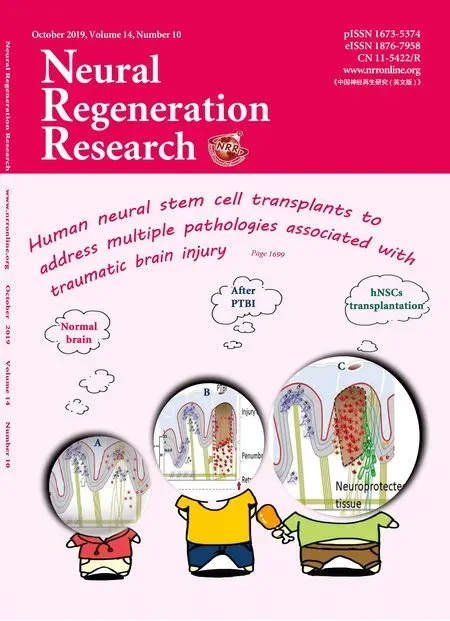
- Human neural stem cell transplants to address multiple pathologies associated with traumatic brain injury
- Glutathione precursors shield the brain from trauma
- Delayed peripheral treatment with neurotrophin-3 improves sensorimotor recovery after central nervous system injury
- Diterpenes and the crosstalk with the arachidonic acid pathways, relevance in neurodegeneration
- Are the mechanisms involved in astrocyte and lymphocyte death during HIV infection similar?
- Can leukocyte telomere shortening be a possible biomarker to track Huntington's disease progression?
- The local mammalian target of rapamycin (mTOR) modulation:a promising strategy to counteract neurodegeneration
- The role of LRRK2 on PKA-NFκB pathway in microglia cells: implications for Parkinson's disease
- New ex vivo demyelination/remyelination models to defeat multiple sclerosis and neuromyelitis optica
- A different view on the pathophysiology of Parkinson's disease: a descendent neurochemical hypothesis?
- Fine-tuning the response of growth cones to guidance cues: a perspective on the role of microRNAs
- Potential preventive disease-modifying pharmacological strategies to delay late onset Alzheimer's disease
- Vascular endothelial growth factor A promotes platelet adhesion to collagen IV and causes early brain injury after subarachnoid hemorrhage
- Resveratrol reduces brain injury after subarachnoid hemorrhage by inhibiting oxidative stress and endoplasmic reticulum stress
- Constraint-induced movement therapy enhances angiogenesis and neurogenesis after cerebral ischemia/reperfusion
- Soluble Nogo receptor 1 fusion protein protects neural progenitor cells in rats with ischemic stroke
- TrkA regulates the regenerative capacity of bone marrow stromal stem cells in nerve grafts
- Eosinopenia is a predictive factor for the severity of acute ischemic stroke
- Collagen-chitosan scaffold impregnated with bone marrow mesenchymal stem cells for treatment of traumatic brain injury
- Melatonin modifies SOX2+ cell proliferation in dentate gyrus and modulates SIRT1 and MECP2 in long-term sleep deprivation
- Differences in pathological changes between two rat models of severe traumatic brain injury
- Brain networks modeling for studying the mechanism underlying the development of Alzheimer's disease
- Ginsenoside Rb1 protects dopaminergic neurons from inflammatory injury induced by intranigral lipopolysaccharide injection
- Mapping theme trends and knowledge structures for human neural stem cells: a quantitative and co-word biclustering analysis for the 2013-2018 period
- Sciatic nerve injury alters the spatial arrangement of neurons and glial cells in the anterior horn of the spinal cord