常見時態典型錯誤例析
2011-02-01 08:02:10姜經志
中學生英語 2011年18期
關鍵詞:動作
常見時態典型錯誤例析
1.如果他明天不能準時來,我們就不知道應該怎么辦。
[誤]If he won’t come on time tomorrow,we won’t know what to do.
[正]Ifhe doesn’t come on time tomorrow,we won’t know what to do.
[析]當主句是一般將來時,與其連用的條件狀語從句的謂語動詞通常用一般現在時代替一般將來時。
2.昨晚七點到八點她一直在看電視。
[誤]She watched TV from 7:00 to 8:00 lastnight.
[正]She waswatching TV from 7:00 to 8:00 lastnight.
[析]表示過去某一階段正在進行或持續進行的動作,應用過去進行時,而不用一般過去時。
3.爸爸進來的時候,我在做作業。
[誤]Iwas doingmy homework whilemy father came in.
[正]Iwas doingmy homework whenmy father came in.
[析]while引導的時間狀語從句中的謂語動詞必須是延續性動詞,不能是終止性動詞;而when引導的時間狀語從句中的謂語動詞既可以是延續性動詞,也可以是終止性動詞。本句中的come是終止性動詞,所以應用when。
4.我從1985年起就在這所學校教書。
[誤]I teach at this school since 1985.
[正]Ihave been teaching at this school since 1985.
[析]現在完成進行時表示動作開始于過去,持續到現在而且還在進行;而一般現在時僅指現在時段內發生的事情或存在的狀況。
5.這臺電腦我已買了三年。
[誤]Ihave bought this computer for three years.
[正]Ibought this computer three years ago.
[正]Ihave had this computer for three years.
[正]It’s three years since Ibought this computer.
[正]Three years has passed since I bought this computer.
[析]英語中動詞有終止性動詞和延續性動詞之分。終止性動詞的現在完成時的肯定形式不能與表示“一段”的時間狀語連用。改正的方法有:
1 )用表示“點”的時間狀語與終止性動詞相配合。
2 )將終止性動詞改為相應的延續性動詞。
6.你剛才到哪兒去了?
[誤]Where have you gone?
[正]Where have you been?
[析]have gone to...表示某人在某地的途中或者已到了某地;have been to…表示某人到過某地,人已回來。
7.我學英語已有兩年多了。
[誤]Ihave learned English since over two years.
[正]Ihave learned English for over two years.
[析]介詞since之后跟表示時間“點”的短語;介詞for后面跟表示時間“段”的名詞短語。
8.我以前從沒見過這么好的畫。
[誤]Inever saw such a beautiful picture before.
[正]Ihave never seen such a beautiful picture before.
[析]在敘述過去的行為時,如果有
never,ever等頻度副詞,往往用現在完成時,強調動作的結果與現在情況密切相關。
9.她病了好久了。
[誤]She has been being ill for a long time.
[正]She has been ill for a long time.
[析]有些不能用現在進行時的動詞,如be,have,like,love,know,see,hear等,同樣也不能用現在完成進行時,而應用現在完成時。
10.在過去的兩年中我讀了很多書。[誤]I readmany books in the past two years.
[正]Ihave read many books in the past two years.
[析]in the past two years是指從兩年前開始一直延續到現在的情況,所以應該用現在完成時。
11.本周他沒做過多少事。
[誤]He didn’t domuch work thisweek.
[正]Hehasn’tdonemuchwork thisweek.
[析]時間狀語包括現在,如this year/month/week,these days,so far等,謂語動詞要用現在完成時。
14.她動身去加拿大了。
[誤]She has been leaving for Canada.
[正]She has left for Canada.
[析]leave是瞬間動詞,不能用于現在完成進行時,但可以用于現在完成時。
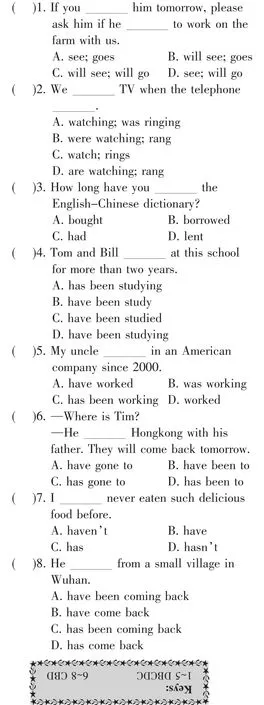
[小試牛刀]
單項選擇。
猜你喜歡
作文周刊·小學一年級版(2022年16期)2022-05-07 11:28:30
作文周刊·小學一年級版(2021年8期)2021-07-07 11:00:47
動漫界·幼教365(大班)(2021年4期)2021-05-23 21:33:16
小學生作文(低年級適用)(2018年3期)2018-04-17 00:58:35
少年博覽·小學低年級(2017年4期)2017-06-09 16:22:28
作文周刊·小學一年級版(2016年28期)2017-06-03 00:28:49
作文評點報·低幼版(2017年7期)2017-03-11 20:49:41
少兒科學周刊·少年版(2015年4期)2015-07-07 20:56:37
電影故事(2015年30期)2015-02-27 09:03:12
七彩語文·低年級(2014年10期)2015-01-14 14:46:27