
靜/慢地震研究現狀及意義*
2011-11-23 06:25:00彭漢書
大地測量與地球動力學 2011年6期
關鍵詞:板塊
閆 偉 彭漢書
(1)中國地震臺網中心,北京 100045 2)中國地震局地球物理研究所,北京100083)
靜/慢地震研究現狀及意義*
閆 偉1)彭漢書2)
(1)中國地震臺網中心,北京 100045 2)中國地震局地球物理研究所,北京100083)
靜/慢地震是地殼能量釋放的一種形式,可能消除一個正趨于斷裂地帶的地震威脅,也可能因為應力的轉移而觸發一個正常的地震;也有一些學者認為靜/慢地震的發生并不在斷層閉鎖區域,兩者的關系不大。對于靜/慢地震的危險性盡管分歧較大,然而看法一致的是靜/慢地震是地震斷裂過程的一個組成部分,在地震成核作用中可能起著重要的作用,靜/慢地震還有可能揭示更多板塊邊界的運動形式。目前,關于靜地震的物理機制還存在較大的爭議,一些學者認為靜/慢地震現象產生的主要因素為含水礦物的脫水作用或流體的浸入作用從而導致孔隙壓力的變化;另外有些學者認為在孔隙壓力不變的情況下只利用摩擦定律數值模擬也能觀測到類似靜/慢地震現象;還有一些學者認為靜/慢地震主要分布在距離俯沖帶一定距離的地震反射體上,而不是發生在距離俯沖帶界面附近一個狹窄的區域內。
靜/慢地震;物理機制;地震危險性;低頻顫動;陣發性震顫和滑動
1 引言
地震研究表明:震源過程是一個持續時間較長的復雜過程,地震發生時所釋放的能量只是其中一部分,有很大一部分能量在地震前以各種形式緩慢釋放,這種能量緩慢釋放的地學現象稱為慢地震或靜地震[1]。
日本學者Watanabe[2]根據俯沖速度總錯動量和地震位錯錯動量的差異推斷,地震位錯只占全部錯動量的一小部分,很大部分由靜地震實現。這些類似的結果表明,緩慢的能量釋放可能是地球內部能量釋放的主要形式。在全部地形變過程中,地震、靜地震和蠕變各自占有多大的份額、靜地震的分布具有怎樣的特征,是一些值得研究的問題。
2 靜/慢地震的概念及分類
對于像常規地震一樣,由于斷層的剪切滑動,而持續時間相對常規地震長些,輻射出的能量比常規地震少些的現象稱之為慢地震或間歇性深部顫動、低頻地震、甚低頻地震、慢滑移事件及寂靜地震等[3-5]。
圖1總結了南海海槽內的低頻顫動、低頻地震、甚低頻地震和慢滑事件連同卡斯凱迪亞消減帶內間歇顫動和滑動以及一些寂靜地震的特征量值。除沿日本海溝發生的兩次寂靜地震沒記錄到顫動活動以外,在特征持續時間T與地震矩M0之間存在著明確的比例關系:

該關系不同于消減帶內常規地震的定標律[6],即

3 靜/慢地震的物理機制
目前,關于靜地震的物理機制還存在較大的爭議,主要集中在對其進行定位的方法上,Obara[7,8]認為脈動信號沒有明顯的初動。Katsumata and Kamaya[9]則指出,并非所有臺站記錄到的脈沖信號都沒有明顯的初動,并挑選出那些能夠拾取初動的臺站記錄,通過提取P波初動對慢地震進行了精確定位。定位結果顯示地震發生在俯沖帶30~40km深處的地殼中,靠近地殼、地幔楔和俯沖板塊交界處的帶狀區域內。Kao[10-12]采用 SSA(Source-Scanning Algorithm)方法對慢地震進行定位的同時,發現慢地震彌散在30~50 km深處的卡斯凱迪亞(Cascadia)俯沖帶附近及其上部相當大的深度范圍,有50~55%的慢地震分布在地震反射體(圖2右圖中的灰色區域)附近,而不是像前人所指出的那樣發生在距離俯沖帶界面附近一個較窄的區域內。

圖1 各種慢地震的地震矩與特征持續時間之間的對比[6]Fig.1 Comparison between seismic moment and character lasting time of varient slow earthquakes[6]
Kodaira[13]綜合利用天然地震和人工地震資料得到南海海槽和日本中部地區的地震速度和反射剖面,指出發震層下的俯沖帶褶皺發育,促進了含水礦物脫水作用產生的流體運動,使孔隙水壓增大、臨界剛度穩定在發生慢滑移的范圍內(圖3)。
巖石試驗[14]表明,俯沖帶附近的穩滑和黏滑現象的發生主要取決于斷層的臨界剛度系數:kc= -(a-b)(σn-Pf)/Lc。其中σn是正壓力,Pf是孔隙壓力,(a-b)是依賴靜摩擦的速度。圖3(b)中的k為把逆沖系統作為一個簡單的彈簧滑塊模型的系統剛度。當(a-b)為正時,kc>0,則不會發生地震;當(a-b)為負,kc<0,斷層不穩定或者有條件的穩定時,就導致了慢滑移現象的發生。
Shelly[15]利用互相關和雙差精定位方法對發生在2002—2005年的6 713次事件進行重新定位,分離出1 180次低頻脈動事件,運用77個鉆孔臺網進行速度結構成像,也得出了高壓流體的變化和慢滑移事件具有很好的關聯性(圖4)。
選取A-A’斷面的主要原因是包括了較多的背景地震(圖4(a)中的黑點)和慢滑移(圖4(a)中的紅點)。斷面長度大約為9km。分析認為:LFE事件發生在逆沖斷層的斷層表面。圖4(d)中的海洋莫霍面由圖4(b)和(c)的高波速層得到。由圖4(e)可以看出LFE事件主要發生在海洋莫霍面和島弧莫霍面交界處的高波速比地區;LFE下方主要發生穩滑現象,上方主要是閉鎖區域。

圖2 卡斯凱迪亞俯沖帶附近P波速度結構圖[11]Fig.2 The P wave velocity structure near the Cascadia subductions zone[11]
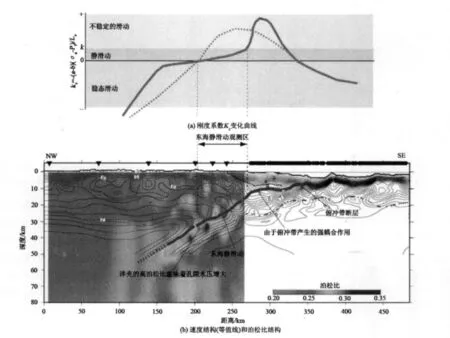
圖3 南海海槽和日本中部地區的地震速度和反射剖面[13]Fig.3 Seismic velocity and reflection profile of The Nankai trough and the central region of Japan[13]
但是Liu[16]利用速度-狀態摩擦定律進行三維數值模擬研究發現,在孔隙壓力不隨時間變化的情況下,僅僅依靠摩擦本構關系隨深度的變化和某些參量在俯沖帶走向上的變化就能夠產出與已有觀測非常相似的慢滑移現象。同時指出不同俯沖帶出慢滑移和脈動存在差異的原因可能與板塊俯沖角度、板塊聚合速度、溫度以及孔隙壓力的差異有關(圖5)。

圖4 對A-A’橫截面重定位結果以及速度結構成像[15]Fig.4 Results of the cross-section A-A’re-positioning and the velocity structure imaging[15]
通過比較圖5(a)~(d)圖像的變化過程可以看出,開始滑動的地方位于60 km和220 km深處,逐漸向140 km處靠攏,當到達40 km處時,出現了最大的速度。圖5(d)的遷移速度約為3 km/a。
4 靜/慢地震的危險性
Linde[17]認為慢地震是地震斷裂過程的一個組成部分,在地震成核過程中可能起著重要的作用。
圖6中藍顏色的圓圈代表ALBH臺站(GPS)的日變化情況。綠色連續線代表長期的東向移動變化趨勢。紅線代表在每次滑動事件之前的東向移動趨勢(周期為13~16月)。底部的圖像表示在Vancouver島南部的震顫的發生頻次。
如果圖6中表示的滑動和顫動一一對應的話,那么類似顫動的波形可以實時檢測滑動事件。由于板塊表面深處的滑移事件在閉鎖板塊表面產生了應力積累,所以Rogers[18]認為滑移事件可能觸發一次破壞型地震。也就是說,陣發性震顫和滑動(ETS)的高發期可以產生一個地震的高發時段。
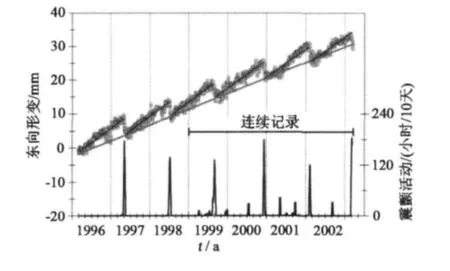
圖6 Victoria地區的滑動事件和震顫事件的對比[18]Fig.6 Comparison between the transient slip events and the tremor events in the area of Victoria[18]
由圖7可以看出,震顫的活躍期為幾天或者幾個星期。當活躍期過后,該地區將會平靜幾個月。震顫有時候看起來像是被一次較大地震的觸發。例如,4月2日發生的Shizuoka M5.1地震后,Tokai地區的震顫開始活躍;3月24日Geiyo M6.7地震后,Shikoku地區的震顫開始活躍。另外,震顫的活躍期也可以在附近一次地震結束后而平靜。例如,在Tokai地區,震顫在9月經歷了大約2個星期的活躍期,恰巧隨著Aichi M4.1地震的發生而結束。
Costello[19]研究表明,如果慢地震發生在原破裂附近,則地震的危險性將會降低,因為慢地震釋放了累積的地應力或者能量,這對應于有慢地震無正常大地震發生的現象;如果發生在斷層的閉鎖段,則發生大地震的可能性將會增加,因為這會造成斷層閉鎖段的解鎖,斷層之間的摩擦力突然減小,產生快速滑動甚至破裂,這對應于慢地震之后有正常地震的現象,或慢地震觸發了正常地震的假說。

圖7 Tokai、Kii半島和Shikoku地區的地震顫發生的頻次[7](箭頭代表在脈沖活躍區發生的大于M4的主要地震)Fig.7 Frequency of tremor occurrence in the Tokai,Kii Peninsula and Shikoku regions(Arrows represent the M>4 main earthquakes occurred in the active tremor area[7]
Kawasaki[4]在探討靜地震和地震預報之間的關系時(圖8),提出兩個問題:第一,在靜地震發生的穩滑和黏滑地區和地震發震區是如何聯系的;第二,我們能否知道慢地震是如何發生的。
Stokstad[20]認為,由于每次慢滑移現象只是使本地的應力降低,但不會對斷層閉鎖區域的應力起作用,而斷層閉鎖區域為大震的發震區域。大量慢地震每隔500年會導致一次特大地震,這使得任何單一慢地震都不可能成為有意義的前兆。然而看法都一致的是,慢地震有可能揭示更多有關板塊邊界是如何運動的。

圖8 地震矩和矩率之間的關系[4]Fig.8 Relation between the rate of seismic moment and the moment[4]
6 全球主要靜地震事件及其分布
Schowartz[21]報道了環太平洋地區主要慢滑移現象的分布及其規律(圖9),其結果指出比較重要的一點便是:在觀測儀器滿足觀測慢滑移現象的條件下,慢滑移事件在環太平洋俯沖地區似乎是一個普遍現象。
其他地區也有慢地震的分布(圖10)。

圖9 環太平洋俯沖帶主要慢滑動事件位置[21]Fig.9 Locations of main slow slip events at circum-pacific subduction zones[21]

圖10 靜/慢地震事件分布圖Fig.10 Space distribution of slow slip events all over the world
目前對絕大多數的慢滑移事件的觀測報道,主要集中在俯沖板塊邊界區域。其中,陣發性震顫和滑動(Episodic Tremor and Slip,ETS)事件主要重點集中于美國卡斯卡迪亞地區及其日本南部板塊交界俯沖帶;慢滑移事件(Slow Slip Events,SSE)和震顫事件分布較廣,除夏威夷群島[21]的震顫報道之外,其余基本位于板塊邊界帶上。關于其他類型板塊邊界地區和板塊內部地區是否存在靜/慢地震的問題,目前只有一些間接的線索。在圣安德列斯斷層附近的觀測表明,靜/慢地震事件似乎不限制于俯沖型板塊邊界[22]。
致謝 感謝吳忠良教授、蔣長勝、武艷強博士的指導!
1 Kawasaki I,et al.The 1992 Sanriku-Oki,Japan,Ultra-Slow Earthquake[J].Journal of Physics of the Earth,1995,43:(2)105-116.
2 Watanabe T,et al.Scaling relationship between the duration and the amplitude of non-volcanic deep low-frequency tremors[J].Geophysical Research Letters,2007,DOI:10.1029/2007GL029391.
3 Hirose H,et al.A slow trust slip event following the two 1996 Hyuganada earthquakes beneath the Bungo Channel,southwest Japan[J].Geophysical Research Letters,1991,26:3 237-3 240.
4 Kawasaki.Silent earthquakes occurring in a stable-unstable transition zone and implication for earthquake prediction[J].Earth Planets Space,2004,56:813-821.
5 Ozawa S,et al.Detection and Monitoring of Ongoing Aseismic Slip in the Tokai Region,Central Japan[J].Science,2002,298:1 009-1 012.
6 Ide S,et al.A scaling law for slow earthquakes[J].Nature,2007,447,DOI:10.1038/nature05780.
7 Obara K.Nonvolcanic deep Tremor associated with subduction in southwest Japan[J].Scince,2002,296:1 679-1 681.
8 Obara K,et al.Episodic slow slip events accompanied by non-volcanic tremors in southwest Japan subduction zone[J].Geophysical Research Letters,2004,31,DOI:10.1029/2004GL020848.
9 Katsumata K,Wada N and Kasahara M.Newly imaged shape of the deep seismic zone within the subducting Pacific plate beneath the Hokkaido corner,Japan-Kurile arc-arc junction[J].J Geophys Res.,2003,108,2565:doi:10.1029/ 2002JB002175.
10 Kao H and Shan S J.The Source-Scanning Algorithm mapping the distribution of seismic sources in time and space[J].Geophys J Int.,2004,157,DOI:10.1111/j.1365-246X.2004.02276.x.
11 Kao H,et al.A wide depth distribution of seismic tremors along the northern Cascadia margin[J].Nature,2005,436,DOI:10.1038/nature03903.
12 Kao H,et al.Spatial-temporal patterns of seismic tremors in northern Cascadia[J].Journal of Geophysical Research,2006,111,DOI:10.1029/2005JB003727.
13 Kodaira,et al.High pore fluid pressure may cause silent slip in the Nankai trough[J].Science,2004,304;DOI:10.1126/science.1096535.
14 Scholz C H,Katsumata A and Kamaya N.Low-frequency continuous tremor around the Moho discontinuity away from volcanoes in the southwest Japan[J].Geophysics Research Letter,2003,30(1):DOI:10.1029/2002GL015981.
15 Shelly D R,et al.Low-frequency earthquakes in Shikoku,Japan,and their relationship to episodic tremor and slip[J].Nature,2006,442,DOI:10.1038/nature04931.
16 Liu Y J.Aseismic slip transients emerge spontaneously in three-dimensional rate and state modeling of subduction earthquake sequences[J].Journal of Geophysical Research,2005,110,DOI:10.1029/2004JB003424.
17 Linde A T,et al.A slow earthquake sequence on the San Andreas fault[J].Nature,1996,383:65-68.
18 Rogers G and Dragert H.Episodic Tremor and Slip on the Cascadia Subduction Zone:The Chatter of Silent Slip[J].Science,2003,300,1 942-1 943.
19 Costello S W and Tullis T E.Can free oscillations trigger foreshocks that allow earthquake prediction?[J].Geophysical Research Letters,1999,26(7):891-894.
20 Stokstad E.Deep quakes slow but very steady[J].Scince,2002,295(5564):2 344-2 345.
21 Susan Y Schwartz and Julianna M Rokosky.Slow slip events and seismic tremor at circum-pacific subduction zones[J].Reviews of Geophysics,2007,45,RG3004,1:32.
22 Nadeau R M and Dolenc D.Nonvolcanic Tremors Deep Beneath the San Andreas fault[J].Science,2005,307:389-390.
SITUATION AND SIGNIFICANCE OF RESEARCH ON SILENT EARTHQUAKE
(1)China Earthquake Networks Center,Beijing 100045 2)Institute of Geophysics,China Earthquake Administration,Beijing100083)
Silent/slow earthquakes are a form of crustal energy release,it is possible to eliminate the fracture of an earthquake fault but it is said that silent/slow earthquakes may also be the trigger of a normal earthquake because the stress transfer.Some scholars believe that the silent/slow earthquakes are not the fault latch area,little relationship between the two.Despite the divergence of viewpoint about the risk of silent/slow earthquake,there is a same view that the silent earthquake rupture process of slow earthquakes are an part of the earthquake nucleation and may play an important role and silent/slow earthquakes may reveal more movement forms of plate boundary.Currently,about the physical mechanism of the earthquake there is a big controversy yet,some scholars believe that the occurence of slow earthquakes is due to the dehydration of mineral water immersion or the invasion of fluid leading to changes in pore pressure,in the same time,some scholars think that under the same pore pressure according friction law only by numerical simulation the silent/slow earthquake phenomenon can also be observed,and some scholars believe that the silent/slow earthquakes are mainly distributed in a certain distance from the subduction zone seismic reflectors,rather than place from the subduction zone near the interface in a narrow area.
silent/slow earthquake;physical mechanism;seismic risk;deep low frequency earthquake(DLF); episodic tremor and slip(ETS)
Yan Wei1)and Peng Hanshu2)
1671-5942(2011)Supp.-0051-06
2011-02-03
地震行業專項(201108009);國家科技支撐計劃項目(2008BAC35B03-05);中國地震局監測預報司預報處震情跟蹤定向工作任務(2011020602)
閆偉,男,1982年生,碩士,助理研究員,主要從事地形變資料分析等研究.E-mail:ywcenc@163.com
P315.1
A
猜你喜歡
股市動態分析(2024年8期)2024-04-28 06:03:10
中學生數理化(高中版.高考理化)(2020年9期)2020-10-27 02:30:48
小哥白尼(神奇星球)(2020年3期)2020-07-27 01:32:36
股市動態分析(2019年14期)2019-07-10 04:25:36
股市動態分析(2019年16期)2019-07-10 04:23:23
股市動態分析(2016年24期)2017-01-07 08:54:53
中國衛生(2016年2期)2016-11-12 13:22:24
股市動態分析(2016年5期)2016-09-29 12:42:27
股市動態分析(2016年29期)2016-08-04 13:59:43
太空探索(2015年3期)2015-07-12 11:01:40
