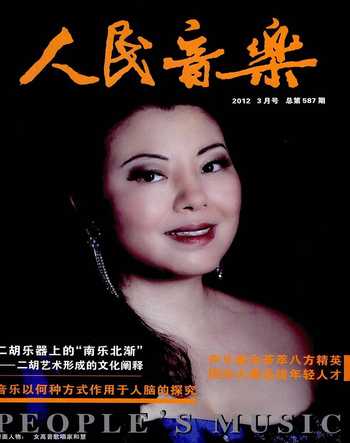
The ″Northward Spread of the Southern Music″ in Erhu
2012-04-29 23:45:09
人民音樂 2012年3期
The ″Northward Spread of the Southern Music″ in Erhu?押
A Cultural Interpretation of the Origination of the Art of Erhu
In the 1920's, Liu Tianhua came to Beijing alone from the South bringing his Erhu and the three works he had composed, namely, ″Groaning in Sickness″, ″The Moonlit Night″ and ″Song of Birds in Desolate Mountain″, and after years of hard working, he finally managed to create the art of Erhu as a solo instrument. From the perspective of cultural communication, this is another example of the so-called ″northward spread of the Southern music″ phenomenon in terms of the musical instrument Erhu, or a proof that the regional music culture in the South of the Yangtze River was spread to the North of China.
In the spring of 1922, Liu Tianhua came to work at the Music Institute of Peking University as Pipa professor while at that time, Huqin, often regarded as instrument for beggar, was not included in the university curriculum at all. But Liu, so persistent in attempting to reform Chinese musical instruments by taking Erhu as a breakthrough, believed that the folk instrument Erhu would become a perfect solo instrument which could parallel other Chinese instruments such as Pipa, Guzheng and Guqin. However, due to lack of the same Erhu tradition in Beijing as in the South, it seemed hardly possible to have recognition of his Erhu music from the music circle in Beijing. Liu never gave up his ambition. He tried all his efforts to make his experiment. When he was teaching Pipa at the Music Institute, he often taught Erhu to his students in secret, instructing them to play his three Erhu pieces ″Groaning in Sickness″, ″The Moonlit Night″ and ″Song of Birds in Desolate Mountain″, in anticipation of raising Erhu to the same high position as Pipa and Guqin. Meanwhile, he asked for more opportunities to play Erhu in concerts as he was aware that it was necessary to discover the artistic charms of Erhu as a solo instrument if he wanted it to catch up with other solo instruments like Pipa ang Guqin. In fact, a successful concert given by him and his students paved the way to the fianl acceptance of Erhu into the official curriculum program. In the autumn of 1923, Liu Tianhua had a chance at last to play his own works ″Groaning in Sickness″ and ″Song of Birds in Desolate Mountain″ with his own Erhu at a concert in the Music Institute of Peking University, where the unique music language of his Erhu music and his great playing techniques won him high applause from the audience. His colleagues including Cai Yuanpei, then president of Peking University, highly appreciated Liu's performance. At the end of that year, Xu Binglin, a student of the Mathematics Department, also a student of Erhu playing that Liu Tianhua had taught secretly, played the ″Groaning in Sickness″ at a concert in the Peking University Third Hospital, and enjoyed the same acclaim from the audience. Soon later, the melody of the piece was often heard on campus as students hummed the music while it was also spread to all the other universities and colleges in the city. What Liu Tianhua and his student Xu Binglin did at the two concerts changed to a great extent the prejudice against Erhu. Moreover, Liu Tianhua and his Erhu music earned recognition and respect from the leaders and staff of the Music Institute. As a result, the institute finally set up the regular course of Erhu. No doubt, without Liu Tianhua and his student's successful performances that had produced great impact upon the intellectuals in Beijing, it would be hardly possible for Erhu to be included in the teaching curriculum of the Music Institute. From then on, with Liu Tianhu's great efforts, the art of Erhu that was gaining momentum in the South of Yangtze River, was introduced to the North where it was officially recognized and later disseminated gradually to the other parts of the country.
How could Erhu as a folk music instrument from the South survive and develop in Beijing and finally turn up to be an art of solo instrument playing?芽 In my opinion, this depends upon the geographical nature and the times of Liu Tianhua's Erhu music.
First, in terms of its geographical nature. After several processes of ″northward spread of the Southern music″ in the Chinese history, the Southern music in the style of implicity and elegance gradually became the leading force in the Chinese music culture. Chinese people from various regions had the same recognition and love of this kind of music. A musical analysis of Liu's Erhu works proves that his music, in typical developing forms with more progressive type than leaping type, played in silk and bamboo music techniques and presented in the unique charms of tenderness and gracefulness, was characterized by the taste of music from the South. When Liu Tianhua came northward to Beijing bringing such kind of Erhu music with implicity, tenderness and elegance, the intellectuals in Beijing were familiar with this already, and were ready to appreciate it, simply taking this as another process of ″northward spread of the Southern music″.
Second, in terms of the times. Although Liu Tianhua's Erhu music is rich in the Southern music style, it is totally different from the festive, self-entertaining traditional folk music. Most part of Liu's life covered the first three decades of the 20th century when, with the end of the feudal system, the changing social system led to immense transformation of human mind. Under the influence of advanced modern Western civilizations, the Chinese intellectuals appealed for spiritual liberation, and the ″New Culture Movement″ in favour of science and democracy was encouraging the intellectuals to participate more actively in the drive for the national independence and social development at the time when the nation was suffering from turmoils and splittism. This was exactly shared by Liu Tianhua. And because of this, Liu's music could easily arouse the passion of Chinese intellectuals. As early as during their years of studying at Changzhou City Middle School, Liu Tianhua and his elder brother Liu Bannong took an active part in the anti-feudal revolution and joined an anti-Manchurian organization. Liu Bannong later became a leading figure in the May 4th New Culture Movement, who greatly influenced Liu Tianhua, the latter then progressive in reforming Chinese music under the impact of the democratic ideas of the May 4th Movement.
A Probe into the Way in Which Music Affects
Human Brain
As early as in the 1990's, large input was made to speed up neurobiological research in the major scientific powers in the world. Today, neurobiology is considered a popular science of the 21st century. In 1990, the United States put forward a ″Ten-Year Plan for Brain″, and in 1991, the Ten-Year Plan for EC Brain was put into practice in Europe. This was followed by a Japanese great cross-century research project named ″The Age of Brain Science″ which was formulated in 1996 with a huge budget of investment for the next 20 years. Spurred on by the tremendous research achievements in neurology and brain science, scientific powers of the world started to establish many related sciences such as Neuroarthistory, Neuromusicology, Neuroaesthetics, Cognitive Aesthetics, Nervous Psychology of Music, Neurological Music Education, Die Kunst des Musizierens, Music Classification Neural Networks and Neural Network Music Composition. These sciences, created on the basis of brain science or neurology, make use of the theories, principles and research methods of brain science or neurology for researches on basic theory and applied theory of music. Neurobiology as principal part of brain science has become the fastest growing advanced science among all the branches of life science. It is now possible to explore into the nervous system, especially the mystery of human brain, and scientists and music researchers have oriented music researches toward human brain and nervous system, expecting to find solutions to some complex problems and issues that have remained unsolved for long. This shows, therefore, that the principles and theories of neurobiology can be used, together with such new technologies as Neurological Imaging Technology, Electrophysiology, Two-photon Microscope, Functional Magnetic Resonance Imaging, Magnetic Resonance Imaging, Positive Emission Tomography, to study the various phenomena in music, solve the existing problems, interpret the relationship between music and man as well as the effect of music on neurobiology, and serve the music cause with the help of the physiological structures and functions of human body. These newest measures and methods in the field of music research are being applied by major technologically advanced countries.
The more sensory cells and nerve cells of other kinds from the thalamus and the brain are involved in music activities, the more possibly he or she will become a musician. During the process of music activity, the sensory cells in the thalamus build countless sensory modules, and each acoustic module may restore various memories of music sensation. ″Auditory sense″ in our words is what a sensory module produces in our thalamus. The nerve cells in the brain make a neuronal circuit with the thalamus during the music activity, to build countless samples related with music, each of which restores the consciousness, concept, understanding and perception of music, and which may include both visual samples and abstract samples. The music samples are the very basis of ″auditory perception″ in terms of neurobiology. Without music samples, there would be no auditory perception of music. Music samples exist in different parts of the brain or nuclei (including cerebral cortex, hypothalamus, basal ganglia and cerebellum). The more exchanges among them in the brain there are and the farther they stay from the centre, the more delicate the music samples will be, and the more precise and explicit the aroused musical sense will be. Therefore, the sensory module of music and the music samples are the essence and kernel of music activity. One of the question that has never been answered perfectly in the music circle is?押 why music can express feelings?芽 The essence and the kernel actually lie in the formation of music sensory module and music samples. Our body is a large chemical plant in which chemical reactions are generated by chemical substances to produce emotion, feeling and mood. Music activity can only be accomplished on the basis of brain mechanism and neural mechanism as the most fundamental way of brain and neural system activity is the intercellular communication and signal transmission in the process of electric signal→chemical signal→electric signal. Every detail of music activity is completed according to this principle. During this process, the neural system may release a lot of chemical substances, such as neurotransmitter, neuropeptide and neurohormone, without which there would be no intercellular communication or signal transmission, and hence no music activity. This research provides a theoretical basis for our music research work in general, and in particular, will be guiding a new approach to the construction of basic music theory.