THREE'S COMPANY CHINA, SOUTH KOREA AND JAPAN CONSIDER FREETRADE AGREEMENT
2012-10-14 07:17:20YuLintao
Beijing Review 2012年21期
COVER STORY
THREE'S COMPANY CHINA, SOUTH KOREA AND JAPAN CONSIDER FREETRADE AGREEMENT
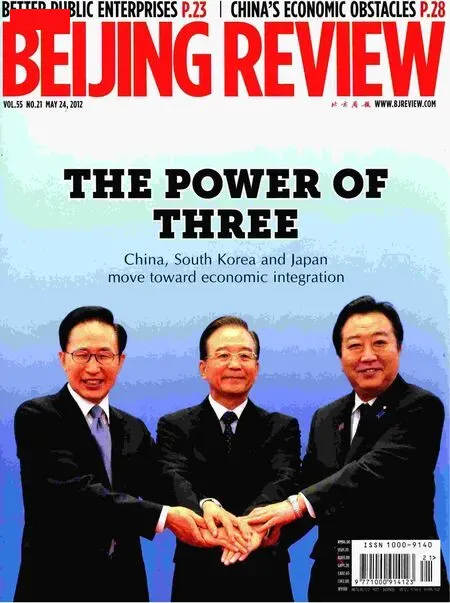
China, South Korea and Japan agreed to launch formal negotiations on a trilateral free trade area (FTA) later this year. The decision was announced at the Fifth Trilateral Summit Meeting among the three major East Asian economies on May 13 in Beijing. Chinese Premier Wen Jiabao, Japanese Prime Minister Yoshihiko Noda and South Korean President Lee Myung Bak attended the meeting.
At a press conference following the meeting, Premier Wen hailed the agreement as “an important strategic decision,” and appealed to the three nations to make concerted efforts for the early establishment of the FTA.

HUANG JINGWEN
Analysts say the move will possibly accelerate East Asian integration and promote regional and global economic development. Since the three countries account for one fifth of global GDP, the trilateral FTA will also have signifcant regional and international infuence.“The China-South Korea-Japan FTA can promote the economic integration of East Asia and elevate the global status of the region. The trilateral FTA is a crucial step for East Asian economic integration,” said Zhang Jianping, a senior economist with the Academy of Macroeconomic Research (AMR) of China’s National Development and Reform Commission.
Inevitable trend
From a strategic perspective, the proposed China-South Korea-Japan FTA accords with the trend of international industrial transfer and the structural adjustment of the world economy, said Zhang.
Since the outbreak of the global fnancial crisis, protectionism and trade frictions have grown more severe. As a result, FTAs have become increasingly important in normalizing international economic relations. While the global free trade regime is still in the air, regional economic integration has sped up.
“Due to the decline of the U.S. economy and the instability of the status of the dollar, the global economic system is undergoing a farreaching change. It is impossible to achieve global economic integration on the basis of the old international order, and it is an inevitable trend that the world will embrace a multi-polar economic system,” said Ren Weidong, a research fellow with the China Institutes of Contemporary International Relations (CICIR).
The China-South Korea-Japan FTA is in line with this trend, he said. Currently, Japan is focusing on industry shifting. South Korea is hindered by its small domestic market. As it pursues industrial upgrading, China needs advanced technologies from foreign countries and is eager to make full use of external resources and markets.
“All the three countries share the common desire for larger space for economic development,” Ren said. “The FTA will give a new impetus to the economic development of the three countries and help enhance their overall strength.”
A white paper titledChina-Japan-ROK Cooperation (1999-2012)released by the Chinese Foreign Ministry shows China, Japan and South Korea together represent 74 percent of the East Asian population and 22 percent of world population. They also represent 90 percent of the East Asian economy and 20 percent of the world economy, and 70 percent of East Asian trade and 20 percent of world trade. In addition, trilateral trade expanded from $130 billion in 1999 to $690 billion in 2011. China has topped the lists of trade partners of Japan and South Korea for many years, while Japan and South Korea rank fourth and sixth among China’s trade partners.
However, trade among the three countries accounts for less than 20 percent of their overall foreign trade, far below the ratio for the EU, which stands at 63.2 percent. Mutual investment among the three countries is also low, accounting for just 6 percent of their total investment in foreign countries.
“This does not match their positions as big economies and important neighbors. There are FTAs in North America, in Europe and in Southeast Asia. Trade arrangements are necessary in Northeast Asia to promote the regional economy,” said Liu Jiangyong, Vice Dean of the Institute of Modern International Relations at Tsinghua University.
Moreover, with the United States shifting its economy to an export-driven pattern, the three Asian countries will face much more pressure in the shrinking export market. They all need to rely more on the Asian market.
“When the China-South Korea-Japan free trade agreement is signed, an East Asian economic community will not be far away.”
— Liu Jiangyong, Vice Dean of the Institute of Modern International Relations at Tsinghua University
Benefits for all
“Undoubtedly, the trilateral FTA will help the three countries with resource allocation and enable them to complement each other’s advantages,” said Zhang of the AMR.
Tariff reduction will stimulate demand in the three economies, increase trilateral trade volume, eliminate trade barriers, enlarge regional markets and push forward economic integration.
“The trilateral FTA will inject vigor to China’s export sector. It can help exportoriented Chinese companies to reduce costs while boosting their motivation. In the process, more jobs will be created,” Liu said.
“The economies of China, Japan and South Korea will become larger and larger, providing a huge market for the whole world. The international status of the three countries will rise together,” Liu said.
Ren of the CICIR said the Japanese economy depends so much on China that the trilateral FTA means a lot for Japan.
Country Profiles

Land area: 100, 210 square kmPopulation: 50 millionGDP: $1.01 trillion (2010)Trade with China: $245.6 billion (2011)

Land area: 378,000 square kmPopulation: 127.71 millionGDP: $5.47 trillion (2010)Trade with China: $342.9 billion (2011)
“The impact of the international fnancial crisis, the violent earthquake last year and the decline of Japan’s industrial advantage have made the Chinese market a life vest for many Japanese enterprises. About 100,000 Japanese enterprises survive mainly by relying on the Chinese market,” Ren said.
While China, Japan and South Korea have yet to start talks on their trilateral FTA, China and South Korea launched negotiations on a bilateral FTA in May.
According to a report by the Japanese fnancial conglomerate Nomura Group, the potential bilateral FTA between China and South Korea could benefit the South Korean economy by increasing the nation’s exports to China, and the bilateral FTA will increase South Korea’s GDP by 3.7 percent in the long term.
The China-South Korea FTA can be a key step toward the establishment of the China-South Korea-Japan FTA, Zhang said.
Business is only part of the cooperation between the three countries. The trilateral relations also include sustainable development, security and cultural exchanges. The FTA can help build political trust, strengthen non-governmental exchanges and deepen friendly feelings of the people of the three countries, Liu said.
Regional impact
“When the China-South Korea-Japan free trade agreement is signed, an East Asian economic community will not be far away,” Liu said.
He said the trilateral FTA will further promote the establishment of an FTA with the 10-member Association of Southeast Asian Nations (ASEAN), which will pave the way for an East Asian economic community.
The trilateral FTA will also provide economic guarantees for building a political and security regime to help ease regional tensions in Northeast Asia, analysts said.
“In history, there were several wars between France and Germany. However, after the establishment of the European Coal and Steel Community, the two countries began reconciliation and cooperation and to promote European integration,” said Qu Xing, President of the China Institute of International Studies.
Qu believes the future China-South Korea-Japan FTA will push forward the settlement of problems left over from the past, such as the Korean Peninsula nuclear issue and territorial disputes, and help the three countries strengthen cooperation on resource exploitation.
Liu of Tsinghua University echoed Qu’s views. “The trilateral FTA will be conducive to a stable and peaceful Korean Peninsula because it can contribute to an open and peaceful development environment for the region,” he said.

LIU JINHAI

CFP
However, though it is a trilateral FTA, it is not merely a matter for the three countries. The United States is also affected by the process. South Korea began its offcial FTA negotiations with China after it signed a free trade agreement with the United States. And at the end of last year, Japan announced it will join negotiations on the Trans-Pacifc Partnership Agreement (TPP), which was originally launched by Brunei, Chile, New Zealand and Singapore and is now supported by the United States.
“Some negative factors should be overcome before establishing the China-South Korea-Japan FTA. In recent years, Washington has drawn some Asian countries to join the TPP. It attempts to disturb the deepening progress of East Asian cooperation, and bring East Asian countries into the U.S. strategic orbit,” said Ren of the CICIR.
Against this backdrop, Japan finds itself in an awkward situation, he said. On the one hand, its economy relies heavily on the Chinese market. On the other hand, it follows the step of the United States to hedge against China. “This is bad for regional cooperation and Sino-Japanese relations,” Ren said. “Japan should give up its contradictory policies, eliminate political barriers and cooperate with China to promote East Asian integration.”
As the largest economy in the region that links Northeast Asia with Southeast Asia, China should play a leading role in the trilateral FTA, he said. It should also help promote broader East Asian cooperation that involves Mongolia, Russia, North Korea and ASEAN countries.
A long way to go
“There will be a period of time from the launching of offcial negotiations to the establishment of the trilateral FTA. During free trade negotiations, exporters want importers to reduce or exempt custom duties on all their outward cargo, but importers want to be selective to protect their vulnerable industries,” Liu said.
Japan is a developed country, South Korea is a newly industrialized country and China is a developing country. Given their vast economic differences, the three countries will have to conduct extensive economic restructuring to facilitate free trade, a process that may encounter resistance by various sectors of society.
Also, the three countries might set preconditions to protect their own interests. As a result, the negotiations could take a long time. Even if the trilateral FTA starts to operate, it needs 10 to 20 years to become as sophisticated as an advanced FTA with low tariffs, free fow of goods, services and people as well as an effective legal framework on intellectual property rights protection, said Liu.
yulintao@bjreview.com