
?In this issue?
2013-04-06 18:53:33
上海精神醫(yī)學(xué) 2013年5期
?In this issue?
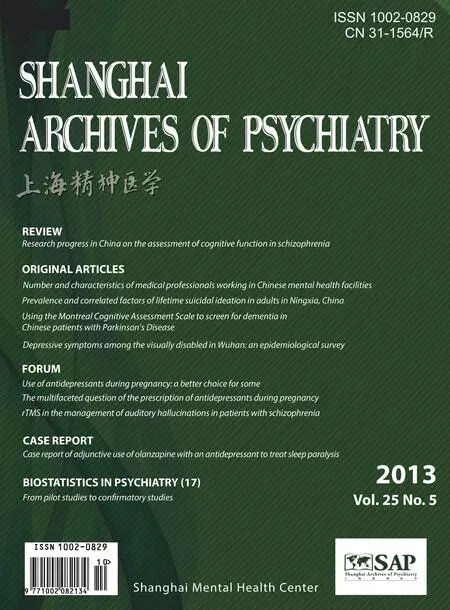
This issue starts with a review of the status of research in China on the cognitve functoning of individuals with schizophrenia.[1]Two major factors have accelerated this type of research in China since the early 1990s: (a) the realizaton that the quality of life and social functoning of individuals afflicted by schizophrenia are closely associated with the degree of cognitive impairment they experience as part of their illness; and (b) the rapid development of functional imaging technologies that have made it possible to localize and, to some extent, characterize the brain abnormalities associated with specific cognitive disabilities. The review considers research in China about the assessment of the various types of cognitive impairments seen in schizophrenia, the factors that are correlated with the severity of cognitve dysfuncton, the biological basis and structural localization of cognitive impairment, and the available pharmacological and non-pharmacological treatments. The authors conclude that more cross-disciplinary research and more long-term cohort studies are needed to understand the natural history of cognitive functioning during the course of schizophrenia and, thus, to develop effectve strategies to prevent or limit cognitve dysfuncton in persons with schizophrenia.
The first original research article in the issue by Liu and colleagues[2]uses data provided by China’s Ministry of Health to describe the distribution and characteristcs of health professionals working in mental health insttutons around the country. Given that very few mental health services in the country are provided in non-specialized health facilites, this report provides a reasonable estimate of the overall distribution of mental health professionals and mental health services around the country. The 649 psychiatric hospitals and 108 other specialized mental health facilities identified had a total of 68,796 medical professionals (5.16/100,000 population), including 20,480 psychiatrists (1.54/100,000) and 35,337 psychiatric nurses (2.65/100,000). These population-adjusted ratios of mental health professionals vary widely across the seven major geographic regions of the country and are much lower than in other upper-middle income countries (which have an average of 28.2 mental health professionals per 100,000 population). The relatively low level of training of the physicians (43% did not have a university degree) and nurses (46% had no academic qualifications) working in mental health facilities, and the lack of clinical psychologists and psychiatric social workers severely limit the quality of services available. Clearly, the size, range, and quality of the mental health workforce available in China are grossly inadequate to meet the needs of the population. This finding highlights the challenges that China will face as it tries to achieve the ambitous goals set out in its new mental health law.[3]
The second research article by Wang and colleagues[4]assessed the lifetime prevalence of suicidal ideation, suicidal plans and suicide attempt in a representative sample of 4789 residents of Ningxia, a relatively poor province in northwestern China with a large Muslim minority ethnic group – the Hui. In contrast to multiple studies about suicide among Muslims (primarily from Arabic countries[5]where suicide is illegal), they found that in Ningxia self-reported suicidal ideation, suicidal planning, and prior suicide attempt were more common in the predominantly Muslim Hui ethnicity respondents than in the primarily atheist Han ethnicity respondents. These differences disappeared in the multivariate analysis after adjusting for gender, mental illness and other factors. Nevertheless, these results suggest that religious beliefs and practices may not be the main reason for the very low reported prevalence of suicidal ideaton and suicidal behaviours in some Islamic countries. Religious beliefs and other cultural parameters may have a greater influence on the reportng of suicidal behaviours than on the actual occurrence of suicidal behaviours. Researchers need to develop creatve ways to distnguish the separate effects of culture on suicidal behaviour and on reported suicidal behaviour.
The third research artcle by Chen and colleagues[6]reports on the use of the Chinese version of the Montreal Cognitive Assessment scale (MoCA-C)[7]to screen for dementia in patients with Parkinson’s disease (PD). Using the Movement Disorder Society Task Force criteria[8]as the gold standard diagnosis of dementia, they administered MoCA-C to 616 patients with PD and then assessed the receiver operating characteristics (ROC) curve to identify the best cutoff score for dementia. The selected cutoff score of 23 had a sensitivity of 0.70, specificity of 0.77 and an overall concordance (kappa) of 0.45. Comparison of the demographic and clinical characteristics of PD patients who screened positive for dementia using the MoCA-C with the characteristics of PD patients who screen negative for dementia confirmed the validity of this cutoff score. The authors also found that increased age, lower educatonal atainment and more severe motor symptoms of PD were associated with increased likelihood of screening positve for dementa; this confirms previous reports about the synergistic effect of increasing age and motor impairment in the development of dementia in PD patients. Their recommended cutoff score of 23 is much lower than the cutoff score of 26 recommended by international authors,[9]so application of this revised standard in China would have significant implications for the screening for dementia both in PD patients and in the general populaton.
The last original article in this issue by Li and colleagues[10]is an epidemiological study about the prevalence of depressive symptoms in individuals with visual disabilities in Wuhan, a municipality with a population of 10 million individuals in central Hubei Province. It is generally accepted that persons with serious sensory or physical disabilities have increased rates of depression and other mental health problems but there has been little systematic research on this problem in China, partly because of the difficulty of identifying disabled individuals in community surveys. To circumvent this problem, the authors of the current study randomly selected their sample from among persons with visual disabilities who were registered in the Wuhan office of the national Disabled Persons’Federation. Using a Chinese version of the Center for Epidemiological Studies Depression Scale (CES-D),[11]they found that 16.0% of visually disabled individuals reported severe depressive symptoms in the prior week and a further 15.6% reported moderate depressive symptoms in the prior week. As expected, more severe depressive symptoms were associated with increasing age, low educational attainment, more severe visual impairment, and high levels of neuroticism or introversion (assessed using the Eysenck Personality Questionnaire[12]). Contrary to expectation, they found no significant differences in the severity of depressive symptoms by gender and more severe depressive symptoms in respondents who reported having religious beliefs than in respondents who reported having no religious beliefs. Almost none of these individuals had ever received treatment for their depressive symptoms. Clearly, the package of services provided to disabled individuals in China needs to be expanded to include the assessment and treatment of depression and other mental health conditons.
The first two Forum pieces in this issue address the perennial question of the risks and benefits of pharmacological treatment of depressed women during pregnancy and the peripartum. Given the high prevalence of depression in women, most reports indicate that 10-15% of pregnant women meet criteria for major depressive disorder at some point during their pregnancy,[13]so this is a common problem that most mental health clinicians will have to deal with at regular intervals. Zhang and Wang[14]highlight the need for a realistic assessment of the benefits and risks, and conclude that only severe depressions or depressions that have not responded to psychotherapeutic approaches should be treated with antidepressant medications. Apter and DeVouche[15]expand the tme period of interest to include the early post-natal period. They present data on over 87,000 pregnant women in France from a national insurance registry that shows a stepwise decrease in use of antidepressant medication as pregnancy progresses. Fear of rare negative outcomes for the infant (such as pulmonary hypertension) is thought to be the main cause of this declining use of antidepressants over the course of pregnancy. Apter and DeVouche argue forcefully that debates about the potential risks and benefits of treating peripartum maternal depression with antidepressant medicaiton have not adequately taken into consideraton the severe negatve effects of maternal depression on parent-infant interactions and on the emotonal development and healthy atachment of infants. They believe that concern about extremely rare medical risks to the infant inappropriately trump concerns about the much more common undervalued risk of damage to the developmentally crucial parentinfant relatonship.
The third Forum[16]is a follow-up to the Forum in the last issue[17]about the potential use of repetitive transcranial magnetic stimulation (rTMS) as treatment for refractory auditory hallucinations in patients with schizophrenia. Both the original paper and this current paper concur that the treatment of refractory auditory hallucinations with rTMS is not yet ready for ‘prime time’. The reported benefits of rTMS treatment have proven ephemeral, the mechanism(s) of acton remain unclear, and the most effective target sites, duration, intensity, and time intervals of the rTMS treatment sessions have not yet been identfed. Much more work will be needed before rTMS can become a standard treatment in the routne clinical care of schizophrenia. And there is no guarantee of success; rTMS for schizophrenia may yet prove to be a therapeutc dead end.
The case report[18]presents evidence of a ‘miracle cure’ of chronic, severe sleep paralysis (SP). The patent had a 40-year history of SP following a traumatc event that resulted in his permanent deafness. Initally, quite infrequent, over the six years prior to admission the SP episodes became more regular and lasted longer. Treatment with a variety of antidepressants over several years proved of limited benefit. At the time of admission the episodes were occurring almost every night and lasting for an hour or more. A nighttime polysomnography (PSG) showed grossly disturbed sleep architecture and the bursts of rapid eye movement sleep with alpha waves characteristic of SP. On the very frst night afer startng combined treatment with paroxitene 40 mg/d and olanzapine 2.5 mg/qn, the patent reported that his symptoms had resolved and a repeat PSG one month later showed return to a normal sleep patern. Atempts to convert him to other atypical antipsychotic medications (because he gained weight on olanzapine) proved ineffective; the SP symptoms would return only to disappear again when he was restarted on olanzapine. Given the risks associated with the chronic use of atypical antipsychotic medications, this should certainly not be a frst-line treatment for SP, but for patients with chronic, antidepressant-resistant SP a trial of an atypical antpsychotc medicaton such as olanzapine would be justfed.
Finally, the Biostatistics in Psychiatry paper[19]by Professor Naihua Duan (a former biostatistics editor for theShanghai Archives of Psychiatry) provides someimportant new insights about the appropriate use of pilot studies. Traditionally, one of the most important purposes of pilot studies was to estmate the potental effect size of the proposed intervention that would subsequently be formally assessed in the much larger confirmatory study. It is now realized that this is an inappropriate use of pilot studies because the small samples typically used in pilot studies result in highly unstable estmates of the effect size of an interventon. Thus, using effect sizes generated from pilot studies to determine the sample size needed in a confirmatory study or to decide on which intervention to pursue between different potential interventions can lead to erroneous conclusions. Pilot studies should focus more on assessing the feasibility and acceptability of the proposed intervention and de-emphasize the focus on generating preliminary estimates of effect size. This means that pilot studies no longer need to be small-scale replicas of the subsequent confrmatory study. Moreover, unless needed to assess feasibility, pilot studies would not necessarily require control groups or the use of random assignment of cases. This fundamental change in the role of pilot studies has been highlighted in a series of directves that have appeared in several recent program announcements from the Natonal Insttute of Mental Health in the United States.[20]
1. Liu DT, Wang YC, Xu YF, Jiang KD. Research progress in China on the assessment of cognitive function in schizophrenia.Shanghai Archives of Psychiatry2013; 25(5): 266-276.
2. Liu CP, Chen LJ, Xie B, Wu ZG, Yan J, Jin TL. Number and characteristcs of medical professionals working in Chinese mental health facilities.Shanghai Archives of Psychiatry2013; 25(5): 277-286.
3. Chen HH, Phillips MR, Cheng H, Chen QQ, Chen XD, Fralick D, et al. Mental health law of the People’s Republic of China (English translaton with annotatons).Shanghai Archives of Psychiatry2012; 24(6): 305-321.
4. Wang ZZ, Qin Y, Zhang YH, Zhang B, Li L, Ding L. Prevalence and correlated factors of lifetme suicidal ideaton in Ningxia, China.Shanghai Archives of Psychiatry2013; 25(5): 287-295.
5. Karam EG, Hajjar RV, Salamoun MM. Suicidality in the Arab world part I: community studies.Arab J of Psychiatry2007; 18(2): 99–107.
6. Chen L, Yu CY, Fu XS, Liu WG, Hua P, Zhang N, et al. Using the Montreal Cognitve Assessment Scale to screen for dementa in Chinese patients with Parkinson’s Disease.Shanghai Archives of Psychiatry2013; 25(5): 296-305.
7. Hu JB, Zhou WH, Hu SH, Huang ML, Wei N, Qi HL, et al. Cross-cultural difference and validation of the Chinese version of Montreal Cognitive Assessment in older adults residing in Eastern China: preliminary fndings.Arch Gerontol Geriatr2013; 56(1): 38-43.
8. Dubois B, Burn D, Goetz C, Aarsland D, Brown RG, Broe GA, et al. Diagnostic procedures for Parkinson’s disease dementa: recommendatons from the movement disorder society task force.Mov Disord2007; 22(16): 2314-2324.
9. Rosset HC, Lacritz LH, Cullum CM, Weiner MF. Normatve data for the Montreal Cognitive Assessment (MoCA) in a population-based sample.Neurology2011; 77(21): 1272-1275.
10. Li WX, Zhong BL, Liu XJ, Huang XE, Dai XY, Hu QF, et al. Depressive symptoms among the visually disabled in Wuhan: an epidemiological survey.Shanghai Archives of Psychiatry2013; 25(5): 306-314.
11. Zhang J, Wu ZY, Fang G, Li J, Han BX, Chen ZY. Development of the Chinese age norms of the Center for Epidemiological Studies Depression Scale (CES-D) in urban area.Chinese Mental Health Journal2010; 24(2): 139-143. (in Chinese)
12. Qian MY, Wu GC, Zhu RC, Zhang S. Development of the Revised Eysenck Personality Questionnaire Short Scale for Chinese (EPQ-RSC).Acta Psychologica Sinica2000; 32(3): 317-323. (in Chinese)
13. Bennett HA, Einarson A, Taddio A, Koren G, Einarson TR. Prevalence of depression during pregnancy: systematic review.Obstet Gynecol2004; 103(4): 698-709.
14. Zhang HX, Wang LW. Use of antidepressants during pregnancy: a beter choice for some.Shanghai Archives of Psychiatry2013; 25(5): 315-316.
15. Apter G, DeVouche E. The multifaceted question of the prescripton of antdepressants during pregnancy.Shanghai Archives of Psychiatry2013; 25(5): 317-318.
16. Maranhao MF. rTMS in the management of auditory hallucinations in patients with schizophrenia.Shanghai Archives of Psychiatry2013; 25(5): 319-321.
17. Wang JJ, Xu YF. Should repetitive Transcranial Magnetic Stimulation (rTMS) be considered an effective adjunctive treatment for auditory hallucinations in patients with schizophrenia?Shanghai Archives of Psychiatry2013; 25(4): 254-255.
18. Duan JF, Huang WL, Zhou MC, Li XJ, Cai W. Case report of adjunctve use of olanzapine with an antdepressant to treat sleep paralysis.Shanghai Archives of Psychiatry2013; 25(5): 322-324.
19. Duan NH. From pilot studies to confirmatory studies.Shanghai Archives of Psychiatry2013; 25(5): 325-328.
20. U.S. Natonal Insttute of Mental Health (NIMH) [Internet]. Bethesda (MD): National Institutes of Health (NIH) [updated 2012 Sep 7; cited 2013 Aug 19]. PAR-12-279: Pilot Interventon and Services Research Grants (R34). Available from: http://grants.nih.gov/grants/guide/pa-files/PAR-12-279.html.
10.3969/j.issn.1002-0829.2013.05.001
- 上海精神醫(yī)學(xué)的其它文章
- From pilot studies to confirmatory studies
- Case report of adjunctive use of olanzapine with an antidepressant to treat sleep paralysis
- rTMS in the management of auditory hallucinations in patients with schizophrenia
- The multifaceted question of the prescription of antidepressants during pregnancy
- Use of antidepressants during pregnancy: a better choice for some
- Depressive symptoms among the visually disabled in Wuhan:an epidemiological survey