關節鏡下喙鎖韌帶增強術治療肩鎖關節脫位
2013-05-15 00:36:57皇甫小橋趙金忠何耀華楊星光劉旭東劉聞欣王海明
中華肩肘外科電子雜志 2013年1期
皇甫小橋 趙金忠 何耀華 楊星光 劉旭東 劉聞欣 王海明
通訊作者:趙金忠,Email:zhaojinzhong@vip.163.com
【摘要】目的研究關節鏡下縫線鋼板增強喙鎖韌帶術治療肩鎖關節脫位的近期治療效果。方法2010年3月至2011年3月,在關節鏡下使用膝關節韌帶重建技術的縫線鋼板(德國ASCULAP公司,B′BRAUN)增強重建喙鎖韌帶(三角韌帶與斜方韌帶),治療Rockwood Ⅲ型9例、Ⅴ型3例新鮮肩鎖關節脫位。術后行X線片檢查,以美國肩肘關節外科醫師(America Shoulder Elbow Surgeons,ASES)評分法和Constant評分法評估療效。術后隨訪12~18個月。結果12例患者ASES評分:術前28.7分,術后86.9分;Constant評分:術前24分,術后91分。治療組X線片顯示,肩鎖關節復位良好。術后1年,91.7%(11/12)病例獲得滿意治療效果,83.3%(10/12)恢復到術前運動水平,僅有1例出現肩鎖關節半脫位。結論關節鏡下縫線鋼板喙鎖韌帶增強術治療肩鎖關節脫位,早期可以獲得滿意的治療效果,術后復位良好,并發癥少。
【關鍵詞】 肩鎖關節脫位; 喙鎖韌帶; 關節鏡
【Abstract】BackgroundAcromioclavicular joint dislocation is commonly seen in shoulder joint injuries. Dysfunction as well as pain and discomfort usually occurred when the integrity of shoulder is damaged, for the acromioclavicular (AC) joint is involved in the connection between the scapula and the body as well as the activities of shoulder joint. Therefore, a consensus has been reached to treat severe AC joint dislocation by surgery. Based on different anatomical and functional cognition, methods for AC joint dislocation are various, which are typically performed by incision to reconstruct its stability and restore function. Attempts had been made by many doctors in the reconstruction of AC joint dislocation with the development of arthroscopy. From March 2010 to March 2011, obvious therapeutic effect was obtained in treating Rockwood type Ⅲ and Ⅴ AC joint dislocation arthroscopically with the suture plate used for the reconstruction of ligaments of knee joint to augment the reconstructed CC ligaments (conoid ligament and trapezoid ligament).MethodsFrom March 2010 to March 2011, nine patients with acute AC joint dislocation type Ⅲ and three patients with type V were treated arthroscopically to augment the reconstructed CC ligaments (conoid ligament and trapezoid ligament) by the suture plate (ASCULAP Company, Germany, B′Braun) used to reconstruct ligaments of knee joint. Patients were pre and postoperatively evaluated with X-ray examinations, American Shoulder and Elbow Surgeons′ Form (ASES) and Constant-Murley Score (CMS).ResultsAll 12 patients were followed up for at least 12 months (range,12 to 18 months). The average ASES score significantly increased from 28.7 preoperatively to 86.9 postoperatively, and the mean CMS score from 24 to 91, respectively. X-ray data showed a good reduction of the AC joint in the treated group. 91.7% of patients (11 patients) obtained an obvious therapeutic effect after operation. 83.3% of patients (10 patients) returned to their pre-injury level of athletics. Acromioclavicular subluxation was only found in one case.DiscussionAC joint dislocation usually appears in youth and adults with obvious traumatic history, and often results from the direct violence on the adducted shoulder. The stable structure of AC joint is achieved by the connection between the scapula and the clavicle, and the integrity of the sternoclavicular articulation and the scapulothoracic joint. According to the injury level of acromioclavicular stability, AC joint injuries can be classified into six types by Rockwood, type Ⅲ、Ⅳ、Ⅴ、Ⅵ should be fixed through operation for its disruption of stable structures.The goal of surgical procedure on AC joint dislocation is to reconstruct its anatomy and function. Activity of AC joint and its postoperative rehabilitation training will be inevitably affected by any operation of strict limitation on its flexibility. Arthroscopically assisted augmentation of reconstructed CC ligaments with the suture plate button technique is an effective method in treating AC joint dislocation, which restores its anatomy and has advantages over the traditional open surgery.(1)AC joint anatomy and dislocation of classification:AC joint dislocation often occurs in youth and adults trauma, and is usually caused by direct violence on the adducted shoulder. The connection between the scapula and the clavicle, and the integrity of the sternoclavicular articulation and the scapulothoracic joint can help to achieve the stable structure of AC joint, the former of which is the most important. Coracoclavicular ligament (conoid ligament and trapezoid ligament ), the deltoid and trapezius muscle fascia as well as AC joint are involved in the connection between the scapula and the clavicle. Therefore, functionally speaking, the conception of AC joint should be replaced by acromioclavicular connection. When aforementioned anatomical structure cannot be fixed after AC joint dislocation, the connection between the scapula and the clavicle should be restored or reconstructed. And there is no necessity to emphasize the restoration of the anatomical integrity.According to the injury level of acromioclavicular stability, AC joint juries are classified into six types by Rockwood, type I and II of which are only acromioclavicular joint ligament injuries without complete dislocation. Except complete dislocation, AC joint stability of type Ⅲ and above with severe damages of other joints and soft tissues should be fixed through operation to restore the stable structures.(2)Treatment of AC joint dislocation:The goal of surgical procedure on AC joint dislocation is to reconstruct its anatomy and function. AC joint is involved in the shoulder activity of abduction, flexion and extension. The scapula rotates around anteroposterior axis when shoulder joint abducts over 60 degrees, and AC joint is involved in the activity when the upper arm anteflexes to 90 degrees. Corresponding reflects of AC joint and sternoclavicular articulation are due to the relative rotation around the body at any angle by the scapula. Large movement of AC joint is involved in the normal shoulder exercise, and activity of AC joint and its post operative rehabilitation training will be inevitably affected by any operation of strict limitation on its flexibility such as AC joint Kirschner pin fixation, Coracoclavicular screw fixation and clavicular hook plate. Internal fixation failure results from its abnormal stress caused by the increased range of the shoulder movement. Hence, reliable clavicle reduction should be achieved by clavicle fixation of AC joint or the scapula and the clavicle, while the relative freedom of movement between the scapula and the clavicle should be maintained. Soft fixation between coracoid and clavicle, such as suture, artificial ligament or wire, may be a better choice.Based on the development of arthroscopy, minimally invasive or arthroscopic surgical procedure of shoulder joint has been evolved from open reduction and internal fixation. Minimally invasive surgery had been conducted by some doctors to treat AC joint, and obvious therapeutic effect is achieved through arthroscopic reconstruction of CC ligaments.(3)Advantages of the arthroscopic technique in treating AC joint dislocation:Compared to traditional open surgery, arthroscopically assisted augmentation of reconstructed CC ligaments with the suture plate button technique has advantages as follows:(1) minimal trauma. Just three 5-mm small incisions are needed as arthroscopic pathways to expose the coracoclavicular joint without the alteration of the tissues nearby, which helps for the postoperative rehabilitation. (2) Reliable reduction may be attained arthroscopically without necessary intraoperative X-ray confirmation, which shortens the operation time. (3) The suture plate with good biocompatibility augments CC ligaments and has no effect on AC joint anatomy, which is propitious to healing of the fresh joint capsule and the ligament. (4) The flexible anatomic enhanced fixation allows certain ranges of AC joint movement during abduction, flexion and extension of shoulder, which conforms to the biological nature of AC joint.Long learning of the arthroscopic skills is required due to its key role in the arthroscopically assisted augmentation of reconstructed CC ligaments. Additionally, such anatomical structures as coracoid base, AC joint and CC ligament should be known well. While establishing bone tunnel from the clavicle to the coracoid root, arthroscopy travels along the CC ligament to guarantee the uniformity of cortical bone around the tunnel. After arthroscopic reduction, the plate should be carefully fixed in the end of coracoidprocess to avoid rarefaction of bone that loosens fixation, breaks it off and thus leads to failure.In addition, arthroscopically assisted augmentation of the reconstructed CC ligaments is applicable for patients of type Ⅲ and Ⅴ in Rockwood classification. Open surgery is necessary to restore the stability of joint for type Ⅵ and Ⅳ patients with reduction difficulties.ConclusionsAugmentation of CC ligaments with the suture to restore the anatomy of AC joint is an effective method in treating the dislocation. Minimal injury, reliable reduction of AC joint, less complication and rapid recovery of the shoulder joint function are found after the arthroscopic operation. Whether AC joint structure is stabilized and its biomechanic features are self-repaired to restore the normal anatomy and function or not, which required long term follow-up.
【Keywords】 Acromioclavicular joint dislocation; Coracoacromial ligament; Arthroscopy
肩鎖關節脫位在肩關節外傷中比較多見,因肩鎖關節既參與肩胛骨和軀干的連接,也參與肩關節的活動,當肩鎖關節的完整性遭到破壞時,常引起各種肩部疼痛、不適和肩關節功能障礙。因此,對于嚴重的肩鎖關節脫位,采用手術治療已成為共識。基于對肩鎖關節解剖結構以及功能認識的不同,治療肩鎖關節脫位的方法各不相同,一般通過切開重建其穩定結構,以恢復關節的功能[1]。近來隨著關節鏡器械技術的發展,許多學者嘗試關節鏡下重建喙鎖韌帶治療肩鎖關節脫位[2-7]。2010年3月至2011年3月,我們在關節鏡下使用膝關節韌帶重建技術的縫線鋼板,解剖增強重建喙鎖韌帶(錐形韌帶與斜方韌帶)治療RockwoodⅢ、Ⅴ型肩鎖關節脫位,取得良好效果。
臨床資料
一、一般資料
本組急性肩鎖關節脫位12例,其中女性4例,男性8例;右肩9例,左肩3例;年齡17~43歲,平均37歲。按照Rockwood分類,肩鎖關節脫位Ⅲ型9例,Ⅴ型3例。均在關節鏡下行縫線鋼板技術增強喙鎖韌帶,手術時間為外傷后1~12 d,平均5 d。術后系統隨訪12~18個月。
二、術前準備
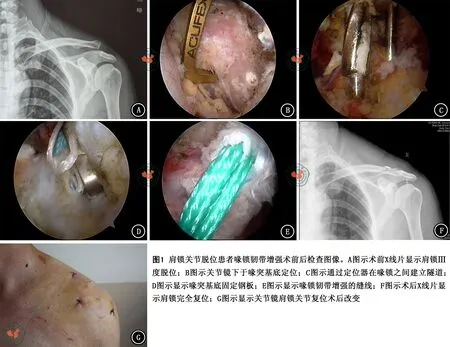
術前常規攝肩鎖關節正位X線片確定脫位的類型(圖1A)。RockwoodⅣ、Ⅴ、Ⅵ型肩鎖關節脫位通過肩關節正位X線片,結合檢查即可確診;為避免將RockwoodⅢ型肩鎖關節脫位誤診為Ⅱ型,需要在應力狀態下,攝肩關節正位X線片進行診斷。為排除肩峰下其他病變,有時需要進行岡上肌出口位X線片或者肩關節MRI檢查。
三、手術方法
本組病例均行臂叢神經肌間溝神經阻滯、氣管插管、全身麻醉,成功后擺放體位,取側臥患肢懸吊位。患肩及上肢消毒無菌巾單包裹。術前對患肩進行全面檢查,用無菌筆作鎖骨、肩峰與喙突輪廓的解剖標記,注意標記肩鎖關節間隙中點。術前在鎖骨走行肩鎖關節近端3 cm處以尖刀做一小切口,采用標準肩關節鏡手術后方入路,進入盂肱關節行關節腔內檢查,經前方入路伸進汽化電刀清理,顯露喙突基底。
然后通過后方入路進入肩峰下隙,取外側入路使用汽化電刀和刨刀清理肩峰下隙滑膜組織,檢查肩鎖關節脫位情況,沿鎖骨向近端清理顯露鎖骨下緣到喙鎖韌帶。
然后關節鏡后方進入盂肱關節,在關節鏡監視下,從前方入路伸進膝關節前交叉韌帶(Anterior Cruciate Ligament, ACL)重建定位器,勾住喙突基底處(圖1B)。通過術前鎖骨切口標記處用2.5 mm克氏針建立骨隧道導向針。進入喙突基底后,此時關節鏡進入肩峰下隙,觀察導向克氏針鎖骨下面位置。保證導向針從鎖骨中間穿過到喙突基底。然后使用4.5 mm鉆頭順導向針建立喙鎖增強隧道(圖1C)。
然后從鎖骨端隧道把牽引鋼絲伸進喙突基底,關節鏡監視下把帶鋼板的增強帶牽出鎖骨端,鋼板置于喙突基底(圖1D)。關節鏡肩峰下觀察肩鎖關節完全復位后,在鎖骨端行增強帶紐扣固定(圖1E)。手術完畢,關節鏡再次觀察喙突基底鋼板位置以及肩鎖復位情況。
術中僅使用30°關節鏡頭,縫線鋼板為BRAUN前交叉韌帶重建包。
四、術后處理
術后前2周休息時用頸腕吊帶制動,盡早行上肢被動前屈和外旋等功能鍛煉,但前屈幅度不宜超過90°,4周后開始主動前屈、外展及外旋功能鍛煉。前屈和外展幅度盡可能達到180°,6周后開始進行肩關節各種抗阻力練習,術后12周行各種體力活動或者運動。
五、評價方法
術后定期攝X線片,了解肩鎖關節維持復位情況(圖1F、G),以及有無其他異常變化。按照ASES評分標準與Constant[2]評分。術后6周,3、6、12個月各評估一次。
六、統計學分析方法
用SPSS統計學軟件包進行數據分析,治療前、后療效對比采用自身配對t檢驗,以P<0.05為差異有統計學意義。
結 果
12例肩鎖關節脫位患者ASES評分:術前28.7分,術后86.9分;Constant評分:術前24分,術后91分。治療組X線片顯示,肩鎖關節復位良好,僅有1例出現肩鎖關節半脫位。術后1年,91.7%(11/12)病例獲得滿意治療效果,83.3%(10/12)恢復到術前運動水平。
討 論
一、肩鎖關節結構及其脫位分類
肩鎖關節脫位多發生于青壯年,有明確的外傷史,常常直接暴力作用于內收的肩關節所致。肩鎖關節的穩定性靠包括肩胛骨和鎖骨之間的連續,胸鎖關節和肩胸關節的完整性來實現,其中肩胛骨和鎖骨之間的連接最為重要。肩胛骨和鎖骨之間的連接不僅包括肩鎖關節,還包括喙鎖韌帶(椎狀韌帶及斜方韌帶)以及三角肌-斜方肌筋膜。因此,從功能上講,應當以肩鎖連接的概念取代肩鎖關節。當肩鎖關節脫位后上述解剖結構不能修復時,只要能恢復或者重建肩胛骨和鎖骨之間的可靠連接即可,不必過于強調恢復肩鎖關節的解剖學完整性[7-10]。
根據肩鎖穩定結構的損傷情況,Rockwood把肩鎖脫位分為6型,其中Ⅰ、Ⅱ 型損傷僅僅為肩鎖關節韌帶損傷,未出現關節的完全脫位,一般采用非手術療法。Ⅲ 型及Ⅲ 型以上的損傷,除肩鎖關節完全脫位外,尚伴有其他關節結構及周圍軟組織損傷較重,這些情況破壞了關節穩定結構,需要通過手術恢復肩鎖關節的穩定性。
二、肩鎖關節脫位的治療
肩鎖關節脫位進行外科手術的目的,就是要進行解剖和功能的重建。肩鎖關節主要參與肩關節展收和屈伸活動。肩關節外展超過60°即出現肩胛骨圍繞矢狀軸旋轉,上臂前屈至90°即有肩鎖關節活動參與。肩胛骨與軀體間的任何角度的相對旋轉活動,都通過肩鎖關節和胸鎖關節有相應的反應。正常肩關節活動涉及肩鎖關節較大的活動,任何嚴格限制肩鎖關節活動的手術,如肩鎖關節克氏針內固定、喙鎖間螺釘內固定、鎖骨鉤鋼板都必然影響肩關節的活動[11-15],從而影響術后肩關節的康復訓練。由于在肩關節活動幅度稍大時,內固定即承受異常應力,易導致內固定失敗。因此肩鎖關節,或肩胛骨與鎖骨間的固定既要達到鎖骨可靠的復位,也必須保持肩胛骨與鎖骨間的相對活動自由。喙突與鎖骨間的軟性固定,如縫線、人工韌帶或鋼絲固定就成為較好的選擇[16-19]。
近年來隨著微創關節鏡技術的發展,對于肩關節切開內固定手術方式已逐漸發展為微創小切口或者關節鏡下手術方式,有學者應用肩關節鏡下微創術式,行喙鎖韌帶重建術治療肩鎖關節脫位,取得良好效果[20-27]。
三、關節鏡技術治療肩鎖關節脫位的手術優點
關節鏡下使用縫線鋼板紐扣技術,行喙鎖韌帶增強重建術治療肩鎖關節脫位,與傳統切開方法比較,有其明顯的優點:(1)手術創傷小。關節鏡手術僅僅需要3個5 mm小切口作為手術的通路完成,僅顯露喙鎖關節,對周圍穩定結構沒有干擾,便于術后的康復;(2) 關節鏡監視下復位可靠,不需要術中X線確認,縮短了手術時間;(3) 縫線鋼板生物相容性好,增強喙鎖韌帶,對肩鎖關節解剖結構沒有影響,有利于新鮮關節囊及韌帶的修復愈合;(4) 解剖位增強固定屬于彈性固定,在肩關節展收屈伸活動中允許肩鎖關節有一定的活動度,符合肩鎖關節的生物特性。
使用關節鏡技術增強重建喙鎖韌帶,首先關節鏡操作技術必須熟練,因此需要較長學習曲線;此外術中需要熟悉鏡下喙突基底、肩鎖關節以及喙鎖韌帶的解剖結構;在建立鎖骨到喙突根部骨隧道時,沿喙鎖韌帶方向走行,關節鏡顯示保證隧道周圍骨皮質均勻;關節鏡下復位后固定時加強喙突端的鋼板固定,避免因骨質疏松,出現固定鋼板松動脫落,導致手術失敗。
此外關節鏡下行喙鎖韌帶增強重建技術適合Rockwood Ⅲ、V型患者,對于難以復位的Ⅵ、Ⅳ型脫位,則需要通過切開手術恢復關節的穩定。總之,通過縫線增強喙鎖韌帶結構,恢復肩鎖關節解剖位置,是治療肩鎖關節脫位的一種有效方法。關節鏡下手術操作創傷小,肩鎖關節復位可靠,并發癥少,肩關節功能恢復快。但能否使肩鎖關節穩定結構及其生物力學特點自行修復,恢復其正常的解剖結構功能,還需要更長期的隨訪觀察。
參 考 文 獻
[1] Weaver JK, Dunn HK.Treatment of acromioclavicular injuries, especially complete acromioclavicular separation.J Bone Joint Surg Am,1972,54(6):1187-1194.
[2] Michlitsch MG, Adamson GJ, Pink M,et al.Biomechanical comparison of a modified Weaver-Dunn and a free-tissue graft reconstruction of the acromioclavicular joint complex.Am J Sports Med,2010,38(6):1196-203.
[3] Lewicky YM, Robertson CM, Foran JR. Anatomic coracoclavicular and acromioclavicular ligament Reconstruction for high-grade acromioclavicular separations:the gracilis weave. Orthopedics,2010,33(3):166-171.
[4] Yoo JC, Ahn JH, Yoon JR, et al. Clinical results of single-tunnel coracoclavicular ligament Reconstruction using autogenous semitendinosus tendon. Am J Sports Med,2010,38(5):950-957.
[5] Tauber M, Gordon K, Koller H,et al.Semitendinosus tendon graft versus a modified Weaver-Dunn procedure for acromioclavicular joint reconstruction in chronic cases:a prospective comparative study.Am J Sports Med,2009,37(1):181-190.
[6] Cohen G, Boyer P, Pujol N,et al.Endoscopically assisted reconstruction of acute acromioclavicular joint dislocation using a synthetic ligament. Outcomes at 12 months.Orthop Traumatol Surg Res,2011,97(2):145-151.
[7] Wei HF, Chen YF, Zeng BF, et al. Triple endobuttton technique for the treatment of acute complete acromioclavicular joint dislocations:preliminary results. Int Orthop,2011,35(4):555-559.
[8] Salzmann GM, Walz L, Buchmann S, et al.Arthroscopically assisted 2-bundle anatomical reduction of acute acromioclavicular joint separations.Am J Sports Med,2010,38(6):1179-1187.
[9] El Shewy MT, El Azizi H. Suture repair using loop technique in cases of acute complete acromioclavicular joint dislocation. J Orthop Traumatol,2011,12(1):29-35.
[10] Chernchujit B, Tischer T, Imhoff AB. Arthroscopic Reconstruction of the acromioclavicular joint disruption:surgical technique and preliminary results. Arch Orthop Trauma Surg,2006,126(9):575-581.
[11] Choi SW, Lee TJ, Moon KH, et al. Minimally invasive coracoclavicular stabilization with suture anchors for acute acromioclavicular dislocation. Am J Sports Med,2008,36(5):961-965.
[12] Zooker CC, Parks BG, White KL,et al.TightRope versus fiber mesh tape augmentation of acromioclavicular joint reconstruction:a biomechanical study.Am J Sports Med,2010,38(6):1204-1208.
[13] DeBerardino TM, Pensak MJ, Ferreira J, et al. Arthroscopic stabilization of acromioclavicular joint dislocation using the AC graftrope system. J Shoulder Elbow Surg,2010,19(2 Suppl):47-52.
[14] Yoo YS, Tsai AG, Ranawat AS,et al.A biomechanical analysis of the native coracoclavicular ligaments and their influence on a new reconstruction using a coracoid tunnel and free tendon graft.Arthroscopy,2010,26(9):1153-1161.
[15] Lafosse L, Baier GP, Leuzinger J.Arthroscopic treatment of acute and chronic acromioclavicular joint dislocation.Arthroscopy,2005,21(8):1017.
[16] Rolla PR, Surace MF, Murena L. Arthroscopic treatment of acute acromioclavicular joint dislocation. Arthroscopy,2004,20(6):662-668.
[17] Wolf EM, Pennington WT. Arthroscopic Reconstruction for acromioclavicular joint dislocation. Arthroscopy,2001,17(5):558-563.
[18] Murena L, Vulcano E, Ratti C,et al.Arthroscopic treatment of acute acromioclavicular joint dislocation with double flip button.Knee Surg Sports Traumatol Arthrosc,2009,17(12):1511-1515.
[19] Yoo YS, Seo YJ, Noh KC, et al. Arthroscopically assisted anatomical coracoclavicular ligament Reconstruction using tendon graft. Int Orthop,2011,35(7):1025-1030.
[20] Elhassan B, Ozbaydar M, Diller D, et al. Open versus arthroscopic acromioclavicular joint resection:a retrospective comparison study. Arthroscopy,2009,25(11):1224-1232.
[21] Freedman JA, Adamson GJ, Bui C, et al. Biomechanical evaluation of the acromioclavicular capsular ligaments and Reconstruction with an intramedullary free tissue graft. Am J Sports Med,2010,38(5):958-964.
[22] van Riet RP, Bell SN. Clinical evaluation of acromioclavicular joint pathology:sensitivity of a new test. J Shoulder Elbow Surg,2011,20(1):73-76.
[23] Tauber M, Koller H, Hitzl W, et al. Dynamic radiologic evaluation of horizontal instability in acute acromioclavicular joint dislocations. Am J Sports Med,2010,38(6):1188-1195.
[24] Rios CG, Arciero RA, Mazzocca AD. Anatomy of the clavicle and coracoid process for Reconstruction of the coracoclavicular ligaments. Am J Sports Med,2007,35(5):811-817.
[25] Scheibel M, Dr?schel S, Gerhardt C, et al. Arthroscopically assisted stabilization of acute high-grade acromioclavicular joint separations. Am J Sports Med,2011,39(7):1507-1516.
[26] Motta P, Maderni A, Bruno L,et al.Suture rupture in acromioclavicular joint dislocations treated with flip buttons.Arthroscopy,2011,27(2):294-298.
[27] Boileau P, Old J, Gastaud O,et al.All-arthroscopic Weaver-Dunn-Chuinard procedure with double-button fixation for chronic acromioclavicular joint dislocation.Arthroscopy,2010,26(2):149-160.