人工關節假體重建肘部腫瘤切除后骨缺損
2013-05-15 00:36:57郭衛湯小東
中華肩肘外科電子雜志 2013年1期
郭衛 湯小東
通訊作者:郭衛,Email:bonetumor@163.com
【摘要】目的肘關節周圍腫瘤切除后骨缺損的重建較為困難。本文回顧在肘關節周圍腫瘤切除術后行全肘關節成型假體重建的病例,明確這種手術的療效、功能及并發癥。方法1998年至2010年,共有24例高度或低度惡性腫瘤患者在北京大學人民醫院接受了腫瘤切除后全肘關節置換術,其中男性14例,女性10例;平均年齡42.6歲。病理診斷:骨肉瘤6例,尤文肉瘤4例,惡性纖維組織細胞瘤3例,骨巨細胞瘤2例,淋巴瘤、滑膜肉瘤、骨的硬纖維瘤各1例,轉移癌6例。腫瘤累及肱骨遠端12例,累及尺骨近端7例,肱骨遠端及尺骨近端均受累5例。骨缺損重建采用定制型絞鏈式人工肘關節。術后鼓勵患者主動活動手部,肘關節制動至傷口愈合后。切除標本進行病理分析確定外科邊界,15例廣泛切除,9例邊緣性切除。對所有患者進行規律隨訪,記錄生存、轉移、復發、功能及假體并發癥情況。采用Mayo肘關節功能評分(Mayo elbow performance scorce,MEPS)及肌肉骨骼腫瘤協會(MSTS)功能評分系統評估患者的術后功能。結果1例患者失隨訪,其余23例患者均至少隨訪1年或隨訪至死亡(平均隨訪37個月)。在隨訪期間,11例患者無瘤生存;4例轉移癌、1例骨肉瘤及1例尤文肉瘤患者分別死于術后2年內;2例尤文肉瘤、1例惡性纖維組織細胞瘤、1例骨肉瘤發生肺轉移以及2例轉移瘤患者帶瘤生存。6例骨肉瘤中,失隨訪、死亡、肺轉移帶瘤生存各1例,其余3例無瘤存活;4例尤文肉瘤中,1例死于腫瘤轉移,2例肺轉移帶瘤生存,其余1例無瘤存活。腫瘤局部復發3例(13%)。6例患者出現并發癥,發生率26.1%,包括橈神經牽拉傷1例,傷口不愈合2例,無菌性松動及假體柄穿出骨皮質共3例。術后MSTS評分:5例關節外腫瘤切除患者平均25分,18例關節內切除患者平均25.9分。MEPS評分平均80分。肘關節的平均屈伸范圍73°(范圍:55°~105°)。結論肘部腫瘤切除、人工關節假體重建術可以提供良好的腫瘤學檢查結果,并發癥發生率較低,術后功能恢復良好。
【關鍵詞】 人工肘關節; 成形術; 腫瘤; 保肢
【Abstract】BackgroundThe tumors at the elbow bone account for 1% of the bone tumors of the whole body. Lymphoma is the most common malignant tumor and osteoid osteomais is the most common benign tumor. In the past, the treatment of elbow malignant tumors is amputation, which results in loss of limb after surgery. With the development of surgery and the technology of radiation and chemotherapy, it is possible to partially excise the tumors and retain upper limbs. However, due to the important anatomical structures of elbow, partial excision of tumor leads to instability and poor function of the joint of elbow, wrist and hand. Before the total endoprosthesis of elbow appeared, there were only several reconstruction methods to rebuild stable functional elbow after tumor resection. Arthrodesis or excisional arthroplasty of the elbow has their respective disadvantage:arthrodesis results in limited elbow motion, and excisional arthroplasty results in joint instability. At present, there are rare literatures guiding the elbow reconstruction after the tumor resection. Therefore, This study presented our results of limb salvage surgery using custom-made prostheses for reconstruction of the elbow after tumor excision. The oncologic results, complications, and functional outcomes were further discussed.Methods(1)General information:The elbow tumor surgery cases from June 1998 to June 2010 were retrospectively collected in Peking University People′s Hospital. The inclusion criteria were as follows:malignant tumor involving the proximal ulna and distal humerus or benign invasive tumor, tumor excision with prostheses for reconstruction of the elbow. The benign tumors, revision and complete humerus surgery patients should be ruled out.There are 24 patients in this study,14 men and 10 women, with a mean age of 42.6 year-old. Pathological diagnosis of these cases were:6 cases of osteosarcoma,4 cases of Ewing′s sarcoma,3 cases of malignant fibrous histiocytoma,2 cases of giant cell tumor, each 1 case of lymphoma, synovial sarcoma and bone of desmoid tumor,6 cases of metastatic carcinoma (3 cases of lung cancer, and each 1 case of melanoma, ovarian cancer and rectal cancer). 12 tumors were in distal humerus, 7 in proximal ulna, 5 in humerus and 5 in ulna. Patients with osteosarcoma, Ewing′s sarcoma and malignant lymphoma received standard chemotherapy preoperatively and postoperatively. Malignant fibrous histiocytoma and lymphoma patients received radiotherapy postoperatively.(2)Prosthesis design Patients underwent reconstruction of elbow joint with custom-made hinged type artificial elbow endoprosthetic (ChunLiZhengDa medical equipment company, Beijing, China). In order to increase the fixation effect of the bone cement, all prostheses were cement type and ulna prosthesis handles were screw type. In order to strengthen the stability, the surface of the prosthesis that contact with proximal humerus and distal ulna were coated by titanium paste or made of granular surface coating. Due to the smaller diameter of ulnar canal and curved shape, the ulnar prosthetic handle diameter was 6 to 7 mm, and length was about 6 to 8 cm.(3)Surgical technique:The elbow posterior approach was commonly used. All of the patients underwent en-bloc resection, 5 patients underwent the joint resection for their tumors were involved in the articular cavity, the remaining cases received intra-articular resection. Those patients with distal humerus tumors needed to reflect the triceps muscle. If possible, we tried to keep the ulna olecranon and triceps tendon attachment points. After removal of the tumor, we repaired to the greatest extent the forearm flexion and extension as well as pronation after spin muscle group attachment points. For cases of proximal ulna, we kept humerus medial condyle and lateral condyle as much as possible, embedding the humerus part of prosthesis into the fossa intercondyloidea. When installing the joints, humerus and ulna part of prosthesis were fixed in the medullary cavity with bone cement, respectively, and then the hinge was connected. The average operation time of the patients was about 120 min, the mean volume of blood loss was 400 ml, and the average time for the use of tourniquet was 80 min.(4)Postoperative recovery and follow-up:Active hand movement was encouraged after operation. Elbow joint cannot be moved until the wound healed. Pathological analysis of the resection specimen was conducted to determine the surgical boundary. 15 cases received wide resection, and 9 cases received borderline resection. Regular follow-up was performed for all patients to record the situation of survival, metastasis, recurrence, function and implant complications. The scoring systems of Mayo elbow joint function (MEPS) and MSTS joint function were used to assess the patient′s postoperative function.ResultsOne patient was lost to follow up, the rest 23 patients were followed up for at least one year or until to death (mean,37 months). During the follow-up,11 patients were tumor-free survivals. 4 with metastatic carcinoma, one with osteosarcoma and one with Ewing′s sarcoma died within two years after the operation, respectively. Two cases of Ewing′s sarcoma, one of malignant fibrous histiocytoma, one of osteosarcoma with lung metastasis, and two of metastatic tumor, survived with tumor. Among the 6 patients with osteosarcoma, one lost to follow up, one died and one survived with lung metastasis, the other three were tumor-free survivals. In the 4 cases of Ewing′s sarcoma, one patient died of tumor metastasis, two survived with lung metastasis, and one was tumor-free survival.Tumors recurred locally in 3 cases (13%).The incidence of complication was 26.1% (6/23), including one patient with pull injury of radial nerve that recovered during the 6 months after operation. The wound was difficult to heal in 2 cases, and cured after debridement. Among 3 patients suffering implant complications,2 patients′ prosthesis handle pricked the bone cortex and one patient′s prosthesis was aseptic loose. These three obtained good function after the operation of prosthesis revision.Postoperative MSTS score were as follows:the score of 5 cases with the whole tumor resection outside the joint and artificial elbow joint replacement was 25 points on average, the mean score of 18 cases with tumor resection inside the joint and artificial elbow joint replacement was 25.9 points.The operation effects of 18 cases were satisfactory (18/23,78.3%) and 5 cases were acceptable (5/23,21.7%). The average MEPS score of all the patients was 80 points. The mean flexion range of elbow was improved from 29 ° to 73 ° (range, 55 °-105 °).DiscussionExcisional arthroplasty or arthrodesis of the elbow always leads to poor function and is difficult for patients with bone loss. The options for reconstruction after excision of the tumor around the elbow are technically difficult and limited. This study presented our results of limb salvage surgery using custom-made prostheses for reconstruction of the elbow after tumor excision, and discussed the oncologic results, complications, and functional outcome.(1)The requirements of prosthesis and the patient in total elbow arthroplasty.The means of limb salvage and application of elbow prosthesis after the tumor resection have rarely been reported before. For total elbow arthroplasty for reconstruction of the elbow, prosthesis and the patient must meet certain requirements. Prosthesis should allow the steady activity of the forearm and hand, its length can make up the bone defects, and its mechanical strength can withstand everyday use. In addition, the prosthesis must be technically easy to install, and ensure stable fixation. In terms of the choice of cases, total elbow arthroplasty can be only applied to the patients with the functional neurovascular bundle, forearm and hand. The total elbow arthroplasty can not be used for the patients, who can be curative after tumor resection, but need to sacrifice margin to secure the implant. The treatment of patients with extensive tumor metastasis and poor prognosis, such as tumor resection, implant replacement surgery, chemotherapy or radiotherapy, need to be performed based on their own conditions. Furthermore, in such case, amputation should be avoided to retain the function of their hand and forearm.(2) Elbow reconstruction after tumor resection.Not many reconstruction methods are reported to rebuild a stable elbow after tumor resection. Arthrodesis or resection arthroplasty is often used for smaller bone defects. Arthrodesis results in limited postoperative elbow movement, and resection arthroplasty leads to postoperative joint instability. The allogeneic elbow transplantation has been applied for the larger defects. Semi-allogeneic transplant articular can make soft tissue attachment to retain muscle function and maintain joint stability, but the rate of postoperative complications can be as high as 70%. Infection, joint instability and dislocation often occur after surgery. Despite the solid internal fixation exists, postoperative bone nonunion occurred frequently ( about 15% ). The other patients may had allogeneic bone resorption. The results of this study showed that the implementation of the whole elbow after tumor resection arthroplasty could significantly reduce the pain and improve the function. Patients with metastases may be treated by this surgical method, especially for whose symptoms can not be relieved by other methods. There is no better method than the artificial elbow replacement for the functional reconstruction after resection of the tumor around the elbow joint. And the incidence of complications after elbow arthroplasty is acceptable.(3)Ensure the success of total elbow arthroplasty:Following points should be noted:①The principles of malignancy wide excision should be followed, otherwise local tumor recurrence might easily appear. ②Soft tissue coverage should be sufficient to avoid incision problems, which could lead to failure of the prosthesis replacement surgery. ③Patients with the tumor of distal humerus should be treated, after removal of the tumor, by the repair of the forearm flexion and extension as well as pronation after spin muscle group start and end points. If possible, partial medial and lateral condyle of humerus should be maintained as far as possible. ④Due to the smaller ulnar canal and less bone cement poured, the intramedullary prosthesis should be designed as the coarse thread type, which helps to cement to prevent the prosthesis rotation and loosening. ⑤For the smaller diameter of ulnar canal and curved shape, the ulnar prosthetic handle must not be too long, with 5-7 cm advisable, otherwise it will be easy to wear a bone cortex; ⑥The medial and lateral condyle of humerus should be kept for patients with the tumor of proximal ulna. And the humerus part of prosthesis between fossa intercondyloidea should be embedded. (4)Function evaluation:All the three groups of patients started functional exercise after the postoperative 3 weeks. After 8 weeks, 70% of patients had a "near normal"-like appearance with the elbow flexion range between 50 degrees to 90 degrees, 5% of patients with an arc of motion of less than 50 degrees,25% of patients with an elbow flexion range of greater than 90 degrees. 90% of the patients could make movements of their elbows without pain; 80% of patients retained the function of the forearm rotation.ConclusionsIn conclusion, local tumor resection together with prosthetic reconstruction of the elbow can provide good surgical outcomes and less complication with oncologic safety for the appropriate patients.
【Keywords】 Endoprosthesis of elbow; Arthroplasty; Neoplasm; Limb salvage
肘部骨腫瘤占全身骨腫瘤發病率的1%。其中,淋巴瘤是最常見的惡性腫瘤,骨樣骨瘤是最常見的良性腫瘤[1]。在過去,治療肘部惡性腫瘤多需要截肢,造成術后肢體功能喪失。隨著外科及放化療技術的進展,使得局部切除腫瘤、保留上肢成為可能。然而,由于肘部重要的解剖結構密集,腫瘤局部切除術后會導致肘、腕及手部關節不穩定、功能喪失。在人工全肘關節出現以前,腫瘤切除術后要重建功能穩定的肘關節,僅有為數不多的幾種重建方法可供選擇[1-3]。關節融合術或切除成形術各自存在弊端:關節融合術導致肘關節運動受限,切除成形術導致關節不穩定。目前,指導腫瘤切除后的全肘關節重建方面的文獻甚少。為此,我們對肘關節周圍腫瘤切除術后人工肘關節置換術患者的臨床資料進行回顧性分析,以探討這種手術的療效、并發癥及術后功能。
材料和方法
一、一般資料
回顧性收集1998年6月至2010年6月在北京大學人民醫院接受肘部腫瘤手術的病例資料。納入標準:累及尺骨近端及肱骨遠端的惡性或良性侵襲性腫瘤;接受腫瘤切除全肘人工關節假體重建。良性腫瘤、接受翻修及全肱骨手術的患者被排除。共有24例患者納入研究,其中男性14例,女性10例;年齡15~71歲,平均42.6歲;病理診斷:骨肉瘤6例,尤文肉瘤4例,惡性纖維組織細胞瘤3例,骨巨細胞瘤2例,淋巴瘤、滑膜肉瘤、骨的硬纖維瘤各1例,轉移癌6例(肺癌3例,黑色素瘤、卵巢癌、直腸癌各1例);累及部位包括肱骨遠端12例,尺骨近端7例,肱骨遠端及尺骨近端均受累5例。術前術后,骨肉瘤、尤文肉瘤及惡性淋巴瘤病例均接受規范化療;惡性纖維組織細胞瘤及淋巴瘤病例均進行了術后放療。
二、假體設計
患者使用研究者設計的定制型絞鏈式人工肘關節(春立正達醫療器械公司,中國北京)進行重建,所有假體均為骨水泥固定型,尺骨假體柄為螺紋式,以增加骨水泥固定效果。為了加強穩定性,假體近端肱骨及遠端尺骨與骨接觸部分表面噴涂鈦漿涂層或制成粒狀表面。由于尺骨髓腔直徑較小、形狀彎曲,因而尺骨髓腔內的假體柄直徑一般為6~7 mm,長度約6~8 cm。
三、手術技術
常規采用肘關節后側入路。本組病例均行整塊切除,其中5例患者因腫瘤累及關節腔,采用關節外切除(圖1,2),其余病例采取關節內切除。對于肱骨遠端腫瘤病例,需形成肱三頭肌肌瓣,如可能,應盡量保留尺骨鷹嘴及肱三頭肌肌腱止點,切除腫瘤后,盡量修復前臂屈伸及旋前旋后肌群的起止點;對于尺骨近端病例,盡量保留肱骨內外側髁,將肱骨部分假體嵌入髁間窩部位。關節安裝時,先將假體肱骨及尺骨部分分別采用骨水泥固定于髓腔,而后連接中間鉸鏈。本組平均手術時間約為120 min,平均失血量為400 ml,平均用止血帶的時間為80 min。
四、術后恢復及隨訪
術后鼓勵患者主動活動手部,肘關節制動至傷口愈合后。切除標本進行病理分析確定外科邊界,15例廣泛切除,9例邊緣性切除。對所有患者進行規律隨訪,記錄生存、轉移、復發、功能及假體并發癥情況。采用Mayo肘關節功能評分(Mayo elbow performance scorce,MEPS)(表1)及肌肉骨骼腫瘤協會(MSTS)關節功能評分系統評估患者的術后功能[1,4]。
結 果
1例患者失隨訪,其余23例患者均至少隨訪1年或隨訪至死亡(平均隨訪37個月)。在隨訪期間,11例患者無瘤生存;4例轉移癌,1例骨肉瘤及1例尤文肉瘤患者分別死于術后2年內;2例尤文肉瘤、1例惡性纖維組織細胞瘤、1例骨肉瘤發生肺轉移以及2例轉移瘤患者帶瘤生存。6例骨肉瘤中,失訪、死亡、肺轉移帶瘤生存各1例,其余3例無瘤存活;4例尤文肉瘤中,1例死于腫瘤轉移,2例肺轉移帶瘤生存,其余1例無瘤存活。腫瘤局部復發3例(13 %)。
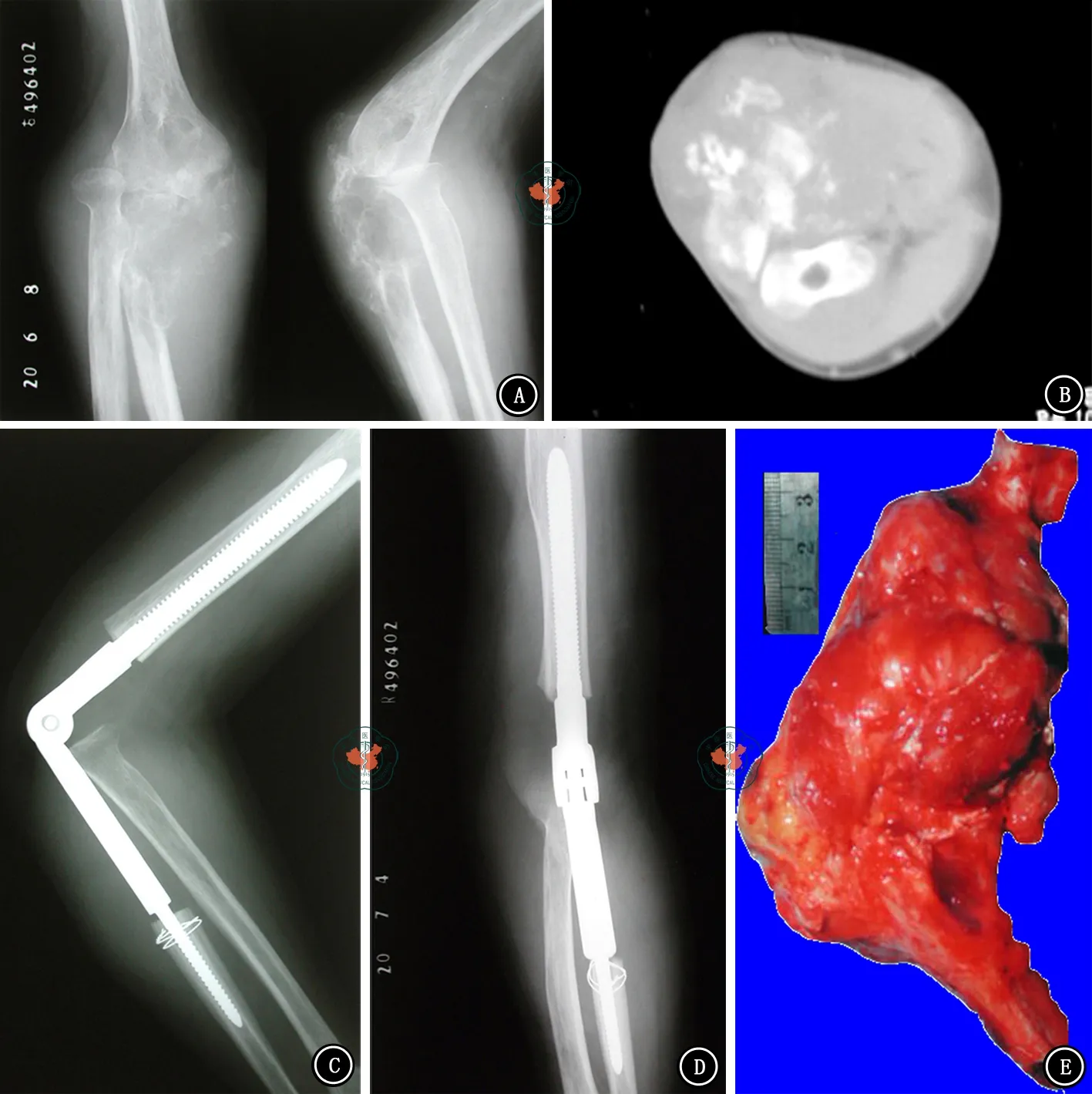
圖1 尺骨近端惡性纖維組織細胞瘤累及肱骨遠端檢查圖像。A圖示術前肘關節X線圖像;B圖示術前 CT圖像;C、D圖示術后肘關節X線圖像;E圖示切除標本圖像

圖2 肱骨遠端骨巨細胞瘤檢查圖像。A、B圖示術前X線圖像;C、D圖示術后X線圖像;E圖示術中圖像
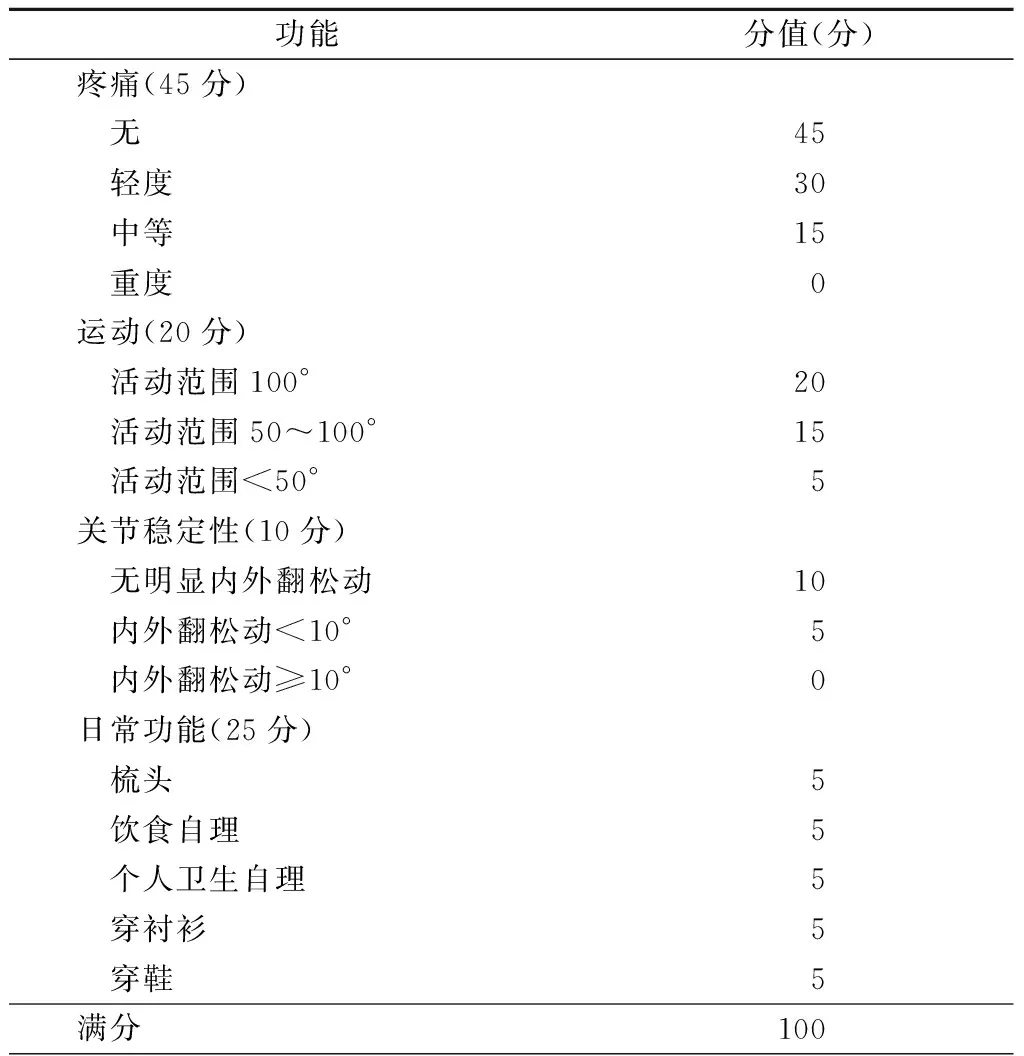
表1 Mayo肘關節功能評分系統
并發癥發生率26.1% (6/23),包括橈神經牽拉傷1例,于術后6個月恢復;傷口不愈合2例,經清創好轉;假體并發癥3例,其中2例假體柄穿出骨皮質(圖3),1例無菌性松動,行假體翻修術后均恢復良好功能。
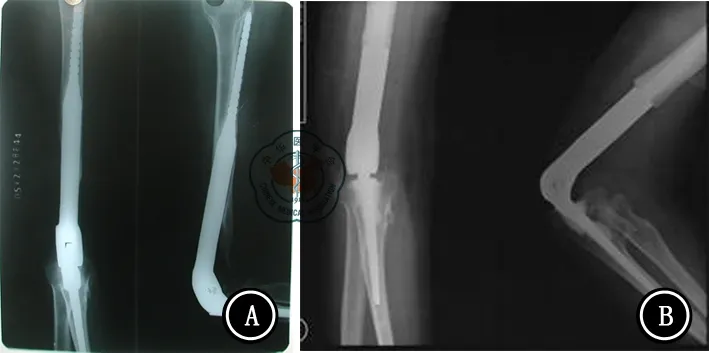
圖3 肱骨遠端骨肉瘤患者術后4年(假體上端柄穿出骨皮質,進行假體翻修)檢查圖像和術中所見圖像。A圖示術前X線圖像;B圖示術后X線圖像
術后MSTS評分:5例關節外腫瘤整塊切除、人工肘關節置換的患者平均25分,18例關節內腫瘤切除、人工肘關節置換的患者平均25.9分。18例患者手術效果優良(18/23,78.3%),5例患者手術效果可以接受(5/23,21.7%)。MEPS評分平均80分。肘關節的平均屈伸范圍由29°改善為73°(范圍:55°~105°)。
討 論
由于上肢解剖及功能要求特殊,使得肘部腫瘤切除與重建較為困難。切除成形術、關節融合、異體骨移植等曾用于肘關節重建,但都受到較多限制并且功能較差。雖然關節假體在骨腫瘤保肢治療中已經廣泛應用,但在肘部的應用報道較少,其多用于創傷、退行性關節病、類風濕性關節炎[5]。我們對肘關節周圍腫瘤切除術后人工肘關節置換術的病例進行了總結,明確這種手術的療效、并發癥及術后功能。
一、全肘關節成形術中假體及病例的要求
在腫瘤切除術后,作為保肢手段而應用肘關節假體的報道很少。1987年,Ross等報道了26例患者因遠端肱骨破壞而接受了假體置換術[6],所有植入物均為定制鉸鏈式。接受假體置換術的患者中,12例為骨折或連枷肘,9例為高度惡性腫瘤,5例為低度惡性腫瘤,1例為肘關節轉移瘤。肘關節的屈伸范圍平均增加85°,但31%的患者出現神經損傷(多數發生在遠端肱骨切除的病例)。本組全肘關節置換的病例中,僅1例出現神經損傷并發癥。肱骨遠端惡性腫瘤向外生長形成軟組織包塊時,行腫瘤廣泛切除容易損傷橈神經,術中應注意游離出橈神經予以保護,如果腫瘤生長包裹橈神經則應選擇切除神經。選擇全肘關節成形術為重建方法時,假體及患者必須滿足一定的要求。假體應該允許前臂及手穩定的活動,能夠替代骨缺損的長度,力學強度能經得起日常使用;另外,假體必須從技術上容易安裝,并且能保證固定牢靠[7]。在病例的選擇方面,全肘成形術僅適用于那些血管神經束未被侵犯、前臂及手具有功能的患者。對于可能治愈性切除腫瘤的患者,如果需要犧牲腫瘤切緣來固定植入物,就不能選用全肘關節置換術。對于腫瘤廣泛轉移,預后較差的患者,可以根據需要選用腫瘤切除術、假體置換術、化療或者放療。這種情況下應當避免使用截肢術,以保留手及前臂的功能[1]。
二、肘關節腫瘤切除后重建的方法
腫瘤切除術后要重建功能穩定的肘關節,可供選擇的重建方法不多。對于較小的骨缺損,常選用關節融合術或切除成形術。關節融合術導致手術后肘關節運動受限,切除成形術導致術后關節不穩定。對于較大的缺損,有報道應用同種異體肘關節移植。異體半關節移植能讓軟組織附著,保留肌肉功能,保持關節穩定性,但術后并發癥較多,可高達70%[8-9]。術后常發生感染、關節不穩定、脫位。盡管有堅實的內固定,術后出現骨不連機會仍很高(約15%)。另外部分患者可出現異體骨吸收。本研究的結果表明,腫瘤切除后實施全肘關節成形術能夠顯著的減輕疼痛,改善功能。轉移瘤的患者,特別是其他方法均不能緩解癥狀時,也可以采用這種手術方法。對于肘關節周圍的腫瘤切除術后功能重建,目前沒有比人工肘關節置換更好的方法。人工肘關節置換術后并發癥發生率可以接受。Hanna等[10]報道18例肱骨遠端腫瘤行人工肘關節置換的病例,包括12例原發腫瘤及6例轉移瘤。并發癥包括無菌性松動3例(16.6%)、感染2例(11%)、橈神經損傷1例(5.5%)及假體周圍骨折1例(5.5%)。本組患者中,總體并發癥發生率26.1%,假體相關并發癥僅1例(4.3%)發生無菌性松動,有2例(8.7%)假體柄穿出骨皮質,未發現假體柄折斷或假體周圍感染的病例。
三、保證人工全肘關節置換術成功的要點
應注意以下幾點:1、首先要遵循惡性腫瘤廣泛切除的原則,否則易導致腫瘤局部復發;2、腫瘤切除后局部要有充分的軟組織覆蓋,以免切口出現問題,導致假體置換手術失敗;3、對于肱骨遠端部位的腫瘤,手術切除腫瘤后,盡量修復前臂屈伸及旋前旋后肌群的起止點。如果可能,術中應盡量保留部分肱骨內、外側髁;4、由于尺骨髓腔較細,灌入骨水泥較少,因而尺骨髓腔內的假體柄可設計成粗螺紋式,便于骨水泥固定,防止假體旋轉及松動;5、由于尺骨有彎曲且髓腔較細,尺骨髓腔內的假體柄一定不要太長,以5~7 cm為宜,否則容易穿出骨皮質;6、對于尺骨近端部位的腫瘤,應保留肱骨內外髁,安裝肱骨遠端假體時,將肱骨遠端髁間窩鋸掉,將假體嵌入髁間窩部位。這樣,一方面保留了肌肉的起止點,另一方面還能防止假體旋轉。
四、功能評價
本組病例中,所有患者術后3周開始功能鍛煉。8周后患者肘關節活動接近正常,活動范圍在50°~90°者占70%,活動范圍<50°者占5%,活動范圍>90°者占25%。90%的患者活動時無疼痛,80%的患者術后保留前臂的旋轉功能。人工肘關節置換術后的患者應避免手提重物及用力旋轉前臂,以免出現假體松動及骨折。定制型人工肘關節的壽命目前尚不清楚,以往文獻報道的人工肘關節置換多為類風濕性關節炎或骨性關節炎病例,且多為老年患者,對肘關節的功能要求較低,主要目的是解除疼痛癥狀。理論上,肘關節腫瘤切除后人工肘關節置換,由于切除范圍廣、假體節段長、患者年輕及使用頻率高,所以并發癥相對高,假體壽命短。Weber 等[11]報道23例肘關節腫瘤患者,包括15例原發腫瘤及8例轉移瘤患者。其中11例患者采用了肘關節腫瘤切除后人工肘關節置換,平均MSTS評分83%。Kulkarni 等[12]報道10例肱骨遠端腫瘤切除、人工肘關節置換患者,所有患者疼痛解除、肘關節功能良好。Schwab 等[13]最近報道了5例肘關節腫瘤、關節外切除患者,平均MSTS評分25.2分。本組病例中,5例關節外腫瘤整塊切除重建患者,平均MSTS評分25分,略低于關節內腫瘤切除重建患者。關節外腫瘤切除的病例,往往腫瘤范圍廣、體積較大,軟組織切除較多,因而術后功能受到影響。
綜上所述,對于適當的患者進行肘部腫瘤切除、人工關節假體重建可以提供良好的腫瘤學結果,較低的并發癥發生率,獲得良好的術后功能。
參 考 文 獻
[1] Sperling JW, Pritchard DJ, Morrey BF.Total elbow arthroplasty after resection of tumors at the elbow[J]. Clin Orthop Relat Res,1999,(367):256-261.
[2] Urbaniak JR, Black KE. Cadaveric elbow allografts. A six-year experience[J]. Clin Orthop Relat Res,1985,(197):131-140.
[3] Kharrazi FD, Busfield BT, Khorshad DS, et al.Osteoarticular and total elbow allograft reconstruction with severe bone loss[J].Clin Orthop Relat Res,2008,466(1):205-209.
[4] Enneking WF, Dunham W, Gebhardt MC, et al. A system for the functional evaluation of reconstructive procedures after surgical treatment of tumors of the musculoskeletal system[J]. Clin Orthop Relat Res,1993,(286):241-246.
[5] Aldridge JM 3rd, Lightdale NR, Mallon WJ,et al.Total elbow arthroplasty with the Coonrad/Coonrad-Morrey prosthesis. A 10-to 31-year survival analysis[J].J Bone Joint Surg Br,2006,88(4):509-514.
[6] Ross AC, Sneath RS, Scales JT. Endoprosthetic replacement of the humerus and elbow joint[J]. J Bone Joint Surg Br,1987,69(4):652-655.
[7] Morrey BF, Bryan RS, Dobyns JH, et al. Total elbow arthroplasty. A five-year experience at the Mayo Clinic[J]. J Bone Joint Surg Am,1981,63(7):1050-1063.
[8] Dean GS, Holliger EH 4th, Urbaniak JR.Elbow allograft for reconstruction of the elbow with massive bone loss. Long term results [J]. Clin Orthop Relat Res,1997,(341):12-22.
[9] Mankin HJ, Gebhardt MC, Jennings LC, et al. Long-term results of allograft replacement in the management of bone tumors[J]. Clin Orthop Relat Res,1996,(324):86-97.
[10] Hanna SA, David LA, Aston WJ, et al. Endoprosthetic replacement of the distal humerus following resection of bone tumours[J]. J Bone Joint Surg Br,2007,89(11):1498-1503.
[11] Weber KL, Lin PP, Yasko AW. Complex segmental elbow Reconstruction after tumor resection[J]. Clin Orthop Relat Res,2003,(415):31-44.
[12] Kulkarni A, Fiorenza F, Grimer RJ, et al. The results of endoprosthetic replacement for tumours of the distal humerus[J]. J Bone Joint Surg Br,2003,85(2):240-243.
[13] Schwab JH, Healey JH, Athanasian EA. Wide en bloc extra-articular excision of the elbow for sarcoma with complex Reconstruction[J]. J Bone Joint Surg Br,2008,90(1):78-83.