利用紅外照相技術分析野生白冠長尾雉活動節律及時間分配
2013-12-09 06:30:38趙玉澤王志臣徐基良安麗丹
生態學報 2013年19期
趙玉澤,王志臣,徐基良,*,羅 旭,安麗丹
(1. 北京林業大學自然保護區學院,北京 100083; 2. 國家林業局調查規劃設計院,北京 100714;3. 國家林業局野生動植物保護與自然保護區管理司,北京 100714)
利用紅外照相技術分析野生白冠長尾雉活動節律及時間分配
趙玉澤1,王志臣2,徐基良1,*,羅 旭1,安麗丹3
(1. 北京林業大學自然保護區學院,北京 100083; 2. 國家林業局調查規劃設計院,北京 100714;3. 國家林業局野生動植物保護與自然保護區管理司,北京 100714)
2012年3月—2013年3月,利用紅外相機技術在湖北省廣水市蔡河鎮對野生白冠長尾雉的活動節律和時間分配進行了研究。利用16臺紅外相機在40個相機位點對白冠長尾雉進行了監測。累計1774個相機日,拍攝到2242個獨立視頻,其中白冠長尾雉的視頻占18%,共記錄538只次,雌雄比為1.43∶1。結果表明,白冠長尾雉每日有兩個活動高峰期,上午雄性個體的活動高峰期比雌性個體早兩個小時。白冠長尾雉的主要行為是移動和覓食,分別占到總頻次的40.71%和33.10%,其余5種行為依次為: 警戒9.29%,梳理7.14%,休息5.00%,對抗2.62%,育幼2.14%。雌性白冠長尾雉的警戒行為頻次比例顯著高于雄性個體(Plt;0.05)。不同季節之間取食行為、移動行為、對抗行為比例之間有顯著差異,冬季的取食行為比例明顯高于夏季(Plt;0.05),夏季移動行為比例顯著高于秋季(Plt;0.05)和冬季(Plt;0.05),而警戒、梳理、休息和育幼行為比例則無顯著差異。
紅外相機技術;白冠長尾雉;活動節律;時間分配
活動節律與時間分配是動物行為學研究的重要內容[1],其結果可以反映出動物個體的營養狀態、社會地位等狀況,也有助于分析物種的生存狀況或對策,對于制定保護措施具有十分重要的意義[2]。雖然瞬時掃描法和焦點動物取樣法[2- 4]比較適用于大型哺乳動物或者是籠養野生動物的觀察研究,但并不適合對人類活動敏感或數量稀少的瀕危物種。紅外線觸發自動數碼相機陷阱技術(以下簡稱紅外相機技術)具有長期性、客觀性、隱蔽性、無損傷性等特征[5- 6],在解決這一問題中具有天然優勢。因此,其逐漸廣泛應用于野生動物相關研究中,且在國外已經有很長的歷史[7- 10],如紅外相機技術在鳥類巢穴捕食、營巢行為等方面已經有過很多研究[5,11]。
白冠長尾雉(Syrmaticusreevesii)是我國特有珍稀雉類,隸屬雞形目(Galliformes)雉科(Phasianidae),被列為國家Ⅱ級重點保護野生動物和IUCN易危種[12- 14]。以往對白冠長尾雉的研究主要集中在數量調查[15- 16]、生態習性[17- 18]、集群行為[19- 20]、孵卵[21]、棲息地選擇和活動區[22- 23]等方面,關于其行為特別是野生個體活動節律和時間分配方面的資料則相當缺乏。因此,本研究利用紅外相機技術,在湖北省廣水市研究了野生白冠長尾雉行為的日時間分配及其季節變化,以探討白冠長尾雉的活動節律。
1 研究地點和方法
1.1 地域概況
研究地點位于湖北省隨州廣水市蔡河鎮平靖關村,地理位置為東經113°54′09″—113°55′21″,北緯31°51′03″— 31°52′40″,與河南省信陽市浉河區接壤(圖1)。年平均降水量865—1070 mm,年日照時長2009.6—2059.7 h,年平均氣溫15.5 ℃,無霜期220—240 d。植被以灌叢和人工林為主。灌叢主要由油桐(Verniciafordii)、小葉鼠李(Rhamnusparvifolia)、野桐(Mallotusjaponicus)、遼東楤木(AraliaelataSeem)和核桃楸(JuglansmandshuricaMaxim)等組成;人工植被主要有茶葉(Camelliasinensis)、板栗(Castaneamollissima)、少量毛白楊(Populustomentosa)和毛竹(Phyllostachyspubescens)以及少量的馬尾松(Pinusmassoniana)和杉木(Cunninghamialanceolata)。根據當地氣候和白冠長尾雉的習性[23],該地四季劃分為春季3—5月、夏季6—8月、秋季9—11月和冬季11月至翌年2月。
1.2 相機布放
2012年3月—2013年3月,在白冠長尾雉活動區內布設ScoutGuard Trail Camera SG550V- 31B 紅外相機16臺。具體布設規則為:根據對8只白冠長尾雉的無線電跟蹤遙測結果,在每只個體的活動區內布設兩臺紅外相機,兩臺同時工作的紅外相機之間相隔至少200 m。根據拍攝效果不定期更換紅外相機的位置及拍攝方向,最終布設了40個相機位點(圖1)。相機位點多選擇郁閉度較高、林下較為開闊且人為活動較少的喬灌叢中,多固定于中小型灌木上,離地面約20—40 cm,確保視野的開闊性,鏡頭與地面大致平行[24]。拍攝時間為4:00—22:00,相機設置為30 s視頻模式,統一相機的日期時間等其它設置。詳細記錄相機位點編號、經緯度、生境、布設日期和時間、安放時長,一臺相機從4:00—22:00正常工作,則記為一個相機日。每1個月檢查和更換1次電池及儲存卡。
1.3 行為分類
根據相關鳥類行為文獻[4,25]及拍攝到的視頻資料,將野生白冠長尾雉的行為劃分為取食、移動、梳理、警戒、休息、對抗和育幼等7種(表 1)。
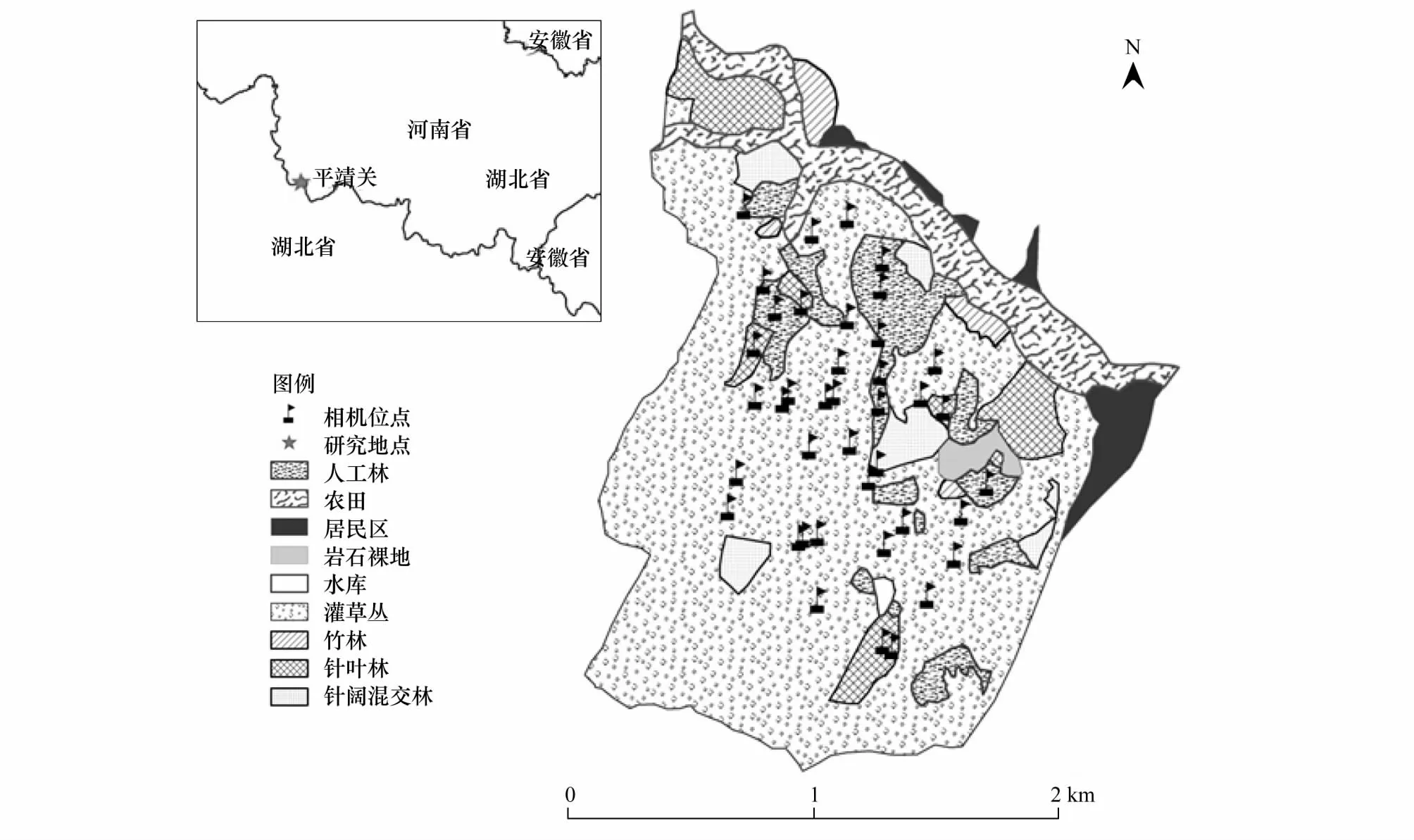
圖1 野外研究地點位置、植被及相機布放位點概況 Fig.1 The status of the location, habitat and camera sites of the study area in Hubei Province
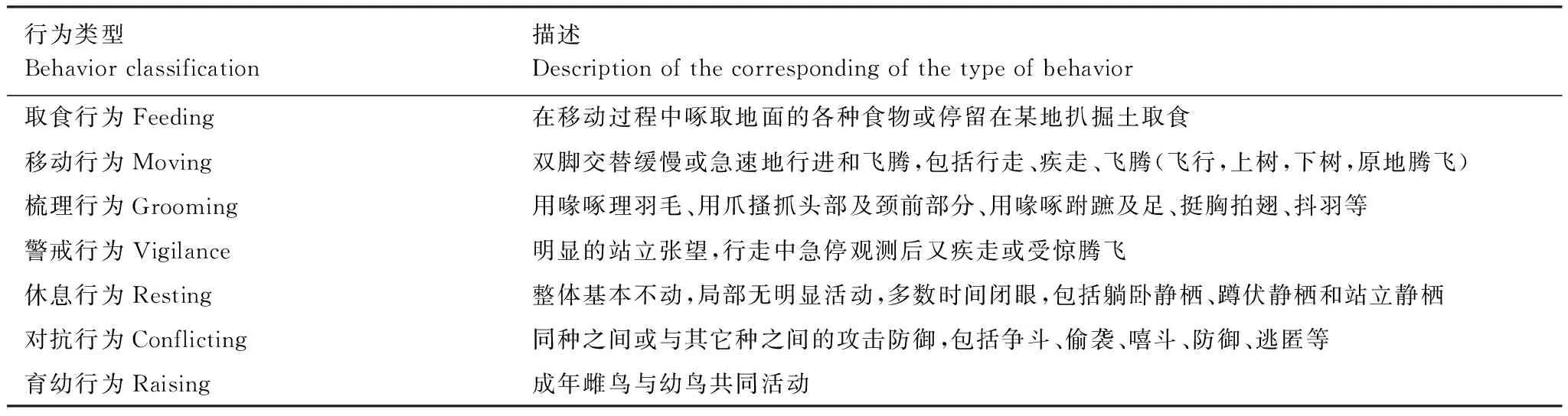
行為類型Behaviorclassification描述Descriptionofthecorrespondingofthetypeofbehavior取食行為Feeding在移動過程中啄取地面的各種食物或停留在某地扒掘土取食移動行為Moving雙腳交替緩慢或急速地行進和飛騰,包括行走、疾走、飛騰(飛行,上樹,下樹,原地騰飛)梳理行為Grooming用喙啄理羽毛、用爪搔抓頭部及頸前部分、用喙啄跗蹠及足、挺胸拍翅、抖羽等警戒行為Vigilance明顯的站立張望,行走中急停觀測后又疾走或受驚騰飛休息行為Resting整體基本不動,局部無明顯活動,多數時間閉眼,包括躺臥靜棲、蹲伏靜棲和站立靜棲對抗行為Conflicting同種之間或與其它種之間的攻擊防御,包括爭斗、偷襲、嘻斗、防御、逃匿等育幼行為Raising成年雌鳥與幼鳥共同活動
1.4 數據處理
統一用KMPlayer視頻播放軟件進行瀏覽,記錄相機位點、視頻編號、觸發日期、觸發時間、時間段、類別(包括白冠長尾雉、其它動物、人為活動等)、物種、數量、雌雄、成幼、行為等數據。在有白冠長尾雉的視頻中,對于連續觸發的視頻,根據目標物種的性別、體型、毛色、尾羽、數量、行為等特征進行判別是否屬于同一只(群)。在利用無線電對白冠長尾雉進行遙測的過程中已經發現,除去暴雨大雪等極端氣候,同一個體在同一個地方停留的時間一般不超過5 min。因此,對于依據外形特征不能區分的個體或群體,連續超過5 min在同一相機位點出現的個(群)體則被定義為一個獨立個(群)體進行分析。所有行為都是記錄頻次,如一段視頻中既有取食行為又有對抗行為,則記錄兩條數據。
紅外相機的拍攝率(CR)為:

(1)
式中,N為拍攝到的白冠長尾雉的個體數量;D為相機日;CR為拍攝率,按月計算。
日活動強度指數(DII)為:

(2)
式中,i為時間段,如6:00—6:59則記為6;Ni為i時段拍攝到的白冠長尾雉個體數量;N為拍攝到的白冠長尾雉總個體數量;DII越大,則表示白冠長尾雉在i時段的活動越強。
日行為頻次比例為:

(3)
式中,i同上;k為1,2,…,7,分別代表取食、移動、梳理、警戒、休息、對抗、育幼7種行為;Bi為某日每種行為的總頻次;ni為相應行為在該日i時段的頻次;Pi表示某種行為在該日i時段的強度。
月行為頻次比例:

(4)
式中,j為月份;nj為j月各種行為的總頻次;Bk為某種行為在j月的總頻次;Pj表示k行為在j月所占的行為頻次比例。
分析雌雄之間的差異時,先用Kolmogorov-Smirnov Z-test檢驗數據是否符合正態分布。當數據不符合正態分布時, 使用Mann-Whitney U-檢驗;當數據符合正態分布時, 使用獨立樣本的T-檢驗。用one-way ANOVA分析季節差異,多重比較使用Tukey法。
所有數據處理和統計分析在Microsoft Excel 2003和IBM SPSS statistics 20.0中進行,顯著水平為P≤0.05。
2 研究結果
2.1 紅外相機拍攝概況
在研究期間內,共安放1774個相機日,拍攝到2242個獨立視頻。其中,有白冠長尾雉的為408個,占18%;其它動物38%,無效觸發35%,人為活動9%。排除相同個(群)體在同一時間內的連續觸發及僅有幼鳥的視頻,共有333個白冠長尾雉的獨立視頻(表2),538只次,雌雄比為1.43∶1,記錄到396條行為樣本。雌雄拍攝率之間不存在顯著差異(t22=0.818,P=0.422)。
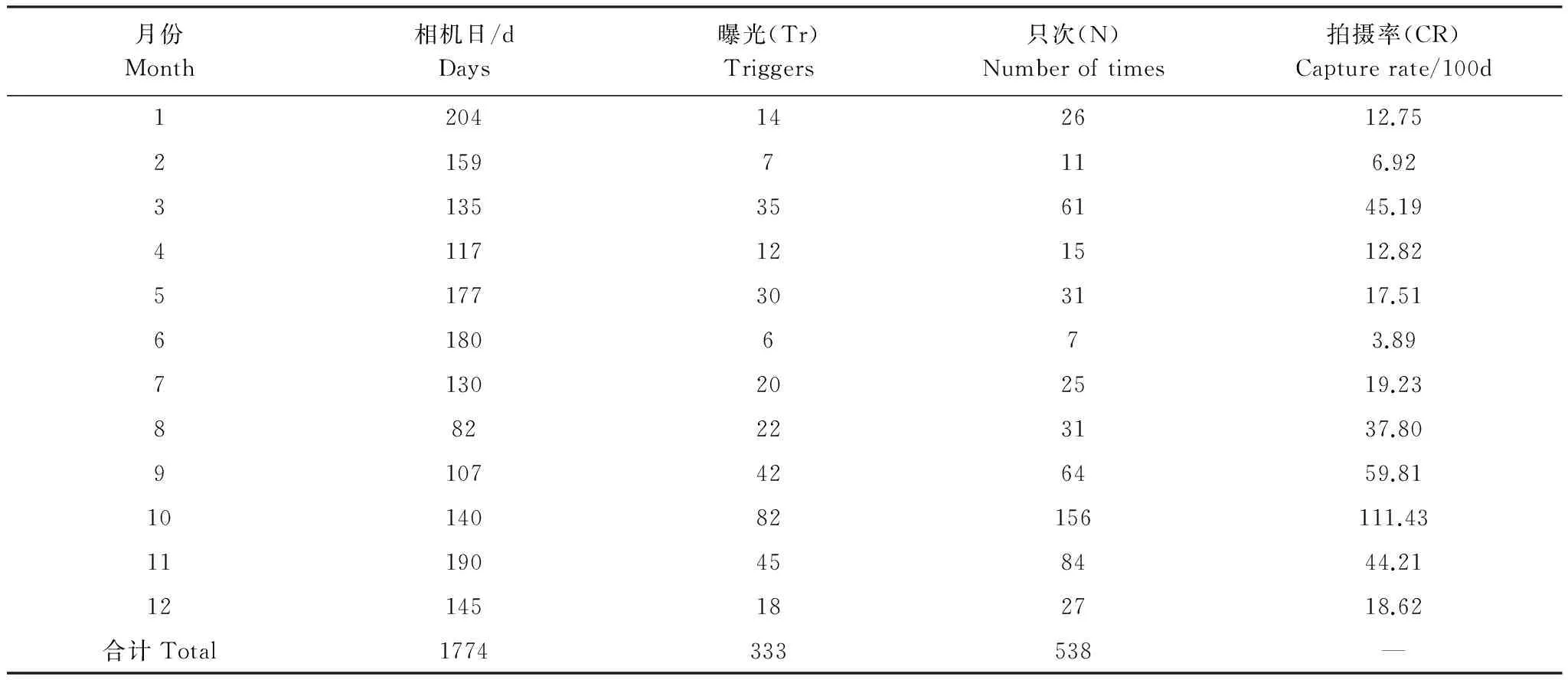
表2 研究區域內紅外相機拍攝概況
2.2 日活動節律和時間分配
白冠長尾雉的主要行為是移動和覓食,分別占到總頻次的40.71%和33.10%,其余5種行為依次為: 警戒9.29%,梳理7.14%,休息5.00%,對抗2.62%,育幼2.14%。
雌性和雄性白冠長尾雉日活動均有兩個高峰期(圖2)。雄性個體為7:00—9:00,17:00;雌性個體為9:00—11:00,17:00。雌雄個體在每天不同時間段的活動強度不存在顯著差異(Independentttest,t28=-0.03,P=0.976)。取食、移動、警戒和梳理行為節律趨勢大致相同,分別在7:00—11:00和17:00達到高峰期;休息行為時間分配相對均勻;育幼行為有一個高峰期,11:00;對抗行為也只有一個高峰期,9:00—10:00(圖3)。
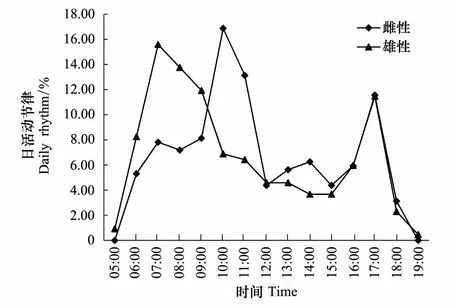
圖2 研究區域內野生白冠長尾雉日活動強度及其性別差異Fig.2 The activity intensity and its sexual differences of wild Reeves′s Pheasants in the study area
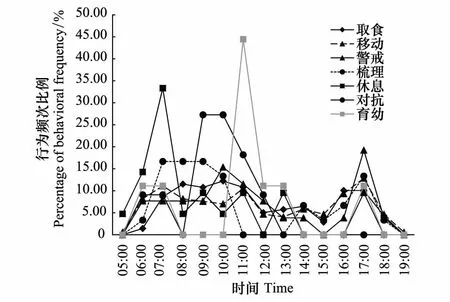
圖3 研究區域內野生白冠長尾雉日活動節律Fig. 3 Diurnal behavioral rhythms of wild Reeves′s Pheasant in the study area
育幼是雌性白冠長尾雉單獨完成的,對抗行為的頻次比例不符合正態分布(Plt;0.05)。雌性白冠長尾雉的警戒行為頻次比例顯著高于雄性個體(圖4,t22=2.782,P=0.011),取食、移動、梳理、休息行為則無顯著差異(Pgt;0.05);對抗行為頻次比例在雌雄間也不存在顯著差異(圖4,Mann-Whitney U test,Z=-0.569,P=0.569)。
2.3 季節差異
不同季節之間白冠長尾雉取食行為(One-way ANOVA,F3=6.552,P=0.015)、移動行為(One-way ANOVA,F3=5.268,P=0.027)、對抗行為(One-way ANOVA,F3=25.687,Plt;0.01)有顯著差異,而警戒行為(One-way ANOVA,F3=0.148,P=0.928)、梳理行為(One-way ANOVA,F3=1.015,P=0.435)、休息行為(One-way ANOVA,F3=0.776,P=0.540)、育幼行為(One-way ANOVA,F3=0.682,P=0.588)則無顯著差異(圖5)。白冠長尾雉在冬季的取食行為比例明顯高于夏季(Tukey post hoc test,P=0.013);移動行為比例夏季最高,顯著高于秋季(Tukey post hoc test,P=0.046)和冬季(Tukey post hoc test,P=0.035);對抗行為僅僅在秋季被記錄到。
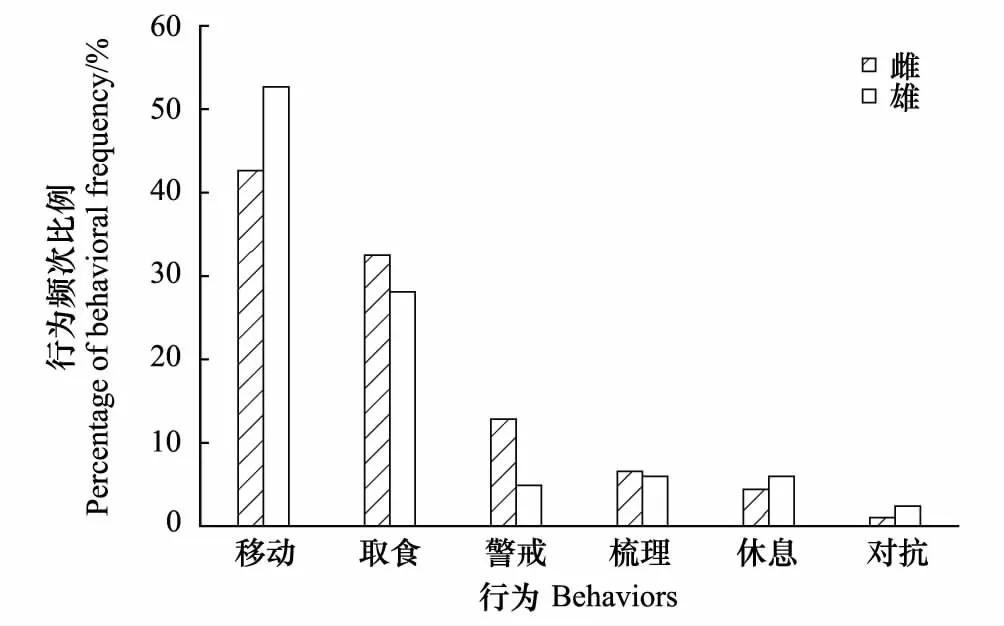
圖4 研究區域內雌雄野生白冠長尾雉行為頻次比例差異Fig. 4 Sexual differences of behavioral frequency rate of wild Reeves′s Pheasant in the study area
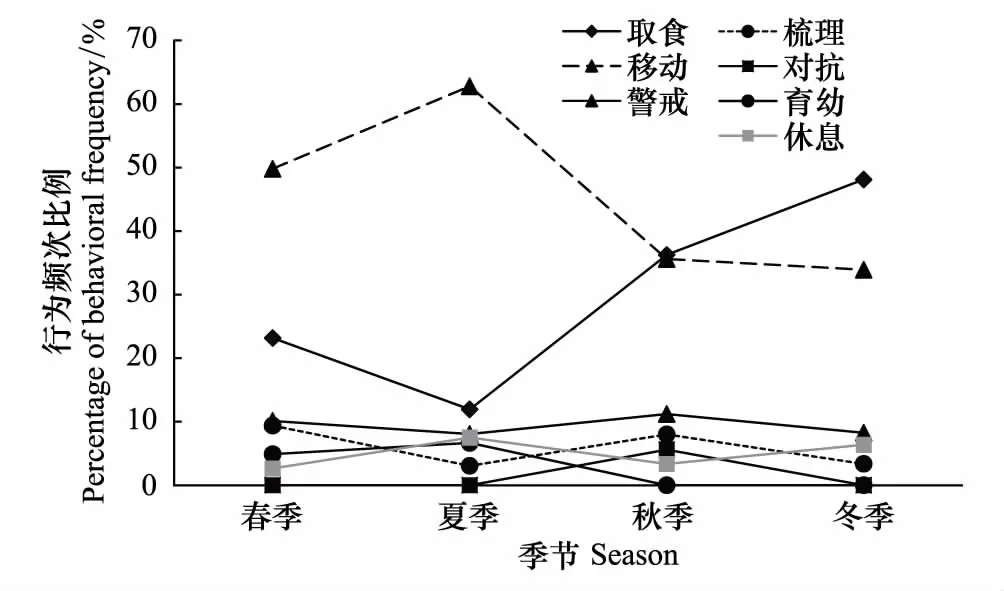
圖5 研究區域內不同季節野生白冠長尾雉行為頻次比例差異Fig. 5 Seasonal differences of behavioral frequency rate of wild Reeves′s Pheasant in the study area
3 討論
根據野外拍攝的538只次成體,當地雌雄比例為1.43∶1。這是分析野生白冠長尾雉性比的一次嘗試。由于野外研究的難度,白冠長尾雉性比方面的資料相對較為缺乏,并且不同的研究結果也不一樣,如雌雄性比有2.18∶1[20],3∶1、0.67∶1[26],而利用標圖法結合無線電遙測的調查得到的結果為1.1∶1[20],這與紅外相機監測的結果比較接近。
動物的活動強度與被相機拍攝到的概率呈正相關[27]。野生白冠長尾雉每天有兩個活動高峰期,這與之前的報道相符[17]。雖然雌雄在不同時間段的活動強度不存在顯著差異,但本研究也發現雄性上午的活動高峰期要早于雌性,這與在賀蘭山地區對石雞(Alectorischukar)的研究結果[28]相似:雄性石雞的覓食最低峰和靜息的最高峰出現在13:30, 雌性石雞覓食最低峰和靜息的最高峰則出現在12:30,雌雄個體間也存在一定差異。
基于自身營養的需要,野生動物通常將大部分的時間用于覓食,尤其是在食物缺乏的季節[29- 30]。野生白冠長尾雉的取食、移動、警戒行為日節律的變化與日活動強度相關,在上午和下午均分別各有一個峰值,且其移動和取食行為頻次比例共占到了記錄行為的73.81%,其中移動行為占40.71%。野生白冠長尾雉休息行為頻次比例很低,盡管無法將其與籠養環境下的白冠長尾雉行為進行比較,但對籠養黃腹角雉(Tragopancaboti)的行為觀察發現,休息行為占到了一半以上[25]。這可能是野外條件下食物資源豐富度、天敵分布及活動空間競爭等與籠養條件下明顯不同而導致的[1]。雌性白冠長尾雉警戒行為頻次比例顯著高于雄性個體,這在一些哺乳動物的研究中也有發現[31]。野生白冠長尾雉取食、移動、梳理、休息行為在性別間并無顯著差異,這可能跟這些行為的剛性強有關[32]。因為動物的行為有剛性與彈性之分,當動物的能量來源和生存空間受限制時, 一些諸如攝食、排遺等生存所必需的生理行仍將表現出來,則這類行為即為剛性行為[32]。
由于不同季節之間,食物資源不同,動物個體可根據能量需求采取最優行為時間分配策略[30]。白冠長尾雉在冬季的取食行為比例明顯高于夏季(P=0.013),可能是因為夏季草本植物、櫻桃和鼠李等落果資源較為豐富,而這個時候白冠長尾雉的集群率又比較低[20],個體容易滿足自身的能量需求;拍攝的視頻也發現,白冠長尾雉在夏季喜歡固定下來啄食青草,而冬季則大多數是走動覓食。夏季的移動行為顯著高于秋季和冬季,這與利用無線電遙測技術監測白冠長尾雉的結果相似,即相對于繁殖期,白冠長尾雉冬季的活動區較小,活動能力也相對較弱[22]。
本研究所在區域位于村莊周圍,人為干擾較重,在野外也發現很多諸如放牧、砍伐、采草藥等現象,這可能對白冠長尾雉的行為產生影響。受研究時間限制,本研究并沒有將其與人為干擾較少條件下的白冠長尾雉行為進行比較。目前,白冠長尾雉種群很多已經納入自然保護區范圍[12],研究這些自然保護區內野生白冠長尾雉的行為,將為進行相關比較研究提供良好的平臺,而這對于評估人為活動對白冠長尾雉行為的影響并提出相應的保護對策將具有重要意義。
本研究的實踐也證明,紅外相機技術非常適合研究警覺性高、數量稀少的大型地棲林鳥[11,33],包括白冠長尾雉。雖然利用紅外相機技術進行鳥類行為研究具有一定的局限性,例如其不能對同一只個體進行連續觀測[11],但其特有的優點卻能彌補傳統方法的許多不足[5- 6],因為以往對野生動物行為的研究,很多都需要佩戴項圈或發射器等[34- 35],這可能會對野生動物的行為產生影響;而在野外進行隱蔽觀測,則易受觀測人員主觀因素的影響,耗費時間且不具有長期性。
致謝:白潔同學參加了部分野外工作,視頻整理得到了曹婉露和王秦韻同學的幫助,張鵬對監測工作提供后勤保障,特此致謝。
[1] Shang Y C. Ethology. Beijing: Peking University Press, 2005.
[2] Long S, Zhou C Q, Wang W K, Pan L, Hu J C. Diurnal behavioral rhythm, time budgets and group behavior of dwarf blue sheep in summer. Zoological Research, 2009, 30(6): 687- 693.
[3] Yi G D, Yang Z J, Liu Y, Zuo B, Zhao J, Hao X L. Behavioral time budget and daily rhythms for winteringMergussquamatus. Acta Ecologica Sinica, 2010, 30(8): 2228- 2234.
[4] Xing M Z, Zhang Z M, Tian H J, Wen J B. Time budget and activity rhythm of captive great spotted woodpecker. Chinese Journal of Zoology, 2013, 48(1): 95- 101.
[5] Tricia L C, Don E S. Using remote photography in wildlife ecology: a review. Wildlife Society Bulletin, 1999, 27(3): 571- 581.
[6] Lu X L, Jiang Z G, Tang J R, Wang X J, Xiang D Q, Zhang J P. Auto-trigger camera traps for studying giant panda and its sympatric wildlife species. Acta Zoologica Sinica, 2005, 51(3): 495- 500.
[7] Karanth K U. Estimating tigerPantheratigrispopulations from camera-trap data using capture-recapture models. Biological Conservation, 1995, 71(3): 333- 338.
[8] Foster M L, Humphrey S R. Use of highway underpasses by Florida panthers and other wildlife. Wildlife Society Bulletin, 1995, 23(1): 95- 100.
[9] Karanth K U, Nichols J D. Estimation of tiger densities in India using photographic captures and recaptures. Ecology, 1998, 79(8): 2852- 2862.
[10] Silver S C, Ostro L E T, Marsh L K, Maffei L, Noss A J, Kelly M J, Wallace R B, Gomez H, Ayala G. The use of camera traps for estimating jaguarPantheraoncaabundance and density using capture/recapture analysis. Oryx, 2004, 38(2): 148- 154.
[11] O′Brien T G, Kinnaird M F. A picture is worth a thousand words: the application of camera trapping to the study of birds. Bird Conservation International, 2008, 18(S1): S144-S162.
[12] Zheng G M, Wang Q S. China Red Data Book of Endangered Animals (Aves). Beijing: Science Press, 1998: 182- 184.
[13] Collar N J. Threatened Birds of Asia: The Birdlife International Red Data Book (Part A). Cambridge: Bird Life International, 2001: 1001- 1009.
[14] IUCN. IUCN Red List of Threatened Species. (2012- 02) [2013- 05- 07]. http://www.iucnredlist.org/details/100600271/0.
[15] Wu Z K, Xu W S. On the geographical distribution and abundance of white crowned long tailed pheasants in Guizhou Province. Zoological Research, 1987, 8(1): 13- 19.
[16] Wu Z K, Li Z M, Xu W S. Distribution and population density of the Reeves′s Pheasant. Guizhou Science, 1991, 9(3): 215- 219.
[17] Wu Z K. The ecology of Reeves′s pheasant.. Chinese Journal of Zoology, 1979, (3): 16- 18.
[18] Fang C L, Ding Y H. Over-wintering ecology of the white-crowned long-tailed pheasant. Chinese Journal of Ecology, 1997, 16(2): 67- 68.
[19] Sun Q H, Zhang Z W, Ruan X F, Zhang K Y, Zhu J G. Studies on flocking behavior of Reeves′s Pheasant in Dongzhai nature reserve, Henan province. Journal of Beijing Normal University: Natural Science, 2001, 37(1): 111- 117.
[20] Zhang X H, Xu J L, Zhang Z W, Zheng G M, Ruan X F, Xie F L. Flocking behavior of Reeves′s Pheasants (Syrmaticusreevesii) at two sites in Henan and Shaanxi. Zoological Research, 2004, 25(2): 89- 95.
[21] Zhang X H, Xu J L, Zhang Z W, Xie F L, Zhang K Y, Zhu J G. A study on the incubation behavior of Reeves′s Pheasant (Syrmaticusreevesii) by radio tracking. Journal of Beijing Normal University: Natural Science, 2004, 40(2): 255- 259.
[22] Xu J L, Zhang X H, Zhang Z W, Zhang G M, Ruan X F, Zhang K Y. Home range and habitat use of male Reeves′s pheasant (Syrmaticusreevesii) in winter in Dongzhai National Nature Reserve, Henan Province. Biodiversity Science, 2005, 13(5): 416- 423.
[23] Xu J L, Zhang Z W, Wang Y, Connelly J W. Spatio-temporal responses of male Reeves′s PheasantsSyrmaticusreevesiito forest edges in the Dabie Mountains, central China. Wildlife Biology, 2011, 17(1): 16- 24.
[24] Zhang S S, Bao Y X, Wang Y N, Fang P F, Ye B. Comparisons of different camera trap placement patterns in monitoring mammal resources in Gutianshan National Nature Reserve. Chinese Journal of Ecology, 2012, 31(8): 2016- 2022.
[25] Wen Z Q, Zheng G M. A study on the behaviours of cabot′s tragopan in breeding season. Journal of Beijing Normal University: Natural Science, 1997, 33(2): 263- 269.
[26] Lu T C. The Rare and Endangered Gamebirds in China. Fuzhou: Fujian Science and Technology Press, 1991: 314- 355.
[27] Li M F, Li S, Wang D J, William J M, Guan T P, Chen L M. The daily activity patterns of takinBudorcastaxicolorin winter and spring at Tangjiahe Nature Reserve, Sichuan Province. Sichuan Journal of Zoology, 2011, 30(6): 850- 855.
[28] Zhou X Y, Wang X M, Jiang Z H. Time budget and activity rhythm ofAlectorischukarin winter. Journal of Northeast Forestry University, 2008, 36(5): 44- 46.
[29] Pépin D, Renaud P C, Dumont B, Decuq F. Time budget and 24-h temporal rest-activity patterns of captive red deer hinds. Applied Animal Behaviour Science, 2006, 101(3/4): 339- 354.
[30] Lian X M, Li X X, Yan P S, Zhang T Z, Su J P. Behavioural time budgets and diurnal rhythms of the female Tibetan gazelles in the Kekexili National Nature Reserve. Acta Ecologica Sinica, 2012, 32(3): 663- 670.
[31] Liu Z S, Wu J P, Teng L W. Time budget and behavior pattern of semi-freeCervusnipponin spring. Chinese Journal of Ecology, 2002, 21(6): 29- 32.
[32] Jiang Z G, Li C W, Peng J J, Hu H J. Structure, elasticity and diversity of animal behavior. Biodiversity Science, 2001, 9(3): 265- 274.
[33] Li S, Mcshea W J, Wang D J, Shao L K, Shi X G. The use of infrared-triggered cameras for surveying phasianids in Sichuan Province, China. Ibis, 2010, 152(2): 299- 309.
[34] Moen R, Pastor J, Cohen Y, Schwartz C C. Effects of moose movement and habitat use on GPS collar performance. The Journal of Wildlife Management, 1996, 60(3): 659- 668.
[35] Wong S T, Servheen C W, Ambu L. Home range, movement and activity patterns, and bedding sites of Malayan sun bearsHelarctosmalayanusin the Rainforest of Borneo. Biological Conservation, 2004, 119(2): 169- 181.
參考文獻:
[1] 尚玉昌. 動物行為學. 北京: 北京大學出版社, 2005.
[2] 龍帥, 周材權, 王維奎, 潘立, 胡錦矗. 矮巖羊夏季活動節律、時間分配和集群行為. 動物學研究, 2009, 30(6): 687- 693.
[3] 易國棟, 楊志杰, 劉宇, 左斌, 趙匠, 郝錫聯. 中華秋沙鴨越冬行為時間分配及日活動節律. 生態學報, 2010, 30(8): 2228- 2234.
[4] 邢茂卓, 張志明, 田恒玖, 溫俊寶. 籠養大斑啄木鳥行為時間分配和活動節律. 動物雜志, 2013, 48(1): 95- 101.
[6] 盧學理, 蔣志剛, 唐繼榮, 王學杰, 向定乾, 張建平. 自動感應照相系統在大熊貓以及同域分布的野生動物研究中的應用. 動物學報, 2005, 51(3): 495- 500.
[12] 鄭光美, 王岐山. 中國瀕危動物紅皮書(鳥類). 北京: 科學出版社, 1998: 182- 184.
[15] 吳至康, 許維樞. 白冠長尾雉 (Syrmaticusreevesii) 在貴州的分布與數量. 動物學研究, 1987, 8(1): 13- 19.
[17] 吳至康. 白冠長尾雉的生態. 動物學雜志, 1979, (3): 16- 18.
[18] 方成良, 丁玉華. 白冠長尾雉的越冬生態. 生態學雜志, 1997, 16(2): 67- 68.
[19] 孫全輝, 張正旺, 阮祥峰, 張可銀, 朱家貴. 白冠長尾雉集群行為的初步研究. 北京師范大學學報: 自然科學版, 2001, 37(1): 111- 117.
[20] 張曉輝, 徐基良, 張正旺, 鄭光美, 阮祥鋒, 謝福錄. 河南陜西兩地白冠長尾雉的集群行為. 動物學研究, 2004, 25(2): 89- 95.
[21] 張曉輝, 徐基良, 張正旺, 謝福錄, 張可銀, 朱家貴. 白冠長尾雉孵卵行為的無線電遙測研究. 北京師范大學學報: 自然科學版, 2004, 40(2): 255- 259.
[22] 徐基良, 張曉輝, 張正旺, 鄭光美, 阮祥鋒, 張可銀. 白冠長尾雉雄鳥的冬季活動區與棲息地利用研究. 生物多樣性, 2005, 13(5): 416- 423.
[24] 章書聲, 鮑毅新, 王艷妮, 方平福, 葉彬. 不同相機布放模式在古田山獸類資源監測中的比較. 生態學雜志, 2012, 31(8): 2016- 2022.
[25] 溫戰強, 鄭光美. 黃腹角雉的繁殖期行為研究. 北京師范大學學報: 自然科學版, 1997, 33(2): 263- 269.
[26] 盧汰春. 中國珍稀瀕危野生雞類. 福州: 福建科學技術出版社, 1991: 314- 355.
[27] 李明富, 李晟, 王大軍, William J M, 官天培, 諶利民. 四川唐家河自然保護區扭角羚冬春季日活動模式研究. 四川動物, 2011, 30(6): 850- 855.
[28] 周曉禹, 王曉明, 姜振華. 賀蘭山石雞越冬期晝間行為時間分配及活動規律. 東北林業大學學報, 2008, 36(5): 44- 46.
[30] 連新明, 李曉曉, 顏培實, 張同作, 蘇建平. 夏季可可西里雌性藏原羚行為時間分配及活動節律. 生態學報, 2012, 32(3): 663- 670.
[31] 劉振生, 吳建平, 滕麗微. 散放條件下春季梅花鹿行為時間分配的研究. 生態學雜志, 2002, 21(6): 29- 32.
[32] 蔣志剛, 李春旺, 彭建軍, 胡慧建. 行為的結構、剛性和多樣性. 生物多樣性, 2001, 9(3): 265- 274.
ActivityrhythmandbehavioraltimebudgetsofwildReeves′sPheasant(Syrmaticusreevesii)usinginfraredcamera
ZHAO Yuze1, WANG Zhichen2, XU Jiliang1,*, LUO Xu1, AN Lidan3
1CollegeofNatureConservation,BeijingForestryUniversity,Beijing100083,China2AcademyofForestInventoryandPlanning,StateForestryAdministration,Beijing100714,China3DepartmentofWildFaunaandFloraConservationandNatureReserveManagement,StateForestryAdministration,Beijing100714,China
The researches on activity rhythm and behavioral time budgets of vulnerable or endangered species were of great importance to form the effective conservation strategies, Reeves′s Pheasant (Syrmaticusreevesii) was a vulnerable species endemic to China, whereas little information on activity rhythm and behavioral time budgets of this species was available. Therefore, we used infrared camera technology, from March 2012 to March 2013, to survey the activity rhythm and behavioral time budgets of wild Reeves′s Pheasant (Syrmaticusreevesii) in Caihe Town, Guangshui City, Hubei province. We radio tracked and outlined 8 Reeves′s Pheasants in the study area at first, and then we determined 4—5 sites as candidate camera sites in each home range. We selected two camera sites with a distance apart from at least 200 m in a home range synchronously, and irregularly moved these cameras across the candidate camera sites in this home range. In consequence, we set 16 infrared cameras at 40 candidate camera sites. The daily work time of a camera was set from 4:00 to 22:00 with the reference to some previous reports on this pheasant behavior, and we defined it as a camera day. We also divided the behavior of wild Reeves′s Pheasant into seven types, including feeding, moving, grooming, vigilance, resting, conflicting, and raising According to the available information on pheasant behavior. As a result, the total work time of these cameras in the field added up to 1774 d. We obtained totally 2242 videos in relation to Reeves′s Pheasants that were responsible for about 18% with a total of 538 individuals in relation to 396 behavior samples. The sex ratio between the female and male photoed is 1.43∶1. Two diurnal activity peaks were observed for the wild individuals, and the activity peak in the morning was around 9:00 and that in the afternoon was around 17:00. In particular, the activity peak of the males in the morning was much earlier about two hours than that of females, i.e. 7:00—9:00 for the males and 9:00—11:00 for the females. The behavior of moving and feeding dominated the diurnal behaviors of Reeves′s Pheasant, accounting for 40.71% and 33.10%, respectively, and then followed in order by vigilance (9.29%), grooming (7.14%), resting (5.00%), conflicting (2.62%), raising (2.14%). The frequency of vigilance of females was significantly higher than that of the males. The wild Reeves′s Pheasant also showed significant seasonal behavior variations, and the rate of feeding, moving, and conflicting varied among seasons. For example, the feeding frequency in winter was much higher than that in summer (Plt;0.05), and the moving frequency in summer was higher than that in autumn (Plt;0.05) and winter (Plt;0.05), whereas the frequency of conflicting, grooming, resting, and raising did not differ significantly. Given this study was conducted in an area with higher human disturbance, it was reasonable to recommend these results to that happened in an area with less human disturbance (e.g. nature reserves) in the future. The practice of this study also proved that infrared camera technology is very suitable for studying highly alert and rare terrestrial forest birds.
infrared triggered camera technique;Reeves′s Pheasant;activity rhythm; behavioral time budget
林業公益性行業科研專項(200904003);國家自然科學基金項目(31172115)
2013- 06- 04;
2013- 07- 25
*通訊作者Corresponding author.E-mail: xujiliang@bjfu.edu.cn
10.5846/stxb201306041335
Zhao Y Z, Wang Z C, Xu J L, Luo X, An L D.Activity rhythm and behavioral time budgets of wild Reeves′s Pheasant (Syrmaticusreevesii) using infrared camera.Acta Ecologica Sinica,2013,33(19):6021- 6027.
猜你喜歡
少先隊活動(2022年5期)2022-06-06 03:45:04
體育科技文獻通報(2022年3期)2022-05-23 13:46:54
家庭科學·新健康(2022年3期)2022-05-10 00:32:13
中老年保健(2021年2期)2021-08-22 07:31:10
天津外國語大學學報(2021年3期)2021-08-13 08:32:18
遼金歷史與考古(2021年0期)2021-07-29 01:06:54
少先隊活動(2021年1期)2021-03-29 05:26:36
快樂語文(2020年30期)2021-01-14 01:05:38
科技傳播(2019年22期)2020-01-14 03:06:54
民用飛機設計與研究(2019年4期)2019-05-21 07:21:24