CO2濃度升高條件下內生真菌感染對宿主植物的生理生態影響
2013-12-09 06:30:43師志冰任安芝高玉葆
生態學報 2013年19期
關鍵詞:植物
師志冰,周 勇,李 夏,任安芝,高玉葆
(南開大學生命科學學院,天津 300071)
CO2濃度升高條件下內生真菌感染對宿主植物的生理生態影響
師志冰,周 勇,李 夏,任安芝*,高玉葆
(南開大學生命科學學院,天津 300071)
以內蒙古草原常見伴生種、感染內生真菌的天然禾草羽茅為研究對象,通過比較不同CO2濃度和不同養分供應條件下,帶內生真菌和不帶菌植物在種子發芽和幼苗生長等方面的差異,探討帶內生真菌的天然禾草對CO2濃度增加的響應。結果表明:CO2濃度增加對帶菌種子發芽率和發芽速度均無顯著影響,但CO2濃度增加顯著降低了不帶菌種子的發芽率和發芽速度,即CO2濃度升高加大了帶菌和不帶菌種子發芽率之間的差異;內生真菌感染顯著提高了宿主植物的最大凈光合速率和水分利用效率;羽茅的營養生長受CO2濃度和養分供應的交互影響,高CO2濃度對生長的促進作用只出現在充足養分供應條件下;CO2濃度升高和內生真菌感染對植物根系形態有顯著的交互作用,在正常CO2濃度下,帶菌植株根徑gt;1.05 mm的根系比例顯著高于不帶菌植株,隨著CO2濃度的升高,帶菌植株上述根徑根系所占比例無顯著變化而不帶菌植株所占比例顯著升高,CO2濃度升高導致帶菌和不帶菌不同根徑根系分配之間的差異縮小。
CO2濃度升高;羽茅;種子發芽;根系形態
產業革命以來,由于人類大量消耗石油化工燃料和對土地的不合理開發利用,使得大氣CO2濃度逐步升高,從1958到2011年的50多年間,大氣CO2濃度已由280增加到391 μmol/mol,若以目前的每年增加 2 μmol/mol計, 預計到2067年,全球大氣CO2濃度將超過500 μmol/mol[1- 2]。由于CO2是植物光合作用的重要原料,所以大氣中CO2濃度的升高,必將影響到植物光合產物的形成以及光合產物在植物及其共生的微生物之間的分配[3], 從而影響到植物和根瘤菌[4]、菌根真菌[5]以及內生真菌[6- 7]等之間的相互作用。
大量的研究表明CO2濃度升高能夠提高菌根真菌的侵染率,增強菌根真菌對宿主植物的有益影響[8- 11]。與菌根真菌類似,內生真菌也是在植物中廣泛存在的一類真菌,只是多生活在植物的地上部分[12],據估計,大約三分之二的冷季型禾草中有與之共生的內生真菌[13],但就已報道的研究工作來看,大量的研究集中在兩個有重要經濟意義的植物種即高羊茅(FestucaarundinaceaSchreb.)和黑麥草(LoliumperenneL.)上面,二者分別與內生真菌Neotyphodiumcoenophialum和N.lolii構成共生關系。內生真菌與高羊茅和黑麥草等人工禾草的互惠共生關系已被大量的實驗證據所證實,具體表現在一方面植物為內生真菌提供光合產物;另一方面內生真菌的代謝物能刺激植物的生長發育[14],提高宿主植物對生物脅迫和非生物脅迫的抵抗能力,其中的生物脅迫主要包括食草動物[15]和食草昆蟲[16]的取食、線蟲[17]和其它真菌[18]的危害以及其它植物的競爭[19]等;非生物脅迫包括干旱[20]、低養分[21]和高溫[22]等。由于內生真菌依靠宿主植物獲得碳源,而對于多數C3植物而言,CO2濃度是其光合作用的限制因子,因此大氣CO2濃度的增加將會通過提高植物的光合能力并增加對共生真菌的光合產物供給,從而對禾草-內生真菌的相互作用產生影響[6, 23],研究感染內生真菌的天然禾草對CO2濃度升高的響應不僅有助于預測全球氣候變化條件下帶菌植物的競爭力,而且有助于預測帶菌植物所在草原群落的發展和演替方向,為實現草原的可持續利用提供實驗數據。
1 材料與方法
1.1 種子的采集
羽茅(Achnatherumsibiricum(L.) Keng)是禾本科芨芨草屬的一種多年生草本植物,在內蒙古的各類草場中較為常見,具有很高的內生真菌侵染率(86%—100%)[24],共生的內生真菌為Neotyphodium屬內生真菌[25],種子于2012年采集自中國農業科學院呼倫貝爾草原生態系統國家野外實驗站,種子采集樣地位于119.40°E,49.06°N,海拔629 m,年降雨量367 mm,年均溫-2.0 ℃,土壤為暗栗鈣土,植被為草甸草原。對采回的種子進行內生真菌的檢測,發現帶菌率為100%,種子于4 ℃冰箱中保存。
1.2 羽茅帶菌(E+)和不帶菌(E-)種群的構建
帶菌的種子由野外采集,存放于4 ℃冰箱中備用,不帶菌的種子則通過將野外采集的種子置于60 ℃溫箱中處理30 d后獲得,前期的研究表明,60 ℃高溫處理羽茅種子30 d能完全殺滅種子中的內生真菌,同時高溫處理對種子發芽率、發芽勢和發芽指數均無顯著影響[26]。選取帶菌和不帶菌的、飽滿成熟的種子分別播種于裝滿蛭石的塑料花盆中,置于溫室中培養,待幼苗生長1個月后,每盆分別選取3株長勢良好的分蘗進行內生真菌的檢測,檢測方法參考Latch等的苯胺蘭染色法[27]。檢測結果顯示一直在4 ℃冰箱存放的種子所獲得的植株的帶菌率為100%,高溫處理過的種子所獲得的植株帶菌率為0。此時,進行間苗,保證每盆有8棵健壯的幼苗,備用。
1.3 種子發芽實驗
本實驗為兩因素實驗,因素一為CO2濃度,包括400 μmol/mol (C-)和800 μmol/mol (C+)兩個水平;因素二為內生真菌感染狀態,包括帶菌(E+)和不帶菌(E-),每個處理5個重復。實驗開始時,分別在每個培養皿中均勻擺放浸泡好的種子50枚,將培養皿分別放入不同CO2濃度的智能人工培養箱中,兩個培養箱除CO2濃度不同外,其余的實驗參數均完全相同,即溫度25 ℃,濕度60%。種子開始發芽后,每天觀察并記錄發芽種子數目,直至連續兩天無種子萌發為止,共歷時14 d,計算種子發芽率及發芽速度指數。種子發芽率及發芽速度指數計算公式[28]如下:
發芽率=(發芽種子數/供試種子數)×100%
發芽速度指數=(N1/1)+(N2-N1)/2 +(N3-N2)/3+…+(Nn-Nn-1)/n
式中,N為第1天、第2天…第n天的發芽種子數目。
1.4 幼苗生長實驗
本實驗為三因素實驗,因素一為CO2濃度,包括400 μmol/mol (C-)和800 μmol/mol (C+)兩個濃度;因素二為養分處理:包括充足養分供應(N+P+)、缺氮(N-P+)和缺磷(N+P-)3個水平;因素三為內生真菌感染狀態,包括帶菌(E+)和不帶菌(E-),每個處理5個重復。將花盆分別放入不同CO2濃度的培養箱中,兩個培養箱的其它參數為:溫度25 ℃,濕度50%,光強40%,光照12 h。養分處理通過澆灌Hoagland營養液控制,充足養分供應組澆完全營養液;缺氮處理組使用CaCl2和KCl分別替代Hoagland營養液中的Ca(NO3)2和KNO3,缺磷處理組使用KCl代替KH2PO4,每周定期澆營養液1次,期間保證水分充足供應。實驗期間每周隨機調換培養箱內花盆的位置,以使花盆位置對實驗的影響效應最小。
1.5 各項指標的測定
在幼苗進入智能人工培養箱之前,測量每盆的總分蘗數、葉片數、株高,分析其差異性,結果發現這些指標在帶菌和不帶菌植株之間均無顯著差異。在人工培養箱培養6周后,用LI-6400便攜式光合作用測定儀(LI-COR,Lincoln,USA)測定植株的最大凈光合速率、氣孔導度和蒸騰速率,測定時選取植株剛剛完全伸展開的葉片,光強由LI-6400-02BLED紅藍光源自動控制到1200 μmol·m-2·s-1,葉片水分利用效率由光合速率/蒸騰速率計算獲得[29],收獲前統計每盆中的葉片數、分蘗數和株高。在收獲時,將地上部分和地下部分分開,取一定量的根系,洗凈后放入裝有蒸餾水的無色透明塑料盤中,用EPSON 1680掃描儀(Epson,Long Beach,USA)以400 dpi分辨率掃描獲取根系圖像,并以WinRHIZO軟件分析得到相關數據。將地上部和地下部烘干稱重,計算生物量和根冠比。所得數據采用SPSS 19.0軟件進行統計處理。
2 結果與分析
2.1 種子萌發
所有種子均在第3天開始發芽,直至第12天后發芽數量不再增加。隨著CO2濃度的增加,帶菌和不帶菌種子的發芽率和發芽速度的變化不同(圖1),表現在正常CO2濃度下,帶菌種子的發芽率和發芽速度均顯著高于不帶菌種子;而在高濃度CO2處理下,與正常CO2濃度相比,帶菌種子的發芽率和發芽速度無顯著變化,而不帶菌種子的發芽率和發芽速度均顯著下降,即CO2濃度增加使得帶菌和不帶菌種子的發芽率和發芽速度之間的差異變得更大。
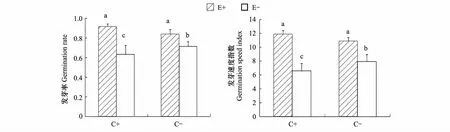
圖1 不同CO2濃度下內生真菌感染對羽茅種子發芽率和發芽速度的影響Fig.1 Effects of endophyte infection on seed germination rate and germination speed of Achnatherum sibiricum under different CO2 concentrations字母不相同表示差異顯著(Plt;0.05)
2.2 幼苗生長
羽茅的營養生長受CO2濃度和養分供應的交互影響(表1,圖2)。在正常CO2濃度下,羽茅的葉片數和地上部分生物量均以充足養分供應組最優,缺氮組最差,缺磷組居中;在高濃度CO2處理下,羽茅的生長狀況與養分供應的關系雖然與正常CO2處理組相似,但與正常CO2處理組相比,充足養分供應顯著促進了羽茅的營養生長,而缺氮和缺磷組羽茅的生長并沒有隨CO2濃度的提高而增加。內生真菌感染顯著提高了宿主植物的最大凈光合速率和水分利用效率(圖3),且內生真菌對宿主植物的這一有益作用不受CO2濃度和養分供應的影響。
表1不同CO2濃度和養分處理下內生真菌感染對羽茅影響的三因素方差分析
Table1Three-wayANOVAforgrowthcharactersofendophyte-infected(E+)orendophyte-free(E-)AchnatherumsibiricumundervariousconditionsofCO2andnutrientsavailability

葉片數Leafnumber分蘗數Tillernumber株高Height地上干重Shootdryweight地下干重Rootdryweight總干重Totaldryweight根冠比Root∶shoot凈光合速率Netphotosyntheticrate氣孔導度Stomatalconductance蒸騰速率Evaporationrate水分利用效率WateruseefficiencyCO2(C)***NS**NS******NS**養分(N)****************NSNS**內生真菌(E)NSNSNSNSNSNSNS**NSNS**C×N*NSNS**NS*NSNSNSNSNSC×ENSNSNSNSNSNSNSNSNSNSNSN×ENSNSNSNSNSNSNSNSNSNSNSC×N×ENSNSNSNSNSNSNSNSNSNSNS
*,**分別表示Plt;0.05,0.01,NS表示差異不顯著
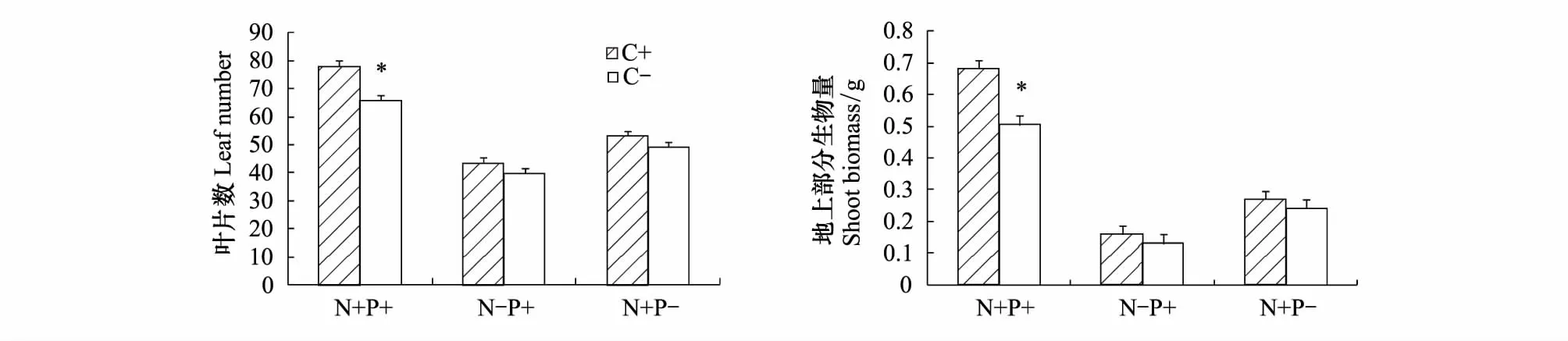
圖2 不同CO2濃度和養分處理對羽茅葉片數和地上生物量的影響Fig.2 Effects of CO2 and nutrients availability on leaf number and shoot biomass of Achnatherum sibiricum*表示差異顯著(Plt;0.05)

圖3 內生真菌感染對羽茅葉片最大凈光合速率和水分利用效率的影響Fig.3 Effects of endophyte infection on maximum net photosynthetic rate and water use efficiency of Achnatherum sibiricum*表示差異顯著(Plt;0.05)
2.3 根系形態
根系表面積的大小與植物吸收能力密切相關,CO2濃度增加和充足的養分供應都顯著增加了羽茅的根系表面積,而內生真菌感染對這一參數無顯著影響(圖4)。為了明確粗細不同的各級根系對表面積變化的貢獻,本文按照根徑大小將根系劃分為如下3類:即根徑 lt;0.45 mm、0.45—1.05 mm、gt;1.05 mm,計算了各根徑下根系長度的百分比,結果發現(表2,圖5),前兩個級別根系的比例只受到養分供應的顯著影響,而后一個級別根系的比例除與養分供應有關外,也與CO2濃度和內生真菌狀態有關,在正常CO2濃度下,帶菌植株根徑gt;1.05 mm根系的比例顯著高于不帶菌植株,隨著CO2濃度的升高,帶菌植株根徑gt;1.05 mm根系所占比例無顯著變化而不帶菌植株該級別根系所占比例顯著升高,即CO2濃度升高導致帶菌和不帶菌不同根徑根系分配之間的差異縮小。

圖4 不同二氧化碳濃度、養分處理和內生真菌感染狀態對羽茅根系表面積的影響Fig.4 Effects of CO2 concentration, nutrients availability and endophyte infection on root surface area of Achnatherum sibiricum字母不相同表示差異顯著(Plt;0.05)
Table2Three-wayANOVAforrootmorphologyofendophyte-infected(E+)orendophyte-free(E-)AchnatherumsibiricumundervariousconditionsofCO2andnutrientsavailability

總長度Totallength總表面積Totalarea平均直徑Averagediameterlt;0.45mm0.45—1.05mmgt;1.05mmCO2(C)NS*NSNSNSNS養分(N)***********內生真菌(E)NSNSNSNSNS**C×NNSNSNSNSNSNSC×ENSNSNSNSNS*N×ENSNSNSNSNSNSC×N×ENSNSNSNSNS**

圖5 不同CO2濃度下內生真菌感染對羽茅根徑gt;1.05 mm根系比例的影響Fig.5 Effects of endophyte infection on the proportion of root length with a diameter of gt;1.05 mm of Achnatherum sibiricum under different CO2 concentrations*表示差異顯著(Plt;0.05)
3 討論
關于CO2濃度增加對種子發芽時間和發芽率影響的報道存在明顯的差異,有的報道為無直接聯系[30],有的報道為有明顯的促進作用[31]。內生真菌是靠宿主的種子進行傳播的,關于內生真菌感染對宿主種子發芽率的影響,Clay[32]發現,帶菌的黑麥草和高羊茅種子,其發芽率均比相應不帶菌種子高10%左右,在對黑麥草的研究中也發現,內生真菌感染顯著提高了宿主種子的發芽勢和發芽率[33],而在天然禾草中,彭清青等[34]發現,內生真菌感染只是提高了宿主植物的發芽勢,而對宿主植物的發芽率無顯著影響,本研究中雖然在兩種CO2濃度處理下,帶菌種子的發芽率和發芽速度均顯著高于不帶菌種子,然而,我們的不帶菌種子是通過高溫殺菌的方法獲得的,因此內生真菌對宿主發芽的促進作用還需進一步證實。值得注意的是,帶菌和不帶菌種子對于CO2濃度增加的反應不同,CO2濃度增加對帶菌種子發芽率和發芽速度均無顯著影響,但CO2濃度增加顯著降低了不帶菌種子的發芽率和發芽速度,即CO2濃度升高加大了帶菌和不帶菌種子發芽率之間的差異。
關于CO2濃度增加對內生真菌-禾草相互作用影響的研究目前還很少,Compant等[35]報道CO2濃度增加會提高高羊茅的內生真菌感染率,與之相對照,Marks和Clay[36]和Chen等[23]發現CO2濃度增加對禾草-內生真菌共生體的影響不大,本研究中內生真菌感染顯著提高了宿主植物的凈光合速率和水分利用效率,但內生真菌的這一有益影響不受CO2濃度的影響。內生真菌對根系形態的影響與CO2濃度有關,在正常CO2濃度下,帶菌植株根徑gt;1.05 mm根系的比例顯著高于不帶菌植株,隨著CO2濃度的升高,帶菌植株上述根徑根系所占比例無顯著變化而不帶菌植株所占比例顯著升高,CO2濃度升高導致帶菌和不帶菌植株不同根徑根系分配之間的差異縮小,在他人的研究中,Compant等[35]報道CO2濃度升高使得宿主體內的生物堿濃度下降,Hunt等[6]發現帶菌和不帶菌植物體內碳水化合物濃度的差異也隨著CO2濃度的增加而減小,即CO2濃度升高縮小了帶菌和不帶菌幼苗生長和代謝物之間的差異。
與菌根真菌-植物共生體相比,內生真菌-禾草共生體對CO2濃度增加較為不敏感[23],Hunt等[6]發現與正常CO2濃度相比,不帶菌植株中的可溶性蛋白濃度在高濃度CO2下下降約40%,而帶菌植株的可溶性蛋白濃度隨CO2濃度增加無顯著變化,本研究中也發現隨著CO2濃度的升高,帶菌種子的發芽率和根系分配均無顯著變化,而不帶菌植株的上述指標均發生了顯著變化,內生真菌感染有可能弱化CO2濃度增加對宿主植物的影響。當然,本文只在種子發芽和幼苗生長方面研究了感染內生真菌的植物對CO2濃度增加的相應,要闡明感染內生真菌的植物對CO2濃度增加的綜合反應及其反應機制,還需要大量的研究工作。
[1] Peters G P, Marland G, Le Quéré C, Boden T, Canadell J, Raupach M R. Rapid growth in CO2emissions after the 2008—2009 global financial crisis. Nature Climate Change, 2012, 2(1): 2- 4.
[2] Franks P J, Adams M A, Amthor J S, Barbour M M, Berry J A, Ellsworth D S, Farquhar G D, Ghannoum O, Lloyd J, McDowell N, Norby R J, Tissue D T, von Caemmerer S. Sensitivity of plants to changing atmospheric CO2concentration: from the geological past to the next century. New Phytologist, 2013, 197(4): 1077- 1094.
[3] Hu S J, Firestone M K, Chapin F S. Soil microbial feedbacks to atmospheric CO2enrichment. Trends in Ecology and Evolution, 1999, 14(11): 433- 437.
[4] Zanetti S, Hartwig U A, Luscher A, Hebeisen T, Frehner M, Fischer BU, Hendrey G R, Blum H, Nosberger J. Stimulation of symbiotic N2fixation inTrifoliumrepensL. under elevated atmosphericpCO2in a grassland ecosystem. Plant Physiology, 1996, 112(2): 575- 583.
[5] Johnson N C, Wolf J, Koch G W. Interactions among mycorrhizae, atmospheric CO2and soil N impact plant community composition. Ecology Letters, 2003, 6(6): 532- 540.
[6] Hunt M G, Rasmussen S, Newton P C D, Parsons A J, Newman J A. Near-term impacts of elevated CO2, nitrogen and fungal endophyte-infection onLoliumperenneL. growth, chemical composition and alkaloid production. Plant, Cell and Environment, 2005, 28(11): 1345- 1354.
[7] Newman J A, Abner M L, Dado R G, Gibson D J, Brookings A, Parsons A J. Effects of elevated CO2, nitrogen and fungal endophyte-infection on tall fescue: growth, photosynthesis, chemical composition and digestibility. Global Change Biology, 2003, 9(3): 425- 437.
[8] Rillig M C, Field C B, Allen M F. Fungal root colonization responses in natural grasslands after long-term exposure to elevated atmospheric CO2. Global Change Biology, 1999, 5(5): 577- 585.
[9] Hartwig U A, Wittmann P, Raun R B. Arbuscular mycorrhiza infection enhances the growth response ofLoliumperenneto elevated atmosphericpCO2. Journal of Experimental Botany, 2002, 53(371): 1207- 1213.
[10] Treseder K K. A meta-analysis of mycorrhizal responses to nitrogen, phosphorus, and atmospheric CO2in field studies. New Phytologist, 2004, 164(2): 347- 355.
[11] Hu S J, Wu J S, Burkey K O, Firestone M K. Plant and microbial N acquisition under elevated atmospheric CO2in two mesocosm experiments with annual grasses. Global Change Biology, 2005, 11(2): 223- 233.
[12] Arnold A E, Meijia L C, Kyllo D, Rojas E I, Maynard Z, Robbins N, Herre E A. Fungal endophytes limit pathogen damage in a tropical tree. Proceedings of the National Academy of Sciences of the United States of America, 2003, 100(26): 15649- 15654.
[13] Müller C B, Krauss J. Symbiosis between grasses and asexual fungal endophytes. Current Opinion in Plant Biology, 2005, 8(4): 450- 456.
[14] Rahman M H, Saiga S. Endophytic fungi (Neotyphodiumcoenophialum) affect the growth and mineral uptake, transport and efficiency ratios in tall fescue (Festucaarundinacea). Plant and Soil, 2005, 272(1/2): 163- 171.
[15] Burns J C, Fisher D S. Intake and digestion of ′Jesup′ tall fescue hays with a novel fungal endophyte, without an endophyte, or with a wild-type endophyte. Crop Science, 2006, 46(1): 216- 223.
[16] Züst T, H?rri S A, Müller C B. Endophytic fungi decrease available resources for the aphidRhopalosiphumpadiand impair their ability to induce defences against predators. Ecological Entomology, 2008, 33(1): 80- 85.
[17] Eerens J P J, Visker M H P W, Lucas R J, Easton H S, White J G H. Influence of the ryegrass endophyte on phyto-nematodes // Neotyphodium/Grass Interactions. New York: Plenum Press, 1997: 153- 156.
[18] Van Hecke M M, Treonis A M, Kaufman J R. How does the fungal endophyteNeotyphodiumcoenophialumaffect tall fescue (Festucaarundinacea) rhizodeposition and soil microorganisms? Plant and Soil, 2005, 275(1/2): 101- 109.
[19] Quigley P E. Effects ofNeotyphodiumloliiinfection and sowing rate of perennial ryegrass (Loliumperenne) on the dynamics of ryegrass/subterranean clover (Trifoliumsubterraneum) swards. Australian Journal of Agricultural Research, 2000, 50(1): 47- 56.
[20] Hesse U, Schoberlein W, Wittenmayer L, Forster K, Warnstorff K, Diepenbrock W, Merbach W. Influence of water supply and endophyte infection (Neotyphodiumspp.) on vegetative and reproductive growth of twoLoliumperenneL. genotypes. European Journal of Agronomy, 2005, 22(1): 45- 54.
[21] Lewis G C. Effects of biotic and abiotic stress on the growth of three genotypes ofLoliumperennewith and without infection by the fungal endophyteNeotyphodiumlolii. Annals of Applied Biology, 2004, 144(1): 53- 63.
[22] Marks S, Clay K. Physiological responses ofFestucaarundinaceato fungal endophyte infection. New Phytologist, 1996, 133(4): 727- 733.
[23] Chen X, Tu C, Burtonm G, Watsond M, Burkeyk O, Hu S J. Plant nitrogen acquisition and interactions under elevated carbon dioxide: impact of endophytes and mycorrhizae. Global Change Biology, 2007, 13(6): 1238- 1249.
[24] Wei Y K, Gao Y B, Xu H, Su D, Zhang X, Wang Y H, Chen L, Nie L Y, Ren A Z.Neotyphodiumin native grasses in China and observations on endophyte/host interactions. Grass and Forage Science, 2006, 61(4): 422- 429.
[25] Zhang X, Ren A Z, Wei Y K, Lin F, Li C, Liu Z J, Gao Y B. Taxonomy, diversity and origins of symbiotic endophytes ofAchnatherumsibiricuminthe Inner Mongolia Steppe of China. FEMS Microbiology Letters, 2009, 301(1): 12- 20.
[26] Li X, Han R, Ren A Z, Gao Y B. Using high-temperature treatment to construct endophyte-freeAchnatherumsibiricum. Microbiology China, 2010, 37(9): 1395- 1400.
[27] Latch G C M, Christensen M J, Samuels G J. Five endophytes ofLoliumandFestucain New Zealand. Mycotaxon, 1984, 20(2): 535- 550.
[28] Chiapuso G, Sanchez A M, Reigosa M J, Gonzalez L, Pellissier F. Do germination indices adequately reflect allelochemical effects on the germination process?. Journal of Chemical Ecology, 1997, 23(11): 2445- 2453.
[29] Farquhar G D, Richards R A. Isotopic composition of plant carbon correlates with water-use efficiency of wheat genotypes. Australian Journal of Plant Physiology, 1984, 11(6): 539- 552.
[30] Garbutt K, Williams W E, Bazzaz F A. Analysis of the differential response of five annuals to elevated CO2during growth. Ecology, 1990, 71(3): 1185- 1194.
[31] Heichel G H, Jaynes R A. Stimulating emergence and growth of Kalmia genotypes with CO2. Horticulture Science, 1974, 9(1): 60- 62.
[32] Clay K. Effects of fungal endophytes on the seed and seedling biology ofLoliumperenneandFestucaarundinacea. Oecologia, 1987, 73(3): 358- 362.
[33] Ren A Z, Gao Y B, Gao W S. Effects of endophyte infection on seed germination, seedling growth and osmotic stress resistance of perennial ryegrass (LoliumperenneL.). Acta Phytoecologica Sinica, 2002, 26(4) 420- 426.
[34] Peng Q Q, Li C J, Song M L, Liang Y, Nan Z B. Effects ofNeotyphodiumendophytes on seed germination of three grass species under different pH conditions. Acta Prataculturae Sinica, 2011, 20(5): 72- 78.
[35] Compant S, van der Heijden M G A, Sessitsch A. Climate change effects on beneficial plant-microorganism interactions. FEMS Microbiology Ecology, 2010, 73(2): 197- 214.
[36] Marks S, Clay K. Effects of CO2enrichment, nutrient addition, and fungal endophyte-infection on the growth of two grasses. Oecologia, 1990, 84(2): 207- 214.
參考文獻:
[26] 李夏, 韓榮, 任安芝, 高玉葆. 高溫處理構建不感染內生真菌羽茅種群的方法探討. 微生物學通報, 2010, 37(9): 1395- 1400.
[33] 任安芝, 高玉葆, 高文生. 內生真菌侵染對黑麥草種子萌發、幼苗生長及滲透脅迫抗性的影響. 植物生態學報, 2002, 26(4): 420- 426.
[34] 彭清青, 李春杰, 宋梅玲, 梁瑩, 南志標. 不同酸堿條件下內生真菌對三種禾草種子萌發的影響. 草業學報, 2011, 20(5): 72- 78.
Physio-ecologicaleffectsofendophyteinfectiononthehostgrasswithelevatedCO2
SHI Zhibing, ZHOU Yong, LI Xia, REN Anzhi*, GAO Yubao
CollegeofLifeSciences,NankaiUniversity,Tianjin300071,China
Carbon dioxide (CO2) enrichment in the atmosphere stimulates photosynthetic activity and growth of C3plants. This may in turn alter the availability of photosynthates for plant-associated microbes, modifying the symbiosis formed such as mycorrhizae and plant-endophyte complexes. Documents are accumulating to show that elevated CO2increases hyphal growth and root colonization by arbuscular mycorrhizal fungi (AMF). Similar to AMF, endophytes are also fungi that are widely associated with plants but they mostly exist in the shoots rather than the roots of plants. Up to now, however, few studies have focused on the responses of endophyte-infected plants to elevated CO2. In the present study, we examined how elevated CO2affects endophytes and their functions, usingAchnatherumsibiricum(L.) Keng as model species.A.sibiricumis a caespitose perennial grass, widely distributed in the Inner Mongolia steppe and usually highly infected byNeotyphodiumendophytes. Seeds ofA.sibiricumwere collected from natural population in Hailar in the Northeast part of China. Detection of endophytes using the aniline blue staining method showed that endophyte infection frequency of the Hailar population was almost 100%. To eliminate the endophyte, we heat-treated a subset of randomly chosen seeds in a convection drying oven for 30 d at 60 ℃. Two experiments were performed in two growth chambers, with ambient (C-) and elevated (C+) CO2, separately. In Experiment 1, germination rates of endophyte-infected (E+) and endophyte-free (E-) seeds were compared under two different CO2concentrations. In Experiment 2, vegetative growth of E+ and E- seedlings was compared. The design of this experiment was completely randomized and a 2×2×3 factorial, with CO2concentration (C+ vs. C-), infection status (E+ vs. E-) and nutrients availability (N+P+, N-P+, N+P-, i.e. N and P supply, N deficiency P supply, N supply P deficiency) as the variables. There were five replicates per treatment group. The results showed that both the germination rate and germination speed of E+ seeds were not affected by elevated CO2while those of E- seeds were significantly decreased by elevated CO2. That is to say, elevated CO2increased the germination rate difference between E+ and E- seeds. Endophyte infection significantly improved maximum net photosynthetic rate and water use efficiency of the host grass. The vegetative growth was significantly affected by the interaction of elevated CO2and nutrients availability, but was not affected by endophyte infection. The beneficial improvement of elevated CO2on vegetative growth ofA.sibiricumoccurred only under N+P+ conditions. With N or P deficiency, the beneficial effect of elevated CO2on the growth did not exist. The root morphological characters were affected by the interaction of elevated CO2and endophyte infection. In the ambient CO2treatment, the proportion of root length with a diameter of gt;1.05 mm was significantly higher in E+ than in E- plants. With elevated CO2, no significant difference was found in the proportion of the root length stated above between E+ and E- roots. Elevated CO2decreased the difference of root morphology between E+ and E- plants. When compared with plant-AMF associations, the present study suggested that the grass-endophyte association was less sensitive to CO2enrichment. It is suggested that more experiments are needed to fully examine the potential impacts of elevated CO2on plant-endophyte associations.
elevated CO2;Achnatherumsibiricum; seed germination; root morphology
國家自然科學基金資助項目(31270463); 國家基礎學科人才培養基金資助項目(J1103503)
2013- 06- 08;
2013- 07- 23
*通訊作者Corresponding author.E-mail: renanzhi@ nankai.edu.cn
10.5846/stxb201306081432
師志冰,周勇,李夏,任安芝,高玉葆.CO2濃度升高條件下內生真菌感染對宿主植物的生理生態影響.生態學報,2013,33(19):6135- 6141.
Shi Z B, Zhou Y, Li X, Ren A Z, Gao Y B.Physio-ecological effects of endophyte infection on the host grass with elevated CO2.Acta Ecologica Sinica,2013,33(19):6135- 6141.
猜你喜歡
少兒科學周刊·兒童版(2021年19期)2021-12-10 14:13:40
小學閱讀指南·低年級版(2021年3期)2021-03-19 06:12:40
小天使·二年級語數英綜合(2020年8期)2020-12-23 04:57:40
小天使·一年級語數英綜合(2020年11期)2020-12-16 02:57:22
學苑創造·A版(2020年3期)2020-04-24 09:21:39
小溪流(畫刊)(2017年11期)2018-01-09 19:15:14
少兒科學周刊·兒童版(2017年5期)2017-06-29 22:24:28
少兒科學周刊·兒童版(2017年5期)2017-06-29 16:46:33
紅領巾·萌芽(2017年5期)2017-06-23 10:35:59
爆笑show(2016年7期)2017-02-09 09:36:13