
云南蒼山火燒跡地不同恢復期地表蜘蛛群落多樣性
2013-12-19 08:40:54馬艷滟楊自忠
生態學報 2013年3期
馬艷滟,李 巧,馮 萍,楊自忠,2,*
(1.西南林業大學云南省森林災害預警與控制重點實驗室,昆明 650224;2.大理學院農學與生物科學學院,大理 671003)
大理蒼山地處青藏高原的南緣,橫斷山脈中云嶺山群的一部分,云南西部大理白族自治州境內,位于東經99°55'—100°12',北緯 25°34'—26°00'之間,是我國生物多樣性最豐富的地區之一[1]。歷史上由于用火不慎,引發過幾次較大的山火,形成了不同恢復時期火燒跡地斑塊,為研究生物多樣性恢復和動植物群落演替提供了良好的天然基地。
蜘蛛是無脊椎動物較大的一個類群,隸屬于節肢動物門Arthropoda蛛形綱Arachnida蜘蛛目Araneae,全世界已知111科3879屬43244種[2],中國記述蜘蛛67科674屬3714種[3]。蜘蛛是陸地生態系統最豐富的天敵資源類群,在控制害蟲發生和維持生態系統平衡方面有重要作用[4-6]。土壤動物作為森林生態系統重要組成部分,在森林演替進程中具有重要的功能性作用[7]。地表蜘蛛是土壤動物組成中重要類群之一,由于易于采集,對森林采伐、干擾等環境變化敏感,在國外被廣泛用于指示生物多樣性和環境變化[8-11]。目前,國內對蜘蛛群落的研究主要集中于農田生態系統中蜘蛛群落的組成、結構、功能及演替與人為干擾活動(農藥施用)的關系[12-14];對于天然林生態系統中蜘蛛群落的研究,國內學者也對湖南、江西、河北、四川、貴州等地的自然保護區蜘蛛群落多樣性狀況進行過報道[15-19]。針對天然林生態系統不同恢復期地表蜘蛛群落組成與多樣性的靜態和動態特征,以及不同恢復期蜘蛛群落間的相互關系的研究不多。本研究以“空間序列代替時間序列”的研究方法,調查蒼山針闊混交林火燒跡地不同恢復期地表蜘蛛群落組成及多樣性特點,考察火燒跡地不同恢復期地表蜘蛛相似性,初步探討地表蜘蛛對火燒跡地不同恢復期生境變化的指示作用。研究結果將豐富國內火燒跡地蜘蛛群落研究,并對該地區生物多樣性監測與保護具有一定的意義。
1 研究地區與研究方法
1.1 研究地區概況
研究區域設在云南蒼山國家級自然保護區內,斜陽峰、應樂峰(均屬于蒼山19峰之一)陽坡的針闊混交林帶,該林帶分布在海拔2400—2900m范圍內,屬于中溫帶山地氣候,年均氣溫8—12℃,最熱月平均13—17℃,最冷月平均氣溫2—5℃。年降水量大于1100mm,土壤為為黃棕壤。植被豐富,喬木主要包括云南松Pinus yunnanensis、高山櫟 Quercus aquifolioides、元江栲Castanopsis orthacantha等。灌木主要包括糙毛杜鵑Rhododendron trichocladum、矮楊梅Myrica nana、厚皮香 Ternstroemia gymnanthera等。草本主要包括大丁草Gerbera piloselloides、麥冬 Ophiopogon japonicus、拳參 Polygonum bistorta、兔兒風 Ainsliaea latifolia、蕨 pteridium aquilinum 等[1]。
1.2 樣地設置
根據蒼山火燒記錄,運用“空間序列代替時間序列”的研究方法[20-21],于海拔2500—2700m間選擇不同恢復期(恢復時間為火燒跡地形成年份距本文調查年份2009年的時間)的5塊火燒跡地為調查樣地,以沒有火燒記錄的為對照樣地,樣地概況見表1。
1.3 抽樣方法及物種鑒定
樣地約2hm2,每個樣地內設置3個樣方,各樣方大小均為30m×20m每個樣方間距200m以上;以口徑80mm、高150mm的塑料杯作為陷阱;按五點取樣法,在每個樣方內布置25個陷阱(即25個樣本),陷阱間距約為1m。以3%—5%甲醛溶液(80mL)作為陷阱溶液,大約每30d取出其陷阱內的蜘蛛,取出的蜘蛛用75%酒精保存[22]。調查時間為2009年1—12月份,共采集12次。
對采集到的成體蜘蛛,主要依據形態特征及生殖器特征進行鑒定到種;無法鑒定到種的標本,按形態種(morphospices)鑒定到屬,進行種類估計和數量統計[23-24]。幼體蛛也盡可能根據可識別特征鑒定到科或屬,但文中不參與數據分析。
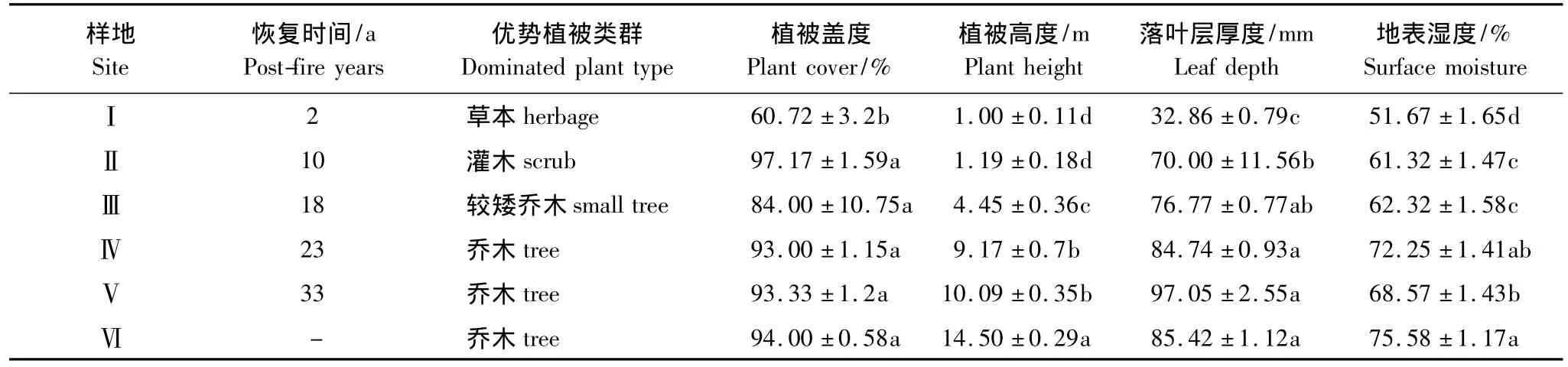
表1 蒼山不同恢復期針闊混交林調查樣地概況Table 1 Conditions of the six sample site in different restorations post-fire forest,Cangshan Mountain
1.4 數據分析
抽樣充分性判斷利用EstimateS(Version8.2.0)軟件計算物種累積曲線(species accumulation curves),并通過Excel進行曲線的繪制[25];應用MMMeans(Michaelis-Menten means)方法對各樣地地表蜘蛛物種豐富度進行估計,比較物種豐富度S值(物種數實際值)與MMMeans值(物種數估計值)的相對大小。根據曲線的特征結合S值與MMMeans值的比值(百分率)進行抽樣充分性判斷[26-27]。
物種組成和相對多度根據蜘蛛種類鑒定結果整理出物種科級組成名錄,采用物種在樣方中的個體數量百分比表示蜘蛛相對多度,相對多度大于10%即優勢類群[21]。
物種多樣性采用地表蜘蛛多度(即個體數量)、物種豐富度S值及MMMeans估計值,利用EstimateS軟件完成各項指數的計算[28]。利用 SPSS16.0 中的 One-way ANOVA 進行方差分析和多重比較[29-31],分析前對數據進行標準化處理,個體數量進行平方根轉換,MMMeans和物種數進行對數轉換,使之符合正態分布;差異顯著性檢驗方法為LSD法。
群落相似性 運用R語言中的vegan軟件包進行主坐標分析(PCoA,Principal Coordinate Analysis)[32-33],對各樣地蜘蛛群落的實際物種組成進行相似性比較。
指示值分析和指示物種確定利用R語言中的labdsv軟件包計算各物種的IndVal值[34],參考相關研究以IndVal值大于等于 0.7 作為標準確定指示物種[31,35]。
2 結果與分析
2.1 抽樣充分性分析
以樣本數量為橫坐標,實際物種數S值為縱坐標繪制樣方和樣地物種累積曲線(圖1)。圖1顯示出6個樣地曲線及樣方曲線均為平滑的漸進線。利用MMMeans進行物種豐富度估計,6個樣地的物種豐富度MMMeans估計值分別為62.08、93.20、96.00、87.67、71.42 和 72.60,物種數 S 值與 MMMeans值的比值分別為 93.43%、92.27%、81.25%、85.55%、86.81%和 89.53%,各樣地抽樣較充分。
2.2 物種組成及相對多度
經過一年的采集,在蒼山針闊混交林火燒跡地中共采集地表蜘蛛成體標本13308頭,隸屬28科66屬158個種(表2)。其中72種蜘蛛(占總物種數45.57%)個體數少于5,59種蜘蛛(占總物種數37.34%)僅在1個樣地中發現。28個科中漏斗蛛科Agelenidae個體數最豐富,占總個體數的38.74%。皿蛛科Linyphiidae種類最大,占總物種數的20.89%;漏斗蛛科次之,占12.03%,跳蛛科 Salticidae,占10.76%;球蛛科 Theridiidae、蟹蛛科Thomisidae、園蛛科Araneidae種類在5%—10%之間,其余科均低于5%。在各個樣地中漏斗蛛科和皿蛛科的物種數均高于其他科。
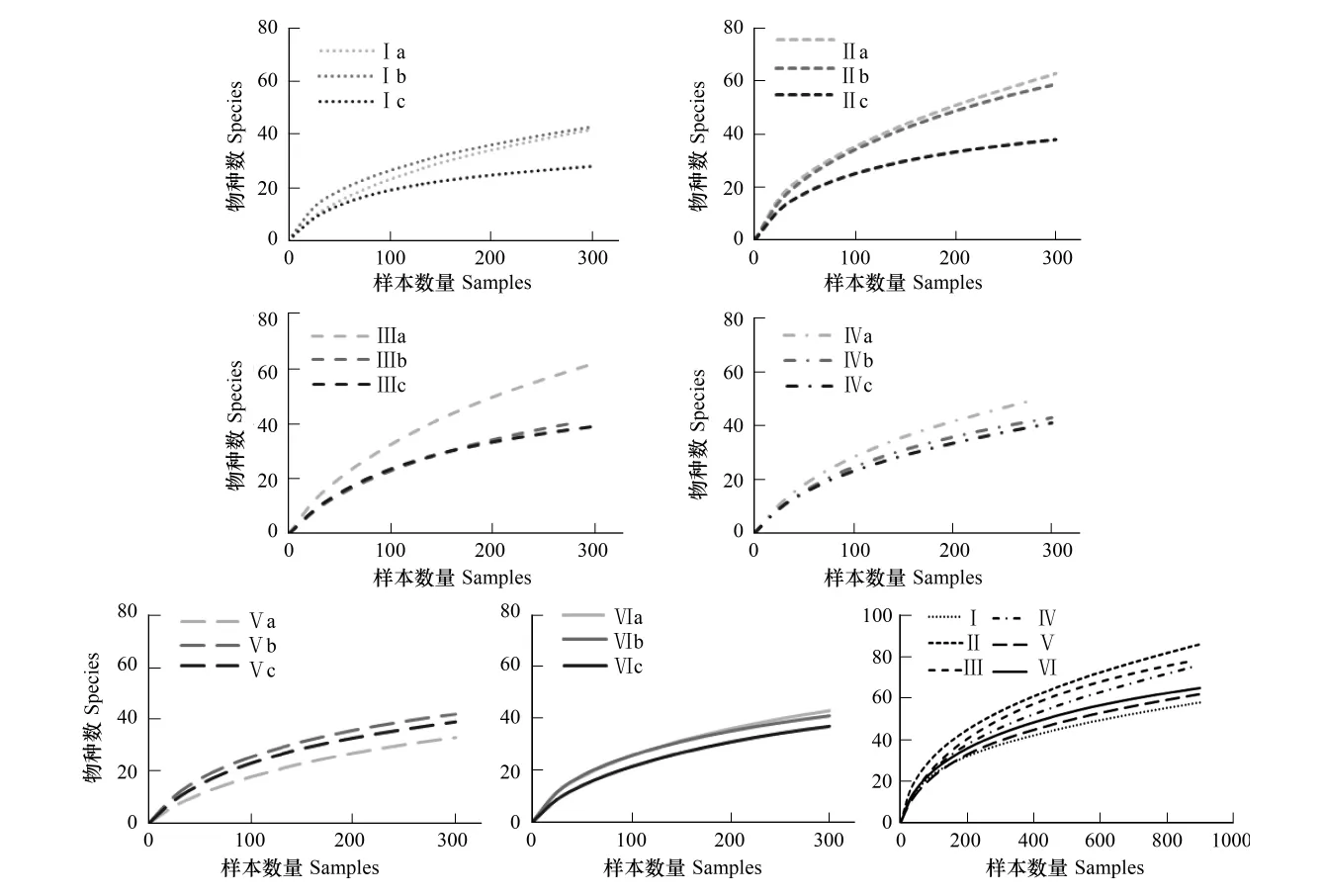
圖1 蒼山不同恢復期針闊混交林地表蜘蛛基于樣本的物種累積曲線Fig.1 Sample-based accumulation curves in different restorations post-fire forest,Cangshan Mountain
比較不同恢復期主要優勢類群(>10%)(圖2):不同恢復期地表蜘蛛群落優勢類群組成具有一定差異。樣地Ⅰ、Ⅲ、Ⅳ、Ⅴ和Ⅵ均有不同的明顯優勢類群;不同恢復期隨恢復時間的增加優勢類群更替趨勢明顯,特別是,平腹蛛科Gnaphosidae、狼蛛科Lycosidae和跳蛛科Salticidae隨恢復時間的增加相對多度明顯減少;弱蛛科Leptonetidae僅出現在對照樣地(即沒有火燒記錄的林地)。漏斗蛛科蜘蛛在火燒跡地不同恢復期均為優勢類群,特別是在樣地IV、V和VI中占絕對優勢(>50%),其中隙蛛亞科蜘蛛占漏斗蛛科蜘蛛的92.16%。
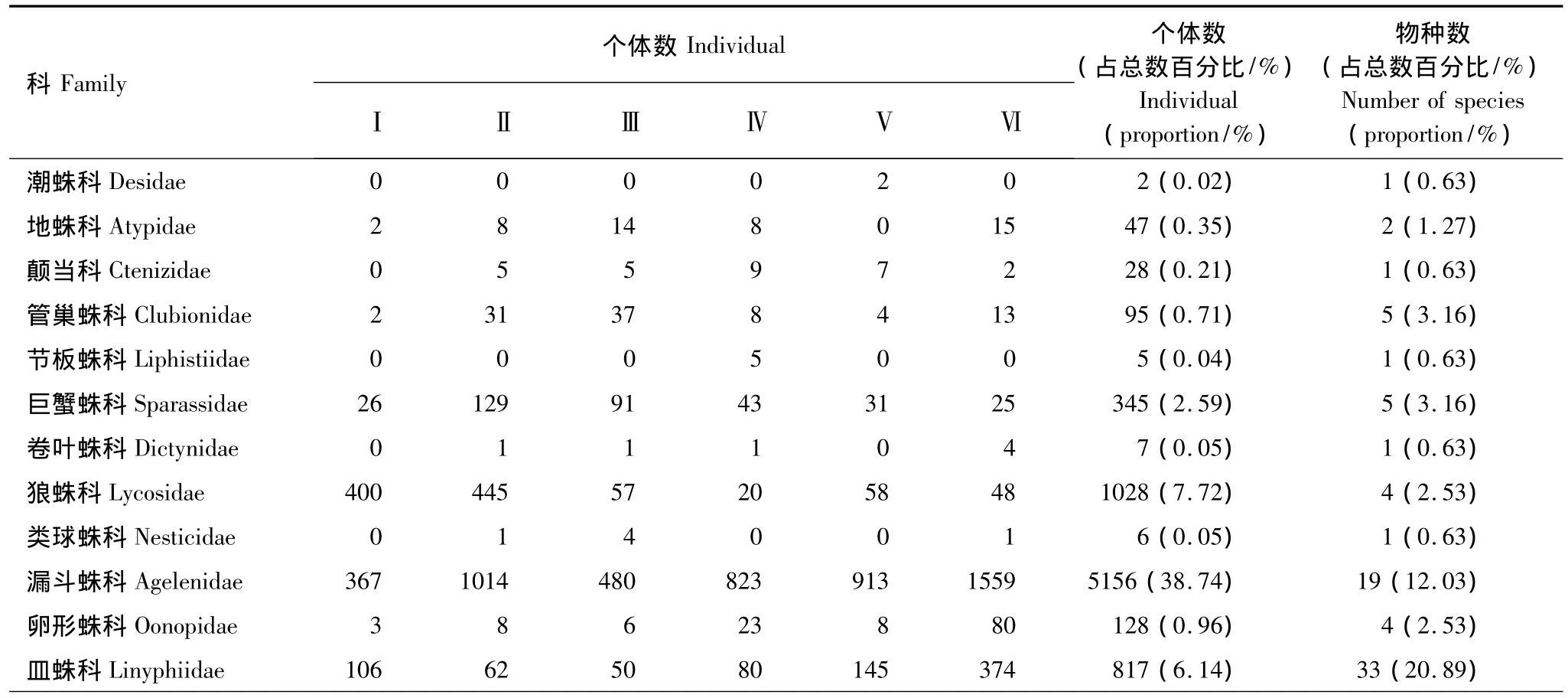
表2 蒼山不同恢復期針闊混交林地表蜘蛛群落組成Table 2 Composition of ground-dwelling spider community in different restorations post-fire forest,Cangshan Mountain
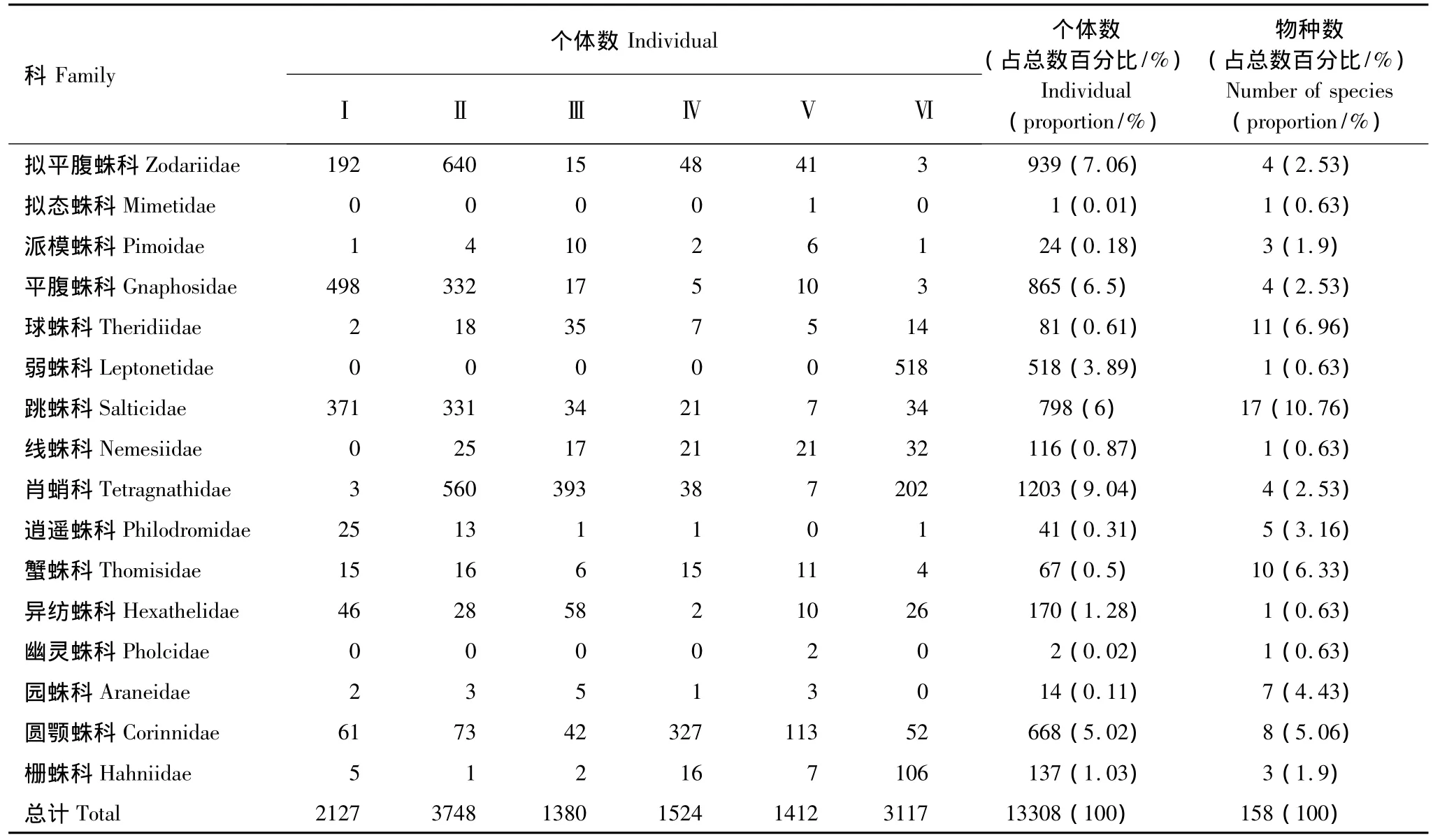
續表
2.3 多樣性比較
方差分析和多重比較結果(表3)顯示,各樣地地表蜘蛛多度存在一定差異,樣地Ⅱ最大,對照樣地次之,樣地Ⅰ與對照比較接近,在樣地Ⅲ、Ⅳ、Ⅴ的地表蜘蛛多度較小,顯著小于樣地Ⅱ和對照;物種豐富度 S值在3.61—3.95之間,各樣地間無顯著差異,物種豐富度MMMeans估計值也沒有顯著的差異。該結果顯示,火干擾發生后,地表蜘蛛多度降低,經過10余年恢復后多度增加,但隨著恢復的繼續進行,多度會下降并趨于穩定;而恢復時間對于物種豐富度沒有顯著影響。
2.4 群落相似性分析
相似性分析結果顯示,6塊樣地在主坐標圖(圖3)上劃分成了4塊明顯的區域。樣地Ⅰ的3個樣方彼此接近,樣地Ⅱ的樣方距離較近,這兩個樣地相互靠近;樣地Ⅲ、Ⅳ和Ⅴ的各樣方彼此混合,而樣地Ⅵ的3個樣方彼此接近,與其他樣地相距較遠。顯然,恢復期較短的樣地地表蜘蛛群落物種組成相似,其與恢復期較長的樣地相比地表蜘蛛群落結構不同;遭受過火干擾的樣地,其地表蜘蛛群落組成與未受火干擾的樣地不相似。根據PCoA分析結果,將不同恢復期的地表蜘蛛群落發展過程分為3個階段:火燒后2a的樣地Ⅰ(階段1)、火燒后10a的樣地Ⅱ(階段2),火燒后18—33a的樣地Ⅲ、Ⅳ和Ⅴ(階段3)。
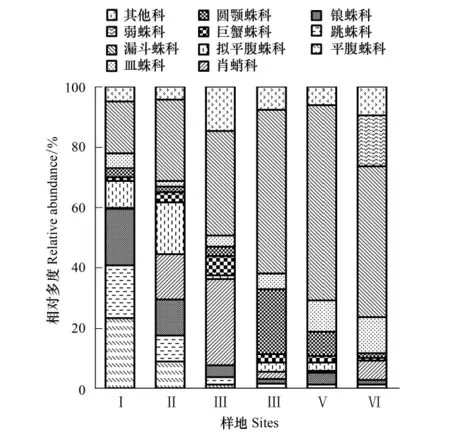
圖2 蒼山不同恢復期針闊混交林地表蜘蛛優勢類群組成及相對多度Fig.2 Composition and relative abundance of dominant spider community in different restorations post-fire forest,Cangshan Mountain
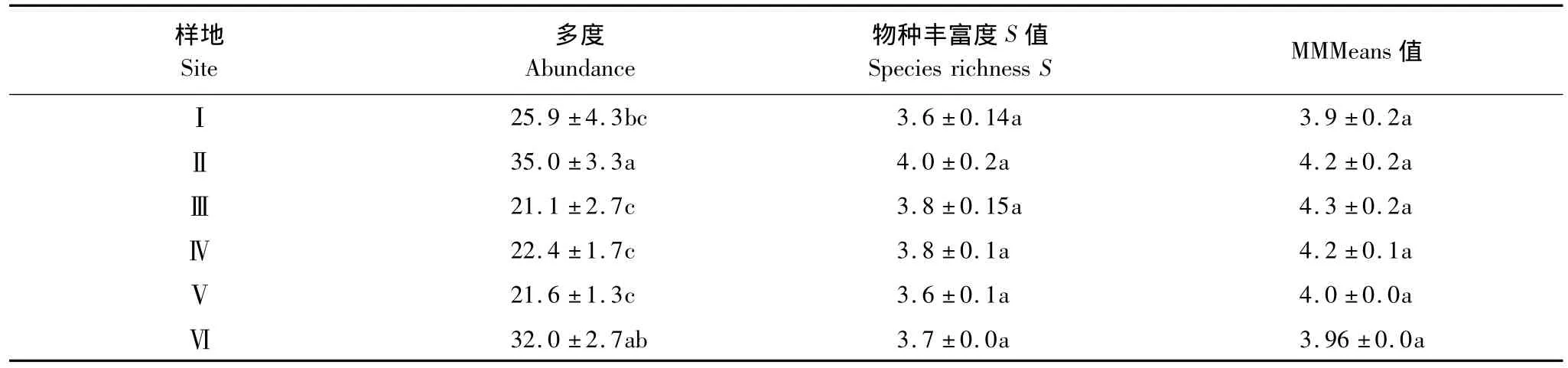
表3 蒼山不同恢復期針闊混交林地表蜘蛛多樣性比較Table 3 Comparison ground-dwelling spider community biodiversity in different restorations post-fire forest,Cangshan Mountain
2.5 指示物種及指示值分析
指示值分析(表4)顯示,在各樣地中有53個種的指示值在統計學上差異顯著,其中15個種分別與各樣地存在顯著相關性(IndVal>0.7)。階段1的指示物種為西菱頭蛛Sibianor sp.1、光先隙蛛Coelotes guangxian和細丘皿蛛Agyneta subtilis;階段2的指示物種為昆明阿斯蛛Asceua kunming、褶蛛Microneta sp.1和格氏狼蛛Lycosa grahami;階段3的指示物種為花蟹蛛Xysticus sp.2和漏斗蛛Agelenus sp.4;對照樣地的指示物種為弱蛛 Leptoneta sp.1、銳 蛛 Asthenargus sp.1、龍 隙 蛛Draconarius sp.2、隙蛛 Coelotes sp.12、卡氏方胸蛛Thiania.cavaleriei、額角蛛 Gnathonarium sp.1 和伽馬蛛Gamasomorpha sp.1,其中弱蛛 Leptoneta sp.1 僅在對照中發現。
3 討論與結論
3.1 不同恢復期地表蜘蛛群落組成
火干擾后,土壤節肢動物即進入恢復過程[36]。隨恢復時間的增加,土壤溫度、濕度、光照等小氣候因子發生了變化及植被類型結構發生了更替[7],進而導致不同恢復期地表蜘蛛群落組成發生改變(圖2)。主要表現在火干擾后2a的優勢類群為偏好于比較開放、干燥、溫熱、簡單的生境棲息的平腹蛛科、狼蛛科和跳蛛科;隨著恢復時間的增加這些在火干擾后快速建群的類群逐漸減少。該結果與國內外相關研究基本一致:Niwa&Peck[37]在美國俄勒岡州針葉林研究規定用火對蜘蛛和步甲群落的影響發現,狼蛛科和平腹蛛蜘蛛在火燒跡地數量比在未被火干擾的樣地中更多。Koponen[38]調查了芬蘭北方針葉林森林火災后地表蜘蛛群落的早期演替,結果顯示狼蛛科個體數量在火燒跡地中占優勢。Hore&Uniyal[39]研究了印度臺拉河草地規定用火對蜘蛛群落的影響,發現狼蛛科和平腹蛛蜘蛛是火干擾的主要受益類群。跳蛛科蜘蛛也是灘涂、草地、農田等與火燒跡地相似生境的優勢類群[40-41]。此外,恢復階段相近的樣地,物種組成相似或相近,且隨恢復時間的增加優勢類群更替趨勢明顯。該結果印證了森林演替對節肢動物群落的物種更替影響極大[42],不同演替階段有不同適應種[43-44]的結論。
與國內其他地區地表蜘蛛群落組成相比較[30,41,45-48],大理蒼山針闊混交林地表蜘蛛群落有鮮明的特點,即漏斗蛛科蜘蛛具有極高的多度和豐富度。這可能與蜘蛛地理分布區系差異有關,因為漏斗蛛科蜘蛛最大的亞科——隙蛛亞科Coelotinae主要分布于中國及周邊的北亞熱帶和溫帶地區[2,49],特別是在滇西橫斷山區為優勢類群[50]。該類群在蒼山針闊混交林火燒跡地恢復過程也扮演重要角色,即在不同恢復期一直是優勢類群(>10%),并且其優勢度隨恢復時間的增加而增加。這可能是由于森林火災燃料燃燒不均勻性[51],以及石塊下、木頭下及樹根表面的空隙使許多這些物種能夠幸存[52-55]。除此之外,鄰近未被火干擾地方提供著豐富的建群者也是一個重要的原因[56]。
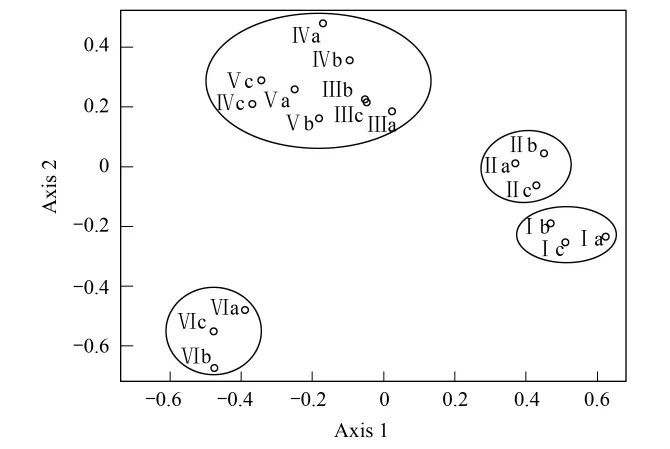
圖3 蒼山不同恢復期針闊混交林地表蜘蛛群落主坐標分析(PCoA)Fig.3 Principal coordinate analysis for ground-dwelling spider community in different restorations post-fire forest,Cangshan Mountain
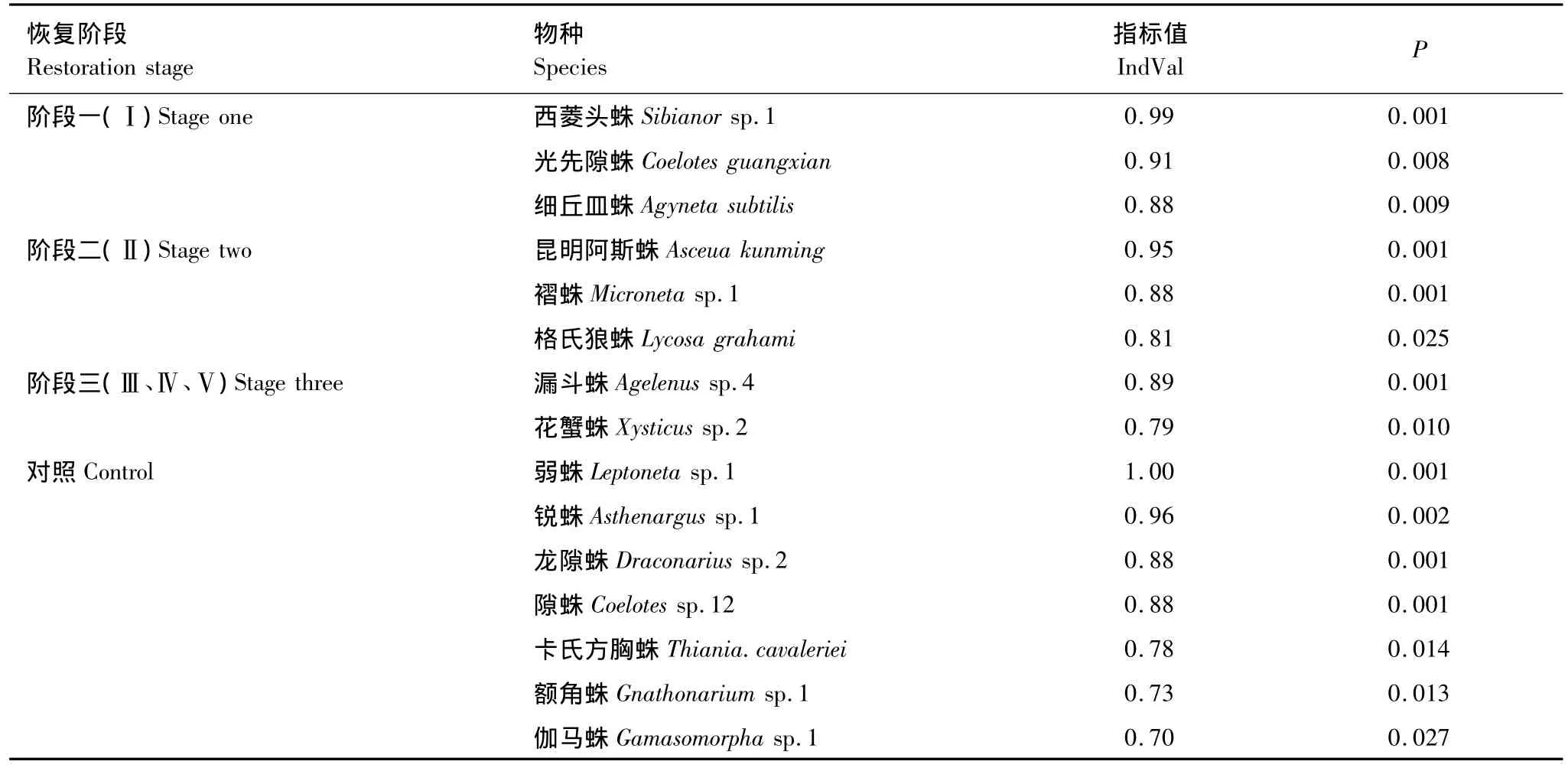
表4 基于PCoA結果對蒼山不同恢復期針闊混交林地表蜘蛛群落進行的指示值分析Table 4 IndVal(Indicator value)analysis of ground-dwelling spider communities of different post-fire age in Cangshan Mountain,the data were based on PCoA results
3.2 不同恢復期地表蜘蛛多樣性
研究顯示,恢復10余年的火燒地地表蜘蛛多度最高,豐富度也較高。該結果與張雪萍等[57]對大興安嶺火燒跡地土壤動物生態地理分析結果相似,輕度火燒后6—7a是土壤動物發展的盛期,土壤動物種類和數量能超過未受火燒影響的地區。與余廣彬和楊效東[58]對不同演替階段熱帶森林地表凋落物和土壤節肢動物群落特征研究結果也有類似之處,即3個林地土壤節肢動物個體數和多樣性存在差異,其最高值并沒有出現在頂級階段的季節雨林。這種多樣性變化現象可以依據生境結構異質性增加來解釋[21]。火燒跡地恢復早期,稀疏植被和密集植被的特征元素極其靠近,使生境有較高的結構異質性,這種異質性為地表提供了一個豐富多樣的小氣候條件,增加了小生境的物種容納量[39];也為地表蜘蛛提供了大量的食物資源[59]。因此,火燒跡地地表蜘蛛多樣性能在10a內彈性恢復。國外一些研究也表明很多地表食肉類無脊椎動物對火干擾都有較高的彈性恢復力[60-64]。
結合蒼山不同恢復期針闊混交林地表蜘蛛群落物種組成及相對多度、多樣性和相似性分析,將地表蜘蛛群落發展的3個階段歸納為:先鋒物種階段(階段1),物種最少,個體數量豐富,有明顯先鋒優勢類群;彈性恢復階段(階段2),地表蜘蛛物種豐富,沒有明顯優勢類群,群落多度彈性恢復達到所有恢復階段最高;穩定發展階段(階段3),歷時時間較長,物種豐富,個體數量較少,有明顯優勢類群,群落趨于穩定。
研究樣地在物種組成上沒有與對照樣地相似或相近的,而且優勢類群弱蛛科蜘蛛弱蛛Leptoneta sp.1僅在未被火干擾過的樣地中發現,說明各恢復期地表蜘蛛群落物種組成還沒有恢復,未受火干擾群落一旦破壞就很難恢復到原狀。項鳳武[65]對大興安嶺森林土壤生物火燒后的恢復狀況進行了調查,表明土壤小動物、微生物種類和數量已基本恢復到火干擾前水平,認為火燒跡地8a后對土壤生物影響已結束。本研究顯示火干擾后10a地表蜘蛛種類和數量雖已恢復到火干擾前水平,但物種組成相差較大。即使恢復期長達30余年與未受火干擾的群落(物種和個體數量比較豐富,有明顯優勢類群及專一性的優勢類群,群落穩定)相比,地表蜘蛛群落組成仍未完全恢復。顯然,火干擾改變了針闊混交林原有的蜘蛛群落組成;隨著恢復或演替的繼續進行,這些受到火干擾的針闊混交林是否能完全恢復,需要多少時間才能完全恢復,值得關注。
4.3 不同恢復期指示物種的指示作用
由于蜘蛛具有重要的生態地位、對生態環境變化敏感、易于采集等特點,在國外已經被廣泛用于指示環境變化[11,66-67]。本文也證實了地表蜘蛛對生境變化有較強的敏感性,指示物種對生境的選擇能夠反映出不同恢復階段地表環境變化。先鋒物種階段的指示物種西菱頭蛛Sibianor sp.1屬于跳蛛科西菱頭蛛屬Sibianor蜘蛛,該屬蜘蛛通常在受人為干擾較大的稻田中為優勢類群[68]。彈性恢復階段的指示物種昆明阿斯蛛Asceua kunming和格氏狼蛛Lycosa graham分別屬于擬平腹蛛科馬利蛛屬Mallinella和狼蛛科狼蛛屬Lycosa蜘蛛,均屬于典型的地面種類,常棲息于石下或穴道內[6]。穩定發展階段的指示物種花蟹蛛Xysticus sp.2屬于蟹蛛科花蟹蛛屬Xysticus蜘蛛,該屬蜘蛛生活于低矮植物、石下或落葉層中[6]。而弱蛛科Leptonetidae個體較小,一般1mm左右,多數種類生活于洞穴里或蔭蔽處,對生境溫濕度及環境的穩定性要求較高[69];卵形蛛科蜘蛛,偏好生活于多縫隙的土壤結構或松軟的土壤環境中[48],而未受火干擾群落的地表小氣候條件比較穩定,能夠滿足它們的需要。
綜上所述,火干擾改變了云南蒼山針闊混交林原有的地表蜘蛛群落多樣性;恢復過程中地表蜘蛛群落多樣性變化主要表現在物種組成及多度隨恢復時間的增加變化明顯;地表蜘蛛群落指示物種對生境的選擇能夠反映出不同恢復階段地表環境變化;5個不同恢復時期火燒跡地中恢復最久的火燒跡地地表蜘蛛群落仍沒有完成恢復,說明云南蒼山火跡地地表蜘蛛的恢復需要30a以上,其多樣性變化過程及其他演替特征值得我們繼續關注。
致謝:大理學院黃榮、黃素珍、張有良、潘永圣、李云春、徐德鵬、楊振興等同學參加標本野外采集工作,標本鑒定工作得到河北大學張鋒博士、西南大學的張志升博士的幫助,大理學院馮建孟博士對寫作給予幫助,特此致謝。
[1] Sun M.General records of Cangshan Mountain.Kunming:The Nationalities Publishing House of Yunnan,2008.
[2] Platnick N I.The world spider catalog,version 13.0.Museum of Natural History.http://research.Amnh.org/iz/spiders/catalog,2012.
[3] Li S Q,Wang X P.Endemic spiders in China.http://www.amaurobiidae.com/araneae,2012.
[4] Nyffeler M,Benz G.Spiders in natural pest control:a review.Applied Entomology,1987,103:321-339.
[5] Nyffeler M,Ecological impact of spider predation:a critical assessment of Bristowes and Turnbulls estimates.Bulletin of the British Arachnological Society,2000,11:367-373.
[6] Song D X,Zhu M S,Chen J.The fauna of Hebei,China.Shijiazhuang:Hebei Sinence and Technology Publishing House,2001.
[7] Yang X D.Comparison of the communities structure and seasonal changes in diversity of soil arthropod in tropical secondary forest,dry-rice land and fired remains.Acta Ecology sinca,2003,23(5):883-891.
[8] Uetz G W.Habitat structure and spider foraging//Hibitat Structure:The Physical Arrangement of Objects in Space.London:Chapman and Hall,1991,325-348.
[9] Bultman T L,Uetz G W.Abundance and community structure of forest floor spiders fllowing litter manipulation.Oecologia,1982,(55):34-41.
[10] Churchill T B.Spiders as ecological indicators:an overview for Australia.Memoirs of Museum Victoria,1997,(56):331-337.
[11] Wheater C P,Cullen W R,Bell J R.Spider communities as tools in monitoring reclaimed limestone quarry landforms.Landscape Ecology,2000,15(5):401-406.
[12] Li D Q,Zhao J Z.The spider community and its diversity in cotton fields.Acta Ecology Sinica,1993,13(3):205-213.
[13] Yin C M.The survey of ecological study of Chinese spider.Acta Arachnologica Sinica,1999,8(2):122-127.
[14] Wang H Q.Studies on the community structure and function of paddy field spiders in China.Changsha:Hunan Normal University Press,2006.
[15] Song D X,Yan H M,Zhu M S.On the structure and diversity of spider communities in mount Fanjing Guizhou Province and Zhangjiajie area,Hunan Provice,China.Acta Arachnologica Sinica,1992,1(1):45-57.
[16] Chen L S,Yuan F F,Rao J,Yan H M.Studies on diversity of spider community in Matoushan natural reserve in Jiangxi Province.Acta Agriculturae Universitatis Jiangxiensis,2005,27(3):429-434.
[17] Zhu L M,Zhang F,Zhang L R,Zhu M S.Study of spider community structure and diversity of Damao Mountain national forest park,China.Acta Arachnologica Sinica,2007,16(2):112-115.
[18] Zhang Z S,Wei G,Liu Z H,Zhang Y F,Zhang Y G.Study on the diversity of the spider community of the Changning national nature reserve for the Bamboo forest sea of Sichuan,China.Sichuan Journal of Zoology,2010,29(3):492-495.
[19] Li Z,Wang L Y,Li Z X,Zhang Z S.Analysis on community diversity of spiders from Chishui national nature reserve for spinulose tree fern,Guizhou province.Sichuan Journal of Zoology,2011,30(6):972-976.
[20] Pickett S T A.Space-for-time substitution as an alternative to long-term studies//Long-term studies in ecology:approaches and alternatives.New York:Springer-Verlag,1989.
[21] Moretti M.Effects of winter fire on spiders.European Arachnology,2000.Aarhus//Toft S.,Scharff N,eds.Aarhus University Press,2002.183-190.
[22] Yu G H,Chen J.Sampling using Pitfall traps in ecological research on spider.Acta Arachnological Sinica,2001,10(1):52-56.
[23] Oliver I,Beattie A J.A possible method for the rapid assessment of biodiversity.Conservation Biology,1993,7(3):562-568.
[24] Krell F.Parataxonomy vs.taxonomy in biodiversity studies-pitfalls and applicability of morpho-species sorting.Biodiversity Conservation,2004,13:795-812.
[25] Colwell R K,Coddington J A.Estimating terrestrial biodiversity through extrapolation.Philosophical Transactions of the Royal Society of London,1994,345:101-118.
[26] Toti D S,Coyle F A,Miller J A.A structured inventory of appalachian grass bald and heath bald spider assemblages and a test of species richness estimator performance.The Journal of Arachnology 2000,28:329-345
[27] Li Q,Chen Y L,Gao C J,Bei R T,Yin L H,Xiong Z P.Community diversity comparisons of spiders among plantation forests in Yuanmou dryhot valley.Journal of Yunnan Agricultural University,2008,23(6):731-735.
[28] Colwell R K,Estimate S.Statistical estimation of species richness and shared species from samples.Version 7.5.http://purl.oclc.org/estimates,2009.
[29] Scharff N,Coddington J A,Griswold C E,Hormiga G,Bj?rn P de P.When to quit?Estimating spider species richness in a northern European deciduous forest.The Journal of Arachnology,2003,31:246-273.
[30] Li Q.Species accumulation curves and its application.Chinese Journal of Applied Entomology,2011,48(6):1882-1888.
[31] Chen Y Q,Li Q,Chen Y L,Lu Z X,Zhou X Y.Ant diversity and bio-indicators in land management of lac insect agroecosystem in Southwestern China.Biodiversity Conservation,2011,20(13):3017-3038.
[32] Roberts D W.labdsv:ordination and multivariate analysis for ecology.R package version 1.3-1.http://ecology.msu.montana.edu/labdsv/R,2007.
[33] R Development Core Team.R:a language and environment for statistical computing.http://www.R-project.org,2009.
[34] Dufrêne M,Legendre P.Species assemblages and indicator species:the need for a flexible asymasymmetrical approach.Ecologe Monogr,1997,67:345-366.
[35] Haddad C R,Honiball A S,Dippenaar-Schoeman A S,Slotow R,Rensburg B J.Spiders as potential indicators of elephant-induced habitat changes in endemic sand forest,Maputaland,South Africa.African Journal of Ecology,2009,48:446-460.
[36] Yue X Q,Zhou D W,Sun G.Microclimate changes in plant community following a Hulunbeier grassland burning.Journal of Northeast Normal University,1999,(1):91-96.
[37] Niwa C G,Peck R W.Influence of Prescribed Fire on Carabid Beetle(Carabidae)and Spider(Araneae)Assemblages in Forest Litter in Southwestern Oregon.Environmental Entomology,2002,31(5):785-796.
[38] Koponen S.Early Succession of a boreal Spider Community after Forest Fire.Journal Arachnology,2005,33:230-235.
[39] Hore U,Uniyal V P.Effect of prescribed fire on spider assemblage in Terai grasslands,India.Turk Journal Arachnology,2008,1(1):15-36.
[40] Liu J W,Wang G X,Liu K Y,Yang Q R.Studies on the structure of spider community in Tianhe Airport.Journal of Central China Normal University,2001,35(1):68-71.
[41] Zhu L M,Zhang F,Zhu M S.Spider community structure in typical habitats of Xiaowutai Mountain,China.Journal of Hebei University(Natural Science Edition),2008,28(01):88-91.
[42] Li X J,Liu Y A,Li C H,Diao C Q.Effect of Forest Succession on Arthropod Diversity in Jinyun Mountain,Chongqing.Journal of Northeast Forestry University,2009,37(10):35-39.
[43] Ricklefs R E.The economy of nature.New York:Chiron Press Freeman(fifth edition),2001.
[44] Langlands P R,Brennan K E C,Framenau V W,Main B Y.Predicting the post-fire responses of animal assemblages:testing a trait-based approach using spiders.Animal Ecology,2011,80(3):558-568.
[45] Yan H M,Yin C M,Wang H Q.Studies on Diversity of spider community in the area of mount Wuling,the southwest of China.Journal of Natural Science of Hunan Normal University,1994,17(3):65-71.
[46] Wang Y Z,Chen F Y,Lu Y C,Nie X Z.Preliminary research on soil spider community in the forests of Jiuhua Mountains,Anhui Province.Acta Ecologica Sinica,1997,17(1):71-77.
[47] Lie W L,Zhu M S,Song D X.Studies on the structure and diversity of soil spider communities in zhangjiakou area,Hebei Province,China.Acta Arachnologica Sinica,1999,8(1):49-54.
[48] Zheng G,Yang X D,Li S Q.Biodiversity of ground-dwelling spider in six forest types in Xishuangbanna,S.W.China.Acta Entomologica Sinica,2009,52(8):875-884.
[49] Li Z X,Wu C Q,Zhang Z S.The analysis of species diversity of Chinese spiders.Acta Arachnologica Sinica,2011,20(1):46-51.
[50] Yang Z Z,Mao B Y,Xu J S,Su Z F.Analysis of fauna and researching resource of spiders in Hengduan Mountains,west Yunnan Province.Journal of Dali University,2006,5(2):20-31.
[51] Marxer P,Conedera M.Experimental fire in Switzerland.Final report of the PROMETHEUS project.Swiss Federal Research Institute WSL -Sottostazione Suddelle Alpi Bellinzona,2000.
[52] Huhta,V.Succession in the spider communities of the forest floor after clear-cutting and prescribed burning.Annales Zoologici Fennici,1971,8:483-542.
[53] Merrett P.Changes in the ground-living spider fauna after heathland fires in Dorset.Bulletin of the British Arachnological Society,1976,3:214-221.
[54] Yang X D,Tang Y,Tang J W.Change on the Composition and Distribution of Soil Arthropod Community before and after Burning in the Secondary Forest of Xishuangbanna.Chinese Journal of Ecology,2001,20(5):32-35.
[55] Underwood E C,Quinn J F.Response of ant and spiders to prescribed fire in oak woodlands of California.Insect Conservation,2010,14:359-366.
[56] Antunes S C,Curado N,Castro B B,Gon?alves F.Short-term recovery of soil functional parameters and edaphic macro-arthropod community after a forest fire.Soils Sediments,2009,9:267-278.
[57] Zhang X P,Zhang S H,Li J K.Eco-geographical analysis of soil animals in burned forest areas in Greater Hinggan Mountains.Geographical Research,2006,25(2):327-334.
[58] Yu G B,Yang X D.Characteristics of litter and soil arthropod communities at different successional stages of tropical forests.Biodiversity Science,2007,15(2):188-198.
[59] Moretti M,Duelli P,Obrist M K.Biodiversity and resilience of arthropod communities after fire disturbance in temperate forests.Oecologia,2006,149:312-327.
[60] Moretti M,Conederaet M,Duelli P,Edwards P J.The effects of wildfire on ground-active spiders(Arthropoda:Araneae)in deciduous forests on the southern slope of the Alps.Ecological Applications,2002,39:321-336.
[61] Moretti M,Obrist M K,Duelli P.Arthopod biodiversity after forest fire:winner and losers in the winter fire regime of the southern Alps.Ecography,2004,27:173-186.
[62] Wikars L O.Immediate effects of fire-severity on soil invertebrates in cut and uncut pine forests.Forest Ecology Manage,2001,141:189-200.
[63] Hanula J L,Wade D D.Influence of long-term dormant season burning and fire exclusion on ground-dwelling arthropod populations in longleaf pine flat woods ecosystems.Forest Ecology Manage,2003,175:163-184.
[64] Parr C L,Robertson H G,Biggs H C,Chown S L.Response of African savanna ants to long-term fire regimes of African savanna ants to long-term fire regimes.Ecological Applications,2004,41:630-642.
[65] Xiang F W.Recovering Investigation of soil edaphon after forest fire.Journal of Jilin forestry University,1998,14(2):99-102.
[66] Bell J R,Shaw E M,Wheater P.Dose stochasticity in emergent pioneer communities reduce the value of indicator species analysis?European Arachnology,2004,143-150.
[67] Buchholz S.Ground spider assemblage as indicator for habitat structure in inland sand ecosystems.Biodiversity Conservation,2010,19:2565-2595.
[68] Wang H Q,Shi G B.Studies on the dominant species and the contributing factors of paddy field spiders in China.Acta Arachnologica Sinica,2002,11(2):85-92.
[69] Ba J W,Li D H.Diversity of the cave-dwelling spider and thire adaptation to the cave environment in China.Acta Zootaxonomica Sinica,2009,34(1):98-105.
參考文獻:
[1] 孫明.蒼山志.昆明:云南民族出版社,2008.
[3] 李樞強,王新平.中國蜘蛛特有物種網.http://www.amaurobiidae.com/araneae.2012.
[6] 宋大祥,朱明生,陳軍.河北動物志-蜘蛛類.石家莊:河北科技出版社,2001.
[7] 楊效東.熱帶次生林、早稻種植地和火燒跡地土壤節肢動物群落結構特征及季節變化.生態學報,2003,23(5):883-891.
[12] 李代芹,趙敬釗.棉田蜘蛛群落及其多樣性研究.生態學報,1993,13(3):205-213.
[13] 尹長民.中國蜘蛛生態學研究概況.蛛形學報,1999,8(2):122-127.
[14] 王洪全.中國稻區蜘蛛群落結構和功能的研究.長沙:湖南科學技術出版社,2006.
[15] 宋大祥,顏亨梅,朱明生.梵凈山和張家界地區蜘蛛群落結構及多樣性研究.蛛形學報,1992,1(1):45-57.
[16] 陳連水,袁鳳輝,饒軍.江西馬頭山自然保護區蜘蛛群落多樣性研究.江西農業大學學報,2005,27(3):429-434.
[17] 朱立敏,張峰,張麗榮,朱明生.大茂山國家森林公園蜘蛛群落結構及多樣性研究.蛛形學報,2007,16(2):112-115.
[18] 張志升,魏國,劉鐘華,張玉富,張耀光.四川省長寧竹海自然保護區蜘蛛群落多樣性研究.四川動物,2010,29(3):492-495.
[19] 李仲,王露雨,李宗煦,張志升.貴州赤水桫欏自然保護區蜘蛛群落多樣性分析.四川動物,2011,30(6):972-976.
[22] 喻國輝,陳建.使用陷阱采樣在蜘蛛生態學研究中的應用.蛛形學報,2001,10(1):52-56.
[27] 李巧.物種累積曲線及其應用.應用昆蟲學報,2011,48(6):1882-1888.
[30] 李巧,陳彥林,高成杰,貝榮塔,尹立紅,熊忠平.元謀干熱河谷人工林蜘蛛群落多樣性比較研究.云南農業大學學報,2008,23(6):731-735
[36] 岳秀泉,周道瑋,孫剛.草原火燒后群落小氣候的變化.東北師大學報,1999,(1):91-96.
[40] 劉家武,王國秀,劉凱于,楊其仁.天河機場蜘蛛群落結構研究.華中師范大學學報(自然科學版),2001,35(1):68-71.
[41] 朱立敏,張鋒,朱明生.小五臺山典型生境的蜘蛛群落結構.河北大學學報(自然科學版),2008,28(01):88-91.
[42] 李曉晶,劉玉安,李春輝,刁紹起.縉云山森林演替對節肢動物多樣性的影響.東北林業大學學報,2009,37(10):35-39.
[45] 顏亨梅,尹長民,王洪全.武陵山地區蜘蛛群落多樣性的研究.湖南師范大學學報(自然科學版),1994,17(3):65-71.
[46] 王宗英,陳發揚,路有成,聶獻忠.九華山森林土壤蜘蛛群落的初步研究.生態學報,1997,17(1):71-77.
[47] 劣旺祿,朱明生,宋大祥.張家口土壤蜘蛛群落結構及多樣性研究.蛛形學報,1999,8(1):49-54.
[48] 鄭國,楊效東,李樞強.西雙版納地區六種林型地表蜘蛛多樣性比較研究.昆蟲學報,2009,52(8):875-884.
[49] 李宗煦,吳成瓊,張志升.中國蜘蛛物種多樣性分析.蛛形學報,2011,20(1):46-51.
[50] 楊自忠,毛本勇,徐吉山,蘇子峰.滇西橫斷山區蜘蛛資源及區系分析.大理學院學報,2006,5(2):20-31.
[54] 楊效東,唐勇,唐建緯.熱帶次生林火燒前后土壤節肢動物群落組成和分布特征的變化.生態學雜志,2001,20(5):32-35.
[57] 張雪萍,張淑花,李景科.大興安嶺火燒遺跡地土壤動物生態地理分析.地理研究,2006,25(2):327-334.
[58] 余廣彬,楊效東.不同演替階段熱帶森林地表凋落物和土壤節肢動物群落特征.生物多樣性,2007,15(2):188-198.
[65] 項鳳武.森林土壤生物火燒后恢復情況調查研究.吉林林學院學報,1998,14(2):99-102.
[68] 王洪全,石光波.中國稻田蜘蛛優勢種及其成因探討.蛛形學報,2002,11(2):85-92.
[69] 巴家文,黎道洪.中國洞穴蜘蛛多樣性及其對洞穴環境的適應.動物分類學報,2009,34(1):98-105.
猜你喜歡
課堂內外·初中版(科學少年)(2025年1期)2025-02-28 00:00:00
課堂內外·初中版(科學少年)(2025年2期)2025-02-28 00:00:00
英語世界(2023年10期)2023-11-17 09:18:18
體育科技文獻通報(2022年3期)2022-05-23 13:46:54
天津外國語大學學報(2021年3期)2021-08-13 08:32:18
遼金歷史與考古(2021年0期)2021-07-29 01:06:54
科技傳播(2019年22期)2020-01-14 03:06:54
民用飛機設計與研究(2019年4期)2019-05-21 07:21:24
科學大眾(中學)(2019年3期)2019-05-17 10:04:30
汽車觀察(2018年10期)2018-11-06 07:05:26
