植物體對硝態氮的吸收轉運機制研究進展
2015-06-15 19:18:53張然然都韶婷
植物營養與肥料學報 2015年3期
張 鵬, 張然然, 都韶婷
(浙江工商大學環境科學與工程學院,浙江杭州 310018)
植物體對硝態氮的吸收轉運機制研究進展
張 鵬, 張然然, 都韶婷*
(浙江工商大學環境科學與工程學院,浙江杭州 310018)
硝態氮是高等植物重要的氮素營養,直接影響植物的生長。植物根系吸收硝態氮并向地上部轉運的機制一直是研究者十分關注的問題。近幾年的深入研究使得新的現象與結論被揭示,推動了我們對植物體吸收轉運硝態氮生理與分子機制的認識。本文綜述了近年來國內外關于植物硝態氮吸收轉運的生理及分子機制的相關研究結果。通過整理歸類植物硝酸鹽吸收相關的生理學數據,介紹了影響植物吸收硝態氮的各種因素。基于膜轉運體在植物硝態氮吸收轉運過程中發揮的重要作用,本文還重點介紹參與該過程的四大基因家族的成員及功能,即硝酸鹽轉運體1(NRT1)、硝酸鹽轉運體2(NRT2)、氯離子通道(CLC)和s型陰離子通道(SLAC),以期為后續研究者提供一個較為全面的理論依據。
硝態氮; 親和力轉運系統; 吸收; 再分配; 轉運蛋白
1 生理機制
1.1 硝態氮的吸收轉運

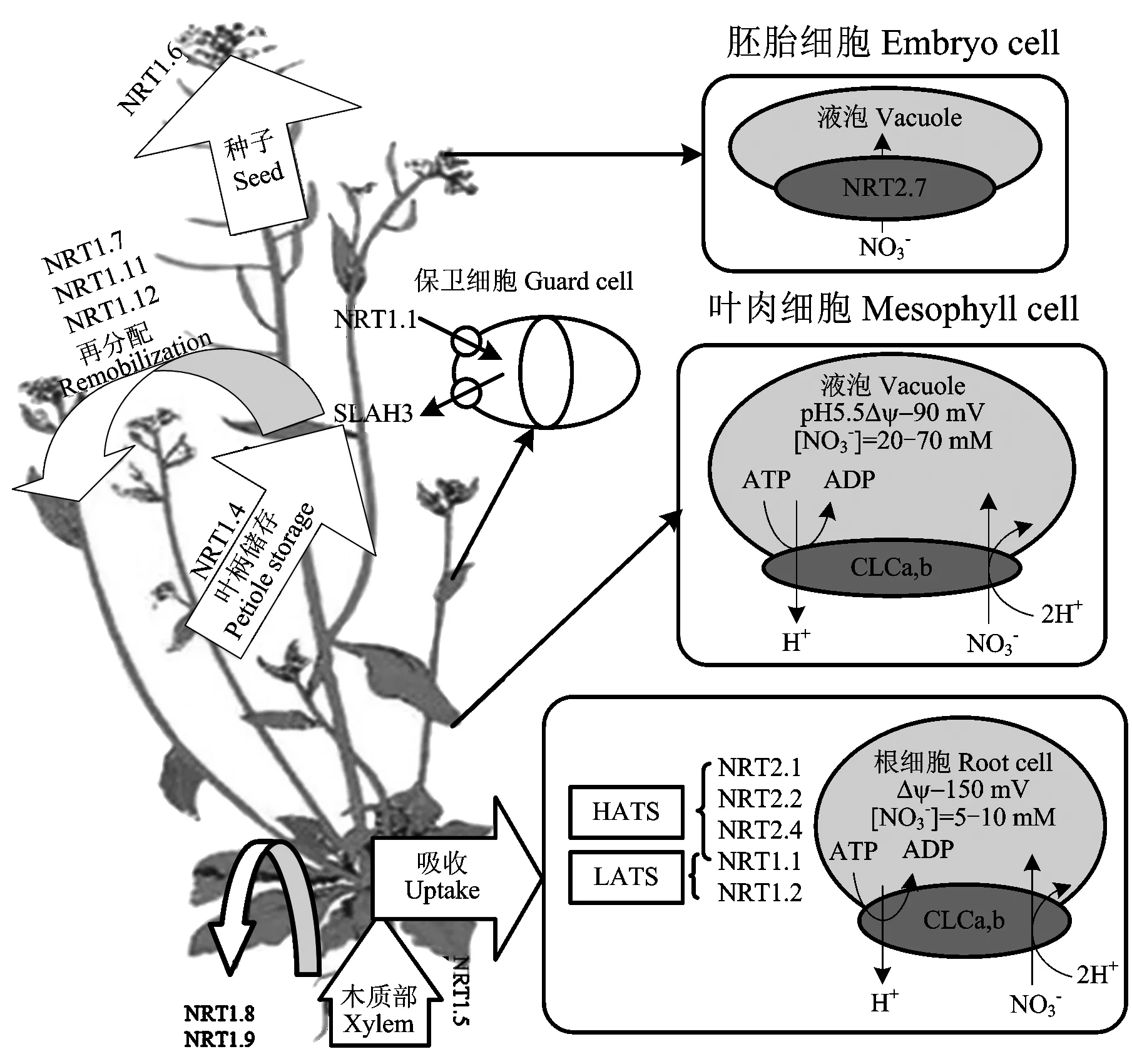
圖1 擬南芥中部分硝酸鹽轉運蛋白的功能 [3,15,48]Fig.1 Function of nitrate transporters in Arabidopsis thaliana[注(Note):HATS—高親和吸收系 High-affinity transport systems; LATS—低親和吸收系統 Low-affinity transport systems.]
運輸到植株地上部的氮素除了參與代謝過程外,一部分又以氨基酸的形態通過韌皮部向根部轉運,甚至外泌[14]。由韌皮部向下運輸到根部的總氮量遠遠超過根系的生長需要,大部分又進入木質部同新吸收的氮素一起向上運輸至地上部[15]。與此同時,硝態氮也能從老葉運輸到新葉中,進行再分配[16]。再分配是所有作物提高氮素利用效率的主要因素,也是植物對硝態氮吸收轉運的重要過程之一。
1.2 硝態氮吸收的影響因素
與其他礦質養分類似,植物對硝態氮的吸收也受到許多外界因素的影響。鑒于弄清植物吸收硝態氮的影響因素對于農業氮素利用有著重要意義,因而筆者從環境條件、養分元素和信號物質等對吸收過程影響較大的幾個方面介紹它們對植物硝態氮吸收的影響(表1)。

表1 硝態氮吸收的影響因素
就供氮條件的變化而言,它也會極大地影響植物對硝態氮的吸收。例如,外源硝酸鹽能顯著促進高親和力轉運系統的轉運能力。以大麥作為研究材料,在培養液中添加硝酸鹽后,組成型高親和力轉運系統的活性可以增加3倍左右[23]。甚至,誘導型高親和力轉運系統具有更強的硝酸鹽誘導效應[24]。介質中的銨態氮同樣也會影響植物對硝態氮的吸收能力[25]。研究結果顯示,銨離子濃度超過 1×10⁻⁵mol/L會抑制硝酸鹽的吸收[26]。氨基酸也能直接影響植物對硝態氮的吸收,如分別給大麥和玉米幼苗供應谷氨酸和天冬氨酸等均抑制了硝酸鹽的吸收[27-28]。綜上所述,在實際農田使用氮肥的過程中,所選用的氮肥形態也會極大地影響植物對硝態氮的吸收效率。

2 分子機制
早在30年前,研究者就利用擬南芥這一模式植物開展了硝酸鹽轉運體編碼基因的相關研究。目前,已經克隆了4類硝酸鹽轉運蛋白基因家族,主要包括NRT1、NRT2、CLC和SLAC[15]。它們均編碼了受硝酸鹽誘導的共運體,但差異較大,基因序列無相似性[47]。我們將上述擬南芥的硝酸鹽轉運體基因家族的概況作如下介紹,其命名及功能[48]見圖1和表2。
2.1 NRT1轉運蛋白

表2 擬南芥中硝酸鹽轉運蛋白的命名及功能
續表2 Table 2 continuous
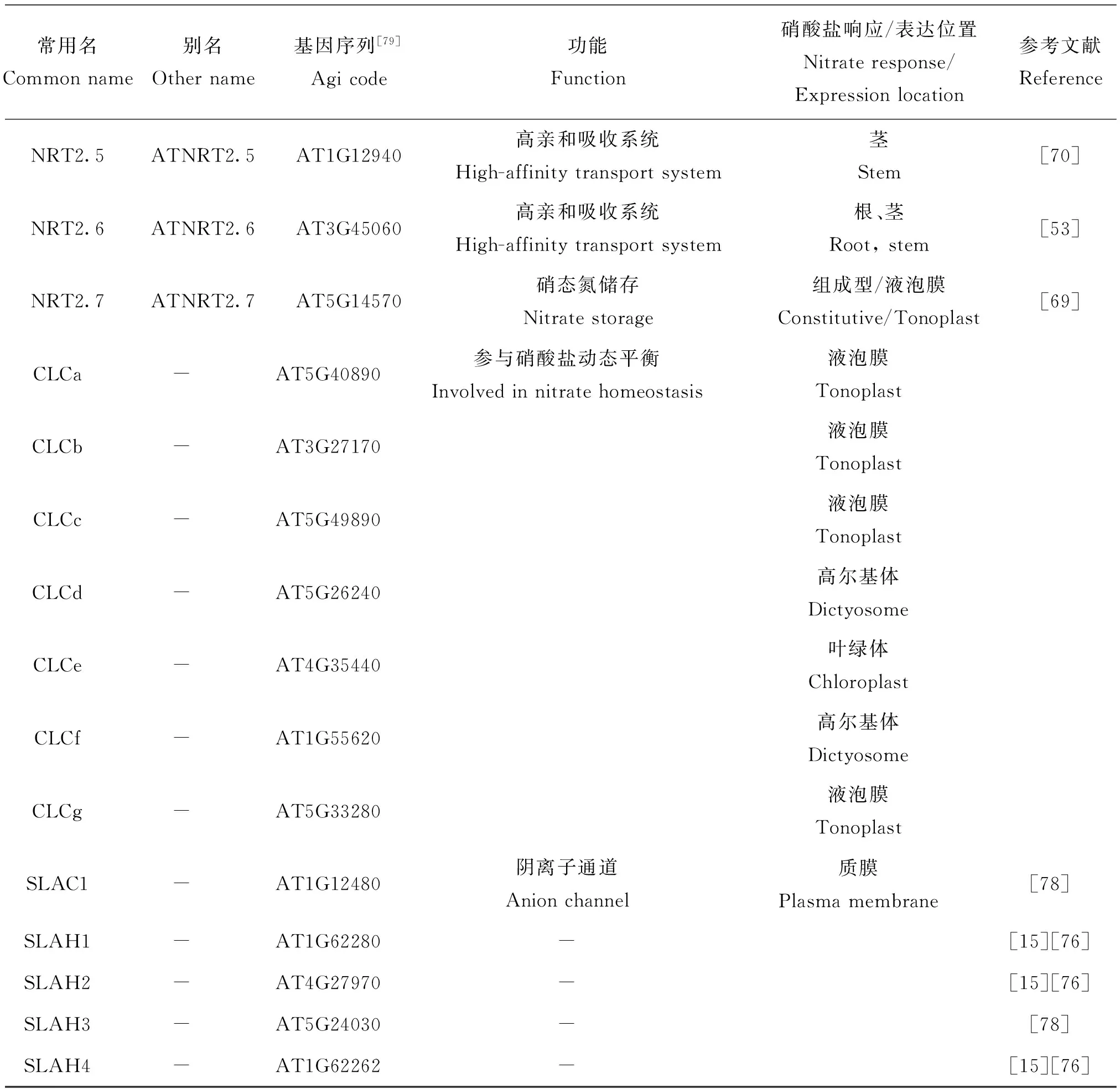
常用名Commonname別名Othername基因序列[79]Agicode功能Function硝酸鹽響應/表達位置Nitrateresponse/Expressionlocation參考文獻ReferenceNRT2.5ATNRT2.5AT1G12940高親和吸收系統High-affinitytransportsystem莖Stem[70]NRT2.6ATNRT2.6AT3G45060高親和吸收系統High-affinitytransportsystem根、莖Root,stem[53]NRT2.7ATNRT2.7AT5G14570硝態氮儲存Nitratestorage組成型/液泡膜Constitutive/Tonoplast[69]CLCa-AT5G40890CLCb-AT3G27170CLCc-AT5G49890CLCd-AT5G26240CLCe-AT4G35440CLCf-AT1G55620CLCg-AT5G33280參與硝酸鹽動態平衡Involvedinnitratehomeostasis液泡膜Tonoplast[15][71][74]液泡膜Tonoplast[72]液泡膜Tonoplast[75]高爾基體Dictyosome[75]葉綠體Chloroplast[75]高爾基體Dictyosome[75]液泡膜Tonoplast[75]SLAC1-AT1G12480陰離子通道AnionchannelSLAH1-AT1G62280-SLAH2-AT4G27970-SLAH3-AT5G24030-SLAH4-AT1G62262-質膜Plasmamembrane[78][15][76][15][76][78][15][76]
注(Note): “-”表示未知 Unkown.
2.2 NRT2轉運蛋白
目前,在擬南芥中已報道發現7種NRT2轉運蛋白,該家族中大部分成員均能在根內表達,并且都是高親和轉運蛋白。其中,NRT2.1和NRT2.2主要通過在根中表達后促使植物根部從土壤中吸收硝酸鹽[64]。更有反向遺傳學的研究表明,NRT2.2只有在NRT2.1缺失的情況下才顯著表達[65]。因此,一般認為相較于NRT2.2,NRT2.1調控植物根系吸收硝酸鹽的過程更為重要。此外,研究還發現硝酸鹽濃度較低時,它們的表達量都明顯減少[66]。甚至,其他氮源(銨鹽和谷氨酸鹽)供應不足,也會導致NRT2.1的表達量受到抑制[67]。NRT2.1的表達量還受光合作用產物的影響[66]。除了上述兩個轉運蛋白,NRT2.4也是備受研究者關注的對象。它是一種高親和轉運蛋白,在側根的表皮部分和莖的韌皮部表達,在氮素(硝酸鹽)缺乏的情況下,nrt2.4突變體對硝酸鹽的吸收及其根韌皮部硝酸鹽的外泌均減少,表明NRT2.4在低氮情況下對硝酸鹽的運輸起著很大的作用[68]。與NRT2.1、NRT2.2和NRT2.4不同,NRT2.7在種子細胞的液泡膜上表達,負責將硝酸鹽運輸到種子的液泡內儲存,其表達量在種子成熟后達到一個最高峰[69]。目前為止,關于NRT2家族的其他成員如NRT2.3、NRT2.5和NRT2.6的功能研究僅有少量報道。如NRT2.5在沒有外源氮素(硝酸鹽和銨鹽)供應的情況下,其表達量增加,當供氮恢復時表達受到抑制[53,70]。不同的是,研究發現NRT2.3和NRT2.6在根和莖中的表達,并且不受供氮濃度的影響[53]。
2.3 CLC和SLAC轉運蛋白
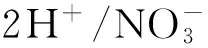
擬南芥中有5種SLAC轉運蛋白:SLAC1、SLAH1、SLAH2、SLAH3和SLAH4,其中SLAH1、SLAH2、SLAH3和SLAH4都是SLAC1的同系物。SLAC1是第一個被發現的s-型陰離子通道上的轉運蛋白位于質膜[76]。其后,也有學者報道了有關SLAC1的調控機制[77]。與SLAC1一樣,它的同系物SLAHs也都位于質膜。研究發現當SLAC1主導氣孔關閉時SLAH1和SLAH3會表現出與SLAC1相似的功能[76]。但是,SLAH2是否與SLAC1家族中其它轉運蛋白功能類似尚未明確。近期一項研究通過GUS染色法在保衛細胞中僅觀察到了SLAH3以及少量的SLAH2,SLAH1和SLAH4則未觀察到[78]。雖然,有關SLAC轉運蛋白的研究仍處起步階段,但我們相信識別這類陰離子通道轉運蛋白有助于弄清楚氣孔關閉過程,并對干旱、信號傳導和硝酸鹽代謝有著深刻影響。
3 展望
植物對硝態氮的吸收是植物生理過程中極為關鍵的一個部分。近六七十年來的關于植物吸收硝態氮的生理機制很好地幫助并解決了較多硝態氮施用的農業問題。隨著近一二十年的分子機制的研究,更推進了我們對植物吸收硝態氮過程的理解。尤其是負責硝酸鹽吸收的轉運蛋白,它們被認為在這個過程中發揮了重要的作用。蔡宜芳教授曾評價說這些轉運蛋白既是硝態氮的搬運工,也是負責探測土壤硝態氮含量的守門員,它們將土壤中硝態氮含量這一信息傳遞到細胞的指揮中心。因此,有關硝態氮轉運蛋白的研究仍應給予極大的重視。此外,除了本文介紹的擬南芥中發現的轉運蛋白外,也有很多關于各種植物硝態氮轉運蛋白的報道,如水稻的 OsNTR1.1、大豆的 GmNRT2、番茄的 LeNRT1、大麥的HvNRT2A、煙草的NpNRT2.1及苜蓿的MtNRT1.3[3,69,80-81]。不同物種硝態氮轉運蛋白之間的差異也值得我們探究。我們相信,雖然硝態氮轉運體的功能及特點尚未完全弄清,但是隨著人們對植物體硝酸鹽吸收途徑認識的日益加深,以及分子生物學技術的發展,必將取得研究上的突破。
[1] Novoa R, Loomis R S. Nitrogen and plant production[J]. Plant and Soil, 1981, 58: 177-204.
[2] Li D D, Tian M Y, Cai Jetal. Effects of low nitrogen supply on relationships between photosynthesis and nitrogen status at different leaf position in wheat seedlings[J]. Plant Growth Regulation, 2013, 70: 257-263.
[3] Crawford N M, Glass A D M. Molecular and physiological aspects of nitrate uptake in plants[J]. Trends in Plant Science, 1998, 3(10): 389-395.
[4] Stitt M. Nitrate regulation of metabolism and growth[J]. Current Opinion in Plant Biology, 1999, 2(3): 178-186.
[5] Miller A J, Smith S J. Nitrate transport and compartmentation in cereal root cells[J]. Journal of Experimental Botany, 1996, 47: 843-854.
[6] McClure P R, Kochian L V, Spanswick R M, Shatf J E. Evidence for cotransport of nitrate and protons in maize roots. I. Effects of nitrate on the membrane potential[J]. Plant Physiology, 1990, 93: 281-289.
[7] Siebrecht S, Herdel K, Schurr U, Tischner R. Nutrient translocation in the xylem of poplar: diurnal variations and spatial distribution along the shoot axis[J]. Planta, 2003, 217: 783-793.
[8] Wegner L H, Raschke K. Ion channels in the xylem parenchyma of barley roots. A procedure to isolate protoplasts from this tissue and a patch-clamp exploration of salt passageways into xylem vessels[J]. Plant Physiology, 1994, 105: 799-813.
[9] Clarkson D T. Roots and the delivery of solutes to the xylem[J]. Philosophical Transactions of the Royal Society London B, 1993, 341: 5-17.
[10] Kohler B, Wegner L H, Osipov V, Raschke K. Loading of nitrate into the xylem: apoplastic nitrate controls the voltage dependence of X-QUAC, the main anion conductance in xylem-parenchyma cells of barley roots[J]. The Plant Journal, 2002, 30: 133-142.
[11] Gilliham M, Tester M. The regulation of anion loading to the maize root xylem[J]. Plant Physiology, 2005, 137: 819-828.
[12] Chen B M, Wang Z H, Li S Xetal. Effects of nitrate supply on plant growth, nitrate accumulation, metabolic nitrate concentration and nitrate reductase activity in three leafy vegetables[J]. Plant Science, 2004, 167(3): 635-643.
[13] Miller A J, Fan X R, Orsel Metal. Nitrate transport and signalling[J]. Journal of Experimental Botany, 2007, 58(9): 2297-2306.
[14] Pearson C J, Volk R J, Jackson W A. Daily changes in nitrate influx, efflux and metabolism in maize and pearl millet[J]. Planta, 1981, 152: 319-324.
[15] Wang Y Y, Hsu P K, Tsay Y F. Uptake, allocation and signaling of nitrate[J]. Trend in Plant Science, 2012, 17(8): 458-467.
[16] Fan S C, Lin C S, Hsu P Ketal. TheArabidopsisnitrate transporter NRT1.7, expressed in phloem, is responsible for source-to-sink remobilization of nitrate[J]. The Plant Cell, 2009, 21: 2750-2761.
[17] Sasakawa H, Yamamoto Y. Comparison of the uptake of nitrate and ammonium by rice seedlings[J]. Plant Physiology, 1978, 62: 665-669.

[19] Lillo C. Signalling cascades integrating light-enhanced nitrate metabolism[J]. Biochemical Journal, 2008, 415: 11-19.
[20] Jackson W A, Flesher D, Hageman R H. Nitrate uptake by dark-grown corn seedlings[J]. Plant Physiology, 1973, 51: 120-127.
[21] Matt P, Geiger M, Walch-Liu Petal. Elevated carbon dioxide increases nitrate uptake and nitrate reductase activity when tobacco is growing on nitrate, but increases ammonium uptake and inhibits nitrate reductase activity when tobacco is growing on ammonium nitrate[J]. Plant Cell and Environment, 2001, 24(11): 1119-1137.
[22] 都韶婷,章永松. 增施CO2降低小白菜硝酸鹽積累的機理研究[J]. 植物營養與肥料學報, 2010, 16(6): 1509-1514. Du S T, Zhang Y S. Mechanisms of CO2enrichment-induced decrease of nitrate accumulation in Chinese cabbage(BrassicachinensisL.)[J]. Plant Nutrition and Fertilizer Science, 2010, 16(6): 1509-1514.
[23] Aslam M, Travis R L, Huffaker R C. Comparative kinetics and reciprocal inhibition of nitrate and nitrite uptake in roots of uninduced and induced barley seedlings[J]. Plant Physiology, 1992, 99: 1124-1133.
[24] Siddiqi M Y, Glass A D, Ruth T, Rufty T W. Studies of the uptake of nitrate in barley[J]. Plant Physiology, 1990, 93: 1426-1432.
[25] Youngdahl L J, Pacheco R, Street J J, Vlek P L G. The kinetics of ammonium and nitrate uptake by young rice plant[J]. Plant and Soil, 1982, 69: 225-232.
[26] Ohmori M, Ohmori K, Strotmann H. Inhibition of nitrate uptake by ammonia in a Blue-Green Algae,Anabaenacylindrica[J]. Archives of Microbiology, 1977, 114: 225-229.
[27] Aslam M, Travis R. Differential effect of amino acids on nitrate uptake and reduction systems in barley roots[J]. Plant Science, 2001, 160: 219-228.
[28] Padgett P E, Leonard R T. Free amino acid levels and the regulation of nitrate uptake in maize cell suspension cultures[J]. Journal of Experimental Botany, 1996, 47(7): 871-883.
[29] Ruffy T W Jr, MacKown C T, Israel D W. Phosphorus stress effects on assimilation of nitrate[J]. Plant Physiology, 1990, 94: 328-333.
[30] Neyra C A, Hageman R H. Nitrate uptake and induction of nitrate reductase in excised corn roots[J]. Plant Physiology, 1975, 56: 692-695.
[31] Blevins D G, Barnett N M, Frost W B. Role of potassium and malate in nitrate uptake and translocation by wheat seedlings[J]. Plant Physiology, 1978, 62: 784-788.
[32] Camacho-Cristóbal J J, González-Fontes A. Boron deficiency decreases plasmalemma H+-ATPase expression and nitrate uptake, and promotes ammonium assimilation into asparagine in tobacco roots[J]. Planta, 2007, 226: 443-451.
[33] Cakmak I, Marschner H. Decrease in nitrate uptake and increase in proton release in zinc deficient cotton, sunflower and buckwheat plants[J]. Plant and Soil, 1990, 129: 261-268.
[34] Heimer Y M, Wray J L, Filner P. The effect of tungstate on nitrate assimilation in higher plant tissues[J]. Plant Physiology, 1969, 44: 1197-1199.
[35] Quaggiotti S, Ruperti B, Pizzeghello Detal. Effect of low molecular size humic substances on nitrate uptake and expression of genes involved in nitrate transport in maize(ZeamaysL.)[J]. Journal of Experimental Botany, 2004, 55(398): 803-813.
[36] Piccolo A, Nardi S, Concheri G. Structural characteristics of humic substances as related to nitrate uptake and growth regulation in plant systems[J]. Soil Biology and Biochemistry, 1992, 24(4): 373-380.
[37] Albuzio A, Ferrari G, Nardi S. Effects of humic substances on nitrate uptake and assimilation in barley seedlings[J]. Canadian Journal of Soil Science, 1986, 66: 731-736.
[38] Rao K P, Rains D W. Nitrate absorption by barley[J]. Plant Physiology, 1976, 57: 55-58.
[40] Ward M R, Aslam M, Huffaker R C. Enhancement of nitrate uptake and growth of barley seedlings by calcium under saline conditions[J]. Plant Physiology, 1986, 80: 520-524.
[42] 周詩毅,高軒,何光源,Cram W J. 不同糖類對水稻硝酸鹽吸收的影響[J].華中師范大學學報(自然科學版), 2009, 43(1): 124-127. Zhou S Y, Gao X, He G Y, Cram W J. The effects of different sugars on the nitrate uptake in rice[J]. Journal of Huazhong Normal University(Nat. Sci.), 2009, 43(1): 124-127.
[43] 鄭冬超, 夏新莉, 尹偉倫. 生長素促進擬南芥AtNRT1.1基因表達增強硝酸鹽吸收[J]. 北京林業大學學報, 2013, 35(2): 80-85. Zheng D C, Xia X L, Yin W L. Auxin promotes nitrate uptake by up-regulating AtNRT1.1 gene transcript level inArobidopsisthaliana[J]. Journal of Beijing Forestry University, 2013, 35(2): 80-85.
[44] Campbell S J. Uptake of ammonium by four species of macroalgae in Port Phillip Bay, Victoria, Australia[J]. Marine and Freshwater Research, 1999, 50(6): 515-522.
[45] Wanek W, Poertl K. Short-term15N uptake kinetics and nitrogen nutrition of bryophytes in a lowland rainforest, Costa Rica[J]. Functional Plant Biology, 2008, 35(1): 51-62.
[46] 都韶婷, 李玲玲, 章永松, 林咸永. 不同基因型小白菜硝酸鹽積累差異及篩選研究[J]. 植物營養與肥料學報, 2008, 14(5): 969-975. Du S T, Li L L, Zhang Y S, Lin X Y. Nitrate accumulation discrepancies and variety selection in different Chinese cabbage (BrassicachinensisL.) genotypes[J]. Plant Nutrition and Fertilizer Science, 2008, 14(5): 969-975.
[47] Steiner H Y, Naider F, Becker J M. The PTR family: A new group of peptide transporters[J]. Molecular Microbiology, 1995, 16: 825-834.
[48] Krouk G, Crawford N M, Coruzzi G M, Tsay Y F. Nitrate signaling: adaptation to fluctuating environments[J]. Current Opinion in Plant Biology, 2010, 13: 265-272.
[49] Tsay Y F, Chiu C C, Tsai C Betal. Nitrate transporters and peptide transporters[J]. FEBS Letters, 2007, 581: 2290-2300.
[50] Huang N C, Chiang C S, Crawford N M, Tsay Y F. CHL1 encodes a component of the low-affinity nitrate uptake system inArabidopsisand shows cell type-specific expression in roots[J]. The Plant Cell, 1996, 8: 2183-2191.
[51] Tsay Y F, Schroeder J I, Feldmann K A, Crawford N M. The herbicide sensitivity gene CHL1 ofArabidopsisencodes a nitrate-inducible nitrate transporter[J]. Cell, 1993, 72: 705-713.
[52] Kanno Y, Hanada A, Chiba Yetal. Identification of an abscisic acid transporter by functional screening using the receptor complex as a sensor[J]. Proceedings of the National Academy of Sciences of the United States of America, 2012, 109(24): 9653-9658.
[53] Okamoto M, Vidmar J J, Glass A D M. Regulation of NRT1 and NRT2 gene families ofArabidopsisthaliana: responses to nitrate provision[J]. Plant and Cell Physiology, 2003, 44(3): 304-317.
[54] Chiu C C, Lin C S, Hsia A Petal. Mutation of a nitrate transporter, AtNRT1: 4, results in a reduced petiole nitrate content and altered leaf development[J]. Plant and Cell Physiology, 2004, 45: 1139-1148.
[55] Lin S H, Kuo H F, Canivence Getal. Mutation of theArabidopsisNRT1.5 nitrate transporter causes defective root-to-shoot nitrate transport[J]. The Plant Cell, 2008, 20: 2514-2528.
[56] Almagro A, Lin S H, Tsay Y F. Characterization of theArabidopsisnitrate transporter NRT1.6 reveals a role of nitrate in early embryo development[J]. The Plant Cell, 2008, 20: 3289-3299.
[57] Mendoza-Cózatl D G, Jobe T O, Hauser F, Schroeder J I. Long-distance transport, vacuolar sequestration, tolerance, and transcriptional responses induced by cadmium and arsenic[J]. Current Opinion in Plant Biology, 2011, 14: 554-562.
[58] Li J Y, Fu Y L, Pike S Metal. TheArabidopsisnitrate transporter NRT1.8 functions in nitrate removal from the xylem sap and mediates cadmium tolerance[J]. The Plant Cell, 2010, 22: 1633-1646.
[59] Wang Y Y, Tsay Y F.Arabidopsisnitrate transporter NRT1.9 is important in phloem nitrate transport[J]. The Plant Cell, 2011, 23: 1945-1957.
[60] Nour-Eldin H H, Andersen T G, Burow Metal. NRT/PTR transporters are essential for translocation of glucosinolate defence compounds to seeds[J]. Nature, 2012, 488: 531-534.
[61] Hsu P K, Tsay Y F. Two phloem nitrate transporters, NRT1.11 and NRT1.12, are important for redistributing xylem-borne nitrate to enhance plant growth[J]. Plant Physiology, 2013, 163: 844-856.
[62] 鄭令欣. 阿拉伯芥AtNRT1.13功能分析 [D]. 臺北:臺灣大學博士論文,, 2010. Zheng L X. Functional study ofArabidopsisAtNRT1.13 [D]. Taibei: PhD dissertation, Taiwan University, 2010.
[63] Leran S, Varala K, Boyer J Cetal. A unified nomenclature of NITRATE TRANSPORTER 1/PEPTIDE TRANSPORTER family members in plants[J]. Trend in Plant Science, 2014, 19(1): 5-9.
[64] Filleur S, Dorbe M F, Cerezo Metal. AnArabidopsisT-DNA mutant affected in Nrt2 genes is impaired in nitrate uptake[J]. FEBS Letters, 2001, 489: 220-224.
[65] Li W, Wang Y, Okamoto Metal. Dissection of the AtNRT2.1: AtNRT2.2 inducible high-affinity nitrate transporter gene cluster[J]. Plant Physiology, 2007, 143: 425-433.
[66] Lejay L, Wirth J, Pervent Metal. Oxidative pentose phosphate pathway-dependent sugar sensing as a mechanism for regulation of root ion transporters by photosynthesis[J]. Plant Physiology, 2008, 146: 2036-2053.
[67] Nazoa P, Vidmar J J, Tranbarger T Jetal. Regulation of the nitrate transporter gene AtNRT2.1 inArabidopsisthaliana: responses to nitrate, amino acids and developmental stage[J]. Plant Molecular Biology, 2003, 52: 689-703.
[68] Kiba T, Feria-Bourrellier A B, Lafouge Fetal. TheArabidopsisnitrate transporter NRT2.4 plays a double role in roots and shoots of nitrogen-starved plants[J]. The Plant Cell, 2012, 24: 245-258.
[69] Chopin F, Orsel M, Dorbe M Fetal. TheArabidopsisATNRT2.7 nitrate transporter controls nitrate content in seeds[J]. The Plant Cell, 2007, 19: 1590-1602.
[70] Dechorgnat J, Patrit O, Krapp Aetal. Characterization of the Nrt2.6 gene inArabidopsisthaliana: A link with plant response to biotic and abiotic stress[J]. Plos One, 2012, 7(8): 1-11.
[71] De Angeli A, Monachello D, Ephritkhine Getal. The nitrate/proton antiporter AtCLCa mediates nitrate accumulation in plant vacuoles[J]. Nature, 2006, 442: 939-942.
[72] Geelen D, Lurin C, Bouchez Detal. Disruption of putative anion channel gene AtCLCa inArabidopsissuggests a role in the regulation of nitrate content[J]. The Plant Journal, 2000, 21: 259-267.
[75] Lv Q D, Tang R J, Liu Hetal. Cloning and molecular analysis of theArabidopsisthalianachloride channel gene family[J]. Plant Science, 2009, 176: 650-661.
[76] Negi J, Matsuda O, Nagasawa Tetal. CO2regulator SLAC1 and its homologues are essential for anion homeostasis in plant cells[J]. Nature, 2008, 452: 483-486.
[77] Geiger D, Scherzer S, Mumm Petal. Activity of guard cell anion channel SLAC1 is controlled by drought-stress signaling kinase-phosphatase pair[J]. Proceedings of the National Academy of Sciences of the United States of America, 2009, 106: 21425-21430.
[78] Geiger D, Maierhofer T, AL-Rasheid K A Setal. Stomatal closure by fast abscisic acid signaling is mediated by the guard cell anion channel SLAH3 and the receptor RCAR1[J]. Science Signaling, 2011, 4(173): 1-12.
[79] http: //www.arabidopsis.org/
[80] Morère-Le Paven M C, Viau L, Hamon Aetal. Characterization of a dual-affinity nitrate transporter MtNRT1.3 in the model legumeMedicagotruncatula[J]. Journal of Experimental Botany, 2011, 62(15): 5595-5605.
[81] Lin C M, Koh S, Stacey Getal. Cloning and functional characterization of a constitutively expressed nitrate transporter gene,OsNRT1, from rice[J]. Plant Physiology, 2000, 122(2): 379-388.
Research advances in nitrate uptake and transport in plants
ZHANG Peng, ZHANG Ran-ran, DU Shao-ting*
(CollegeofEnvironmentalScienceandEngineering,ZhejiangGongshangUniversity,Hangzhou310018,China)
Nitrate is one of the major nitrogen sources for higher plants, which most frequently limits the growth of plants. Recently, the mechanisms of nitrate uptake and transport to the aboveground parts in plants have
widespread attention. New phenomenons and conclusions have been revealed and thereby give us a new sight into the physiological and molecular mechanisms of nitrate uptake and transport in plants. In this review, the current worldwide research conducted on nitrate uptake and transport in plants was summarized in the physiological and molecular levels. Besides, the influence factors responsible for nitrate uptake in plants were also discussed by integrating the large amount of physiological data. Membrane bound transporters are required for nitrate uptake, allocation and storage inside the plants. Therefore, we also summarized the members and the functions of four gene families that encode the nitrate transporters, including nitrate transporter 1(NRT1), nitrate transporter 2(NRT2), chloride channel(CLC) and slow anion channel-associated(SLAC). We hope that the recent advances in molecular biology of nitrate uptake and transport can provide a more comprehensive theoretical basis for further research.
nitrate; affinity transport system; uptake; remobilize; transporter
2014-06-05 接受日期: 2014-10-13
浙江省自然科學基金項目(LY14C130001,R13C130001); 浙江省教育廳項目(Y201432146)資助。
張鵬(1989—),男,湖北黃石人,碩士研究生,主要從事污染環境的生理生態方面的研究。E-mail: zp2231989@163.com * 通信作者 Tel: 0571-28008209, E-mail: dushaoting@zjgsu.edu.cn
Q945.1
A
1008-505X(2015)03-0752-11
猜你喜歡
體育科技文獻通報(2022年3期)2022-05-23 13:46:54
中學生數理化·八年級物理人教版(2022年3期)2022-03-16 05:55:08
遼金歷史與考古(2021年0期)2021-07-29 01:06:54
當代陜西(2021年2期)2021-03-29 07:41:24
科技傳播(2019年22期)2020-01-14 03:06:54
民用飛機設計與研究(2019年4期)2019-05-21 07:21:24
紅領巾·萌芽(2017年5期)2017-06-23 10:35:59
爆笑show(2016年7期)2017-02-09 09:36:13
中國塑料(2016年3期)2016-06-15 20:30:00
少兒科學周刊·兒童版(2015年10期)2015-11-07 03:42:03