
被動(dòng)語態(tài)小結(jié)
2015-07-06 02:05:45傅俊生
試題與研究·教學(xué)論壇 2015年7期
傅俊生
一、被動(dòng)語態(tài)
英語中有兩種語態(tài),即主動(dòng)語態(tài)和被動(dòng)語態(tài)。主動(dòng)語態(tài)表示主語是動(dòng)作的執(zhí)行者,被動(dòng)語態(tài)表示主語為動(dòng)作的承受者,被動(dòng)語態(tài)常用來陳述客觀事實(shí)。
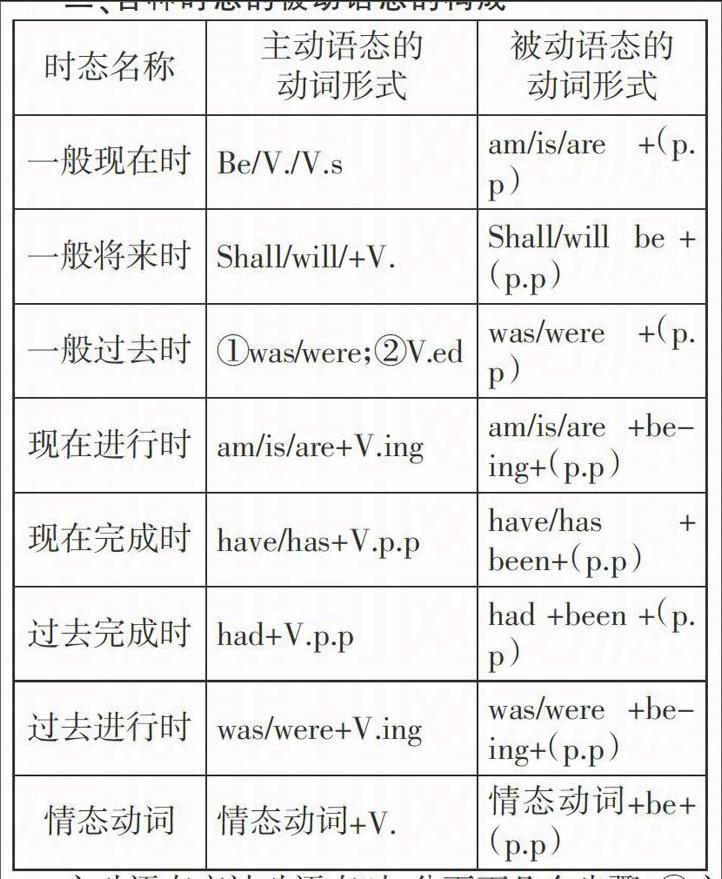
二、各種時(shí)態(tài)的被動(dòng)語態(tài)的構(gòu)成
主動(dòng)語態(tài)變被動(dòng)語態(tài)時(shí),分下面幾個(gè)步驟:①主動(dòng)語態(tài)句中的賓語變成被動(dòng)語態(tài)句中的主語;②主動(dòng)語態(tài)中的動(dòng)詞改為相應(yīng)時(shí)態(tài)的被動(dòng)語態(tài);③主動(dòng)語態(tài)句中的主語成為被動(dòng)語態(tài)句中的動(dòng)作的發(fā)出者;④句子的其他成分(定語、狀語)不變。下面舉例說明:
1.一般現(xiàn)在時(shí)和一般過去時(shí)的被動(dòng)語態(tài)
一般現(xiàn)在時(shí):am/is/are+pp.;一般過去時(shí):was/were+ PP.例句:
a.主動(dòng):The students gave the foreign guests a warm welcome.
被動(dòng):The foreign guests were given a warm welcome by the students.
b.主動(dòng):The students regard him as their monitor.
被動(dòng):He is regarded as the students' monitor.
以上兩例都是一般時(shí)態(tài)用“be done”的例子,be有人稱、時(shí)態(tài)、數(shù)量變化,第三人稱“foreign friends"是復(fù)數(shù),時(shí)態(tài)一般過去時(shí),所以“be done”就是“were given”,而“The students regard him as their monitor”一句,被動(dòng)后的“be done”就變成單數(shù)第三人稱“is regarded”的形式了。
2.完成時(shí)態(tài)的被動(dòng)語態(tài)
(1)現(xiàn)在完成時(shí):Have/has been+ pp.
例句:a.主動(dòng):We have studied English for 3 years.
被動(dòng):English has been studied for 3 years by us.(“have”隨新主語變?yōu)椤癶as”)
b.主動(dòng):They have warned us to be careful of rats
被動(dòng):We have been warned to be careful of rats by them.
(2)過去完成時(shí):had been+pp.
例句:
a.主動(dòng):Somebody had cleaned the classroom.
被動(dòng):The classroom had been cleaned by somebody.
h.主動(dòng):They had build three buildings by last year.
被動(dòng):By last year three buildings had been built by them.
3。一般將來時(shí)的被動(dòng)語態(tài)
Will/shall/be+pp.
例句:
a.主動(dòng):We shall build several big modem schools in our city next year.
被動(dòng):Several big modern school will be built in our city next year.
(“shall do”中的“shall”要隨新主語變?yōu)椤皐ill",“do”要變?yōu)椤癰e done")
b.主動(dòng):They will ask you a lot of strange questions.
被動(dòng):You will be asked a lot of strange questions by them.
被動(dòng)句中的“by”引出的賓語,一般說來,如果是人稱代詞你、我、他等,要用賓格形式;如果是名詞,不能省略。
4.過去將來時(shí)的被動(dòng)語態(tài)
過去將來時(shí),過去某時(shí)將發(fā)生:would/should be+pp.
例句:
a.主動(dòng):l never thought that he would bring me the information so early.
b.被動(dòng):I never thought that the information would be brought to me so early.
5.現(xiàn)在進(jìn)行時(shí)和過去進(jìn)行時(shí)的被動(dòng)語態(tài)
現(xiàn)在進(jìn)行時(shí)的被動(dòng)語態(tài):am/is/are+being+pp、過去進(jìn)行時(shí)的被動(dòng)語態(tài):was/were+being+pp.
例句:
a.主動(dòng):Uncle Wang is repairing the radio.
被動(dòng):The radio is being repaired by Uncle Wang.
b.主動(dòng):They were having a meeting at that time.
被動(dòng):A meeting was being had at that time.
6.情態(tài)動(dòng)詞的被動(dòng)語態(tài)
情態(tài)動(dòng)詞+be +pp.
例句:
a.主動(dòng):We must keep this in? mind.
被動(dòng):This must be kept in mind.
b.主動(dòng):We shall not use the washing machine again.
被動(dòng):The washing machine will not be used again.
(原來的謂語“shall use”在被動(dòng)態(tài)中隨新主語變?yōu)椤皐ill")
c.主動(dòng):We are going; to paint the desk yellow.
被動(dòng):The desk are going to be painted yellow.
d.主動(dòng):You neednt type this letter.
被動(dòng):This letter need not be typed.(“need"是不變助動(dòng)詞)
7.被動(dòng)語態(tài)的否定和疑問
在否定句的被動(dòng)態(tài)中,否定副詞“not”一定加在第一助動(dòng)詞之后,不放在別的助動(dòng)詞之后。同樣,在疑問句的被動(dòng)態(tài)中,第一助動(dòng)詞置于主語之前。
例句:
a.Why has(一助)not anything been(二助)done to stop air pollution?
(“not”必須放在第一助動(dòng)詞“has”之后,第一助動(dòng)詞“has”必須放在主語“anything”之前。絕不可寫成: Why has not been anything done to end the strike?或Why has been not anything done to stop air pollution?)
b. The exercise will not be done in class.
不可寫成:The exercise will be not done in class.
8.含有雙賓語主動(dòng)詞的被動(dòng)語態(tài)
在用于被動(dòng)結(jié)構(gòu)時(shí),有些動(dòng)詞可以帶雙賓語。在這種情況下,主動(dòng)結(jié)構(gòu)中的間接賓語變?yōu)橹髡Z時(shí),直接賓語仍然保留在謂語后面;直接賓語變?yōu)橹髡Z時(shí),間接賓語前通常加上介詞for/to。
例l:My father gave me a gift on my tenth birthday.
I was given a gift on my tenth birthday by my father.
A gift was given to me on my tenth birthday by my father.
這類動(dòng)詞有g(shù)ive(給),pass(遞),hand(傳給),show(展示),teach(教),send(寄)等。
例2:Father bought me a watch
I was bought a watch by father
A watch was bought for me by father
這類動(dòng)詞有buy(買),make(制造),fetch(取),do(做)。
9.含有不帶to的動(dòng)詞作賓語補(bǔ)足語的被動(dòng)語態(tài)
有些動(dòng)詞后跟不帶to的不定式作賓語補(bǔ)足語,但改為被動(dòng)結(jié)構(gòu)后要加上“to"。
例句:
a. We heard him??; sing in the room just now.
-He was heard to sing in the room just now.
b. The boss made them work for 12 hours a day.
-They were made to work for 12 hours a day bythe boss.
三、被動(dòng)語態(tài)的用法
1.不知道或不必說出動(dòng)作的執(zhí)行者時(shí)使用被動(dòng)語態(tài)
例句:
When was the window broken?
How is this word book pronounced Book.
A lot of English grammar books will be published next year.
2.強(qiáng)調(diào)動(dòng)作的承受者時(shí)使用被動(dòng)語態(tài)
例句:
If you break the school rules,you will be punished.
A new Hope School will be opened in our village.
Our English teacher?is liked by everybody.
3.當(dāng)動(dòng)作的執(zhí)行者不是人而是無生命的事物時(shí)使用被動(dòng)語態(tài)
例句:
The house was washed away by the flood.
We were shocked by the news of his death.
Many accidents were caused by careless driving.
4.為了表示委婉或禮貌,避免提及動(dòng)作執(zhí)行者或說話者自己時(shí)使用被動(dòng)語態(tài)?; 例句:
You've been told many times riot to make thesame mistake.
Everybody is expected to obey the traffic rules.
The house must not be entered without permission.
四、不用被動(dòng)語態(tài)的情況
不及物動(dòng)詞或動(dòng)詞短語無被動(dòng)語態(tài),即多數(shù)的瞬間動(dòng)詞rise,happen,take place等。
例句:
a.(錯(cuò))The price of meat has been risen.
(對)The price has risen.
b.(錯(cuò))The accident was happened last week.
(對)The accident happened last week.
c.(錯(cuò))Great changes have been taken place in the last years.
(對)Great changes have taken place in the last years.
要想正確地使用被動(dòng)語態(tài),就須注意哪些動(dòng)詞是及物的,哪些是不及物的。特別是一詞多義的動(dòng)詞往往有兩種用法。解決這一問題唯有在學(xué)習(xí)過程中多留意積累。
五、使用被動(dòng)語態(tài)時(shí)的注意事項(xiàng)
1.“get+過去分詞”可以表被動(dòng)的意義
例句:
His sister got married three years ago.
The boy got hurt on his way to school.
He got caught in the heavy rain on his way home.
類似短語:get burnt(著火)、get killed(被殺)、get hurt(受傷)、get lost(迷路);get dressed(穿衣服)、get changed(變化)、get married(結(jié)婚)、get washed(洗)等。
2.有些“動(dòng)詞+介詞/副詞”構(gòu)成的固定動(dòng)詞短語變?yōu)楸粍?dòng)語態(tài)時(shí).不可分開
例句:
主動(dòng)語態(tài):We should take good care of the old and the children.
被動(dòng)語態(tài):The old and the children should be taken good care of.
3.有些由“動(dòng)詞+名詞+介詞”構(gòu)成的短語動(dòng)詞.變成被動(dòng)語態(tài)時(shí)也可以將名詞和其后的介詞拆開
例句:
主動(dòng)語態(tài):They make good use of the time.
被動(dòng)語態(tài):Good use is made of the time.
總之,被動(dòng)語態(tài)的用法比較復(fù)雜,大家在學(xué)習(xí)中要注意積累。
