
·In this issue (April 2016)·
2016-04-05 15:44:06
上海精神醫學 2016年2期
·In this issue (April 2016)·
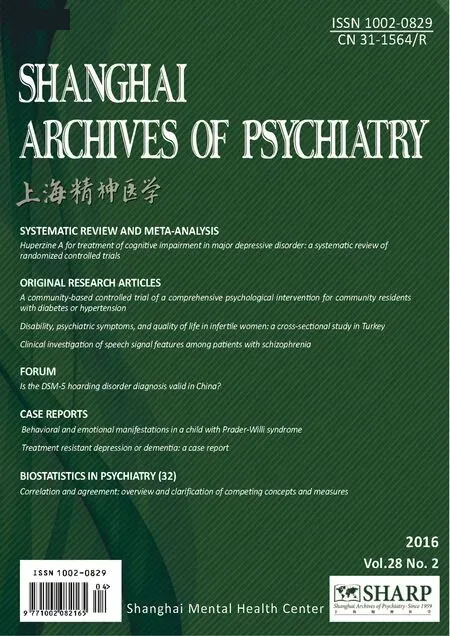
This issue begins with a systematic review and metaanalysis by Zheng and colleagues[1]about the use of a tradional Chinese medicine - Huperzine A (HupA) - as an adjunctive treatment for depression. The rationale for this treatment is that acetylcholinesterase (AChE)inhibitors may reduce the cognitive impairment that often accompanies depressive episodes and HupA is a powerful AChE inhibitor. After an exhaustive literature search in English language and Chinese language journals, the authors only found three randomized controlled trials (with a pooled sample of 238 individuals) comparing monotherapy with an antidepressant to combined treatment with an andepressant and HupA. When pooling results, there was no significant difference between groups in the degree of improvement in depressive symptoms, but there was signi fi cantly greater improvement in cognive funconing in the group that received adjuncve HupA(as assessed by the Wisconsin Card Sorting Test and the Wechsler Memory Scale-Revised). However, the three studies were open label (i.e., non-blinded) and only followed subjects for a mean of 6.7 weeks, so the studies were classified as ‘low-quality’. Thus, more rigorously conducted studies that follow participants longer are needed to con fi rm this important result. This is an example of a common problem in using Tradional Chinese Medicine (TCM): the results are often promising, but the lack of rigorous scienfi c proof limits the acceptance of the results in non-Chinese sengs.
The first original research article by Zeng and colleagues[2]reports on a large community-based intervenon aimed at reducing the severity of depressive and anxiety symptoms in community residents receiving treatment for diabetes or hypertension. China, like other low- and middle-income countries, does not have sufficient psychiatric manpower to provide individualized treatment to persons with chronic illnesses who have comorbid depression or anxiety, so the authors adapted the community-based IMPACT model developed in the United States[3]for use in Shanghai. This approach includes community-based health education about psychological problems, peergroup support for persons with mild depression or anxiety, and individual counseling (using the Problem Solving Treatment for Primary Care[4]method) for those with moderate or severe depression or anxiety. Baseline evaluaons and 6-month follow-up evaluaons using self-compleon instruments assessing depressive symptoms, anxiety symptoms, and quality of life were completed by 3039 individuals in the intervention group and 1239 individuals in the treatment as usual group (i.e., standard follow-up care of chronic physical illnesses). All community members in the intervention communities were exposed to the health education iniave, but parcipaon of eligible individuals in the peer-support groups was low (31%) and participation of eligible individuals in the individual counseling was very low (9%). Nevertheless, after 6 months the improvement in depressive symptoms, anxiety symptoms, and quality of live was significantly greater in the intervenon group than in the control group. This study demonstrates the feasibility of such communitybased interventions for decreasing the severity of comorbid psychological symptoms in persons with chronic physical illnesses, but further work is needed to increase the parcipaon rates in the support services provided for persons with mild and moderate depression and anxiety.
The second original research article by Sezgin and colleagues[5]is a cross-seconal study from urban Turkey that compares self-reported psychological symptoms and disability between 100 married women seeking treatment for inferlity and 100 ferle married women. The authors used Turkish versions of the Hospital Anxiety and Depression Scale (HADS),[6]the Brief Disability Questionnaire (BDQ),[7]and the Short Form Health Survey (SF-36)[8]to compare the self-reported levels of depressive symptoms, anxiety symptoms, disability, and quality of life of the two groups of respondents. The study found no signi fi cant di ff erence in the self-reported levels of depressive or anxiety symptoms, but the respondents in the inferle group reported signi fi cantly greater disability, and a signi fi cantly lower quality of life. Thus western assumpons about the close relaonship between social stressors, psychological symptoms, and funconing may not hold true in non-western countries or for specific types of stressors (such as infertility). But this was a relatively small cross-sectional study;larger, longitudinal studies are needed to con fi rm these interesng results.
The third original research article by Zhang and colleagues[9]considers the possibility of using easily obtained acoustic features of speech (i.e., ‘speech signal features’), which can reflect the emotional responsiveness of the speaker, as biomarkers for schizophrenia. The authors analyzed 10 acoustic features of a 15-minute speech sample obtained by smart phone from 26 inpatients with schizophrenia and compared them to the features of speech samples obtained from 30 healthy controls. They also assessed the severity of the paents’ symptoms at baseline and obtained a second speech sample from the paents one week later. The ten speech signal features (6 prosody features, formant bandwidth and amplitude, and two spectral features) were stable over time (intraclass correlaon coeffi cients ranging from 0.55 to 0.88), but only two of the features (the two spectral features) were significantly different between patients and controls.There were significant correlations between some of the speech features and the severity of the negative symptoms of schizophrenia. These fi nding provide some support for the potential value of acoustic features of speech as biomarkers for schizophrenia, particularly the negative symptoms of schizophrenia. But larger studies that monitor the acoustic features over time as patients’ symptoms wax and wane are needed to determine whether or not these features can accurately differentiate persons with and without schizophrenia,and whether or not they can be used as markers of the severity of the illness.
The Forum by Wang and colleagues[10]addresses a perennial issue: whether or not the diagnostic criteria for a condition described in the 5th edition of the American Psychiatric Association’s Diagnostic and Stascal Manual (DSM-5)[11]are culturally appropriate for China. China had previously developed its own psychiatric classification system -CCMD3[12]—but this has now been abandoned; in clinical sengs the offi cial recommendation from the government is to use the classification system of the World Health Organization(ICD-10[13]), but most clinical researchers prefer to use the DSM system. However, for certain disorders there are serious concerns about the validity of diagnostic criteria developed for use in the American populaon in other cultural sengs. In this parcular case the authors discuss hoarding disorder which has been ‘upgraded’from one of the symptoms of obsessive-compulsive disorder in the 4thedition of the DSM (DSM-IV)[14]to a separate disorder under the ‘Obsessive-Compulsive and Related Disorders’ chapter of DSM-5. The raonale for this change was that research that was primarily conducted in the United States and other Western countries had found distinct differences between the clinical symptoms, family history, and neuroimaging characteriscs of individuals with pathological hoarding and those with obsessive compulsive disorder in the absence of hoarding. Aer review of available literature from China and other East Asian countries, the authors conclude that pathological hoarding is relatively common in East Asia and that the DSM-5 classi fi caon of this as a separate disorder is justified in East Asia. However, they cauon that in countries like China with a recent history of material scarcity, thriiness is oen a culturally sanctioned trait, so the hoarding behavior needs to be associated with significant distress and with substantial social impairment before it should be considered a psychiatric diagnosis.
The first case report from India by Satyakam and Panda[15]is about a 9-year-old girl with Prader-Willi syndrome who was brought to a psychiatric hospital by her family because of serious behavioral problems including irritability, emotional lability,and temper tantrums. The family reported delayed motor and language development, over-eating, and unexplained emotional outbursts. On physical exam she was obese (BMI of 43), had small hands and feet,almond-shaped palpebral fissures, and self-inflicted excoriated skin lesions. She had an IQ of 40, but the computed tomography of her brain was normal. Diagnosed with Prader-Willi syndrome based on the clinical presentation, she was treated with low-dose antipsychotics (risperidone 1mg/d). After 8 weeks of treatment the behavioral outbursts and self-injurious behavior improved significantly. In low- and middleincome countries without the resources to conduct sophisticated genetic testing, the diagnosis of such rare conditions depends on the correct identification of the typical clinical symptoms; given the unfamiliarity of most clinicians with such conditions, it is likely that many of them remain undiagnosed and untreated.
The second case report by Shi and colleagues[16]discusses an increasingly common dilemma in China as the populaon ages: di ff erenang chronic, treatmentresistant depression from the early onset of demena. In this case of a 78-year-old woman with previous episodes of major depression, the clinical picture was complicated by her long-term use of a reserpine-based hypertensive. She presented with typical symptoms of both depression and dementia; after 8 weeks of inpatient treatment (including changing her antihypertensive medication) the depressive symptoms improved but the cognitive symptoms did not. She subsequently developed cancer at which point the depressive symptoms exacerbated. The authors conclude that in such complicated cases of elderly patients with symptoms of both depression and demena it will oen be necessary to follow the course of the symptoms for one or two years before it can be determined whether the cognitive symptoms are secondary to depression or a newly emerging demena(or both).
The Biostatistics in Psychiatry paper by Liu and colleagues[17]discusses an important topic that is oen misused by statistically-challenged researchers: the difference between agreement and correlation. The degree of agreement between variables is assessed when considering the relationship between variables that are di ff erent measures of the same construct; the level of correlaon between variables is assessed when considering the relationship of variables that measure different constructs. The authors discuss the different statistics used to evaluate these two measures of association, emphasize the importance of considering the distribution of the variables being considered(continuous or non-continuous), and provide several examples of the issues than need to be considered when assessing commonly used measures of associaon such as the Pearson correlation coefficient and the intraclass correlaon coeffi cient.
[Shanghai Arch Psychiatry. 2016; 28(2): 61-63. doi: hp://dx.doi.org/10.11919/j.issn.1002-0829.216050]
1. Zheng W, Xiang YQ, Ungvari GS, Chiu HFK, Ng CH, Wang Y,et al. Huperzine A for treatment of cognitive impairment in major depressive disorder: a systematic review of randomized controlled trials.Shanghai Arch Psychiatry. 2016; 28(2): 64-71. doi: http://dx.doi.org/10.11919/ j.issn.1002-0829.216003
2. Zeng QZ, He YL, Shi ZY, Liu WQ, Tao H, Bu SM, et al. A community-based controlled trial of a comprehensive psychological intervention for community residents with diabetes or hypertension.Shanghai Arch Psychiatry. 2016; 28(2): 72-85. doi: http://dx.doi.org/10.11919/ j.issn.1002-0829.216016
3. Katon W, Unutzer J, Wells K, Jones L. Collaborative depression care: history, evolution and ways to enhance dissemination and sustainability.Gen Hos Psychiatry. 2010; 32(5): 456-464. doi: http://dx.doi.org/10.1016/ j.genhosppsych.2010.04.001
4. Hegel M, Areán P.Problem-solving Treatment for Primary Care: A Treatment Manual for Project Impact. (Thesis dissertaon). Dartmouth University; 2003
5. Sezgin H, Hocaoglu Cicek, Guvendag-Guven ES. Disability,psychiatric symptoms, and quality of life in inferle women:a cross-seconal study in Turkey.Shanghai Arch Psychiatry. 2016; 28(2): 86-94. doi: http://dx.doi.org/10.11919/ j.issn.1002-0829.216014
6. Aydemir O, Guvenir T, Kuey L, Kultur S. [Reliability and validity of the Turkish version of the Hospital Anxiety and Depression Scale].Turk Psikiyatri Derg.1997; 8(3): 280-287. Turkish
7. Kaplan I. [The relationship between mental disorders and disability in patients admitted to the semi-rural health centers].Turk Psikiyatri Derg. 1995; 6(2): 169-179. Turkish
8. Ko?yigit H, Aydemir O, Fisek G, Olmez N, Memis A. [The reliability and validity of the Turkish version of Short Form-36 (SF-36)]. ?la?ve Tedavi Dergisi.1999; 12(3): 102-106. Turkish
9. Zhang J, Pan ZD, Gui C, Zhu J, Cui DH. Clinical invesgaon of speech signal features among paents with schizophrenia.Shanghai Arch Psychiatry. 2016; 28(2): 95-102. doi: hp:// dx.doi.org/10.11919/j.issn.1002-0829.216025
10. Wang Z, Wang Y, Zhao Q, Jiang Kd. Is the DSM-5 hoarding disorder diagnosis valid in China?Shanghai Arch Psychiatry. 2016; 28(2): 103-105. doi: http://dx.doi.org/10.11919/ j.issn.1002-0829.215054
11. American Psychiatric Associaon.Arlington VA: American Psychiatric Associaon; 2013
12. Chinese Medical Association. [Chinese Mental Disorders Classi fi caon and Diagnosc Criteria, Third Edion (CCMD-3)]. Jinan: Shandong Science and Technology Press; 2001. Chinese
13. World Health Organization.The ICD-10 Classification of Mental and Behavioural Disorders: Clinical Descripons and Diagnosc Guidelines. Geneva: World Health Organizaon;1992
14. American Psychiatric Associaon.Washington, DC: American Psychiatric Associaon; 1990
15. Satyakam M, Panda UK. Behavioral and emotional manifestations in a child with Prader-Willi syndrome.Shanghai Arch Psychiatry. 2016; 28(2): 106-109. doi: hp:// dx.doi.org/10.11919/j.issn.1002-0829.215110
16. Shi ZY, Xiao SF, Li X. Treatment resistant depression or dementia: a case report.Shanghai Arch Psychiatry. 2016; 28(2): 109-114. doi:http://dx.doi.org/10.11919/ j.issn.1002-0829.215085
17. Liu JY, Tang W, Chen GQ, Lu Y, Feng CY, Tu XM. Correlaon and agreement: overview and clarification of competing concepts and measures.Shanghai Arch Psychiatry. 2016; 28(2): 115-120. doi: http://dx.doi.org/10.11919/ j.issn.1002-0829.216045
- 上海精神醫學的其它文章
- Treatment resistant depression or dementia: a case report
- Behavioral and emotional manifestations in a child with Prader-Willi syndrome
- Is the DSM-5 hoarding disorder diagnosis valid in China?
- Clinical investigation of speech signal features among patients with schizophrenia
- Disability, psychiatric symptoms, and quality of life in infertile women: a cross-sectional study in Turkey
- A community-based controlled trial of a comprehensive psychological intervention for community residents with diabetes or hypertension