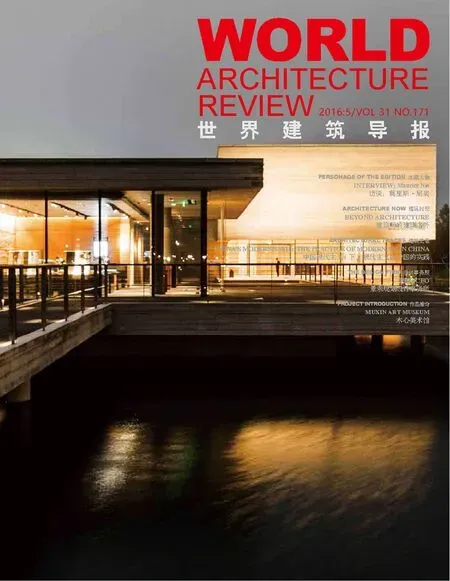
莫里斯 · 尼奧
2016-11-19 03:47:03
世界建筑導報 2016年5期
莫里斯 · 尼奧
Maurice Nio
簡介
莫里斯 · 尼奧(1959年出生)1988年作為建筑師以優異成績畢業于代爾夫特科技大學建筑學院,負責當年最令人好奇的也是最后一個項目--邁克爾·杰克遜別墅。這個項目對他的混合方法是至關重要的。通過虛構與務實的精神過程的混合,神秘同時完全透明的設計策略,他在BDG建筑設計師事務所(1991-1996)完成了很多項目,如巨大的avitwenteavitwente垃圾焚燒爐。在VHP stedebouwkundigen Architekten landschapsarchitekten建筑設計師事務所(1997-1999年)他實現了zuidtangent運輸線,歐洲最長、優質的公共交通線路。從2000年1月1日起他開始經營自己的尼奧建筑師設計工作室,目前正負責荷蘭世界上最美麗的購物中心和最朦朧的游艇。尼奧莫里斯在國內外作了許多講座,但他決定不想在文科院校或大學做老師。他想再次寫書,或者進行他第九個視頻制作,或者寫關于城市發展、建筑、電影、視頻、電視、攝影、舞蹈的新文章。不管怎樣,他的成績還是他的書,《你有權保持沉默》(1998)、《看不見我悄悄溜走了》(2004)和很快出版的《從現在開始事事難》(2015)。
CurricuIum Vitae
Maurice Nio (1959) graduated cum laude as an architect in 1988 at the Faculty of Architecture of the Delft University of Technology on a villa for Michael Jackson, the most curious final project of that year. This project has been of vital importance to his hybrid approach. Through a mixture of mythological and pragmatic mental processes, cryptic and at the same time utterly transparent design strategies, he has realized projects at BDG Architekten Ingenieurs (1991-1996), such as the enormous waste incinerator aviTwente. At VHP stedebouwkundigen +architekten +landschapsarchitekten (1997-1999) he realized the Zuidtangent, the longest high-quality public transport line in Europe. As from January 1st, 2000 he operates from his own design studio NIO architecten and currently works on the most beautiful shopping centre in the world and the most obscure houseboat in the Netherlands. Maurice Nio gives many lectures home and abroad, but has decided he no longer wants to be a teacher on art schools, academies or universities, and would like to design books again, or make his ninth video production, or else write new articles on urban development, architecture, film, video, television, photography or dance. Achievements anyway are his books You Have the Right to Remain Silent (1998), Unseen I Slipped Away (2004)and soon Things Won't Be Easy From Here On Out (2015).
邁向充分的魯本斯特征
1988年我翻譯了讓·鮑德里亞的書《美國》(1986年出版)。這是一本充滿了瑣碎而爆炸性的、半夢半醒、半新聞評論的書,一本偽裝成一個看似無目的隨想炸彈的書。讓·鮑德里亞他的《冷酷的記憶》(1987出版)中對《美國》這本書進行了回顧:
對于書《美國》只有一個辦法:一個特定的時間按一定數量收集的片段、筆記和故事,必須有一個解決方案把他們串聯成,不進行任何添加或刪除(包括最平庸的)一個必要的整體:在表面之下,支配他們的收集非常必要。假定這是唯一的和最好的素材,因為它是由相同的思維秘密編排的,并假設作為相同的癡迷部分所隱藏的都有意義,并且重構問題必須有解決方案。作品確定,一切都已經存在,只有找到解決問題的鑰匙就夠了。
當我讀到這一點的時候,我就要畢業了,但直到許多年之后,我才開始領悟那一句話的精髓。頓時我如釋重負,就是連貫性的問題。畢竟,對于連貫性的欲望無處不在、伸手可及,尤其是在作家、藝術家、建筑師等的圈子中更是如此。因為如果你不設法處理一個連貫的作品,那你是什么啊?正如鮑德里亞,在某一點上,我開始想知道所有這些不同和所有的太多樣化項目,由一個(幾個)人完成的—無與倫比的視頻制作,無與倫比的文本,無與倫比的圖形設計,無與倫比的建筑—有著共同的點。一個局外人無法理解。至少這是很好的想象,那種無法實現的感覺開始折磨著我。大多數建筑師都設法建立一個美麗連貫的風格,而我的每一個項目似乎都在抹去前一個項目的記憶和印象。就好像是你不斷地燃燒你所有建筑、電影、圖形和文本的船。幸運的是,現在的連貫性的重要性不再困擾我了。在寫了《獨立自主與標新立異》內容之后,但實際上已經在1988年(《美國》荷蘭翻譯版出現后10年)編寫《你有權保持沉默》中就有了。我明白在風格、形式和明確表達中找不到連貫性,但可以在方法、結構和含蓄表達中可以找到。這也正是概念如“主題”和“編碼”之間的確切區別。在《獨立自主與標新立異》中,我反對他們互相對立。設計一個主題的或隱喻,或故事依據,總是針對一個外部的連貫性,而設計編碼的依據時,針對的是內部的連貫性,不是直接可見的連貫性。設計編碼依據無法在機構上、因果關系上或明確的方法上完成。這個過程是異想天開的、憑直覺的、沖動的、含蓄的。因此,你不能說一個進化,因為沒有發展;設計總是在那里。它在那里等著你,盡管設計的過程需要很多年。所有你需要做的是找到設計和解開其編碼。所有這些項目可以如此不同,因為他們有相同的意圖和動機。
除了連貫性概念之外,也有對語境的具體認識。全部項目與人們可能認為的相反,與環境緊密相關。對我來說,上下文和代碼是兩個關鍵的概念。如果人們說項目不適合環境,當然是對的。我們的建議是不把環境為一個環境或背景對待,但作為一個對手,另一個球隊的隊員,你必須解決的問題。是在上下文和代碼之間,在環境和項目之間建立緊張的唯一方法。在這種緊張關系中,作為一個用戶或路人,你可以獲得經驗。可能對于很多人來說這就是為什么他們好像是抽象的。
除了這兩關于連貫性和環境概念之外,連貫性和環境我想要顛倒一下;還有自然需要、無法表達的迫切要求、應分離的深層欲望。與“分離”我指破壞、拙劣模仿、嘲笑、激進;所有應用于開創新基礎的方法以創造新的可能性,打開大門,而不是關閉大門。作為這一戰略的一個例子,你可以看看題為火皇帝帝的研究,在這個問題上可以看到火皇帝帝的形象。我們已經研究了食物在城市公共領域的中的作用。食品和飲料的補給往往是走出房子進入城市的一個理由。每個人每天都必須吃飯喝水。對于某些人來說,這種日常的購買,烹飪和飲食,甚至成為一種儀式。我們需要的所有這些慣例和現狀把我們緊密聯系在一起,所以食物的親密關系和文化的豐富性變得更清晰,更可見。這是公共和私人生活可以相互極好容忍的地方。我們已經討論了食品供應商和供應商的空間提供者,并與他們在一起,我們制定了十種從非常簡單到更復雜的、從非贏利的到商業上的和從薄利到利潤豐厚的模型。
我們的建議,無論是市場大廳的設計,還是種植果樹的計劃,他們總是在公共和私人之間的區域進行精確的操作。例如商場有私有化和合理化的公共空間的特點,我們用我們的模型來給空間不同的面孔。在公共空間,由于其通用性,失去了城市居民的參與,我們引進當地親切感。
其中的一個模型是火皇帝,鹿特丹市中心的新面貌。火皇帝會是公共生活的支點。沒有人能逃離這個貪婪的建筑,白天和黑夜凝視任何靠近它的東西:天真的游客和經驗豐富的老饕、蒼白的土豆和新鮮的香菜、馴養的鴿子和活魷魚、邋遢的市場攤位和高級餐廳、衣衫不整的音樂家和色情服務、鹿特河水和女招待香味淡去的香水。.一切都被消化,推進和再次鏟出,但是已經在高壓下進行了實質再造。因為它是新的直達市場容納火皇帝的大廳。. 每個人都有東西要找,每個人和東西都準備好了,要對抗火皇帝的廚房的熱。.這就是城市沸騰的地方,人們沿著在異國風味的菜肴的蒸汽前行的地方。
火皇帝里面沒有透明通風的大廳,而是一個大的吞食機,腸道激發的享樂糾結的空間。提供的食物的令人眼花繚亂的多樣性,體現在室內設計的節日精神。這好像是市場本身已經被所有的各民族風格的內飾所充實豐滿。一個老掉牙的德國表現主義的空間正在被一種朦朧的泰國新時代間空間所替換。市場大廳來者不拒,食用另一種文體的絕技之后打薄嗝。
火皇帝位于斯坦格,在戰爭爆發前,曾是鹿特丹最神秘的地方之一,但現在看起來荒涼而失落。這就是為什么我們把不必要的大運河進入室內,散落著火熱的舢板和著名的黑洞—入口到“格羅特市場”下的運河被重新開放,這樣市場大廳有了水平面入口。轉動它,你可以說,火皇帝內部在水中延續,所以戰前的饑餓城市,那深不可測的暴飲暴食的斯坦格,可以滿足了。改善的外部市場通過火皇帝改變成運河上新浮動市場,可以嘗到了運河上小舢板上的食物流的秘密。
我喜歡以不常規的方式調查主題,從不同的角度收集所有的片段。我不知道這種設計政策是否可以被稱為典型的荷蘭,但我相信我不是唯一一個有這樣的感覺的人。
當然,在荷蘭不是所有更新項目都是同樣成功,但我更喜歡(在這件事上我有話要說)詢問失敗的項目,而不是一個“成功”的建筑這個或那個問題。
另外一個很難回答的問題是,出現問題你會冒很多風險。即使你提出簡單的事情,問題也會出現。問題在簡單的項目中等待著處理。問題也會從意想不到的角度突然出現。這兩個問題都是最大的危機。第一個是開發商,發展承包商,他們已經成為建筑師的最大的敵人。作為未來的用戶和客戶的代表,他們服務的共同點,并扼殺所有的可能性和所有可能的萌芽狀態的新的計劃或生活形式。第二是監理,作為項目經理代理接管調試機構,由于項目經理缺乏調試知識。這些項目經理的唯一目標是按時和預算內完成項目。這當然是好的,但它完全忽略了建筑的文化方面。項目經理也沒有能力給你信任。甚至也不允許他,因為不信任建筑師欺詐或類似的,是項目經理的任務。然而,信任始終是一個真正的好項目的基礎。
建筑學比僅僅按時和在預算內完成項目更重要建筑學是靈魂的本性行為,一種與地球的至關重要的協定。建筑與地心引力綁定,并能夠體現這個綁定結合。像素或頂點做不到。除了一些自然的山之外,建筑是外化引力的最佳媒介。看看我們的教堂和宮殿:多么強大的吸能顯示,地心引力多么美妙,地心多么什么艷麗。我個人認為,建筑和重力之間的結合是感性空間的秘密。虛擬的一切都是無效的、膨脹的、不受影響的。一切真實的都是精力充沛的、至關重要的、致命的。像素和頂點是不性感的,也不是感性的。整個所謂的“性、政治和經濟”領域的所謂虛擬“優勢”,都是一個無聊的、呆板的混亂。我寧愿走在街上或在一個建筑內,而不是在網絡空間中。你可以說,建筑學只是當今越來越重要,我們不得不精確布置建筑,作為一種媒介,作為一種手段,而不是尋找輕質的,透明的,瘦小的,干燥的和民主的,而是沉重的,不透明的,這具有主宰一切的,精力充沛的和充分魯本斯特征的。

作品:火皇帝
TOWARDS THE RUBENESQUE FULL
In 1988 I translated Jean Baudrillard’s book Amérique (1986). It is a book full of small but explosive, half dream-like, half journalistic observations, a book disguised as a seemingly unaimed mental fragmentation bomb. In Cool Memories (1987)Baudrillard looks back on this book:
‘’For America, only one method: given a certain number of fragments, notes and stories collected over a given time, there must be a solution which integrates them all, including the most banal, into a necessary whole, without adding or removing any: the very necessity which, beneath the surface, presided over their collection. Making the supposition that this is the only material and the best, because it is secretly ordered by the same thinking, and assuming that everything conceived as part of the same obsession has a meaning and that there must necessarily be a solution to the problem of reconstituting it. The work starts out from the certainty that everything is already there and it will be sufficient simply to find the key.’’
When I read this, I was graduating, but it was not until many years later that the essence of that statement started to dawn on me. And immediately an enormous weight fell off my shoulders- the weight of coherence. After all, the desire for coherence is everywhere and always tangible, especially within the circle of writers,artists, architects etc. Because what is it that you are if you cannot even manage to build a coherent oeuvre? Just like Baudrillard, at a certain point I started to wonder what all those different, all too diverse projects- incomparable video productions,incomparable texts, incomparable graphic designs, incomparable buildings- made by (or around) one person, had in common. An outsider cannot make any sense of it. At least that is very well imaginable, and that feeling of being unpursued started to gnaw at me. Where most architects have managed to build a beautifully coherent style, with me every project seems to erase the memory and the image of the previous one. As if you are constantly working on burning all your architectural,cinematic, graphic and textual boats. Fortunately, now the weight of coherence does not bother me anymore. After writing the text ‘Sovereignty & Singularity’, but actually already during the production of the book You Have the Right to Remain Silent in 1998 (ten years after the appearance of the Dutch translation of Amérique)I understood that coherence could not be found in style, form and the explicit, but in method, structure and the implicit. That is also precisely the difference between notions such as ‘theme’ and ‘code’. In ‘Sovereignty & Singularity’ I have opposed them against each other. To design on the basis of a theme- or metaphor, or story- is always aimed at an external coherence, while designing on the basis of a code is aimed at an internal coherence, a coherence that is not directly visible. To design on the basis of a code cannot be done in a structural, causal or explicit way. The process is whimsical, intuitive, impulsive, and implicit. You can therefore not speak of an evolution because there is no development; the design was always there. It was there waiting for you, even though the process of designing can take many years. All you need to do is to find the design and decode its code. All these projects can thus be so different because they share the same intention and motive.
Besides the notion of coherence, there is also a peculiar awareness of context. All projects are, contrary to what people might think, very contextual. To me, context and code are the two key notions. But of course they are right if people state that the projects do not adjust to the environment. Our proposals do not treat the context as an environment or background, but as an opponent, a player of the other team,something you have to tackle. It is the only way to build up a tension between context and code, between environment and project. Within that tension, as a user or passer-by, you could acquire an experience. Maybe that is the reason why, for many people, they seem ‘abstract’.
Except these two notions of coherence and context, which I like to turn upside down,there is this natural need, this unexplainable urge, this deeper desire to detach. And with ‘detach’ I mean to disrupt, to parody, to ridicule, to radicalise; all methods that are applied to break new ground, to create new possibilities, to open doors instead of closing them. As an example of this strategy you may look to the research entitled the Fire Emperor whose images can be seen in this issue. We have doneresearch into the role that food plays in the urban public domain. The supply of food and drink are often a reason to go out of the house, into the city. Everybody has to eat every day. For some, this daily routine of buying, cooking and eating has even become a ritual. All these routines and actualities we want to bring closely together,so the intimacy and cultural richness of the food becomes clearer, more visible. That is where the public and the private life can tolerate each other wonderfully. We have talked to food suppliers and providers of space and together with them we drew up ten models varying from very simple to more complex, from non-profit to commercial, from lean to fat.
Our proposals, whether that is for the design of a market hall or for the plan for planting fruit trees, they always operate exactly on that area between public and private. Where for example shopping malls have the character to privatise and streamline the public space, we use our models to give the space different faces. And where the public space, because of its generic character, has lost the involvement of the townsman, we introduce local intimacy.
One of those models is the Fire Emperor, the new appearance in the heart of Rotterdam’s city centre. The Fire Emperor will be the pivot of public life. No-one can escape from this voracious building that day and night devours anything that comes near: innocent tourists and experienced gluttons, pale potatoes and fresh coriander,tame pigeons and live squid, raunchy market stalls and exclusive restaurants, wornout musicians and erotic services, the water of the ‘Rotte’ and the faded perfumes of waitresses. Everything is being digested, pushed along and shovelled out again,but not before it has been substantially reshaped under high pressure. Because it is the new non-stop market hall that houses in the Fire Emperor. Everybody has something to look for here, and everybody and everything is prepared to defy the heat of the kitchen in the Fire Emperor. This is where the city boils and where people travel along on the vapours of exotic dishes.
The Fire Emperor has no transparent airy hall on the inside, but is one big devouring machine, a hedonic tangle of spaces inspired on intestines. The dazzling diversity of the food on offer is reflected in the festive spirit of the interior design. It is as if the market hall itself has been fattened with interiors that have all nationalities and styles. A corny German-expressionist space is being alternated with an obscure Thai-New Age room. It is a market hall that is not embarrassed of anything and that burps nicely after having consumed yet another stylistic tour de force.
The Fire Emperor is situated on ‘het Steiger’, a spot that, before the war, was one of Rotterdam’s most mysterious places but now looks desolate and deluded. That is why we have converted this needlessly broad canal into an interior, strewn with sizzling sampans, and the famous black hole- the entrance to the canal under the‘Grote Markt’- that was re-opened so that there is an entrance to the market hall on water level. Turning it round, you can say that the interior of the Fire Emperor is being continued in the water, so the pre-war hunger, that unfathomable gluttony of‘het Steiger’, can be satisfied. The stream of food from the improved outside market is, as it where, being diverted via the Fire Emperor to the new floating market in the canal, where, on those sampans, the secret can be tasted again.
I like to investigate topics in not a conventional way, to collect all the fragments from different points of view. I don’t know if this design-politics could be called typically Dutch but I am sure I am not the only one who feels about it this way.
Of course not all renewing projects in the Netherlands are equally successful, but I prefer (insofar as I have something to say in this matter) a failed project in which questions were asked rather than a ‘successful’ building that is neither one thing nor the other.
Another question which is rather difficult to answer is the problems which arise when you take many risks. Problems will arise anyway, even when you propose simple things. Problems are waiting for you inside simple projects. Problems can arise suddenly, from unexpected angles. But two problems are the biggest ‘downturns’. The first downturn is the developers, the developing contractors; they have become the architect’s biggest enemies. As representative of future users and clients,they serve the common denominator and nip all possibilities, all possible new programs, all new forms of living or exchange, in the bud. The second downturn is the consultancies, the agents that as project managers have taken over the role of commissioning authority due to a lack of knowledge of the latter. These project managers’ sole aim is to realise the project in time and within the appointed budget. Which is fine of course, but it completely ignores the cultural aspects of architecture. A project manager is also not capable of giving you trust. He is not even allowed to,because it is his task to distrust the architect of fiddling, or something like that. Trust,however, is always the base for a real good project.
Architecture is more then merely ‘on time’ and ‘within budget’. Architecture is fundamental act of the soul, an essential pact with the earth. Architecture is bound to gravity and capable of embodying this union. A pixel or a vertex cannot do this. Apart from something as natural as mountains, architecture is the best medium to externalise gravity. Look at our churches and palaces: what an absorbing display of power, what a glorification of the gravity, what a voluptuous ode to the centre of the earth. I personally believe that this union between architecture and gravity is the secret of the sensual space. Everything virtual is impotent, inflationary,immune. Everything real is virile, vital, virulent. A pixel and a vertex are not sexy,not sensual. That entire so-called dominance of the virtual in the fields of sex,politics and economy is one boring, dead mess. I rather walk on the street or in a building than in cyberspace. You could say that architecture is only becoming more important nowadays, but then we have to deploy architecture very precisely as a medium, as a means, and not search for the light, the transparent, the lean, the dry and the democratic, but for the sovereign, the heavy, the turbid, the lusty and the Rubenesque full.

作品:火皇帝
猜你喜歡
北方建筑(2021年6期)2021-12-31 03:03:54
文苑(2020年10期)2020-11-07 03:15:36
現代裝飾(2020年7期)2020-07-27 01:27:42
現代裝飾(2020年6期)2020-06-22 08:43:12
現代裝飾(2020年4期)2020-05-20 08:55:08
流行色(2020年1期)2020-04-28 11:16:38
藝術啟蒙(2018年7期)2018-08-23 09:14:18
海峽姐妹(2017年7期)2017-07-31 19:08:17
Coco薇(2017年5期)2017-06-05 08:53:16
福建農業科技(2016年10期)2016-03-07 09:46:49