基于最優貝葉斯算法的密集RFID網絡迭代檢測技術
2016-12-21 02:24:54朱婭周小林鄭立榮
微型電腦應用 2016年8期
朱婭,周小林,鄭立榮
基于最優貝葉斯算法的密集RFID網絡迭代檢測技術
朱婭,周小林,鄭立榮
食品安全溯源體系正受到社會越來越多的關注,溯源大部分是通過射頻辨識技術(RFID)完成的。倉儲運輸環節呈現密集RFID的環境,如何在這種密集環境中避免沖突地實現信息的準確讀取是很關鍵的問題。提出了一種可降低干擾影響的迭代檢測方案,使用最優貝葉斯交織多址迭代技術,在密集部署了多讀卡器和多標簽的環境中,能有效地改善區域內由于讀卡器檢測范圍重疊干擾而對系統性能造成的不良影響。給出適用于被動RFID反向散射信道的最優貝葉斯迭代檢測算法的計算過程與判決公式,通過Matlab仿真證明了該算法在不同調制方式下對提升系統性能均有良好表現。
最優貝葉斯算法;射頻識別(RFID);交織多址技術
0 引言
近年來隨著農業物聯網應用的廣泛普及,由其衍生出的食品安全溯源問題開始越來越受關注。在各類溯源體系中的倉儲和運輸環節中,幾乎都會遇到在密集RFID(Radio Frequency Identification)環境下的檢測問題。在此環境下,多個讀卡器密集排列,要求系統在一定時間內準確識別大量RFID標簽內容,標簽記錄貨物的基本信息及從生產到運輸期間生成的所有電子履歷。這就需要系統保證較高吞吐率、較低延遲和實時性。一般的RFID系統在此環境下會出現不同程度的讀卡器沖突和標簽沖突,從而嚴重影響接收數據的準確性。
RFID網絡中沖突問題可分兩類[1]:(1)標簽之間的沖突:多個標簽同時響應讀卡器的查詢命令,讀卡器接收到疊加的各路信號,導致信號沖突;(2)讀卡器之間的沖突:多個讀卡器的覆蓋范圍有所重疊,一個標簽同時響應多個讀卡器,造成接收端得到不正確的后果,而解析錯誤。為了最大限度地避免這類沖突,本文提出一種交織多址迭代檢測方案運用最優貝葉斯(Optimal Bayes,OB)算法進行迭代檢測,同時采用交織多址(Interleave Division Multiple Access,IDMA)技術,來實現降低RFID網絡中沖突干擾的目的,降低誤碼率,提升系統整體性能。
1 方案介紹
倉儲系統的RFID一般由多個讀卡器和一個與它們連接的中央處理器組成。這些讀卡器密集部署在一定區域內,中央處理器用來接收和合并信號如圖1所示:


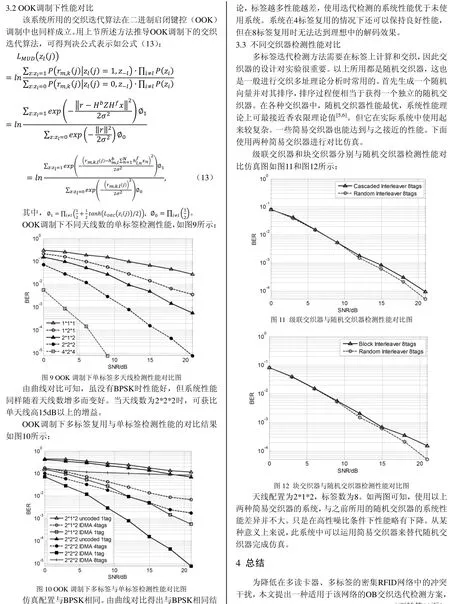
并進行Matlab仿真,通過仿真結果對比分析系統性能。結果表明使用OB交織迭代檢測方案的系統性能明顯優于未使用系統;讀卡器與標簽上設置的天線越多,系統性能越好;在多標簽用戶的情況下,使用該方案可在相同甚至更好的誤碼率條件下實現2-8倍的多用戶復用,用戶越多,系統性能越差。說明所提方案在密集RFID網絡環境下有優化系統性能的良好作用。
[1] Dheeraj K. Klair, Chin K W, Raad Raad. A Survey and Tutorial of RFID Anti-Collision Protocols[J]. IEEE Communications Surveys & Tutorials, 2010, 12.
[2] Ping L, Liu L, Wu K, et al. Interleave division multiple-access[J]. IEEE Transactions on Wireless Communications, 2006, 5(4):938-947.
[3] Shen W, Zhou X, Tu Y. A multi-reader joint detection scheme for dense RFID networks[C]. Solid-State and Integrated Circuit Technology (ICSICT), 2012 IEEE 11th International Conference on. 2012:1-3.
[4] Levin G, Loyka S. From Multi-Keyholes to Measure of Correlation and Power Imbalance in MIMO Channels: Outage Capacity Analysis[J]. IEEE Transactions on Information Theory, 2011, 57(6):3515-3529.
[5] Barbulescu A S, Pietrobon S S. Interleaver design for three dimensional turbo codes[C]. Information Theory, 1995. Proceedings., 1995 IEEE International Symposium on. IEEE, 1995.
[6] Battail G. A conceptual framework for understanding turbo codes[J]. IEEE Journal on Selected Areas in Communications, 2006, 16(2):245-254.
An Iterative Detection Technology for Dense RFID Networks Based on Optimal Bayes Algorithm
Zhu Ya, Zhou Xiaolin, Zheng Lirong
(School of Information, Fudan University, Shanghai 200433, China)
This paper proposes an iteration detection scheme which can effectively decline the impact, to avoid the adverse impact from radio frequency identification (RFID) collision under dense environment in the storage and transportation of traceability systems for food security. In the environment of multiple readers and multiple tags in a high density, by using optimal Bayes interleave division multiple access (IDMA) iterative technology, the adverse impact from overlapped readers can be effectively improved. The paper proposes computation process and decision formula of optimal Bayes iteration detection algorithm applied to passive RFID backscattering channel. Through computer simulation, it is proved that this algorithm behaved well in improve the performance of system under different modulation methods.
Optimal Bayes Algorithm; Radio Frequency Identification (RFID); Interleave Division Multiple Access (IDMA)
TN 92
A
1007-757X(2016)08-0003-05
2016.06.14)
國家科技支撐計劃項目(2015BAD17B00)
朱 婭(1991-),女,復旦大學,碩士研究生,研究方向:物聯網,無線通信等,上海,200433
周小林(1973-),男,復旦大學,副教授,博士,研究方向:物聯網,FSO,迭代接收機等,上海,200433
鄭立榮(1969-),男,復旦大學,教授,博士,研究方向:電子系統設計,上海,200433
猜你喜歡
工業設計(2022年8期)2022-09-09 07:43:20
中學生數理化·七年級數學人教版(2021年6期)2021-11-22 07:50:58
中學生數理化·七年級數學人教版(2021年6期)2021-11-22 07:50:58
中學生數理化·七年級數學人教版(2021年6期)2021-11-22 07:50:58
軍民兩用技術與產品(2021年10期)2021-03-16 06:05:30
中學生數理化·七年級數學人教版(2020年12期)2021-01-18 06:57:46
中學生數理化·七年級數學人教版(2020年12期)2021-01-18 06:57:46
北京測繪(2020年12期)2020-12-29 01:33:58
裝備制造技術(2019年12期)2019-12-25 03:06:46
中國洗滌用品工業(2019年4期)2019-05-11 09:27:34