
紅細胞分布寬度與急性冠脈綜合征相關性的研究
2017-01-19 00:46:45張清盧輝和
四川生理科學雜志 2016年4期
張清 盧輝和
(南通市第一人民醫院心內科,江蘇 南通 226001)
紅細胞分布寬度與急性冠脈綜合征相關性的研究
張清 盧輝和△
(南通市第一人民醫院心內科,江蘇 南通 226001)
目的:研究紅細胞分布寬度(Red distribution width,RDW)與急性冠脈綜合征(Acute coronary syndrome,ACS)患者住院期間發生不良心血管事件的關系,為ACS患者危險度分層提供新的參考指標。方法:選取2011年3月~2015年3月于我院心內科就診的ACS患者130例,按RDW中位數分為高RDW組和低RDW組;同時選取穩定型心絞痛及冠脈造影正常患者100例作為對照組。比較組間住院期間主要不良心血管事件發生情況,包括:再發心肌梗死、心源性死亡、心力衰竭、惡性心律失常、頑固性心絞痛。結果:ACS組的RDW值較對照組明顯增高(P<0.05);高RDW組ACS患者住院期間主要不良心血管事件的總發生率較明顯高于低RDW組(P<0.05)。多因素Logistic回歸分析顯示RDW可作為預測住院期間發生主要不良心血管事件的獨立危險因素(OR:3.683,95%Cl:1.131-11.989,P<0.05)。結論:RDW可作為ACS患者短期預后的獨立預測因素。
急性冠脈綜合征;紅細胞分布寬度;預后
急性冠脈綜合征(Acute coronary syndrome,ACS)包括急性非ST段抬高型、ST段抬高型心肌梗死及不穩定心絞痛,急性期有較高死亡率。如能準確的對ACS患者進行危險度分層,可及早對高危患者提供積極的干預,改善其預后。紅細胞分布寬度(Red distribution width,RDW)是血液常規檢查中常見的指標,主要反映了外周血中紅細胞體積的異質性。一系列臨床試驗顯示RDW與急、慢性心力衰竭患者的預后密切相關。目前普遍認為RDW可作為評估急慢性心力衰竭患者預后的指標[1-3]。RDW是否能作為判斷冠心病尤其是急性冠脈綜合征患者預后的新指標同樣值得我們重視,故本研究選取RDW這項指標,著重研究其與ACS患者短期預后的相關性,并探討可能的機制。
1 臨床資料與方法
1.1 一般資料
收集2011年03月份-2015年03月份入住我院心內科擬診為ACS并行冠脈造影的患者共230例,分為ACS組及非ACS組。其中ACS組共130例,其中女性61例,男性69例,平均年齡66.11±11.21歲;非ACS組共100例,包括冠脈造影正常及穩定型心絞痛患者,女性49例,男性51例,平均年齡60.36±9.71歲。排除標準:臨床資料不齊備者,已知有嚴重肝功能不全,營養不良者,有血液系統疾病者,有惡性腫瘤者,有嚴重感染者,近期接受外科手術及接受輸血或獻血者。
1.2 方法
所有患者入院后記錄一般情況,包括:性別、年齡、高血壓(史)、高脂血癥(史)、2型糖尿病(史)、吸煙(史)等。空腹靜脈血標本于入院后次日清晨采集,檢測紅細胞分布寬度(Red distribution width,RDW)、平均紅細胞體積(Mean corpuscular volume,MCV)、白細胞計數(White blood cell,WBC)、超敏C反應蛋白(High-sensitivity C-reactive protein,Hs-CRP)、尿素氮(Urea nitrogen,BUN)、肌酐(Creatinine,Cr)、總膽固醇(Total cholesterol,TG)、甘油三酯(Triglyceride,TC)、低密度脂蛋白(Low density lipoprotein, LDL-C)、高密度脂蛋白(High density lipoprotein,HDL-C)、腦鈉肽(Brain Natriuretic Peptide, BNP)、胱抑素C(cystatin C, Cys C)等指標。血常規由JT3COULTER(美國COULTER公司)血細胞分析儀測定,血生化結果由日立7600全自動生化儀完成測定。
入院后利用心臟彩色多普勒檢查,檢測左心室射血分數(Left ventricular ejection fraction,LVEF)及左心室舒張末徑(Left ventricular end-diastolic dimension, LVEDD)。所有檢測由同一操作者完成,采用飛利浦公司生產的iE33型彩色多普勒超聲儀。
1.3 記錄30天內主要不良心血管事件的記錄
主要不良心血管事件的記錄包括:心源性死亡、心力衰竭、再發心肌梗死、惡性心律失常、頑固性心絞痛。
1.4 統計學方法
2 結果
2.1 非ACS組與ACS組間一般臨床資料的比較
由表1可見,ACS組的hs-CRP、WBC、BNP、Cys C、RDW較非ACS組之間明顯增高(P<0.05)。
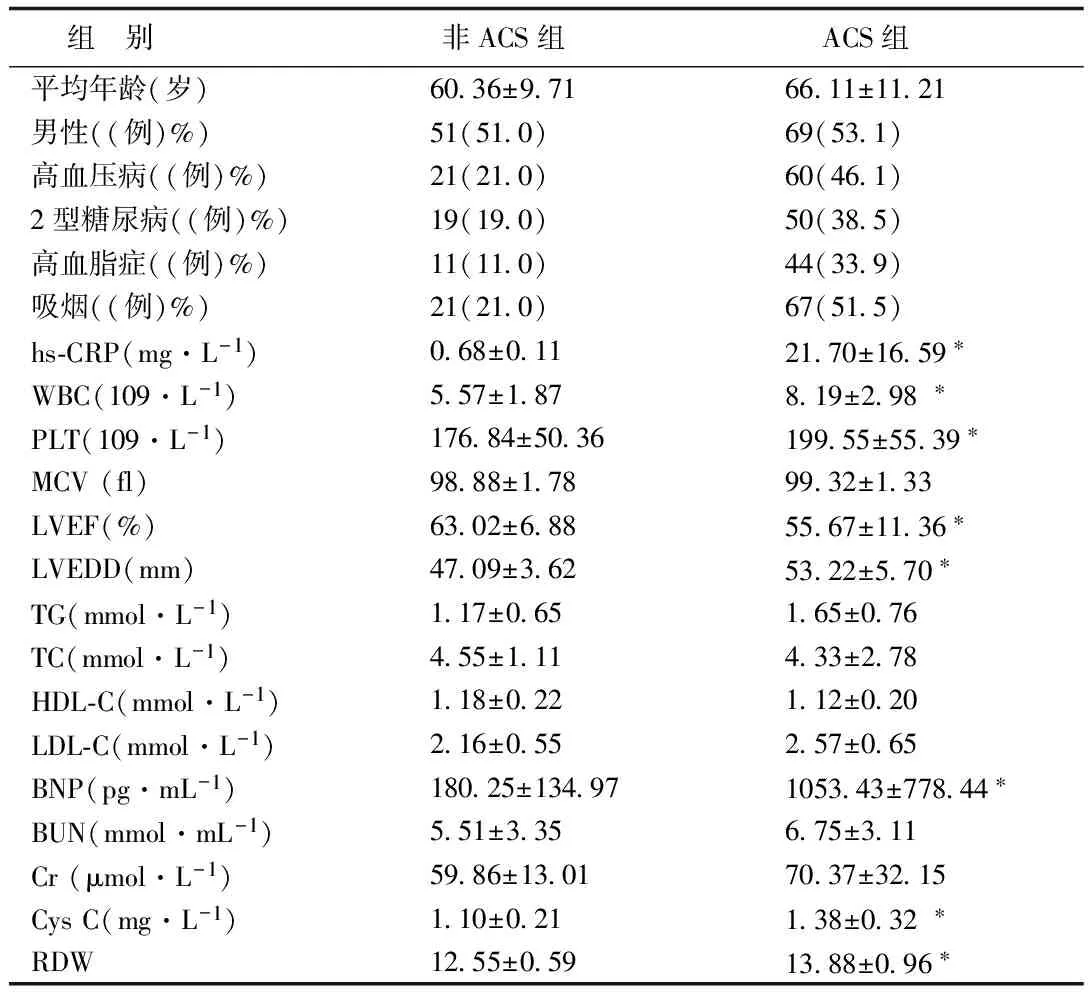
表1 ACS組與非ACS組間一般臨床資料及RDW的比較
注:與非ACS組相比,*P<0.05。
2.2 低PDW組和高PDW組間一般臨床資料的比較
按RDW中位數[4]13.7%分界,將ACS組分為低RDW組(PDW<13.7%)和高RDW組(PDW≥13.7%)。比較組間一般臨床資料及心血管不良事件的發生情況,見表2,3。
由表2可見高RDW組的hs-CRP、BNP、Cy s C較低RDW組之間明顯增高(P<0.05)。由表3可見高RDW組住院期間惡性心律失常、心力衰竭、心源性死亡的發生率及不良事件的總發生率均高于低RDW組,兩組間頑固性心絞痛、再發生心肌梗死率未見明顯差異(P>0.05)。
2.3 ACS患者住院期間發生主要不良心血管事件多因素Logistic回歸分析
將糖尿病史、高血壓病史、高脂血癥病史、年齡、RDW、WBC、MCV、hs-CRP、BNP、CysC、LVEF、LVEDD、TG、TC、HDL-C、LDL-C等因素作為入選變量,以有無發生主要不良心血管事件為因變量,首先進行單因素分析,選擇有統計學意義的變量作為自變量,進行多因素Logistic回歸分析。結果顯示其中RDW、hs-CRP、BNP可作為預測發生不良事件的獨立危險因素。RDW回歸系數為1.315,優勢比(OR)為3.786(P=0.030,95%CI:1.115-9.989),見表4。
3 討論
不穩定斑塊破裂介導的冠狀動脈內血栓形成是ACS的發生的基礎[5],ACS急性期可出現各種并發癥,住院期間死亡率高。所以早期的危險度評估以及積極干預對改善預后顯得尤為重要。RDW是反映外周血中紅細胞體積不均一性的參數,它主要反映紅細胞體積的離散程度。既往臨床上多用于貧血的形態學分類及缺鐵性貧血的鑒別診斷[6]。Felke等人于2007年提出升高的RDW與心力衰竭發病率獨立相關[7]。近幾年一系列研究表明RDW與心力衰竭患者的預后密切相關。本實驗著重研究RDW與ACS患者短期預后的相關性。

表2 低PDW組和高PDW組間一般臨床資料的比較
注:與低RDW組比,*P<0.05。
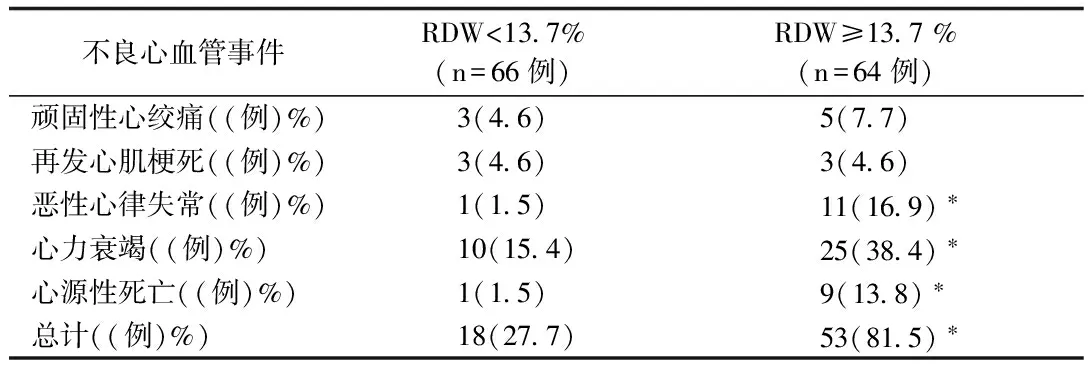
表3 高RDW組與低RDW組主要不良心血管事件發生率的對比
注:與RDW<13.7%組相比,*P<0.05。

表4 ACS患者住院期間發生主要不良心血管事件多因素Logistic回歸分析
本研究中ACS組的RDW值較非ACS組明顯增高。依據中位數將入選的ACS患者分為高RDW組和低RDW組比較各組患者住院期間出現的主要不良心血管事件。高RDW組患者總的不良心血管事件發生率及發生心力衰竭、惡性心律失常、心源性死亡的概率較低RDW組明顯增高,難治性心絞痛和再次心梗的發生率兩者間無統計學差異。多因素Logistic回歸分析發現RDW也可作為ACS患者短期內發生主要不良心血管事件的獨立預測因子。
目前有關RDW與心血管疾病相關的機制考慮有以下幾種可能:①炎癥機制:炎癥反應在心血管疾病中扮演著重要的角色。炎癥介質能抑制紅細胞生成素介導的紅細胞成熟,導致紅細胞成熟障礙,使得紅細胞大小的不均一性增加進而導致RDW增高[8]。②神經內分泌系統的激活:有研究認為神經內分泌系統激活時紅細胞生成加速過快的紅細胞生成導致不成熟的紅細胞提前進入外周血中,導致紅細胞體積的不均一性顯著的提高[9]。③營養代謝障礙:營養代謝障礙使鐵離子、維生素B12、葉酸攝入吸收障礙,紅細胞大小異質性增高[10]。⑥氧化應激:有學者認為紅細胞的代謝與氧化應激有關[11]。
本實驗存在一定的不足之處,如樣本量相對偏少、所研究的時間較短,缺少長期隨訪的資料,無法對研究對象進行遠期預后的評估,同時由于資料收集有限,導致某些系統誤差不可避免。
1 Liu S, Wang P, Shen PP, et al. Predictive values of red blood cell distribution width in assessing severity of chronic heart failure[J]. Int Heart J, 2016, 22(6): 2119-2125.
2 Lukasz W, Daniel R, Joanna B, et al. The prognostic significance of red cell distribution width (RDW) and other red cell parameters in patients with chronic heart failure during two years of observation[J]. Kardiol Pol, 2016, 74(7): 657-664.
3 Vrtovec B, Poglajen G, Sebestjen M, et al. Poor stem cell mobilization in patients with advanced chronic heart failure is associated with increased red cell distribution width[J]. Arch Cardiovasc Dis, 2015, 57(14): 186-193.
4 Cavusoglu E, Chopra V, Gupta A, et al. Relation between red blood cell distribution width (RDW) and all-cause mortality at two years in an unselected population referred for coronary angiography[J]. Int J Cardiol, 2010, 141(2): 141-146.
5 Bacquelin R, Oger E, Filippi E, et al. Safety of prasugrel in real-world patients with ST-segment elevation myocardial infarction: 1-year results from a prospective observational study (Bleeding and Myocardial Infarction Study)[J]. Arch Cardiovasc Dis, 2015, 109(5): 31-38.
6 陳文彬. 診斷學5版[M]. 北京: 人民衛生出版社, 2002, 105-107.
7 Felker GM, Allen LA, Pocock SJ, et al. Red cell distribution width as a novel prognostic marker in heart failure. data from the charm program and the duke databank[J]. J Am Coll Cardiol, 2007, 50(1): 40-47.
8 Turcato G, Serafini V, Dilda A, et al. Red blood cell distribution width at emergency department admission increases the accuracy of the HEART score for predicting death in patients with chest pain[J]. Int J Cardiol, 2016, 22(7): 999-1000.
9 Fukuta H, Ohte N, Mukai S, et al. Elevated plasma levels of B-type natriuretic Peptide but not C-reactive protein are associated with higher red cell distribution width in patients with coronary artery disease[J]. Int Heart J, 2009, 50(3): 301-312.
10Dai Y, Konishi H, Takagi A, et al. Red cell distribution width predicts short-and long-term outcomes of acute congestive heart failure more effectively than hemoglobin[J]. Exp Ther Med, 2014, 8(2): 600-606.
11Semba RD, Patel KV, Ferrucci L, et al. Serum antioxidants and inflammation predict red cell distribution width in older women: the women′s health and aging study I[J]. Clin Nutr, 2010, 29(5): 600-604.
Correlation of red blood cell distribution width with acute coronary syndrome
Zhang Qing, Lu Hui-he△
(Department of Cardiology, First People′s Hospital of Nantong, Jiangsu nantong 226001)
Objective:To study the correlation of red blood cell distribution width (Red distribution width, RDW) and acute coronary syndrome patients with adverse cardiovascular events occurred during the period of hospitalization. Methods: Totally 130 patients with acute coronary syndrome were chose in our hospital during March 2011~March 2015. According to the median RDW, all patients were divided into high RDW and low RDW group. One hundred patients with stable angina pectoris and normal coronary angiography was chose as control group. The major adverse cardiac events, including: recurrence of myocardial infarction, cardiac death, heart failure, malignant arrhythmia, intractable angina pectoris were compared. Results: The RDW value in ACS group was significantly higher than control group (P<0.05). The total incidence of major adverse cardiac events in high RDW group of ACS patients was significantly higher than the low RDW group (P<0.05). The analysis of Multivariable Logistic regression showed that RDW can be predict independent risk factors for major adverse cardiovascular events (OR: 3.683, 95% ci: 1.131 11.989, P<0.05). Conclusion: The RDW can be as an independent predictor of short-term prognosis in patients with ACS.
Acute coronary syndrome; Red blood cell distribution width; Prognosis
張清,男,主治醫師,主要從事心血管介入工作,Email:jhonking22@sina.com。
△通訊作者:盧輝和,男,主治醫師,主要從事心血管介入工作,Email:ett956@163.com。
2016-9-19)
