
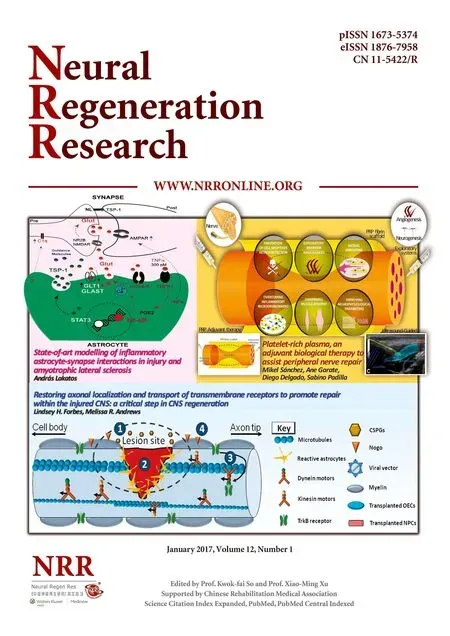
Restoring axonal localization and transport of transmembrane receptors to promote repair within the injured CNS: a critical step in CNS regeneration
2017-03-30 04:44:35LindseyForbesMelissaAndrews
中國神經再生研究(英文版) 2017年1期
Lindsey H. Forbes, Melissa R. Andrews,
1 School of Medicine, University of St. Andrews, St. Andrews, United Kingdom
2 Biological Sciences, University of Southampton, Southampton, United Kingdom
Restoring axonal localization and transport of transmembrane receptors to promote repair within the injured CNS: a critical step in CNS regeneration
Lindsey H. Forbes1, Melissa R. Andrews1,2,*
1 School of Medicine, University of St. Andrews, St. Andrews, United Kingdom
2 Biological Sciences, University of Southampton, Southampton, United Kingdom
How to cite this article:Forbes LH, Andrews MR (2017) Restoring axonal localization and transport of transmembrane receptors to promote repair within the injured CNS: a critical step in CNS regeneration. Neural Regen Res 12(1):27-30.
Open access statement:is is an open access article distributed under the terms of the Creative Commons Attribution-NonCommercial-ShareAlike 3.0 License, which allows others to remix, tweak, and build upon the work non-commercially, as long as the author is credited and the new creations are licensed under the identical terms.
Funding:MRA acknowledges support from the Morton Cure Paralysis Fund and Royal Society Research grant.
Each neuronal subtype is distinct in how it develops, responds to environmental cues, and whether it is capable of mounting a regenerative response following injury. Although the adult central nervous system (CNS) does not regenerate, several experimental interventions have been trialled with successful albeit lim‐ited instances of axonal repair. We highlight here some of these approaches including extracellular matrix (ECM) modi fi cation, cellular graing, gene therapy‐induced replacement of proteins, as well as application of biomaterials. We also review the recent report demonstrating the failure of axonal localization and trans‐port of growth‐promoting receptors within certain classes of mature neurons. More speci fi cally, we discuss an inability of integrin receptors to localize within the axonal compartment of mature motor neurons such as in the corticospinal and rubrospinal tracts, whereas in immature neurons of those pathways and in mature sensory tracts such as in the optic nerve and dorsal column pathways these receptors readily local‐ize within axons. Furthermore we assert that this failure of axonal localization contributes to the intrinsic inability of axonal regeneration. We conclude by highlighting the necessity for both combined therapies as well as a targeted approach speci fi c to both age and neuronal subtype will be required to induce substantial CNS repair.
axonal transport; cellular therapies; extracellular matrix; gene therapy; integrin; regeneration; viral vectors
Accepted: 2016-12-21
Introduction
As the mammalian central nervous system (CNS) matures, it loses its ability to repair itself. Alongside the inhibitory envi‐ronment characterized by a glial scar and an upregulation of inhibitory proteins such as chondroitin sulphate proteogly‐cans (CSPGs) and myelin‐associated glycoproteins (MAGs), CNS axons have an intrinsically low capacity for self‐repair which continually diminishes with age (Reviewed by Chew et al., 2012). As neurons mature, proteins that were once key regulators of axon guidance and elongation are downregu‐lated resulting in a reduced capacity for axonal repair aer injury. By recapitulating neuronal expression of growth‐pro‐moting proteins, such as integrins, transmembrane receptors involved in mediating cell‐cell and cell‐matrix interactions, neurite outgrowth and axon regeneration can be signi fi cant‐ly enhanced (Condic, 2001; Andrews et al., 2009; Cheah et al., 2016). The α9β1 integrin heterodimer, for example, is highly expressed during CNS development aiding growth cone formation and axonal elongation but is downregulated in mature CNS axons. It binds the main extracellular matrix (ECM) glycoprotein of the CNS, tenascin‐C, which is highly upregulated aer injury and has been a recent target of axo‐ nal regeneration research (Andrews et al., 2009; Chen et al., 2010; Cheah et al., 2016). For example, increasing expression of the alpha9 subunit in adult dorsal root ganglion (DRG) neurons alongside its activator Kindlin‐1, has been shown to promote growth cone formation and regeneration of severed axons after dorsal root injury (Cheah et al., 2016). Despite these promising fi ndings, recent data reveals region‐speci fi c and age‐specific differences exist resulting in variations in integrin tra fficking into the axonal compartment (Franssen et al., 2015; Andrews et al., 2016) creating yet another hurdle for regeneration.
Blockage of Integrin Localization into the Axonal Compartment

Figure 1 Current approaches for promoting axonal repair following central nervous system (CNS) injury.
In newly published work, Andrews et al. (2016) highlight differences in integrin localization in distinct neuronal subtypes, following viral vector‐based expression. Their findings show that in mature corticospinal tract (CST) and rubrospinal tract (RST) axons, exogenously‐expressed integrins are not localized or transported into the axonal compartment, remaining instead in the somatodendritic compartment (Andrews et al., 2016). On the other hand, exogenously‐expressed integrins in early postnatal CST neurons are readily localized within the axonal compart‐ment of developing CST axons. Furthermore, exogenous‐ly‐expressed integrins successfully localize in mature optic nerve axons as well as mature dorsal root axons following intravitreal or dorsal root ganglia injections, respectively (Andrews et al., 2016). These data establish a differential ability of transmembrane receptors to localize in distinct areas of the nervous system. Previous research in cultured cortical neurons suggests this is due to the axon initial seg‐ment acting as a filter and barrier for integrin entry into the axonal compartment (Franssen et al., 2015).erefore, region‐speci fi c and age‐speci fi c axon transport mechanisms are likely to play a role in modulating intrinsic CNS repair. In this article we consider the di fficulties of enhancing in‐trinsic‐mediated repair of neurons including the delivery of growth‐promoting proteins necessary for regrowth of adult axons in addition to considering extrinsic targets and ther‐apies for enhancing CNS repair.
Current Approaches to CNS Repair
A number of experimental avenues have been pursued with the hope of finding a robust treatment to promote axonal regeneration within the CNS (Figure 1). Treatments in‐clude modification of ECM components, such as through the removal of CSPGs, to stimulate neuronal plasticity, and removal of inhibitory proteins, such as Nogo‐A, to alleviate degradation and apoptotic pathways (Reviewed by Chew et al., 2012). Furthermore, cellular replacement therapies and application of biomaterials to stabilize lesion architecture have also been utilized as therapies for CNS repair (Reviewed by Assun??o‐Silva et al., 2015). In addition, a number of signalling pathways involved in maintaining axonal growth, guidance, trafficking, receptor turnover and apoptosis, in‐cluding neurotrophic factors and other growth‐promoting receptors such as integrins, have provided several targets for viral vector‐based gene therapy to promote intrinsic regen‐eration following axonal injury.
Failed Axonalransport of Signalling Molecules in CNS Repair
Current research has focused on targeting and reinstating regenerative signalling pathways associated with neurite outgrowth and survival, such as tropomyosin‐related kinase (Trk) receptors, insulin‐like growth factor 1 (IGF‐I) recep‐tors and integrin receptors following injury. Advancements in viral vector research have made gene therapy a common‐ly used experimental tool to study regenerative signalling pathways together with axonal repair. Research suggests expression levels of endogenous TrkB in injured CST axons are not sufficient to promote neurite outgrowth and repair (Lu et al., 2001) however nowever forced expression of TrkB using lentiviral vectors following CST lesioning resulted in enhanced regeneration (Hollis et al., 2009). In that study, however, Hollis et al. (2009) demonstrated that exogenously expressed TrkB was only localized as far as the proximal part of CST axons (subcortical white matter) suggesting that intrinsic transport mechanisms within these axons are compromised in the adult nervous system. Axonal trans‐port and localization of growth‐promoting molecules in‐volved in neuronal signalling are necessary and essential for the development of the nervous system as well as for axon growth and homeostasis. Long‐distance transport is driven by kinesin and dynein motors which are regulated by Rab GTPases, kinases and a number of scaffolding proteins (Maday et al., 2014). Failure of axon transport can have a detrimental effect on axon growth and function and has been linked to disease and injury, such as in motor neuron disease, Alzheimer’s disease, and spinal cord injury (SCI). Research now suggests that axon transport and localization in certain neuronal regions is inherently downregulated as the normal uninjured CNS matures (Andrews et al., 2016). Furthermore, evidence suggests growth‐promoting recep‐tors are excluded from mature CST axons, including TrkB, the receptor for brain‐derived neurotrophic factor (BDNF) (Lu et al., 2001) and integrins (Franssen at al., 2015; An‐drews et al., 2016).
Use of Biomaterials to Bridge CNS Lesion Sites
Not only is it necessary to consider localization of viral‐ly‐expressed proteins in neurons, viral vectors themselves may have limited temporal expression, although more treatments currently utilize standard adeno‐associated vi‐rus or lentivirus which have been shown to have long‐term sustained expression.e literature suggests however that by combining gene therapy with biomaterials, better long‐term expression may result (omas et al., 2014). Sca ff old bridges made from poly(lactide‐co‐glycolide) (PLG) have been used to deliver lentiviral vectors carrying sonic hedge‐hog (Shh) and neurotrophin‐3 to T9/T10region of spinal cords of mice following lateral hemisection (omas et al., 2014). Results demonstrate that expression of both proteins was sustained at the injury site, promoting axonal regrowth through the bridge architecture as well as facilitating re‐cruitment of endogenous oligodendrocyte precursors and Schwann cells. This also resulted in increased axonal my‐elination 8 weeks post‐transplant. Use of biodegradable bridges that contain a channel network for axonal guidance allows for localized delivery of multiple transgenes to the injury site, however, delivery of scaffolds can be invasive and does not overcome the inhibitory milieu created aer injury. Likewise, there are also cases where sustained ex‐pression of virally‐expressed proteins is unnecessary. In these cases, tamoxifen‐inducible systems would overcome issues in regulating expression.
Modi fi cation of CNS Extracellular Matrix to Promote Axonal Growth
Restoring intracellular signalling pathways is one approach to tackle the failure in axon repair however we can also tar‐get removal of inhibitory proteins.e lesion environment consists of proteins that are known to prevent axonal re‐generation including CSPGs and myelin‐derived inhibitory proteins, such as Nogo, MAG and oligodendrocyte‐myelin glycoprotein (OMgp). Removing or inactivating inhibitory molecules by blocking their action has shown efficacy in promoting regeneration.ese strategies include application of the bacterial enzyme, chondroitinase ABC (ChABC) to digest glycosaminoglycan side chains of CSPGs and mono‐clonal antibodies against Nogo‐A to inhibit Nogo activity. Research indicates a combination of treatments may provide the best recovery after axonal injury. Indeed, combined administration of anti‐Nogo‐A antibodies by intrathecal infusion, and ChABC by intraspinal injections and intrathe‐cal infusion, alongside behavioral rehabilitation was shown to promote axonal regeneration and functional recovery following SCI, more than either treatment alone (Zhao et al., 2013). Unfortunately, administration of both molecules is invasive with ChABC requiring multiple applications to maintain the level of enzymatic activity required for axonal regeneration and sprouting.
Cellular Grafting to Reconnect Damaged Pathways
Bridging SCI lesion sites with cellular replacement therapies including oligodendrocytes and Schwann cells to encourage remyelination, as well as astrocytes and neural stem cells to replace lost cells is another avenue that has resulted in suc‐cessful regeneration following damage. Research suggests however that a lesion environment can affect transplanted cell survival, engraftment, migration, proliferation and the availability of differentiation and growth promoting cues (Sontag et al., 2014).is study suggests that cell transplant treatments need to be combined with tandem therapies to utilize ECM environment to support and promote the gra‐ed cellsin vivo. Indeed, combining a neural stem cell (NSC) grawith ChABC enzyme to degrade CSPGs can promote grasurvival, regeneration, axonal plasticity and functional recovery in a chronic animal model of SCI (Karimi‐Abdolre‐zaee et al., 2010).
Age and Neuronalype Dictates Axonalransport and Localization
Research indicates that there are age‐associated changes within CNS axonal transport, including a decrease in an‐terograde trafficking (Milde et al., 2015). Interestingly this decrease in transport in mature neurons can be partially reversed within peripheral nerves (Milde et al., 2015). No‐tably age‐associated changes in axonal transport are also region specific, with differing transport rates in different neuronal areas, such as optic nerve, sciatic nerve and areas of the hippocampus (Milde et al., 2015).is brings us back to the current study. Andrews et al. (2016) showed devel‐oping motor and sensory neurons have the ability to tra ffic growth‐promoting integrins within the axonal compartment but only sensory neurons of the PNS, speci fi cally neurons of the DRG and retinal ganglion cells (RGCs), retain this ability as they mature. In the case of mature CST and RST axons, integrins are excluded and instead are retained within the somatodendritic compartment. This work confirms obser‐vations of Milde et al. (2015) that there are region‐specific di ff erences in axonal transport, but also indicates there are age‐related changes. This suggests that treatment for CNS damage would not be the same for every injury and would likely have to be modi fi ed to target injuries in di ff erent neu‐ronal regions.
Conclusion
Together this work emphasizes promoting transport and expression of growth‐promoting proteins can prompt axon repair however, a better awareness of the mechanisms re‐quired for targeting delivery into CNS axons remains. The answer to this problem may include a combination of sev‐eral approaches such as biomaterials and nanoparticles, cell replacement, modi fi cation of ECM, and gene therapy. Viral vectors allow for long‐term gene expression however there is a small risk of insertional mutagenesis which keeps many of these techniques currently out of clinical trials. As research‐ers we need to consider how these age‐related and site‐spe‐cific changes in axon transport can tailor our approaches for repair.is includes CNS delivery methods as research indicates different viral vectors transduce DRGs different‐ly (Mason et al., 2010).e question is not, do we need to re‐establish axon transport, but rather how can it be done in a controlled site‐specific, age‐specific manner. Within this review we have discussed how reinstating age‐associated changes in signalling pathways can lead to enhanced repair aer injury, but when it comes to CNS injury this is only half the battle. A combination of treatments that target the milieu of injury‐induced proteins to alleviate inhibitory signalling alongside region‐specific modification of target signalling pathways together with physical rehabilitation is likely to o ff er the best hope for robust functional recovery aer CNS injury.
Con fl icts of interest:None declared.
Andrews MR, Soleman S, Cheah M, Tumbarello DA, Mason MR, Moloney E, Verhaagen J, Bensadoun JC, Schneider B, Aebischer P, Fawcett JW (2016) Axonal localization of integrins in the CNS is neuronal type and age dependent. eNeuro 3:0029‐16.2016.
Andrews MR, Czvitkovich S, Dassie E, Vogelaar CF, Faissner A, Blits B, Gage FH, ff rench‐Constant C, Fawcett JW (2009) Alpha9 integrin promotes neurite outgrowth on tenascin‐C and enhances sensory axon regeneration. J Neurosci 29:5546‐5557.
Assun??o‐Silva RC, Gomes ED, Sousa N, Silva NA, Salgado AJ (2015) Hydrogels and cell based therapies in spinal cord injury regeneration. Stem Cells Int 2015:948040.
Cheah M, Andrews MR, Chew DJ, Moloney EB, Verhaagen J, F?ssler R, Fawcett JW (2016) Expression of an activated integrin promotes long‐distance sensory axon regeneration in the spinal cord. J Neuro‐sci 36:7283‐7297.
Chen J, Joon Lee H, Jakovcevski I, Shah R, Bhagat N, Loers G, Liu HY, Meiners S, Taschenberger G, Kügler S, Irintchev A, Schachner M (2010)e extracellular matrix glycoprotein tenascin‐C is bene fi cial for spinal cord regeneration. Moler 18:1769‐1777.
Chew DJ, Fawcett JW, Andrews MR (2012)e challenges of long‐dis‐tance axon regeneration in the injured CNS. Prog Brain Res 201:253‐294.
Condic ML (2001) Adult neuronal regeneration induced by transgenic integrin expression. J Neurosci 21:4782‐4788.
Franssen EH, Zhao RR, Koseki H, Kanamarlapudi V, Hoogenraad CC, Eva R, Fawcett JW (2015) Exclusion of integrins from CNS axons is regulated by Arf6 activation and the AIS. J Neurosci 35:8359‐8375.
Hollis ER 2nd, Jamshidi P, L?w K, Blesch A, Tuszynski MH (2009) In‐duction of corticospinal regeneration by lentiviral trkB‐induced Erk activation. Proc Natl Acad Sci U S A 106:7215‐7220.
Lu P, Blesch A, Tuszynski MH (2001) Neurotrophism without neurot‐ropism: BDNF promotes survival but not growth of lesioned cortico‐spinal neurons. J Comp Neurol 436:456‐470.
Maday S, Twelvetrees AE, Moughamian AJ, Holzbaur EL (2014) Axo‐nal transport: cargo‐speci fi c mechanisms of motility and regulation. Neuron 84:292‐309.
Mason MR, Ehlert EM, Eggers R, Pool CW, Hermening S, Huseinovic A, Timmermans E, Blits B, Verhaagen J (2010) Comparison of AAV se‐rotypes for gene delivery to dorsal root ganglion neurons. Moler 18:715‐724.
Milde S, Adalbert R, Elaman MH, Coleman MP (2015) Axonal trans‐port declines with age in two distinct phases separated by a period of relative stability. Neurobiol Aging 36:971‐981.
Sontag CJ, Uchida N, Cummings BJ, Anderson AJ (2014) Injury to the spinal cord niche alters the engrament dynamics of human neural stem cells. Stem Cell Rep 2:620‐632.
Zhao RR, Andrews MR, Wang D, Warren P, Gullo M, Schnell L, Schwab ME, Fawcett JW (2013) Combination treatment with anti‐Nogo‐A and chondroitinase ABC is more e ff ective than single treatments at enhancing functional recovery aer spinal cord injury. Eur J Neuros‐ci 38:2946‐2961.
Melissa R. Andrews, Ph.D., M.R.Andrews@soton.ac.uk.
10.4103/1673-5374.198968
*< class="emphasis_italic">Correspondence to: Melissa R. Andrews, Ph.D., M.R.Andrews@soton.ac.uk.
orcid: 0000-0001-5960-5619 (Melissa R. Andrews)
- 中國神經再生研究(英文版)的其它文章
- Information for Authors -Neural Regeneration Research
- Correction: Multi-site spinal stimulation strategies to enhance locomotion after paralysis
- Molecular chaperones and hypoxic-ischemic encephalopathy
- Multiple injuries of the ascending reticular activating system in a stroke patient: a di ff usion tensor tractography study
- Immunohistochemical evidence of axonal regrowth across polyethylene glycol-fused cervical cords in mice
- Transfer of the extensor indicis proprius branch of posterior interosseous nerve to reconstruct ulnar nerve and median nerve injured proximally: an anatomical study