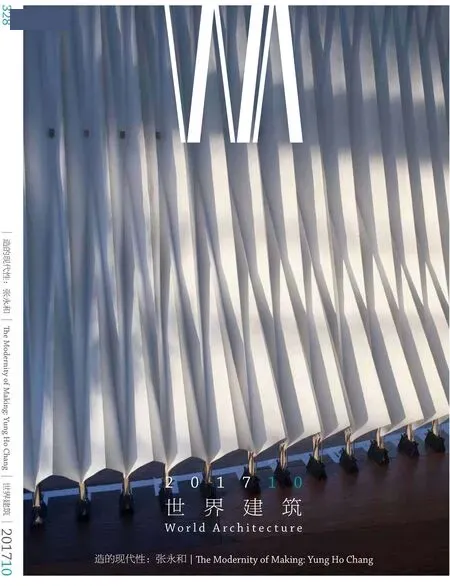
一個人的現代性之辯
2017-10-20 08:27:23張利
世界建筑 2017年10期
關鍵詞:建筑
張利
篇首
一個人的現代性之辯
張利
又到了文革后中國建筑師的個人時間——我們每年以一期《世界建筑》聚焦于一位在“文革”后接受教育的中國建筑師,期望借此一點一點地窺探當代中國建筑的故事。本期的主角是“當代中國獨立建筑師”一詞的最重要定義者之一——張永和,他對“現代性”的持續探尋——不僅在實踐,也在教育上——在某種意義上刻畫了一條當代中國建筑師成長的啟發性路徑。
張永和自文革晚期因“子承父業”而觸及建筑,其正式的建筑教育則從成為東南大學(當時的南京工學院)的第一屆文革后學生起,歷經美國的中部和西部不同大學的不同學位;上個世紀末回國進行建筑實踐與教育的實驗;其后于本世紀初再次赴美,不僅擔任重要建筑教育機構的領導者,還成為了最重要的建筑獎項的評委;再后,再次回到中國,在一個新的高度上繼續其未完成的建筑實踐與教育的實驗。在這一中西交替的“正弦波”軌跡中,其影響力“振幅”隨時間積累得以戲劇性地擴大,而貫穿于其中的基本學術訴求——建筑本體所承載的現代性意義——始終不曾改變。
張永和的現代性之辯呈現為一種知性的好奇而非憤怒的反叛。抑或是家庭環境與父輩友人的熏陶,抑或是個人天性使然,張永和對建造的好奇如同他最喜歡的“小偵探”故事一樣,是一個內省的、反思的和求證的過程。從早初的概念競賽作品,到早期實踐的家具空間,到后來的原型化空間和物性化工藝,張永和避免在抽象的建筑空間之上附帶情景化或意識形態化的敘事,避免其作品流入“正確”與“錯誤”的倫理評判之中。與20世紀之初的國際現代主義運動先鋒們和二戰之后平權運動的建筑師社會批判家們相比,張永和的建筑觀以中立的正向建構存在,可以不依賴于對某種即定價值觀的破除而獨立成立。
張永和的現代性之辯得益于混雜的多元營養而非純粹的單一價值。其成長年代的歷史驟變及其成長線索的復雜性在今天看來是一份寶貴的財富。與今天互聯網媒體時代的價值觀趨同相比,與今天赴海外求學者的目的地趨同相比,當年改革之初的中國對各種外界信息的同等關注與歡迎,以及文革后到海外留學的第一代人的天真與包容,實在是一種難得的開放態度。這也決定了在張永和的建筑中我們雖然可以找到不同師承的片斷基因,卻無法找到一個被分析模仿的原型。強勢預判的缺席也造就了張永和對無處不在的建筑啟示的敏感,他可以放松地從觀察到的事物中獲取營養,而不必擔心這種營養是否有損于自己已有的立場。
張永和的現代性之辯更多是以東方語言講述的國際故事而非國際語言講述的中國故事。張永和曾經表示對“東方”一詞(形容詞性)的質疑,并說到“南北”(指氣候)可能比“東西”(指文化)更能令人信服地定義世界建筑的性格。這一觀點毫不隱諱地表達了張永和在全球化和地域化之間的選擇,也幫助解釋了為什么在迄今為止的張永和建筑中,文化根源的話題不是被相對回避,就是被以隱晦的方式加以討論。這種策略在客觀上與全球化的傳播需求更為兼容,也在事實上曾助力于增加中國當代建筑的國際關注度。有趣的是,時代的演進也使張永和不得不面臨新的挑戰,其剛剛競賽勝出的巴黎國際大學城中國之家項目,因其外交意義而呈現出不折不扣的“中國故事”需求,我們期待張永和在這一話題上的新答案。
感謝張永和老師、魯力佳老師和非常建筑團隊對本期專輯的大力支持。□
It is time to look closely on one Chinese contemporary architect again. For years, we have been doing this once a year: to focus a full issue of World Architecture entirely on the works and thoughts of one Chinese architect educated after the"Culture Revolution".The protagonist of this issue is Yung Ho Chang. His individual quest for modernity,not only through practice but also education, draws a path of personal development that is widely regarded as inspirational in China.
Yung Ho Chang entered the field architecture long before his college education, at a time when a junior following his father's trade was still the default growing-up pattern. His architecture education started in the Southeast University(under the name Nanjing Institute of Technology back then), followed by different programmes in different parts of the United States. He came back to China in the 1990s, formed his own practice and led the experimental architecture programme in Peking University. In the early 2000s he went to the States again, this time taking the Chair of MIT and sitting on the Pritzker Jury soon after. In the second decade of the 21st century he came back to China for the second time, resuming his unfinished China experiments in both practice and education. This alternating China-US career track can be rendered in a growing sine curve. While its extent of impact amplifies drastically through time, the underlying academic interest remains unchanged: the quest for modernity through making.
Yung Ho Chang's quest for modernity is more based on intellectual curiosity than ideological overhaul. It might be his family, it might be himself,that his search in the making of things is like the Little Detective story he has cherished so much in his mind: a reflective, introspective process of finding. From his early conceptual designs, to his early furniture spaces, to his recent trials in new typologies and material crafts, Yung Ho Chang has freed his architecture of any scenographic or ideological narrative. There is no right or wrong in his architecture proposition. Compared to the Modernist pioneers of the early 20th century and the Leftist critic-architects of the late 20th century,Yung Ho Chang's architecture is a neutral construct.His works explain themselves, without the need to launch any attack on anything else.
Yung Ho Chang's quest for modernity is nourished by multiple, hybrid sources, not one single, monopolising source. The historical world change in his formation years, and the complexity in his personal development are precious advantages from today's point of view. In the 1980s, China was a country just opening up and every input from outside is equally welcomed. People testing their foot on a western ground to study bared an ignorance that can only be seen as a true open-mind today. It was through these that Yung Ho Chang experienced cross fertilisations from different schools and different people. It was also through these that Yung Ho Chang eventually developed the skill of learning the best from most. That is why we might be able to identify traces of different teachers in Yung Ho Chang's work, but we cannot find a single model that Yung Ho Chang has replicated. The absence of any pre-judgment also enabled Yung Ho Chang to freely observe and learn from the world around him, without the worry of any conflict with his own positions.
Yung Ho Chang's quest for modernity is more international than local. Yung Ho Chang has openly commented that the use of the word "east"as a cultural adjective worries him. When it comes to identity, he would rather believe in "northsouth" (climate), not "east-west" (culture). This unapologetic position clearly expresses Chang's choice between globalisation and localisation.It also helps to explain why in Yung Ho Chang's works so far, the issue of identity is either suspended or addressed in an implicit, tongue-incheek fashion. Practically, this approach is more compatible with international communication and has indeed contributed to the emerging of Chinese contemporary architecture on the global stage.Interestingly, time has put new challenges before Yung Ho Chang. Along with his winning of the China House project in Paris, given the diplomatic significance of the project, Yung Ho Chang has to be more local in it. How Yung Ho Chang will cope, we are keen to see.
Our biggest thanks to Mr. Yung Ho Chang, Ms.LU Lijia and Atelier FCJZ.□
造的現代性:張永和

1
張永和
美國注冊建筑師,美國建筑師學會會員
非常建筑創始人、主持建筑師
同濟大學教授,北京大學教授,麻省理工學院(MIT)建筑系前主任、實踐教授
張永和曾在中國和美國求學,于1984年獲得加利福尼亞大學伯克利分校建筑學碩士學位。1992年與魯力佳創立獨立實踐非常建筑,其作品涉及建筑、城市、景觀、室內、家具、產品、服裝、首飾、舞臺、展覽及裝置等多個方面。
張永和與非常建筑曾獲諸多獎項,如1987年日本新建筑國際住宅設計競賽一等獎第一名,美國“進步建筑”1996年度優秀獎,2000年聯合國教科文組織藝術貢獻獎,2006年美國藝術與文學院的學院建筑獎,2016年第四屆中國建筑傳媒獎實踐成就大獎,2017年贏得法國巴黎大學城中國之家設計競賽(與法國CAAU合作)。出版發表過多本書籍和專著,包括《繪本非常建筑》《圖畫本》《作文本》、中英雙語《小偵探》、英法雙語Yung Ho Chang / Atelier Feichang Jianzhu∶ A Chinese Practice及意大利語Yung Ho Chang∶Luce chiara,camera oscura、《平常建筑》 《非常建筑》等。曾多次參加國際建筑及藝術展,如2000-2016年先后6次參加威尼斯建筑及藝術雙年展;還曾舉辦6次個展,1999年在紐約Apex Art畫廊,2002年在哈佛大學,2005年在紐約前波畫廊,2007年在麻省理工學院,2008年在倫敦維多利亞和阿爾貝特(V&A)博物館應邀做裝置設計“塑與茶”,2012年在北京尤倫斯當代藝術中心“張永和+非常建筑:唯物主義”舉辦大型回顧展,2016年在上海當代藝術博物館舉辦大型個展“建筑之名:非常建筑泛設計展”。張永和也曾擔任2005首屆深圳城市建筑雙年展的總策展人,2008年威尼斯雙年展中國館聯合策展人,以及2013首屆上海西岸建筑與當代藝術雙年展總策展人。非常建筑的產品、建筑模型和裝置被倫敦V&A博物館、日本越后妻有大地藝術三年展、中國國家美術館、深圳何香凝美術館、香港M+等機構收藏。
張永和曾在美國和中國的多所建筑學校任教,現任同濟大學、麻省理工學院(MIT)、北京大學教授及香港大學榮譽教授,曾于2002年任哈佛大學設計研究院丹下健三講席教授,2004年任密歇根大學伊利爾·沙里寧講席教授,1999-2005年任北京大學建筑學研究中心創始主任,2005-2010年擔任麻省理工學院建筑系系主任,2016年任加利福尼亞大學伯克利分校霍華德·弗里德曼教席教授。2009年被選為美國建筑師學會香港分會榮譽會員。2011-2017年任普利茲克建筑獎評選委員會評委。
Yung Ho Chang
AIA
Founder, Principal Architect, Atelier Feichang Jianzhu (FCJZ)
Professor, Tongji University, Peking University
Professor of the Practice and former Head,Architecture Department, MIT
Chang and FCJZ have received a number of prizes, such as First Place in the Shinkenchiku Residential Design Competition in 1987, a Progressive Architecture Citation Award in 1996,the 2000 UNESCO Prize for the Promotion of the Arts, and the Academy Award in Architecture from American Academy of Arts and Letters in 2006, 2016 China Architectural Media Award Achievement in Practice Prize, and won the design competition for Fondation de Chine a la Cite Universitaire de Paris with CAAU. Chang has published several books and monographs,including Graphic FCJZ, Yung Ho Chang Draws,Yung Ho Chang Writes, The Little Detective in Chinese/English, Yung Ho Chang/Atelier Feichang Jianzhu: A Chinese Practice in English/French,Yung Ho Chang: Luce chiara, camera oscura in Italian, Pingchang Jianzhu, and Feichang Jianzhu,etc. They have participated in many international exhibitions of art and architecture, including six times in the Venice Biennale since 2000. FCJZ has held solo exhibitions of its work at Apex Art in New York in 1999, Harvard GSD in 2002, Chambers Gallery in New York in 2005, and MIT in 2007 and was invited to create an installation Poly & Chai in the central court at Victoria & Albert Museum in London in 2008. In 2012, FCJZ held a milestone retrospective at UCCA in Beijing entitled Yung Ho Chang + FCJZ: Material-ism. In 2016, FCJZ held a major solo exhibition at PSA in Shanghai entitled In The Name of Architecture: Pan-Design Practice of Atelier FCJZ. Chang also curated/cocurated the 1st Shenzhen Biennale of Urbanism and Architecture in 2005, the China Pavilion at Venice Biennale in 2008, and the 1st West Bund Biennale of Architecture and Contemporary Art in Shanghai in 2013. Products, architectural models,and installations by FCJZ are in the permanent collection at V&A, Echigo-Tsumari Land Art Triennale in Japan, National Art Museum of China in Beijing, He Xiangning Art Museum in Shenzhen,and M+ in Hong Kong.
Chang has taught at various architecture schools in the USA and China; he is presently a professor at Tongji, PKU, and MIT where he served as the head of Architecture Department from 2005 to 2010, as well as Honorary Professor at HKU. He founded the Peking University Graduate Center for Architecture in 1999, and held the Kenzo Tange Chair at Harvard in 2002, the Eliel Saarinen Chair at Michigan in 2004, and the Howard Friedman Chair at Berkeley in 2016. In 2009 he was bestowed the honorary membership by AIA Hong Kong. He was a Pritzker Prize Jury member from 2011 to 2017.
One Man's Quest for Modernity
ZHANG Li
a Master of Architecture degree from the University of California at Berkeley in 1984 and has been practicing as Atelier Feichang Jianzhu(FCJZ) with LU Lijia in China since 1992. FCJZ's work ranges from architecture, urbanism, landscape,interior, to furniture, product, clothing, jewelry,stage, exhibition and art installation.
清華大學建筑學院/《世界建筑》
2017-10-11
猜你喜歡
北方建筑(2021年6期)2021-12-31 03:03:54
文苑(2020年10期)2020-11-07 03:15:36
現代裝飾(2020年6期)2020-06-22 08:43:12
現代裝飾(2020年4期)2020-05-20 08:55:08
攝影之友(影像視覺)(2019年2期)2019-03-05 08:27:16
藝術家(2017年3期)2018-01-26 08:54:49
文學自由談(2016年3期)2016-06-15 13:01:16
福建農業科技(2016年10期)2016-03-07 09:46:49
少兒科學周刊·兒童版(2015年6期)2015-11-24 03:49:38
中國工程咨詢(2015年4期)2015-02-14 03:49:56