
Music electric stimulation of points for anxiety:a multi-center randomized controlled clinical trial
2018-03-13 12:57:17ZhangHong張洪DengHong鄧鴻JiaLianbin賈聯斌AiShuangchun艾雙春
關鍵詞:醫院
Zhang Hong (張洪), Deng Hong (鄧鴻), Jia Lian-bin (賈聯斌), Ai Shuang-chun (艾雙春)
1 The Third Hospital of Mianyang, Sichuan Province (Sichuan Mental Health Center), Mianyang 621000, China
2 Sichuan Mianyang 404 Hospital, Mianyang 621000, China
3 Mianyang Hospital of Traditional Chinese Medicine, Sichuan Province, Mianyang 621000, China
The rise in incidence of anxiety disorder has occurred along with the rapid pace of life[1]. It affects up to 20%of the adult population[2]. Although anxiety disorder is commonly seen in outpatient department of internal medicine, its diagnosis is mainly based on a patient’s medical history and symptoms. This often results in missed diagnosis or misdiagnosis[3-4]. Long-lasting anxiety may disturb the normal functioning of the brain and adversely affect both the body and mind[5-6].Anxiety disorder is characterized by significant feelings of anxiety, fear or panic attack. It is more commonly seen in women around the age of 40 years old. Its onset can be sudden or insidious. Clinical manifestations include uneasiness, fear, worries or restlessness for no apparent reason, and frequent worrying about future events or imminent threats. Individuals may also experience palpitations, tremor of the hands/feet,somatic discomfort and sleep disturbance. These symptoms may greatly affect the patients’ study and work efficiency. Music electric stimulation involves a systematic professional process to intervene with music or musical elements to improve the patients’ quality of life, mood, emotion, and happiness index[7].This study applied music electric stimulation therapy to a total of 125 anxiety cases and compared with the efficacy in 117 cases treated with oral doxepin. The results are now summarized as follows
1 Clinical Materials
1.1 Diagnostic criteria
It’s based on the diagnostic criteria for anxiety disorders in theChinese Classification and Diagnostic Criteria of Mental Disorders[8]. In accordance with the diagnostic criteria for neurosis; with persistent anxiety symptoms as predominant complaint, and conforming to the 2 items below: frequent or lasting fear or uneasiness without a particular object or content;accompanied by autonomic nervous symptoms or psychomotor agitation.
1.2 Inclusion criteria
Conforming to the above diagnostic criteria;Hamilton anxiety rating scale (HAMA) >14 points[9], and Chinese revised edition of self-rating anxiety scale(SAS-CR) >50 points[10]; aged 19-70 years old; not on any anti-anxiety drugs in the recent 1 month; having signed informed consent form.
1.3 Exclusion criteria
Pregnant or breast-feeding women; subsequent anxiety following physical illness or mental disorders;Alzheimer’s or Parkinson’s disease; anxiety due to alcohol abuse or drugs; taking anti-anxiety drugs during the recent 1 month.
1.4 Dropout criteria
Unable to tolerate music electric stimulation because of adverse reactions; poor compliance, failed to stick to the treatment protocol or take the prescribed medications on time; symptoms aggravated during the intervention or coupled with other illnesses, unwilling or unable to complete the intervention; against the design of the trial and switched to other treatments during the intervention; quitted the trial voluntarily.
1.5 Statistical method
The SPSS 11.0 version software was used for data analyses. The comparisons of HAMA and SAS-CR scores before the treatment, and respectively after 1-week,2-week and 4-week treatment were processed by two-factor repeated measures ANOVA; the data of clinical efficacy, belonging to ranked data, were analyzed byRiditanalysis. Fisher’s exact test was used to compare the data of gender. The data of age and disease duration were in normal distribution and analyzed by independent samplest-test.P<0.05 indicated a statistical significance.
1.6 General data
A total of 270 patients with anxiety disorders were recruited from the inpatients of the Third Hospital of Mianyang, Sichuan Mianyang 404 Hospital and Mianyang Hospital of Traditional Chinese Medicine between January 2012 and January 2015. By using the Proc plan in SAS software to determine the seed, with block-9 and center-rand-10, the 270 subjects were divided into a treatment group and a medication group,135 each. Three groups of 90 successive numbers were distributed respectively to the three study centers, i.e.001-090, 091-180, and 181-270. The randomized allocation design was concealed by complete allocation concealment, sealed in kraft paper envelopes following its sequence. The envelopes were attached to the case report forms (CRF). When there was a to-be-enrolled subject, the clinician would take the coded CRF according to the order, open the attached envelope and allocate the subject into the corresponding group according to the contained randomized allocation.
Of the 270 subjects, 242 cases completed the whole study and 15 dropped out; five patients quitted in the treatment group because of failure to continue the treatment, while 10 quitted in the control group due to dizziness and dry mouth; 13 cases were screened out: 5 in the treatment group due to change of the intervention method and 8 in the medication group because of poor compliance in taking medications on time. The whole study process is shown in Figure 1.
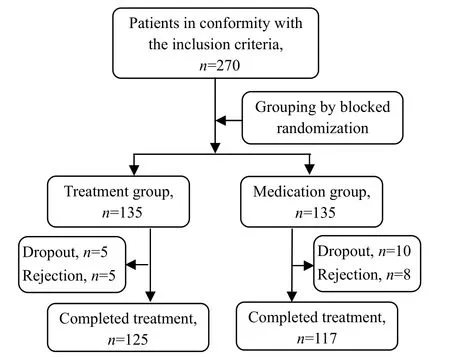
Figure 1. Flow chart
Finally, there were 125 cases in the treatment group,with age ranged between 19 and 65 years old, and disease duration ranged between 1 month and 10 years.Of the 117 cases in the medication group, the age ranged between 20 and 70 years old, and disease duration ranged between 20 d and 12 years. There were no significant differences in gender, age and disease duration between the two groups (allP>0.05),indicating the comparability (Table 1).
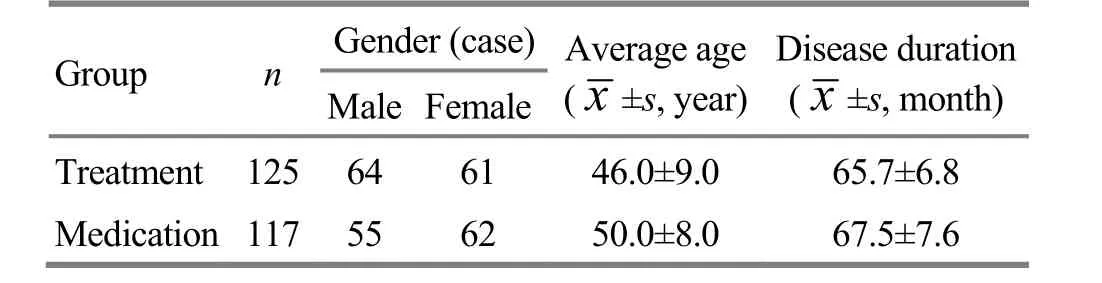
Table 1. Comparison of the general data
2 Treatment Methods
2.1 Treatment group
Major acupoints: Baihui (GV 20), Yintang (GV 29),bilateral Taiyang (EX-HN 5) and Fengchi (GB 20).
Adjunct acupoints: The five-mind acupoints [Pohu(BL 42) for lung, Shentang (BL 44) for heart, Hunmen(BL 47) for liver, Yishe (BL 49) for spleen, and Zhishi(BL 52) for kidney] were properly selected based on the symptoms prescribed by patients, e.g. Shentang (BL 44)added for palpitations, insomnia and restlessness; Yishe(BL 49) for stomachache, reduced intake of food and abdominal bloating.
Operation: Music electric stimulation appliance(model 8808) was adopted for treatment. The appliance has 5 electrodes. Five acupoints, including Baihui(GV 20), Yintang (GV 29), bilateral Fengchi (GB 20) and the selected five-mind acupoint on the left side were treated on single days; bilateral Taiyang (EX-HN 5),bilateral Fengchi (GB 20) and the selected five-mind acupoint on the left side were treated on even days.After sterilization by alcohol swab, the five electrodes were attached to the five acupoints respectively. The electrode at scalp acupoint was fixed by a specific bandage, and the one at the emotion point was fixed by paper tape. The instrument was then turned on to play the patient’s favorite music. The output intensity was slowly increased till the patient felt tolerable and comfortable tingling. The stimulation was given once a day, 30 min each session, at an interval on Sunday, 30 d as a course of treatment.
2.2 Medication group
Patients in the medication group were intervened by oral administration of doxepin (lot number: J14901207,produced by Hubei Wuhan Pharmaceutical Co., Ltd.,China, 25 mg/tablet). Generally, the medication was taken at a dose of 25 mg and 3 times a day during the first week, then either reduced or increased according the efficacy and adverse reactions, averaged at 150 mg per day. Treatment of 30 d was taken as a treatment course.
3 Therapeutic Efficacy
3.1 Observation items
HAMA and SAS-CR were evaluated before the intervention, and respectively after 1-week, 2-week and 4-week treatment.
3.1.1 HAMA
HAMA consists of 14 items, scored 0-4: 0 point, no symptoms; 1 point, mild; 2 points, moderate; 3 points,severe; 4 points, extremely severe. The aggregate HAMA score can well reflect the severity of anxiety symptoms. By referring to the data provided by the Chinese Scale Collaboration Group: aggregate score ≥29 points, possibly significant anxiety; ≥21 points, definitely significant anxiety; ≥14 points, determined anxiety; >7 points, anxiety possible; <7 points, no anxiety symptoms.
3.1.2 SAS-CR
SAS-CR consists of 20 components, scored 0-4 points.After test, the sum of the 20 component scores is taken as the aggregate. The higher the aggregate score of SAS-CR, the severer the anxiety symptoms.
3.1.3 Safety evaluation
The general tests included body temperature, blood pressure, pulse and respiration; routine blood test;electrocardiogram; liver and renal function tests.
The two groups of patients underwent these tests once 1 week before the intervention and 1 week after.
3.2 Criteria of therapeutic efficacy[5]
The therapeutic efficacy was evaluated based on the reduction rate of HAMA score.
Reduction rate of HAMA score = (Pre-treatment aggregate HAMA score - Post-treatment aggregate HAMA score) ÷ Pre-treatment aggregate HAMA score ×100%.
Recovered: The reduction rate of HAMA score ≥80%.
Markedly effective: The reduction rate of HAMA score ≥60%, but <80%.
Improved: The reduction rate of HAMA score ≥30%,but <60%.
Invalid: The reduction rate of HAMA score <30%.
3.3 Treatment results
3.3.1 Clinical efficacy
The total effective rate was 85.6% in the treatment group versus 92.3% in the medication group, and the between-group difference was statistically insignificant(P>0.05), indicating that the clinical efficacies of the two groups were equivalent (Table 2).
3.3.2 HAMA and SAS-CR scores
After 1-week treatment, the HAMA and SAS-CR scores dropped in both groups. The intra-group differences compared with the scores before the intervention were insignificant in the treatment group(P>0.05), while the intra-group differences were statistically significant in the medication group (P<0.01).The between-group differences in the scores after 1-week treatment were statistically significant (P<0.01),indicating that the medication group took a faster action.
Respectively after 2-week and 4-week treatment, the HAMA and SAS-CR scores showed significant changes compared to those before the intervention in both groups (P<0.01), but the between-group differences were insignificant (P>0.05), indicating that the two interventions produced similar effects in improving the anxiety symptoms (Table 3 and Table 4).

Table 2. Comparison of the clinical efficacy (case)

Table 3. Comparison of HAMA score (x±s, point)

Table 4. Comparison of SAS-CR score (x±s, point)
3.3.3 Adverse reactions
Adverse reactions occurred in the medication group mainly were dizziness (10 cases), dry mouth (9 cases),headache (3 cases), nausea (2 cases), constipation (5 cases), insomnia (3 cases), and urination difficulty (4 cases), forming up an occurrence rate of 30.8%; in the treatment group, adverse reactions mainly were dizziness (3 cases), and the occurrence rate was 2.4%.There was a significant difference in the occurrence rate of adverse reactions between the two groups (P<0.01).
The general tests, including body temperature, blood pressure, pulse, respiration, routine blood test, liver and renal function tests, and electrocardiogram didn’t present abnormal changes after the intervention in the two groups.
4 Discussion
Music electric stimulation is a treatment method by stimulating acupoints on human body with low-mid frequency currents synchronously transformed from music signals by a therapeutic appliance. Modern scientific research has proven that music can work on the limbic system and reticular formation of brain stem to regulate cerebral cortex[11-14]. Music electric stimulation to Yintang (GV 29) (the frontal lobe), Baihui(GV 20) (the parietal lobe), Fengchi (GB 20) (the occipital lobe) and Taiyang (EX-HN 5) (the temporal lobe)can boost blood circulation and benefit the secretion of neurotransmitters, regulating organ function and emotion, and finally relieve anxiety[15]. It has been testified in animals that music electroacupuncture (EA)can inhibit the cell apoptosis in rat’s neurons after acute cerebral hemorrhage[16-17].
Anxiety, belonging to the scope of depression syndrome in traditional Chinese medicine, is usually caused by fire transformed by depression, phlegm heat disturbing the spirit, or deficiency of heart, liver and kidney. Emotions and moods are all psychological activities. Although the minds are respectively governed by the five Zang organs, their relationship with the heart is especially close[18]. Anxiety patients often present restless, anxious, frightened, sad, and angry, etc.Based on the patient’s symptoms, corresponding five-mind acupoints can be selected to regulate the emotion and mind. Governor Vessel connects with the brain, which is the house of original spirit. Also, from the angle of modern medicine, brain is where thoughts originate. Governor Vessel is the sea of yang meridians.The manifestations of anxiety disorders such as sleep disturbance, fright and uneasiness are often associated with the blocked meridian qi of Governor Vessel.Therefore, Baihui (GV 20) and Yintang (GV 29) can be used to regulate the meridian qi. To treat a disease, its root must be sought. Zang-fu organs are the origin of meridians and the meridian qi of five Zang organs transports into the back. Treatment based on syndrome differentiation by taking the five-mind acupoints as the center can dredge the meridians, regulate qi and blood,and eliminate the discomforts related to the internal organs. When the five Zang organs are in harmony, the patient can get cured.
Music electric stimulation is a novel therapy combining modern electric technique and traditional acupuncture-moxibustion method[19]. Ordinary EA uses electric pulse to replace manual needling skills by connecting the needles and electrodes after needle insertion to treat disease or kill pain. With a built-in stereo CD player to provide music waves, ML8808 music electric stimulation instrument first processes the music wave into medical music wave, which consists of a couple of unit pulse waves and still maintains the melody and rhythm of the music waves. Stimulating acupoints with medical waves can adjust information of human body and achieve the purpose of treatment.With its own headphones and monitor, the instrument makes patients able to receive music electric stimulation in nice light music. With medical music waves input directly into acupoints via electrodes, this therapy truly realizes acupuncture without needles, not only eradicating the fear of patients towards the needling pain, but also preventing from possible cross infection.
In this study, with relaxing, delightful and harmonious music, patients were able and willing to receive treatment in a pleasant environment. Listening to dulcet music can regulate the excitability and inhibition of cerebral cortex, so as to help patients release the unhappiness. Fengchi (GB 20), Baihui (GV 20), Yintang(GV 29) and Taiyang (EX-HN 5) are major points in the treatment of anxiety disorders. Stimulation to these points with tranquilizing and soft medical music waves can modulate the Governor Vessel, dredge meridians,and harmonize qi and blood, and finally release anxiety and tension. The results of the current study suggested that music electric stimulation can produce equivalent effects in treating anxiety disorders compared to doxepin. But, oral administration of doxepin may cause kinds of adverse reactions, including dizziness, dry mouth, constipation, urinary difficulty, and drowsiness.On the contrary, music electric stimulation rarely causes any adverse reactions, thus it is applicable for those who can’t take drugs.
Conflict of Interest
The authors declared that there was no potential conflict of interest in this article.
This work was supported by Scientific Project of the Third Hospital of Mianyang, Sichuan Province [四川省綿陽市第三人民醫院科研科題, No.(12) 2013].
Statement of Informed Consent
Informed consent was obtained from all individual participants in this study.
[1] Taylor DJ, Lichstein KL, Durrence HH. Insomnia as a health risk factor. Behav Sleep Med, 2003, 1(4): 227-247.
[2] Kraus SS, Rabin LA. Sleep America: managing the crisis of adult chronic insomnia and associated conditions. J Affect Disord, 2012, 138(3): 192-212.
[3] Milanovi? SM1, Erjavec K, Polji?anin T, Vrabec B, Bre?i? P. Prevalence of depression symptoms and associated socio-demographic factors in primary health care patients.Psychiatr Danub, 2015, 27(1): 31-37.
[4] Paykel ES, Brugha T, Fryers T. Size and burden of depressive disorders in Europe. Eur Neuropsychopharmacol, 2005, 15(4): 411-423.
[5] Li AM. Influence of motivated interview on negative emotions and compliance of stroke patients. Zhongguo Linchuang Huli, 2014, 6(4): 328-330.
[6] Wang LP, Li XC, Meng CF, Huang WM, Zhuang XM, Lin GQ. Abnormal glucose metabolism in patients with ischemic stroke. Tongji Daxue Xuebao (Yixue Ban), 2014,35(1): 73-75.
[7] Liang DS. Effect comparison of music therapy for poststroke depression patients with different syndromes.Qiqihar Yixueyuan Xuebao, 2016, 37(12): 1550-1551.
[8] Psychosis Branch of Chinese Medical Association. The Chinese Classification and Diagnostic Criteria of Mental Disorders. 3rd Edition. Jinan: Shandong Technology Press,2001: 118-119.
[9] Zhang MY. Psychiatry Assessment Scale Manual.Changsha: Hunan Science & Technology Press, 1998:39-42.
[10] Tao M, Gao JF. Reliability and validity of Chinese revised edition of self-rating anxiety scale. Zhongguo Shenjing Jingshen Jibing Zazhi, 1994, 20(5): 301-303.
[11] Hegde S. Music-based cognitive remediation therapy for patients with traumatic brain injury. Music-based cognitive remediation therapy for patients with traumatic brain injury.Front Neurol, 2014, 5: 34.
[12] Sun J, Chen W. Music therapy for coma patients:preliminary results. Eur Rev Med Pharmacol Sci, 2015,19(7): 1209-1218.
[13] Guétin S, Portet F, Picot MC, Pommié C, Messaoudi M,Djabelkir L, Olsen AL, Cano MM, Lecourt E, Touchon J.Effect of music therapy on anxiety and depression in patients with Alzheimer's type dementia: randomised,controlled study. Dement Geriatr Cogn Disord, 2009, 28(1):36-46.
[14] Narme P, Clément S, Ehrlé N, Schiaratura L, Vachez S,Courtaigne B, Munsch F, Samson S. Efficacy of musical interventions in dementia: evidence from a randomized controlled trial. J Alzheimers Dis, 2014, 38(2): 359-369.
[15] Xu CL, Wang F, Dong HS. Effect of music electroacupuncture on perifocal ferric ions and neuronal apoptosis percentage and the brain water content in rats with acute cerebral hemorrhage. Shanghai Zhenjiu Zazhi,2017, 36(7): 840-845.
[16] Tan YT, Yi X, Huang Y, Yuan Q, Liu HH, Yang L.Research progress on music therapy for Broca aphasia.Hunan Zhongyi Zazhi, 2016, 32(1): 169-170.
[17] Zhang DL, Zhang XM. The interview and treatment of generalized anxiety disorder. Sichuan Jingshen Weisheng,2016, 29(2): 111-117.
[18] Zhang JH. Acupuncture plus auricular point sticking for 24 cases with anxiety. Zhongguo Zhen Jiu, 2004, 24(21):68-69.
[19] Zhang H, Deng H. Observations on the efficacy of acupuncture plus acupuncture point injection in treating post-earthquake generalized anxiety disorder. Shanghai Zhenjiu Zazhi, 2010, 29(9): 576-578.
猜你喜歡
兒童繪本(2018年10期)2018-07-04 16:39:12
中國衛生(2016年10期)2016-11-13 01:07:44
中國衛生(2016年3期)2016-11-12 13:23:36
中國衛生(2016年3期)2016-11-12 13:23:20
中國衛生(2016年2期)2016-11-12 13:22:26
小朋友·快樂手工(2016年5期)2016-05-14 17:18:34
中國衛生(2015年8期)2015-11-12 13:15:20
中國衛生(2014年11期)2014-11-12 13:11:28
中國衛生(2014年8期)2014-11-12 13:00:54
中國衛生(2014年7期)2014-11-10 02:33:12
 Journal of Acupuncture and Tuina Science2018年1期
- Journal of Acupuncture and Tuina Science的其它文章
- Points selection pattern in acupuncture-moxibustion treatment of gouty arthritis: an analysis based on bibliometrics
- Analysis of points selection pattern in acupuncture treatment of sleep apnea syndrome based on data mining
- Clinical observation of Shu-acupuncture method in Nei Jing (Classic of Internal Medicine) for shoulder and arm pain
- Efficacy observation on acupuncture plus moving cupping with compound white mustard oil for lumbar myofascitis
- Acupuncture plus bloodletting therapy for insomnia in blood stasis constitution: a clinical study
- Development of workplace-related Liver Meridian-depression scale