
三元橋We+聯合辦公空間,北京,中國
2018-03-20 05:28:08設計MATOffice超級建筑
世界建筑 2018年3期
關鍵詞:設計
設計:MAT Office | 超級建筑

1 入口吧臺/Bar in the entrance area
北京三元橋We+聯合辦公空間位于北京市朝陽區遠洋新干線D座,空間使用面積為800m2,分為首層、二層和地下層。業主希望將此空間改造成為聯合辦公品牌——“We+”的聯合辦公和線下活動空間,同時也作為對新型辦公空間的一個拓展性探索。
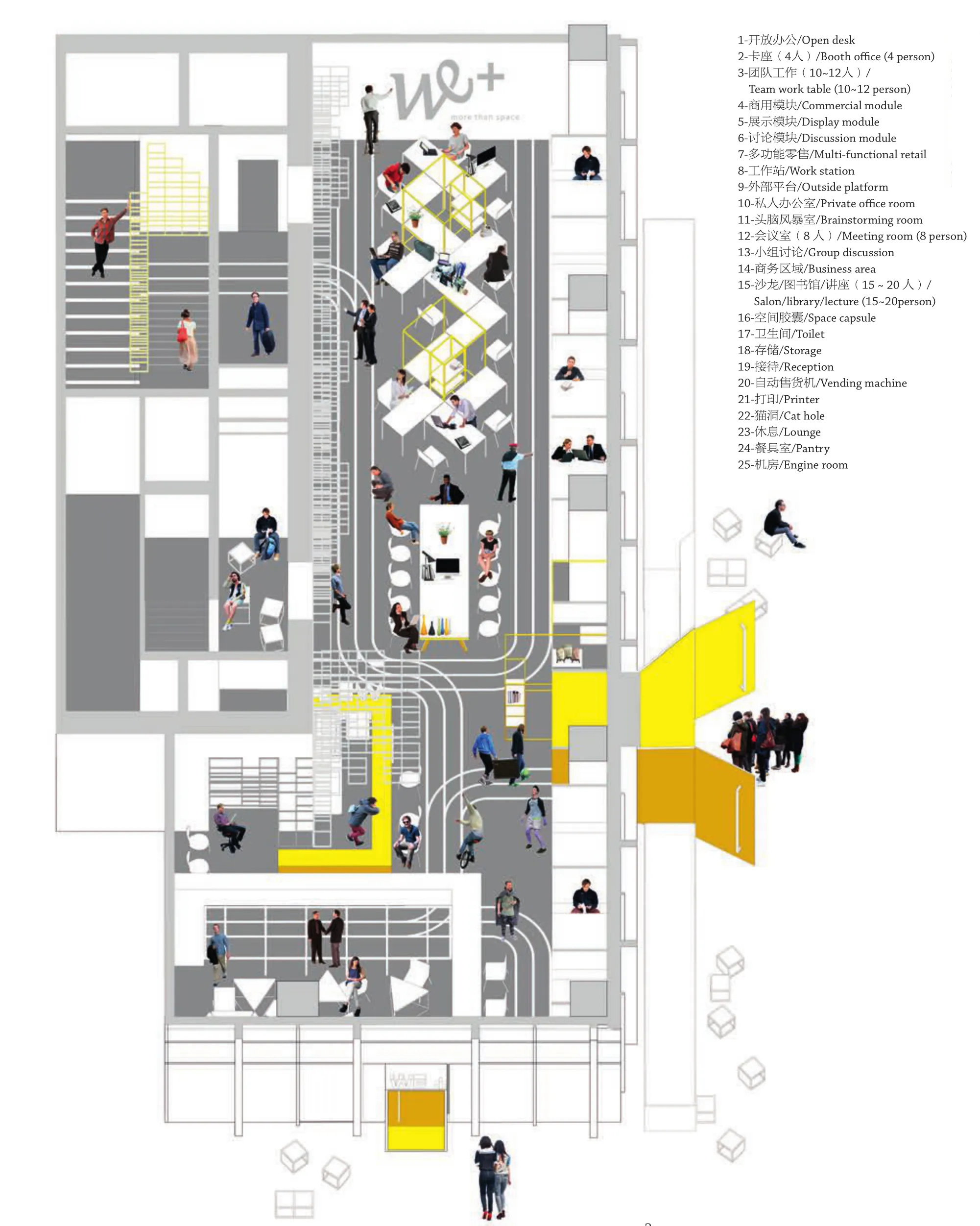
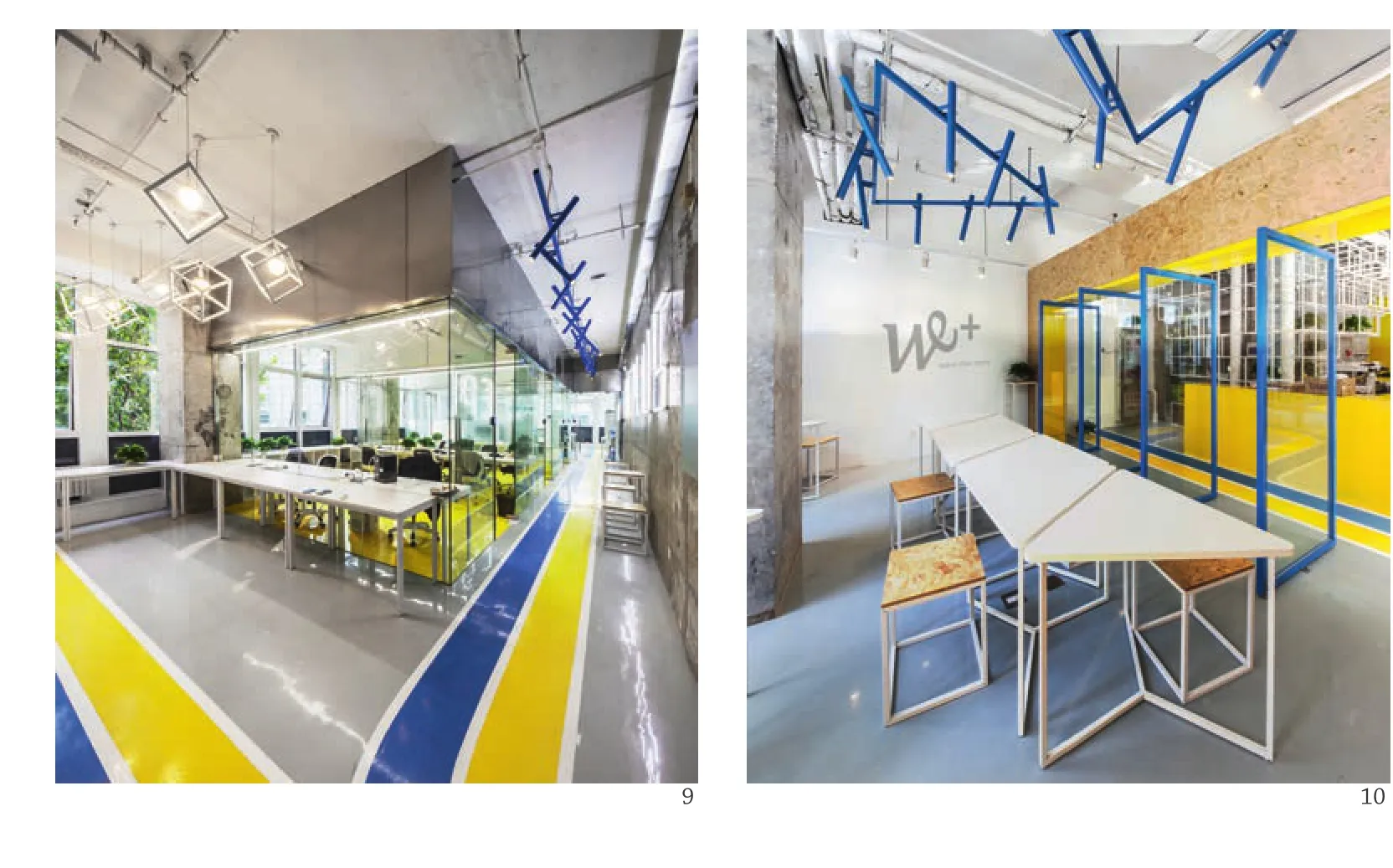
建筑師在項目初期,采用研究導入設計的方式,通過大量調研和案例分析,從而得出了一個靈活多變的共享空間模式。最終完成的設計給人們帶來了一種“圖書館”式的空間體驗:在首層空間中,傳統的門廳—走廊—辦公室布局已經不復存在,取而代之的是一個完全開敞式的流動空間,吧臺提供著聯合辦公空間最基本的管理和服務;大討論桌除了團隊工作之外,還可以作為共享的個人辦公使用;卡座區則有著更多的私密性,適合兩三人的小組工作和討論;如果你不想被來往的人們所干擾,還可以一頭埋進工作站中專注手頭的工作……
除了“圖書館”式的體驗之外,建筑師借用“展覽”的方式在首層植入了4個展示模塊單元和一整面的展示墻為創業團隊提供展示空間。此時,聯合辦公不僅僅是辦公團隊的入駐,也可以是創業團隊產品的入駐。
為了提升地下空間的舒適感,建筑師將通往地下的樓梯間整體噴成了明快的黃色,在創造了強烈引導性的同時也激發了原本消極空間的活力。明黃色的樓梯間在地下層出口處打開,形成大臺階,成為該聯合辦公空間中入駐團隊的小型宣講和活動發布場地。地下層的公共部分還設置了“貓洞”空間和“睡眠艙”空間,供入駐團隊交往、放松和短時休憩所用。與此同時,通往二層獨立辦公區的樓梯間被懸吊的黃色鋼架填充,鋼架在提供了樓梯圍護的同時,還在樓梯間頂部產生了一個小小的半透明討論區,作為團隊頭腦風暴使用。
空間建構上,建筑師通過植入小盒子的方式來界定該辦公空間中更為私密的會議室和辦公隔間:歐松板家具組合限定了位于二層和地下層的會議室空間;而獨立辦公隔間則是由2.4m高的透明玻璃分隔而成。這種采用分離的方式植入家具的設計也從另一面暗示了聯合辦公空間的即時性、靈活性和可變性。□

2 卡座區/Booth area
Beijing Sanyuanqiao We+ Co-working Space is located at Block D, Yuanyang Express, Sanyuan Bridge, Chaoyang District. The client intends to transform this place into a co-working space, as well as to explore the possibility of future workplace.
This co-working space covers an area of about 800 square metre, divided into first level, second level and underground level. At the beginning stage of the project, a research-based design method was introduced in by the architects, with sufficient case studies and precedent analyses, which aimed at the solution of a flexible space-sharing model.
The final design brings in a library-like space experience: on the first level, a widely-open space replaces the traditional lobby-corridor-office layout,and a bar counter provides basic management and service to the co-working space; the huge table for serves both group and individual discussion; more privacy can be found in booth area, which is suitable for a smaller group. If you are not interrupted by the crowd, workstations will allow you to dive into work.In a word, the way a university library space used is integrated into this project: any space you want is open as option here.
3 軸測/Axo

4 二層平面/Floor 1 plan

5 首層平面/Ground floor plan

6 地下一層平面/Floor B1 plan
Besides the library-like experience, the way of"exhibition" is also adapted to the space design. Most users here are small or medium size start-up team,meaning that the product publication, presentation and even marketing activity requires consideration on the design stage as well. Therefore, 4 displayunits and a whole display wall are placed on the first level to meet the needs for presentations. Here the notion of co-working not only accommodates the members of the team, but also their product.
The stairway that leads down to the underground level is painted in a bright yellow as a whole, which provides strong visual guiding and vitalises the formerly-negative space. The yellow staircase opens up at the entrance of the ground level, turning into large steps down into a presentation space for the occupant teams to hold information session or launch projects. The underground public space also contains programme such as "cat cave" and "sleeping cabin", for the teams to socialise and relax.
The other stair space to the second floor is occupied by suspended yellow steel frames. These frames are integrated into the railing structure and extends to the top of the staircase – a small translucent space for the barnstorming teams.
Those more private spaces, such as meeting rooms and office cubicles, are defined by inserted small boxes: modular furniture made of OSB materials restricts office spaces on the second and underground levels; independent office cubicles are divided by 2.4-metre-high transparent glass wall.Bright-coloured floor are used to emphasise the idea of "insertion", while this method, furniture detached from original walls, also imply the Immediacy,flexibility and variability of this co-working space.□
項目信息/Credits and Data
客戶/Client: 上海帷迦科技有限公司/We+
設計團隊/Design Team: 唐康碩,張淼,蔡月虹,季云竹,李彥儒/TANG Kangshuo, ZHANG Miao, CHUA Guat Hong,JI Yunzhu, LI Yanru
建筑面積/Floor Area: 800m2
材料/Finishing Materials: 歐松板,鏡面不銹鋼板,鋼框架,鋼化玻璃/OSB, Steel panel, Steel frame, Armoured glass
攝影/Photos: 唐康碩/TANG Kangshuo

7.8 地下一層內景/Interior views of floor B1
WA:在這個項目中,設計發揮了什么作用?
MAT:本項目的運營團隊一開始就想嘗試一種新的模式,所以對于建筑師來說,設計的過程在一開始其實也是共同制定任務書的過程。設計條件也不僅僅是面積的分配指標,而更多的是功能內容及有效的使用方式的場景要求,建筑師需要在空間中把拼貼的、碎片的場景通過設計的方式進行梳理整合。
WA:設計中最有創意和最具吸引力的部分是什么?
MAT:我們在整個設計過程中最有創造性的主要是兩個方面,一是說服了運營方將首層空間完全作為公共空間來使用,并更改了上下樓的流線。在面對樹林和小廣場的一側分別用閃店、卡座、咖啡、展示和即時辦公區等功能將其填滿,通過對流動空間的創造提升其活力和使用價值;第二個方面是我們用模塊化的組織方式,把聯合辦公中所需要的獨立隔間、討論、會議、展示、輔助等配套功能很好地在空間里組織起來。
WA:設計過程中最大的困難是什么?
MAT:難點是一些功能空間的不確定性。這個項目設計于2015年初,當時在北京還很少有嚴格意義上的聯合辦公成功案例可以借鑒。同時,聯合辦公空間的使用者又是未知的、動態的,建筑師如何能夠通過對不同功能空間的分配,最大化地調動使用者的積極性,這也是設計過程中與運營方反復溝通驗證的問題。
WA:使用者的反饋如何?
MAT:人們會在第一時間被明黃的色彩所吸引,并順著色彩的指引上樓下樓。回訪中我們發現,人們喜歡在首層的公共空間里待著。相比于開放的即時工位,卡座和大長桌更容易受到使用者們的青睞。
WA:這個項目是如何改善使用者的工作狀態的?
MAT:最大的影響是讓人們在小隔間里獨自伏案埋頭工作的時間減少。首層的公共空間成為很多人消耗最多時間的地方,不同的工作場景植入讓人很容易在這兒找到工作、洽談甚至咖啡休閑的角落。□
9.10 首層內景/Interior views of ground floor
WA: What is the role of design in this project?
MAT: Actually, from the very beginning, the operation team clearly expressed the intention to try a new model of working space, for the architects involved, this meant that the design phase immediately became a process of coming up with a programme of design.
In this case, the design conditions were not only determined by the distribution index of the surface,but mostly by its functional content and efficiency of use, as required in different circumstances.Architects therefore had to find a design method to integrate different working scenarios within the same physical space.
WA: What is the most creative and attractive solution?
MAT: Considering the entire design phase, our creativity has been mainly displayed in two aspects.
On one side, we convinced the operation team to convert the entire first floor as an open public space, meanwhile changing the circulation between the first and the second floor.
The side opposite the forest and the little plaza respectively fills with utilities such as a pop-up store,booth, coffee, an exhibition area and an action office space by the creation of a fluid working space has also enhanced its dynamics and utility value.
On the other side, a co-working space also needs independent apparitions for different and independent tasks – such as discussing, organizing meeting, setting up exhibitions, tutoring et cetera.By employing a modular organisation, we have ensured that all of these accessory functions could be well distributed and integrated within the space.WA: What was the most difficult part in the process of design?
MAT: The greatest difficulty was actually the uncertainty of these functional spaces. This project was firstly designed at the beginning of 2015: at that time, Beijing still did not offer many successful examples of co-working spaces to take as model.Moreover, the users who would be using these co-working spaces were still undefined and quite dynamic. Therefore, the biggest challenge for the architects was to maximise and at the same time to coordinate the activities of the users, through an optimal distribution of the different functional spaces. This issue has been repeatedly debated and tested with the operation team throughout the entire design process.
WA: What is the feedback from users?
MAT: Apparently, people were quite attracted to the vivid yellow colour of the space and following its visual guidance they would climb upstairs and then come downstairs again. Regarding feedback, the open space on the ground floor turned out to be the place people like to stay/linger in the most. Also, in comparison to the open on-demand work units, the booth and the long table seem to more easily attract users with appreciation.
WA: How did this project improve the users' work?
MAT: Our space has great impact on the users'working experience by reducing the time spent in narrow, isolated cubicles, all day head-bowed over one's desk. The open workspace on the first floor has already become the place where people spend the most part of their time: the integration of different working environments and situations has naturally rendered it an ideal corner to look for working,talking or simply a coffee break.□(Translated by Milena Lazzaretti)

11.12 黃色鋼架/Yellow steel frames


13.14 歐松板家具模塊/Modular furniture made of OSB materials
猜你喜歡
河北畫報(2020年8期)2020-10-27 02:54:06
現代裝飾(2020年7期)2020-07-27 01:27:42
流行色(2020年1期)2020-04-28 11:16:38
電子制作(2019年19期)2019-11-23 08:41:36
電子制作(2019年15期)2019-08-27 01:11:50
電子制作(2019年7期)2019-04-25 13:18:16
藝術啟蒙(2018年7期)2018-08-23 09:14:18
海峽姐妹(2017年7期)2017-07-31 19:08:17
Coco薇(2017年5期)2017-06-05 08:53:16
商周刊(2017年26期)2017-04-25 08:13:04
