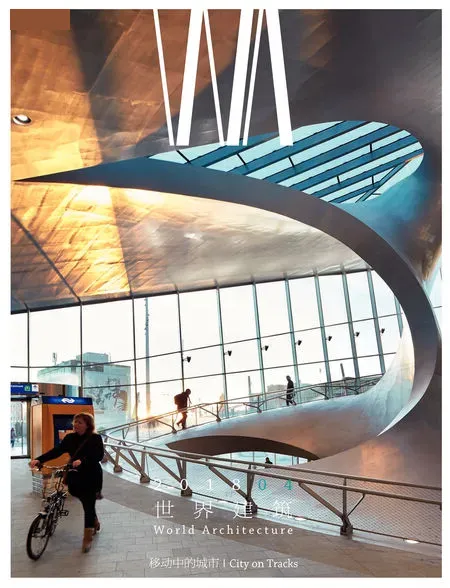
柏林中央火車站,柏林,德國
2018-04-21 07:04:25建筑設計格康瑪格及合伙人建筑師事務所
世界建筑 2018年4期
關鍵詞:建筑
建筑設計:馮-格康,瑪格及合伙人建筑師事務所

柏林中央火車站是歐洲最大的包括遠程、區域和市內交通在內的樞紐型火車站,建在萊爾特老火車站的原址上,位于柏林市的動物園地區。新的城際特快地下層南北線與東西線弧形鐵軌在新火車站匯聚相連。此外,雙向的區域列車以及一條地下南北線路也途徑此站。這條南北線位于地下15m深的隧道中,橫穿施普利河與動物園地區。這是一座擁有8站臺遠程線路、4站臺區域線路以及U5號地鐵線的全新火車站。東西線的標高被抬高了10m,并與之前的鐵軌線路弧度吻合。四座新建鐵路橋上排布了4條遠程線路與兩條城市鐵路線。目前,火車站每日車次達1800次,日均客流量已達到30萬人/次。由于臨近施普利河灣處的行政區,中央火車站也被賦予了更多的內涵。從城市角度,它同時服務于北部的柏林莫阿比特區。
柏林中央火車站設計的核心思想是在城市環境中凸顯現存鐵路線的走向。巨大的輕質玻璃屋頂與兩棟與之交叉的辦公樓體量作為建筑語言詮釋了這一設計原則。
火車站通過3個層面組織交通功能:
地下二層:南北向遠程線路與區域列車;U5號地鐵
地面層:市內公共交通;旅客私人交通(連接市政道路、臨時停車場);自行車與行人交通;游客交通(大巴、游船)
地上一層:遠程線路與區域列車;城市軌道交通線路S3、S5、S6、S7、S9
柏林中央火車站總建筑面積達17.5萬m2,包括1.5萬m2的商業餐飲、5萬m2辦公、5500m2鐵路管理用房以及2.1萬m2的交通面積。站臺區域共計3.2萬m2,此外還有2.5萬m2停車場。
玻璃大廳
東西向長達430m的站臺大廳被一片321m長的大型輕質玻璃屋頂覆蓋。兩條建筑體量在此交匯,地下鐵路線的南北走向定義了兩棟建筑體的位置與排列方向。從城市規劃與建筑角度出發,這些被命名為“拱樓”的體量與火車站的玻璃大廳共同組成了一個整體。45m寬、159m長的南北向車站大廳同樣位于兩棟辦公樓之間,并被一片輕巧的玻璃拱頂覆蓋。玻璃大廳在朝向莫阿比特區與行政區兩個方向都呈現出友好的迎客姿態,因此也加強了政府行政區與市民街區之間的聯系。經由南北向的玻璃入口大廳可以進入拱形辦公樓。玻璃拱頂由4.7m高的魚型梁支撐,坐落在“拱樓”的承重結構上。
東西站臺大廳玻璃頂結構
地上弧形城市鐵路橋沿東西方向伸展,容納了6條鐵軌與3個站臺,結構上采用了無柱的三向拱形輕質殼結構。拱梁在縱向每隔1.5~1.7m排列,與縱向梁形成了近乎方形的結構網格單元。每個方形單元在對角線上用鋼索加固并覆蓋玻璃。拱形、縱向梁與斜向鋼索共同構成了一個完整的殼式結構。
氣候策略方面主要考慮不同形式的自然通風。室內熱空氣在玻璃拱頂的幫助下迅速上升到屋頂。新鮮的冷空氣則從檐口位置導入室內空間,廢氣通過屋頂開窗排出。為了實現優化的室內氣候,東西向玻璃屋頂全部采用了防紫外線單層玻璃。在占屋頂面積8.4%的最易傳熱的面積布置了光伏電板,也為站臺區域提供了額外的遮陽措施。

站臺大廳與基座建筑
十字形的火車站坐落在一個基座建筑上,后者同時聯系了兩座主要的辦公樓。矩形的基座可以從四面經由樓梯到達,提供了標高4.43m上的開放公共空間,與交通區域明確隔離。從城市規劃方面講,基座中容納的功能恰好促成了十字形大廳與周邊街區的聯系。同時,這一基座也為火車站綜合體提供了進一步開發利用的可能,推動城區發展。服務與供貨區位于基座的東西側。大面積的商業主要位于西部的地下一層與地面層。鐵路相關功能被安置在夾層中,包括柏林中央火車站的出入境管制站。
十字形大廳的中央區域設計了一個巨大的中庭,令日光灑入整個大廳,直達地下層空間,同時也為旅客創造了清晰的方向感。除了多部樓梯,6部觀景玻璃電梯也為各個南北向火車站臺與東西向城市軌道站臺提供了便捷的聯系。
拱樓
兩棟46m高的建筑橫跨東西向鐵軌,格網式的幕墻結構映射著玻璃大廳的輕質外觀。承重鋼結構暴露在幕墻外清晰可見,也因此定義了南北大廳的室內風格。拱樓與車站玻璃大廳共享地面層至四層的幕墻立面,從而共同組成了一個建筑整體。城市軌道上部,辦公樓懸挑結構從7~14層跨越87m。懸挑部分的荷載通過通高的外部鋼結構承擔,進而傳遞到外部的鋼柱與鋼梁。
兩座拱樓被分為兩個獨立的功能區域。鐵路相關的商業、餐飲與服務設施被安排在低層(地面層與夾層),地下一層為交通空間。10層拱樓中,9層被設計為靈活的辦公空間。1.45m的幕墻網格保證了辦公單元的靈活劃分:小型辦公空間與開放型大空間辦公皆有可能。不同樓層之間的內部樓梯也創造了未來單個辦公單元進行擴展的可能性。
2006年建成后,柏林中央火車站已經成為歐洲最大的火車交通樞紐,以及行政區附近的一個重要交通中心。作為城市、國家與整個歐洲共同發展的象征,中央火車站是往來旅客的一個重要落腳點。同時,這座包含了商業與辦公的充滿活力的城市綜合體整合了周邊多樣的城市空間,成為柏林心臟發展的內動力。它在落成時還僅僅是一個孤立的個體,現在則成長為城市的基石。在周邊逐步進行的城市建設過程中,柏林中央火車站始終保有著地標的力量,使其無可非議地成為了一個首都的獨一無二的中央火車站。□
Berlin's new Central Station –Europe's largest train station for long-distance, regional, and local transport – was built on its historical site in the Tiergarten District. At this station the new underground north-south link of the Inter City Express service connects with the west-east line running on a curved railway track. Additionally,suburban railway runs in both directions, as well as an underground line from north to south arrive at this station. The north-south track runs 15 m below ground level in a tunnel, which also passes below the River Spree and the Tiergarten. A train station for long-distance journeys with eight platforms, four platforms for long-distance and regional transport as well as a new train station for the U5 underground line positioned parallel to the eastern platform was realised in this location.The east-west line is elevated 10 m above street level und corresponds to the previous course of the railway tracks. A total of four long-distance railway tracks and two urban train tracks run on four newly constructed urban railway bridges. 1,800 trains call at the station per day and the daily number of passengers has reached 300,000. The train station gains additional significance from its proximity to the government district south of the Spreebogen.Simultaneously it serves the urban district Berlin-Moabit adjoining in the north.
The key design principle of Berlin's Central Station is the clear emphasis of the existing course of the railway tracks in the urban environment.Large, lightweight glass roofs as well as two intersecting office buildings translate this principle with architectural means.
The traffic of the train station is organised on three levels:
Level –2: Long-distance and regional lines from north to south; U5 underground line
Level ±0: Local public transport; individual transport (access road, short-term car park); bicycles and pedestrians; tourist transport (coaches, ships)
Level +1: Long-distance and regional lines on the urban railway track; S3, S5, S6, S7, and S9 urban railway lines.
The new Berlin Central Station comprises a total floor area of 175,000m2, with approximately 15,000m2 reserved for shops and gastronomy,50,000m2 are provided as office space in the arch buildings, 5,500m2 serve for operational railway use as well as 21,000m2 as circulation area. The platforms cover an area of 32,000m2, the garage comprises 25,000m2.
The glazed halls
The platform hall, 430 m long and orientated in east-westerly direction, is spanned with a large,light-weight glass roof over a length of (at present only) 321 m. It intersects two building bars, their location and alignment defining the north-south part of the train station located underground in the urban environment. From an urban planning and architectural aspect, these so-called arch buildings form a unity with the glass halls of the train station.The north-south station hall, 45 m wide and 159 m long, is located between these building bars and also covered by a fine, vaulted glass roof structure. The hall offers an inviting gesture towards the Moabit district on one side as well as the government district on the other, consequently taking on an additional function of connection between government district and urban quarter. The glass roof of the north-south orientated entrance hall is connected to the lateral arch buildings. The vaulted glass surface of the roof is supported by 4.70-metrehigh fi sh beams resting on the external load-bearing structure of the arch buildings.
Glass roof structure of the east-west platform hall
The above-ground, curved urban railway bridges, running in an east-westerly direction,with a total of six tracks and three platforms located in between, are column-free spanned with a lightweight shell construction, which is vaulted in three directions. Bars of arch are positioned at a spacing of 1.50 m to 1.70 m in the longitudinal direction, which together with longitudinal bars located in between form almost square (respectively rectangular) net modules. Each of these modules is diagonally braced with cables and covered with glass.The combination of vaults, longitudinal beams, and diagonal cables forms a shell-like structure.
Platform hall and base building

4-6 外景/Exterior views

7 中央大廳內景/Interior view, central hall
The cruciform train station rests on a building base, which simultaneously integrates the dominant, diagonal building bars. The rectangular base is accessible on all four sides via stair links and offers open public spaces at a height of 4.43 m above street level, which are clearly separated from the circulation zones. From an urban planning aspect,the building parts accommodated in the base serve to integrate the cruciform hall ensemble and the urban district. Simultaneously it adds further usesto the train station complex, giving an important impetus to the overall urban district. Service and delivery functions are located in the base element on the eastern and western sides. Large areas for shops are found primarily on levels – 1 and ±0 in the western part. Railway-specific uses are located on the mezzanine –1/2. The control point of Berlin's Central Station is also to be found in this location.
The arch buildings
Two 46-m-high building bars bridge the east west railway track, with the lattice structure of the fa?ade reflecting the lightweight appearance of the glass station halls. The supporting steel structure of the building bars is visibly positioned in front of the fa?ade level, consequently defining the character of the north-south station hall. The external fa?ade of the building bars forms an architectural unity with the train station hall by serving as a joint external wall on levels ±0 to +4. In the area of the urban railway bridge, a cantilevered building structure stretches over 87 m on levels +7 to +10. Load transfer for the bridge element is provided via an external steel framework across the complete bridge height, integrating external columns and beams.
After its completion in 2006, Berlin Central Station as Europe's largest intersection train station serves as important transport centre in immediate proximity to the government district, and simultaneously presents a lively building complex thanks to its mixed use with commercial areas and offices, integrating the various surrounding urban environments.□

8-11 中央大廳內景/Interior views, central hall

12 地下2層平面/Floor -2 plan

13 地下1層平面/Floor -1 plan

14 首層平面/Ground fl oor plan

15 1.5層平面/0.5 fl oor plan

16 二層平面/1st fl oor plan
評論
王江燕:柏林中央火車站是歐洲最大的包括了遠程、區域和市內交通的樞紐型火車站,建成于2006年。每個使用過它的乘客和到車站休閑旅游、吃飯購物的游客都會對它緊湊集約的交通樞紐布局、便捷的換乘、為周邊景觀錦上添花的建筑設計和車站的綜合商業、辦公功能留下深刻的印象。5層的中心大廳和東西側玻璃大廳界定了明確的長短途交通功能,十字交叉的換乘安排造就了便捷舒適的換乘環境。雖然它是一座火車站,但卻成為柏林的必游之地。因此,柏林中心火車站不僅是一座交通樞紐,也只一個建筑杰作和成功的以公交為先導的開發范例。
王睦:柏林中央車站為歐洲最大、最現代化的火車站,坐落在城市中心地帶——東西德昔日的邊界上,既成為德國統一的鮮明象征,更重要的是由于車站位于歐洲高鐵網的核心,強化了柏林穩坐新歐洲的中心位置,并向全世界展現德國的國家形象。
車站設計注重考慮與城市中心區的遠期發展和區域整體性相匹配:通過簡潔、堅定又不失輕盈的方正玻璃整體外觀塑造出現代感十足的印象,與施普雷河(護城河)對面的國會大廈遙相呼應,并與不遠處的地標勃蘭登堡門形成市中心的三大標志性建筑;車站46m的高度與國會大廈從穹頂到地面47m的高度保持協調;為適應城市中心區緊張的用地條件,特意將鐵路地下化,并通過車站一層大廳將南北向空間連接起來;車站體量雖大,但由于大量使用玻璃和金屬的材料、結構,化整為零的體量處理手法,使整個車站顯得輕盈通透,既保證了自身的形象突出,又不至于顯得過于突兀;沿站臺方向使用拱形的玻璃雨棚,兩座橫跨于站臺上的辦公塔樓暗示了位于地下的火車的運行方向,也增加了火車站的可識別性。
車站場地設計分為三個部分:北廣場、臺階基座及南廣場。空間組織十分集約,縮短與城市其他建筑的距離。其中,4.43m高的臺階基座直接與車站的二層連接,既增加了車站的體量感,又形成了周邊建筑到車站的過渡,并作為車站露天功能區,增添了車站的城市門戶形象。
在豎向功能布局上,柏林站采用了典型的“三明治”結構,地上三層和地下二層主要為車站對外的軌道交通設施層,地下一層至地上二層為車站配套的商業服務區域。以交通換乘動線串接所有的商業空間,極大地提高了商業空間的商業價值。
Comments
WANG Jiangyan: Berlin Central Station, built in 2006, is the largest railway station hub in Europe, which includes long-distance, regional and city transport services. Every passenger who has used it and tourist who has been to the station for leisure, travel, eating and shopping would be deeply impressed by its compact and intensive transportation hub layout, convenient transfer, architectural design that added beauty to the surrounding landscape,and the comprehensive business and office functions of the station. The central hall on the fifth floor and the glass halls on the west and east sides define the clear function of long and short distance transport, and the crossing transfer arrangement creates a convenient and comfortable transfer environment. Although it is a railway station, it has become a must-go destination in Berlin. Therefore, the Berlin Central Station is not only a transportation hub, but also an architectural masterpiece and a successful example of transit-oriented development. (Translated by CHEN Yuxiao)
WANG Mu: Berlin Central Station is the biggest, most modern train station in Europe. It's located at the city central area, the former border between DDR and BRD. Not only did it become a distinctive symbol of Germany's unification,but more importantly, sitting at the core of European highspeed rail network, it also strengthened the central position of Berlin in the new Europe and presented the German national image to the whole world.
The design of the station laid emphasis on matching it with the long-term development of the city central and the integrity of region: forming a very modern image with the simple, firm but also light cubic glass appearance, responding to the Parliament House across Spree River (moat), and making up the three iconic landmarks in the city centre together with Brandenburger Tor not far away; keeping coordination to the 47m height of the Parliament House from top of the dome to the ground with the 46m height of the station; intentionally making the railway underground and connecting the North-South space with the hall on the first floor of the station to adapt to the intensive land use condition in the city central area; making the whole station look light and transparent by the large usage of glass and metal material and structure, and the volume treatment of breaking into pieces, although the station is massive, which kept the figure to be outstanding but not too abrupt; using vaulted glass canopy along the side of the platforms and implying the train moving direction underground with the two office tower buildings across the platforms which also enhanced the identity of the train station.
The site design of the station is divided into three parts: the north square, the step foundation and the south square. The space organisation is very intensive,which shortens its distance from other buildings in the city. The 4.43m high step foundation is directly connected to the second floor of the station. It not only increases the sense of weight of the station, but also forms the transition from the surrounding buildings to the station.As a layout area for the outdoor functions of the station,it also adds to the frontal image of the station in the city.
In terms of vertical functional layout, the Berlin Station has adopted the typical sandwich structure:the levels of 3F and B2 are mainly the external rail transportation facilities of the station and from B1 to 2F are the commercial service areas matching to the station.Linking all the commercial space with transportation transfer route greatly enhanced the commercial value of commercial space. (Translated by CHEN Yuxiao)
項目信息/Credits and Data
業主/Client: 德國鐵路股份有限公司/Deutsche Bahn AG represented by DB ProjektVerkehrsbau GmbH
主持建筑師/Principal Architects: 邁因哈德·馮-格康,于爾根·希爾默/Meinhard von Gerkan, Jürgen Hillmer
鐵路項目負責人/Project Managers, Long-Distance Rail:Hans-Joachim Glahn, Klaus Hoyer
玻璃屋面項目負責人/Project Manager, Glass Roofs: Prisca Marschner
U型建筑項目負責人/Project Manager, Building Slabs:Prisca Marschner, Susanne Winter
結構設計/Structural Engineering: SchlaichBergermann und Partner, IVZ/Emch+Berger
照明設計/Lighting Design: Peter Andres + Conceptlicht GmbH
建筑設備/Technical Building Equipment: Brandi IGH
建筑面積/Gross Floor Area: 175,000m2(5個交通層/5
transportation levels)
東西向玻璃屋面長度/Length of Glass Roof: 321m
玻璃屋面寬度/Width of Glass Roof: 59~68m
玻璃屋面高度/Hight of Glass Roof: 自站臺標高算起15~17m/15~17m from platform
基地面積/Site Area: 100,000m2
建設周期/Construction Period: 1996-2006
攝影/Photos: Marcus Bredt

17.18 剖面/Sections

19 橫剖面/Cross section
猜你喜歡
北方建筑(2021年6期)2021-12-31 03:03:54
文苑(2020年10期)2020-11-07 03:15:36
現代裝飾(2020年6期)2020-06-22 08:43:12
現代裝飾(2020年4期)2020-05-20 08:55:08
攝影之友(影像視覺)(2019年2期)2019-03-05 08:27:16
藝術家(2017年3期)2018-01-26 08:54:49
文學自由談(2016年3期)2016-06-15 13:01:16
福建農業科技(2016年10期)2016-03-07 09:46:49
少兒科學周刊·兒童版(2015年6期)2015-11-24 03:49:38
中國工程咨詢(2015年4期)2015-02-14 03:49:56