
Analysis of point-selection pattern in acupuncture-moxibustion treatment of amblyopia
2018-04-28 03:27:16CaoZhaoxia曹朝霞LiuAnguo劉安國YanXingke嚴興科LiXiaojuan李小娟
Cao Zhao-xia (曹朝霞), Liu An-guo (劉安國), Yan Xing-ke (嚴興科), Li Xiao-juan (李小娟)
1 Gansu University of Chinese Medicine, Lanzhou 730000, China
2 Dazhou Hospital of Integrated Chinese and Western Medicine, Sichuan Province, Dazhou 635000, China
Amblyopia is a disorder of sight due to refers to interactions of the two eyes or sufficient visual deprivation during the critical period of visual development. It causes a decrease in vision in one or both eyes with no apparent structural abnormality. The best corrected vision is still less than 0.9[1-2]. In China,amblyopia affects 0.81%-2.80% of children[3-4]. Modern treatment methods include patching (occlusion),penalization, levodopa, or laser eye surgery. However,children may not respond well to these therapies due to their poor compliance and adverse reactions of levodopa or surgery[5]. Acupuncture is widely used for the treatment of amblyopia because of its reliable efficacy, easy operation and fewer side effects[6-8]. This paper analyzes the points used for amblyopia and point-combination pattern in acupuncture literature over the past 17 years and aims to provide valuable reference for future treatment in this regard.
1 Data and Methods
1.1 Data sources
Domestic databases: China National Knowledge Infrastructure (CNKI), Chongqing VIP Database (CQVIP),Wanfang Academic Journal Full-text Database(Wanfang), and Chinese Biomedical Literature Database(CBM).
Overseas databases: PubMed, Cochrane Library(Cochrane), and Excerpta Medica Database (EMBASE).
Search time: Between January 1, 2000 and March 31,2017.
1.2 Search terms
Amblyopia, acupuncture-moxibustion, acupuncture,moxibustion, electroacupuncture, plum-blossom needle,auricular point, ear acupuncture, points, etc.
1.3 Inclusion criteria
Confirmed diagnosis of amblyopia; major points mainly from the fourteen meridians, extraordinary points and ear points, with the therapies of acupuncture,moxibustion, electroacupuncture, plum blossom puncture and ear acupuncture, treatment of amblyopia by single therapy or plus other methods; precise selection of points; definitive criteria for assessment of therapeutic effects; one latest-published article in the similar articles of the same author.
1.4 Exclusion criteria
Literatures of review, general summary and expert’s comments; literatures of animal experiment or mechanism study; and literatures without concrete points in the treatment.
1.5 Statistical management
After Excel tables were established, the points of the collected literatures were categorized statistically by meridian, major points, adjunct points and ear points,and respectively recorded with their frequency. The frequency of the collected points was statistically analyzed by frequency statistics, to sum up the pattern of the point selection and draw up the tables.
2 Results
2.1 Results of literature search
In accordance with the above methods, totally 121 relevant articles were collected. After screening, 52 articles were in conformity with the inclusive criteria, in which there were 21 articles on treatment by ear acupuncture, and 31 articles on treatment by non-ear acupuncture.
2.2 Point-selection and meridian
It can be seen from Table 1 that in 31 articles of nonear acupuncture, acupuncture-moxibustion treatment of amblyopia involved 10 meridians, and 10 commonlyused extraordinary points. Totally 44 points at 217 times of frequency involved, including 159 times of frequency in major points and 58 times of frequency in adjunct points. The meridians with most points used were the Bladder Meridian of Foot Taiyang (8 points), the Stomach Meridian of Foot Yangming (6 points),Governor Vessel (5 points), and the Gallbladder Meridian of Foot Shaoyang (4 points), (Table 1).

Table 1. Points, meridians and frequency
2.3 Major and adjunct points
In 31 articles of non-ear acupuncture, the top 10 major points in frequency were Jingming (BL 1) (17 times), Taiyang (EX-HN 5) (15 times), Cuanzhu (BL 2) (13 times), Fengchi (GB 20) (13 times), Baihui (GV 20) (11 times), Hegu (LI 4) (10 times), Guangming (GB 37) (9 times), Sibai (ST 2) (9 times), Chengqi (ST 1) (9 times)and Sizhukong (TE 23) (8 times). The top 5 adjunct points in frequency were Zusanli (ST 36) (8 times),Shenshu (BL 23) (8 times), Ganshu (BL 17) (7 times),Sanyinjiao (SP 6) (4 times) and Taixi (KI 3) (4 times).
In 31 articles of non-ear acupuncture, the high percentage in the total frequency of the major points was extraordinary points (34 times), points of Bladder Meridian (36 times), Gallbladder Meridian (25 times),and Stomach Meridian (23 times). The high percentage in the total frequency of the adjunct points was Bladder Meridian (19 times), Stomach Meridian (10 times),Large Intestine Meridian (5 times) and Spleen Meridian(5 times). The high percentage in the total frequency of the adjunct points was Bladder Meridian (55 times),extraordinary points (41 times), Stomach Meridian (33 times) and Gallbladder Meridian (29 times), (Table 2).
2.4 Ear points
In 21 articles of treatment by ear points, totally 37 ear points were involved (161 times). The ear points with the using frequency larger than 30% were Kidney (CO10)(100.0%), Liver (CO12) (90.5%), Eye (LO5) (80.9%), Eye 1(TG2) (57.1%), Eye 2 (AT1) (57.1%), Heart (CO15) (42.8%)and Spleen (CO13) (33.3%), (Table 3).
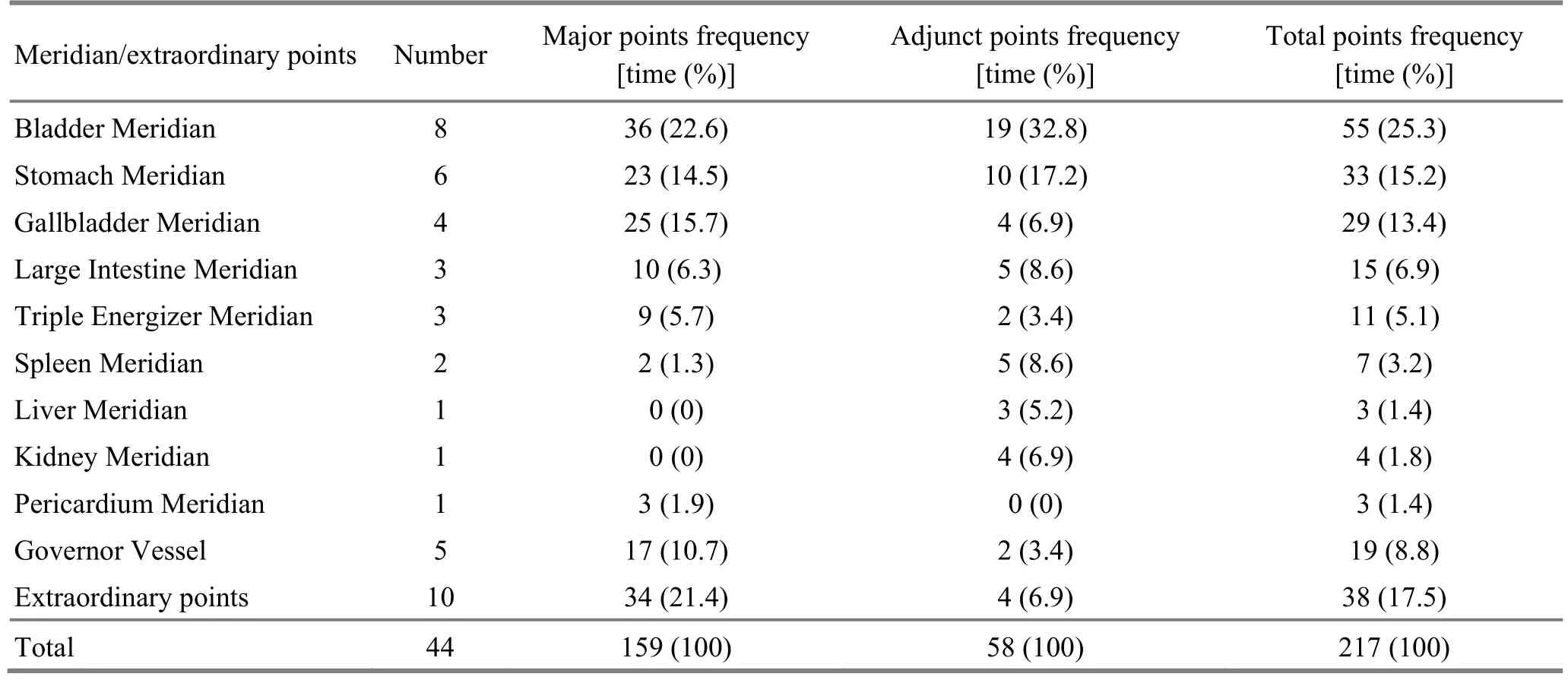
Table 2. Number of points and their frequency

Table 3. Ear points in using frequency larger than 30%
3 Analysis of the Pattern in the Point-selection
Amblyopia is a common ophthalmic disease in children. Although the patients with amblyopia have no organic lesions in the eyes, the vision after correction is still lower than that of the children at the same age.Amblyopia can be divided into strabismic amblyopia,anisometropic amblyopia, ametropic amblyopia, and form deprivation amblyopia[9].
There was no term of amblyopia in the classical literature of traditional Chinese medicine. Based upon the clinical manifestations, it can be categorized into the scope of ‘blurry vision’ and ‘glaucoma’, and is mostly caused by deficiency of the liver and kidney due to prenatal insufficiency or postnatal malnutrition due to deficiency of the spleen and stomach, or failure in treatment or error in the treatment[10]. The points in the literatures collected for this study were categorized and summarized by the proper order of meridian, major and adjunct points, showing that the selection of points in acupuncture-moxibustion treatment of amblyopia was characterized by 4 aspects.
3.1 Points predominantly from yang meridians
It has been shown in the analysis of the literatures that amblyopia was mainly treated by the points from yang meridians, predominantly from the Bladder,Stomach and Gallbladder Meridians. Because the pathways of those three meridians are closely related to the eye system, the stimulation to the points on those three meridians can be used for the diseases of the eyes.The points in the top three of the frequency were respectively from the Bladder, Stomach and Gallbladder Meridians. Ge HL,et al[11], reported that in the treatment of intractable amblyopia by mainly the points from the Bladder, Gallbladder and Stomach Meridian,the total effective rate was 100% for amblyopia after cataract surgery and anisometropic amblyopia.
3.2 Points mainly around the eyes, plus holistic consideration
It has found out in this study that the points used most frequently for amblyopia did not belong to the fourteen meridians, but were the extraordinary points distributed around the eyes. Generally, the extraordinary points are developed from Ashi points[12].Qiuhou (EX-HN 7) and Yuyao (EX-HN 4) are located around the eyes, distributed with many arterial branches in the deep layer. Blood circulation in the ocular region mainly comes from the ocular arteries.Acupuncture can dilate the local blood vessels, speed up blood flow and accelerate the local metabolism, so as to treat amblyopia[13]. Since the ancient times,Jingming (BL 1) around the eye had been extensively used in treatment of amblyopia[14]. Distributed with the ophthalmic nerves in the deep layer[15], Jingming (BL 1)was combined with various points for directly regulating the meridian qi of the eyes[16]. Taiyang (EX-HN 5),adjacent to the branch of the trigeminal nerve and oculomotor nerve, is a commonly used point for diseases in the ocular region[17-18]. Cuanzhu (BL 2) is mainly used to treat ocular diseases and forehead pain,and can be used to brighten the eyes, if it is combined with Fuyang (BL 59). Zhao JH,et al[19], achieved satisfactory therapeutic results in the treatment of amblyopia in children by selecting Cuanzhu (BL 2) in combination with Fuyang (BL 59), and Hegu (LI 4) with Fuyang (BL 59), based upon the theory of combination of remote and adjacent points and the points in the lower body for problems in the upper body.
3.3 Points selection by pattern identification plus combination of points by experience
Amblyopia is mostly caused by essence deficiency of the liver and kidney, essence deficiency and shortage of blood, or insufficiency of natural endowment, postnatal malnutrition, or failure in treatment or error in the treatment, and its pathogenesis is mainly related to deficiency. Therefore, clinically, Fengchi (GB 20),Chengqi (ST 1), Baihui (GV 20), Zusanli (ST 36), Hegu(LI 4), Ganshu (BL 18), Pishu (BL 20), and Shenshu (BL 23)could be selected for pathogenesis, in combination with empirical points such as Zhengguang 1 (Extra),Zhengguang 2 (Extra), Xinming (Extra), and Yandian(Extra), jointly for treating amblyopia.
Fengchi (GB 20) is a crossing point of yang meridians and Yang Link Vessel, and links with the collaterals of the eyes. Acupuncture at Fengchi (GB 20) can dredge the collaterals of the eyes, clear and benefit the head and eyes. It has been proven that acupuncture at Fengchi (GB 20) has an obvious improving effect on the excitability of the cerebral cortex[20]. Miao CY,et al[21],treated amblyopia in children of high age by heat-sensitive moxibustion at Fengchi (GB 20) and the total effective rate was 85.1%. In combination of Fengchi (GB 20) and Chengqi (ST 1), essence of the spleen and stomach could be guided to flow upward and nourish the eyes, and ensure the healthy transportation of the spleen and stomach, sufficiency in production of qi and blood, exuberance of essence and blood in the liver and kidney, and smooth flow of the meridians, so as to nourish the ocular system. Baihui(GV 20) is located at the vertex and can be used to regulate yang qi of the whole body. Zusanli (ST 36), the Lower He-Sea point, is a healthcare point. Acupuncture at Zusanli (ST 36) can be used to reinforce the spleen and benefit the stomach, and strengthen the source of qi and blood production[22]. Hegu (LI 4) is the Yuan-Primary point of the Large Intestine Meridian of Hand Yangming. Acupuncture at Hegu (LI 4) can be used to regulate qi and blood, nourish blood, dredge the collaterals and brighten the eyes. Ganshu (BL 18), Pishu(BL 20) and Shenshu (BL 23), as Back-Shu points, can be used to regulate the liver and nourish blood, reinforce the spleen and benefit the kidney. As an effective point to brighten the eyes, Ganshu (BL 18) is also able to regulate the liver to brighten the eyes[23]. The above points in combination can improve the circulation of qi and blood in the eyeballs and surrounding tissues, and dredge the collaterals of the ocular fundus, so as to transport the essential qi of five Zang and six Fu organs to the eyes for treating amblyopia. Lin ZH,et al[24],punctured Ganshu (BL 18) and Shenshu (BL 23) for treating the patients with amblyopia and the effective rate was 100%.
Zhengguang 1 (Extra), Zhengguang 2 (Extra), Xinming(Extra) and Yandian (Extra) are the frequently-used empirical points. Zhengguang 1 (Extra) and Zhengguang 2 (Extra) are located in the ocular region and have the effects to brighten the eyes[6]. Xinming (Extra), an empirical point innovated in 1980s[25], has the effects to regulate the meridian qi of the ocular region, accelerate blood circulation of the ocular region, improve nutrition of the ocular nerves and is mainly used for treating diseases in the ocular region. Yandian (Extra) is located in the ear lobe and is stimulated to dredge the meridians and collaterals, and regulate and harmonize qi and blood, so as to improve the vision of the patients with amblyopia.
3.4 Emphasis on ear points
It has been found out in this study that in 52 articles in conformity with the inclusion criteria, 21 articles were the literatures about ear acupuncture, accounting for 40% of the selected literatures. It could be seen that ear points were significant in the treatment of amblyopia.
It is believed in Chinese medicine that the ear is most densely distributed with the meridians and collaterals.Twelve meridians and three hundred and sixty five collaterals all go through the ear. It has been proven by the study that oppression on the ear points can regulate the physiological functions of the human organs.Seed-embedding method at ear points can stimulate the nervous pathways of the lymphatic vessels, blood vessels and nerves of the ocular region, so as to improve the functions of the organs[26]. The selection of ear points is mainly focused on Liver (CO12), Kidney(CO10), Eye (LO5), Heart (CO15), Eye 1 (TG2), Eye 2 (AT1),and Spleen (CO13). Among them, Heart (CO15), Liver(CO12) and Kidney (CO10) can regulate qi and blood, and dredge the meridians. The spleen dominates the muscles. Therefore, stimulation on Spleen (CO13) is able to improve the vision. Eye (LO5), Eye 1 (TG2) and Eye 2(AT1) are the corresponding points of the eye and are able to dredge the meridians and improve the vision by stimulation.
The commonly used herbal product for earembedding method isWang Bu Liu Xing(Semen Vaccariae)[27]and Er Xue Zeng Shi Dan (Ear Point Visionincreasing Pills)[28]. Liu HY[29]treated 65 children with amblyopia by embedding the herbal seeds at ear points and the total effective rate was 97%. Miao CY,et al[30],treated amblyopia by applying round magnetic steel sheet, in diameter of 4 mm and 3 000 Gauss of surface magnetic field strength, to the bilateral ear points of Eye(LO5), Liver (CO12), Spleen (CO13), Central Rim (AT2,3,4i),Subcortex (AT4) and Sympathetic (AH6a), by stimulating the ear points with magnetic stimulation and pressure from suction of the two pieces of magnetic sheets, and the total effective rate was 90.3%, without adverse reactions.
4 Summary
It can be seen from the findings of this study that the selection of the points in acupuncture-moxibustion treatment of amblyopia reflects the holistic concept and therapy based upon pattern identification in traditional Chinese medicine, and the point-selecting pattern of the selection of the local points, plus the selection of the points by holistic consideration, the selection of the points based upon pattern identification, and the combination of the points based upon experience, in order to strengthen the spleen and circulate qi,reinforce and benefit the liver and kidney, dredge the eye collaterals, clear the head and eyes, and harmonize yin and yang, so as to realize the goal to treat amblyopia.
Conflict of Interest
The authors declared that there was no potential conflict of interest in this article.
This work was supported by National Natural Science Foundation of China (國家自然科學基金項目, No.81660816, No.81260560); Science Fund Project for Middle-young Age of Gansu University of Chinese Medicine (甘肅中醫藥大學中青年科研基金項目, No.ZQ2015-1).
[1] Amblyopia and Infantile Ophthalmology Group,Ophthalmology Society of Chinese Medical Association.Experts consensus on diagnosis of amblyopia (2011).Zhonghua Yanke Zazhi, 2011, 47(8): 768.
[2] Liu JQ. Practical Ophthalmology. Beijing: People’s Medical Publishing House, 2010: 595.
[3] He M, Huang W, Zheng Y, Huang L, Ellwein LB.Refractive error and visual impairment in school children in rural southern China. Ophthalmology, 2007, 114(2):374-382.
[4] He M, Zheng J, Liu Y, Xu J, Pokharel GP, Ellwein LB.Refractive error and visual impairment in urban children in southern China. Invest Ophthalmol Vis Sci, 2004, 45(3):793-799.
[5] Xu JS, Wang HW. Progress of treatment for amblyopia in children. Guoji Yanke Zazhi, 2013, 13(2): 302-305.
[6] Wu L, Zhang GL, Yang YX, Hu XD, Wu D, Wu DL, Luo CC, Zhang SM, Cui GF. Clinical study on electrical plum-blossom needle for treatment of amblyopia in children. Zhongguo Zhongxiyi Jiehe Zazhi, 2011, 31(3):342-345.
[7] Lam DS, Zhao J, Chen LJ, Wang Y, Zheng C, Lin Q, Rao SK, Fan DS, Zhang M, Leung PC, Ritch R. Adjunctive effect of acupuncture to refractive correction on anisometropic amblyopia: one-year results of a randomized crossover trial. Ophthalmology, 2011, 118(8): 1501-1511.
[8] Vanzini M, Gallamini M. Amblyopia: can laser acupuncture be an option? J Acupunct Meridian Stud, 2016,9(5): 267-274.
[9] Zhao JH. Study of amblyopia definition. Zhongguo Zhongyi Yanke Zazhi, 2014, 24(5): 353-359.
[10] Duan JG. Ophthalmology of Integrated Traditional Chinese and Western Medicine. Beijing: China Press of Traditional Chinese Medicine, 2005: 320.
[11] Ge HL, Liu SQ. Observation of intractable amblyopia treated by acupuncture. Shijie Zhongxiyi Jiehe Zazhi, 2009,4(8): 567-569.
[12] Liu Y. Complete Compendium of Chinese Extraordinary Points. Shanghai: Shanghai Scientific and Technical Publishers, 2001: 119-125.
[13] Yin LX, Duan L. Clinical observation of acupuncture at local points for optic atrophy. Baotou Yixueyuan Xuebao,2012, 28(6): 93.
[14] Chen C, Cui HF, Yan XK, Wang FC. Clinical study progress of acupuncture-moxibustion for amblyopia.Shanghai Zhenjiu Zazhi, 2011, 30(1): 64-67.
[15] Xu XD, Jin LZ, Lou XF, Sun SH, Jiang SH. Anatomical study on Jingming (BL 1). Zhongguo Zhen Jiu, 2006, 26(6):415-416.
[16] Wang SJ. Experience on application of Jingming (BL 1).Shanghai Zhenjiu Zazhi, 2009, 28(7): 426-427.
[17] Zhang CH, Ma XP, Wu DW, Liu ZW. Rules of acupoints for treating eyes disorder in acupuncture verses. Shanghai Zhenjiu Zazhi, 2011, 30(3): 195-197.
[18] Zhang CH, Zhang LL, Ma XP, Yang L, Hong J, Liu J, Wu LX. Research on acupuncture-moxibustion for dry eye syndrome. J Acupunct Tuina Sci, 2013, 11(2): 72-78.
[19] Zhao JH, Lam DS, Chen LJ, Wang Y, Zheng C, Lin Q, Rao SK, Fan DS, Zhang M, Leung PC, Ritch R. Randomized controlled trial of patchingvs.acupuncture for anisometropic amblyopia in children aged 7 to 12 years.Arch Ophthalmol, 2010, 128(12): 1510-1517.
[20] Chen RX. Experimental Acupuncture Science. Beijing:Science Press, 2004: 6.
[21] Miao CY, Chen RX, Pei CG, Xiong ML. Efficacy observation of heat-sensitive moxibustion for older children’s amblyopia. Zhonghua Zhongyiyao Zazhi, 2013,26(3): 461-463.
[22] Wan J. Observation on clinical effects of acupuncture plus amblyopia apparatus for amblyopia. Zhongguo Shiyong Yixue, 2016, 11(8): 269-270.
[23] Wang L, Zhou ZY. Observation on clinical effects of intradermal needle embedded at Ganshu (BL 18) plus bird-pecking moxibustion for children with amblyopia.Zhongguo Yiyao Zhinan, 2014, 12(32): 286-287.
[24] Lin ZH, Wei LJ, Zhou D, Zheng W. Clinical observation of acupuncture treatment of amblyopia based on “tonifying after dredging stasis” theory. Changchun Zhongyiyao Daxue Xuebao, 2014, 30(2): 331-333.
[25] Li PQ. Observation on clinical effects of acupuncture at Xinming (Extra) in treatment of 698 cases with optic atrophy. Zhongguo Zhen Jiu, 1989, 9(2): 1-4.
[26] Round R, Litscher G, Bahr F. Auricular acupuncture with laser. Evid Based Complement Alternat Med, 2013, 2013:984763.
[27] Gong PY, Zhang QL. Treatment of 60 children with amblyopia by ear point-embedding method. Changchun Zhongyiyao Daxue Xuebao, 2007, 23(1): 55-56.
[28] Gu SG, Cheng HF, Gu ZH, Dong J, Lü SL, Pei ZZ, Wang KJ. Treatment of 45 children with amblyopia by plumblossom needle plus ear point-embedding method.Zhongguo Minjian Liaofa, 2005, 13(10): 45-46.
[29] Liu HY. Treatment of children with amblyopia by herbal seed-embedding method. Zhongguo Linchuang Kangfu,2003, 7(10): 1615.
[30] Miao CY, Chen RX. Treatment of 25 children with amblyopia by magnet therapy at ear points. Jiangxi Zhongyiyao, 2000, 31(6): 46.
 Journal of Acupuncture and Tuina Science2018年2期
- Journal of Acupuncture and Tuina Science的其它文章
- Clinical observation on cervical chiropractic for cervical spondylosis of vertebral artery type
- Observation on clinical effect of tuina plus Western medication for functional dyspepsia due to liver qi stagnation and spleen deficiency
- Yi Jin Jing (Sinew-transforming Qigong Exercises) for primary osteoporosis in the elderly: a clinical trial
- Effect of acupuncture plus Tai Ji Quan on the recovery of neurological function and depression state in post-stroke depression patients
- Effect of An-pressing manipulation on the serum levels of T-AOC and CK-MM in volunteers with delayed onset muscle soreness in biceps brachii
- Effect of acupuncture in intervening heroin-induced brain damage via regulating ubiquitin-proteasome pathway