《項目管理世界期刊》總編輯戴維·佩爾斯:PM盛,國則強
2018-05-31 07:02:37尉艷娟
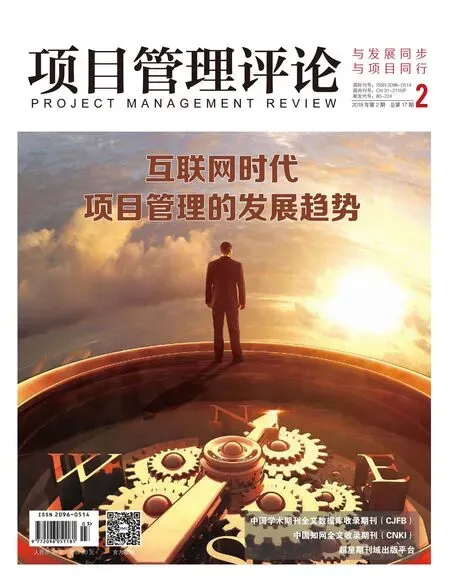
項目管理評論 2018年2期
文/本刊記者 尉艷娟
編者按
《項目管理世界期刊》(PM World Journal)是項目管理界頗具影響力的專業期刊,其總編輯戴維·佩爾斯是國際公認的項目管理頂級專家,曾兩次入選美國項目管理協會(PMI)董事會,曾為很多重大項目提供項目管理咨詢服務,在工程、建設、國防、運輸、高新技術等領域有豐富的項目和項目集管理經驗。2018年年初,《項目管理世界期刊》共享了一篇《項目管理評論》的文章,雙方開啟了友情合作之旅。借此機會,我們對戴維·佩爾斯進行了專訪,請他與大家分享從業35年來的感悟。
觀點精要
● 從業35年來,戴維·佩爾斯洞悉到行業的五大變化:項目管理工具的出現;《項目管理知識體系指南》的出版、各種標準和認證的出臺;全球項目管理組織的增加;“軟技能”的重要性日益凸顯;項目管理的價值逐步得到政府的認可。
● 沒有有效的項目管理,中國企業不可能迅速完成那么多機場、鐵路、航天發射等重大項目。
● 項目管理是國家能力。發展中國家都應該向英國學習,建立國家級項目管理辦公室(PMO),來指導和監督重要項目的實施。
● 人工智能對項目管理的影響主要體現在兩個方面:一是更多項目將受到“物聯網”的影響;二是BIM模型將帶來項目管理的革命。
● 文化智商(Cultural Intelligence)是項目經理應具備的重要“軟技能”之一。管理多文化的團隊雖然頗具挑戰,但是文化多樣性能夠推動創新和敏捷。因此,領導者應該對文化多樣性持開放態度。
● 項目是獨一無二的,項目經理從定義上來講應該是“變更經理”。
● 變更雖然充滿不確定性和風險,但也為我們帶來了機遇。未來我們應更加重視“風險管理”的積極面,把“敏捷”和“創新”作為基本能力要求。
● 每個人都是自己人生的“項目組合經理”。由于項目組合經理需要知識、教育、經驗,對于年輕人來講,做自己人生的項目組合經理有點“偶然”。
● 未來項目管理將應用于每個行業,女性應該發揮同等重要的作用。

采訪實錄
Q1 You have more than 35 years of experience in project management; what changes have happened in PM?
David L. Pells (Pells): In 35 years there have been many, many changes in the project management field. When I began to work in major projects in the mid-1970s, such important concepts as critical path planning, work breakdown structure (WBS), and earned value management (EVM) were already well developed. The first big disruptive change that I remember was not directly associated with project management per se, but rather the advent of the personal computer in the early 1980s. This was followed immediately by Microsoft and other companies introducing project planning tools that anyone could use on a desktop PC.Microsoft recognized the growing importance of projects in many industries, created MS Project and integrated it with the MS Oきce suite of business applications. Whereas previously project planning, scheduling and cost control tasks were often performed by specialists, now anyone could use similar tools and manage (or at least try to manage) their own projects.
The second really disruptive change was the publication of theGuide to the Project Management Body of Knowledgeby the Project Management Institute (PMI), followed soon thereafter by PMI’s Project Management Professional (PMP)certification. These two PMI products began to drive growth in both PMI membership as well as industry recognition of project management. This growth has continued, with PMI membership now well over 400,000 worldwide. Combined with PMP certificate holders, PMI serves more than one million. PMI, APM in UK, AIPM in Australia, IPMA, AACE and other professional organizations added more standards and more certifications; the combination of these products and growing numbers of associations, members, chapters and stakeholders has resulted in widespread recognition of projects and project management in many organizations and countries.
The third change, a trend really, was the growth of PM professional organizations in many countries. By the time we held the first Global PM Forum in New Orleans in 1995, there were more than 30 professional PM societies worldwide. Now there are more than 80. Over the last 30 years, the PM profession has grown, expanded and matured. Combined with PM standards, tools, publications,education and training, these organizations have spurred widespread recognition of project and project management across nearly all industries and locations. Many of these organizations offer competing standards, qualifications, products and services,but together they represent a very significant trend (resulting in change). Project management is now well established in most industries and countries.
The 4th major change was the recognition that such soft skills as communication, teamwork, leadership, stakeholder engagement and similar issues were just as important, perhaps more so in many cases, than skills and knowledge about scope,schedules, costs, quality, procurement and other engineering or scientific-oriented aspects of PM. Whereas the largest PM professional associations all had standards and certifications by the year 2000, they all began to incorporate these soft skills into the professional products and messages. The field of human psychology rocked the PM landscape. Emotional Intelligence made its appearance in the PM field. With economic and industrial globalization came the need for more cultural awareness and knowledge, and Cultural Intelligence. Now we often see “project leadership” emphasized rather than project management, with the soft skills headlining.
The 5th big change (trend in some locations) is the increasing awareness by government leaders that professional project and program management can lead to very serious improvements in managing public programs, projects and organizations. The best example may be in the UK where the national government began issuing program and projects management standards in the late 1990s (PRINCE2, MSP, etc.), the creation of the current Major Projects Oきce and the recent Charter awarded to APM.
Q2 As you have said, there are signs of leapfrogging happening in the project management world, especially in Asian countries.Have you paid attention to PM development in China? What impresses you most? What message would you like to say to project management professionals in China?
Pells:I am impressed with the increasing interest in project management in China. I don’t follow developments there closely,as I can only read English. But I know that there are now many project management programs at both the undergraduate and graduate levels in Chinese universities. There are multiple PM professional organizations in China; both PMI and IPMA are active there as well. And I can tell you that Chinese readers rank seventh among all visitors to the PM World Journal website (www.pmworldjournal.net), behind only large English language countries(USA, UK, India, Canada, Australia and South Africa).
Another observation has been the impressive and globally visible number and range of big projects completed by Chinese organizations, both government and industrial. We have watched the rapid completion of such projects as new airports, rail lines,space launches, web-based businesses (and entire industries),manufacturing plants, buildings and even entire new cities. Projects around Asia and Africa by Chinese organizations have been equally impressive. It’s hard to imagine so many projects being completed without eあective project management, so well done!Leapfrogging is really possible. My message to PM professionals in China is to find opportunities to leapfrog.Learn some history and proven methodologies, but study new research, consider current changing and future conditions,figure out what fits best for you and your projects. Learn what’s new, figure it out, and don’t wait.
Q3 In one of your articles, you mention that project management is a national competence. Would you please elaborate a little more on the importance of project management?
Pells: In a global economy where organizations and solutions compete across borders, the organizations that can complete their programs and projects most efficiently and successfully are more successful, at home and abroad. Programs and projects financed with public (taxpayer) money should be performed as eきciently and eあectively as possible. Since many project management methodologies were created to complete projects better, faster and cheaper, PM should be widely used.Some countries like Norway and the UK have recognized this;all developing countries should have a national PMO like in the UK to guide and monitor major projects.
Q4 You are the managing editor of the PM World Journal (PMWJ). From your perspective as an editor, what’s the significance and value of publishing project management magazines?
Pells: There are several answers to this question, depending on perspective. First, we play a crucial role in advancing the profession, by informing and educating working professionals.Publishing thus goes hand-in-hand with education in PM and in all professional fields.
For the PMWJ, there was another motivation. It seemed to me that the authors of PM articles and papers do not receive enough visibility or recognition for their work. In some cases, new creative works are brilliant, oあer new solutions, create new knowledge and advance the PM profession. Certainly the authors of such works deserve visible credit. So everything we publish in the PMWJ has an author profile at the end. We also showcase authors in the PM World Library (PMWL). This is very important to me.
Q5 You’ve listed Cultural Intelligence as one of the top soft skills of project managers. I think what you said makes great sense in the context of multi-cultural and virtual working teams.
Pells: Culture is important in project management, but it’s not as simple as the word implies. What is culture? While the focus is often on ethnic, national or regional differences, every organization, family, location, school or social group creates cultural influences or identifies. I worked on a very large project in the early 1990s that brought people together from many diあerent backgrounds, including academia, engineering organizations,scientific laboratories, defense and construction industries and many diあerent countries. The challenge became, how to create a new culture of our own for our big project that could empower the most people. It was a challenge. You are right; this is a big issue on virtual projects where awareness and sensitivity are both more diきcult and more important. It takes both experience and maturity.
Many people consider cultural diあerences as challenges or risks on project teams. While that may often be true, I see it diあerently.Cultural diversity on teams can provide opportunities to identify and explore new ideas and possible solutions. Diversity can thus contribute to innovation and agility, in my opinion.I think the best leaders recognize the potential value of diversity, are open to diあerences and act accordingly.
Q6 Discussions and predictions about Artificial Intelligence(AI) are common nowadays. As far as you are concerned, how will technologies like AI influence project management world?
Pells:This is a fun topic, and highly related to the emergence of the “Internet of Things” (IOT). These technologies will have great influence on project management from two angles— more projects will include smart materials, components and systems that are digitally (often wirelessly) connected.Some industries will be influenced more quickly than others,but already include aerospace, construction, defense, energy,healthcare, manufacturing and transportation. Project managers will still need to be human for the foreseeable future, but project teams will soon include robots (think about drones, for instance) doing specific tasks, some smarter than others. So what are the challenges when your team includes both people and robots? How do they interact? Who’s in charge? How are they trained, directed, rewarded or cared for?
The other perspective is related to project information.Building information Modelling (BIM) technology is already revolutionizing PM in the “built environment” where various kinds of project data are created, integrated, communicated and managed in multiple, inter-connected databases and systems.This is affecting project teams, communication processes,contracting and procurement capabilities (including logistics and deliveries), change control, project reporting, stakeholder engagement, financing and nearly every traditional PM role and activity. It’s both unsettling and exciting.
Q7 As people have said, the only thing that never changes is change itself. You even noted that change management and project management are becoming synonymous. In the fast-changing world, how will companies embrace change management?
Pells:If projects are defined as unique endeavors, then every project creates change. So by definition, project managers are change managers. Dealing with rapid change has led to all of the attention on “agility” in my opinion. But there is another related and important aspect of this topic that better answers your question.
Change has often been correlated with risk, and considered from a negative perspective. Numerous or rapid changes are bad because they introduce more uncertainty, more risks of making mistakes(aあecting scope, schedule, costs and other traditional performance objectives). But if you embrace agility and the need to innovate,to find new creative solutions, then change can be embraced as opportunities to improve, adjust, achieve more positive outcomes and benefits. In the future, I expect the opportunity side of risk management to increase in importance and for PM to incorporate both agility and innovation as fundamental skills.
Q8 It’s said that everyone is the project manager of his /her own life. Do you agree with that?
Pells:No and yes! Portfolio managers might be more accurate.The problem is this: the best PM normally takes experience,education, knowledge and maturity gained over many years.Young people, my younger self included, seldom have a good picture of their future life (or life cycle), don’t know what projects they will (or want) to achieve, or how to plan (let alone manage) those goals. Some people focus on an industry or career quite early (accountant, engineer, builder, doctor,scientist, soldier, teacher, spy, etc.), but still don’t have a clear understanding of the projects that they will attempt or achieve.So in retrospect, maybe we are all project managers, but mostly“accidental project managers” with respect to our own lives.
Q9 What’s your biggest harvest after working in this field for so long? What is it that you are most proud of?
Pells: Of course, I am very proud to have received the PMI Fellow award in 1999, and to have been named an honorary Fellow of APM in the UK, PMA in India and SOVNET in Russia. Recognition by one’s peers must always rank at the top of anyone’s career. I’m also proud of the work I did in the 1990s to bring various project management societies together to promote cooperation and collaboration. I learned more about PM faster, gained leadership experience, gained recognition and made many friends around the world, many of whom I then had opportunities to visit in their home countries.
I would also rank my current work as editor and publisher of the PM World Journal, and the creation of the PM World Library, just as high. It is fulfilling to provide a real service for others, to promote professional PM and to possibly even contribute to important projects.
For the last ten years, I have also acted as a program management advisor for several major US government programs. I am proud to have contributed my program and project management knowledge to the success of these programs. The point is that if we have an opportunity to work on projects that solve global problems or help our national homelands, those are the projects that can cap a career.
Q10 How do you view women’s role in or contribution to project management? What strengths do women have in this profession?
Pells:Generally speaking, women are equal to men in intelligence, capabilities and now very often in experience. Their capabilities and success in project management, as is the case with men, depend on their education, training, experience and motivation. It is often argued that men and women have diあerent natural tendencies,for example, that women are more socially adaptive with better communication skills. In many cases, this might be true, but I am not 100% convinced. In the project management field,soft skills must be tailored appropriately to be most aあective;project management education and knowledge are critical. I firmly believe that women and men should be valued and treated equally in our profession.
That said, it is still true that there are far more men in project management than women, although that is rapidly changing. If women constitute 50% of the world’s population and if projects and project management exist in all industries (as I believe they do or will), then women must play an equal role in the project management field. Project managers and project team members should generally be selected based on knowledge,experience and capabilities. There may be project or organization-specific reasons for exceptions. But every person and every professional, man or woman, is capable of making a contribution, some better than others regardless of gender.
猜你喜歡
中國德育(2022年12期)2022-08-22 06:16:18
建材發展導向(2022年10期)2022-07-28 03:04:30
湖北教育·綜合資訊(2022年4期)2022-05-06 22:54:06
金橋(2022年2期)2022-03-02 05:42:50
金橋(2022年1期)2022-02-12 01:37:04
建材發展導向(2021年14期)2021-08-23 00:57:24
現代企業(2021年2期)2021-07-20 07:56:54
建材發展導向(2019年11期)2019-08-24 06:36:28
小天使·一年級語數英綜合(2018年9期)2018-10-16 06:30:16
中國資源綜合利用(2017年4期)2018-01-22 02:46:47