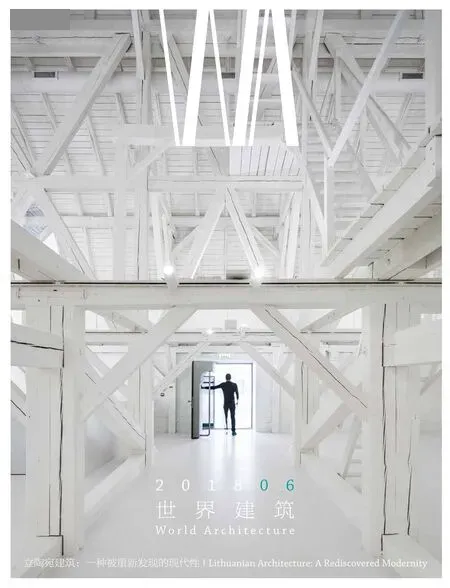
立陶宛居住建筑
2018-06-19 08:23:14馬塔斯蘇普辛斯卡斯Matasiupinskas
世界建筑 2018年6期
馬塔斯·蘇普辛斯卡斯/Matas ?iup?inskas
陳茜 譯/Translated by CHEN Xi
“居住”與家庭生活是建筑學科的基本概念之一。建筑師要面對由處理私人空間所帶來的額外限制,并與居住空間的未來使用者建立密切的關系。這并非輕而易舉的事,更何況還需在空間的表現力與便利性之間尋求適度的平衡。居住空間首先作為某人的家而存在,也是其被視為建筑作品而賦予表現力的先決目標。但家庭空間又恰恰呈示了豐富地區性的建筑類型——人的生活習慣、價值觀、居住傳統。簡而言之,與相對宏大的公共建筑相比,居住建筑能夠更加顯著地反映出文化傳統、社會關系及當地經濟狀況。
近年來,住宅設計思想廣泛的跨國傳播令家庭空間愈加全球化。各類建筑出版物令不同區域的住宅類型得以傳播共享,也令建筑師比以往更易了解多樣的住宅設計項目。同時,常規客戶的意愿不再僅受制于其個人經驗,還受到無數網絡圖像信息流的沖擊(如Pinterest, Instagram等)。對地產開發商來講亦是如此,其他城市甚至國外的成功案例成為其著力嘗試的全新發展計劃。盡管對家庭空間的審美差異正日漸消解,固有的日常生活習慣也在緩慢改變,氣候條件作為阻止同一性在全球蔓延的僅存因素之效力也有所折扣。盡管如此,它仍然是保持本土建筑特殊性的一種值得玩味的方式。那么,我們應當如何描述立陶宛日常建筑的特殊性呢?又是哪些作用力塑造了其特殊性?
首先,立陶宛建筑的靈感始終受到鄉村傳統的影響。這一影響孕育自兩次世界大戰期間(1918-1939),直到蘇維埃時代仍保持主導地位。彼時,尋求建筑中的民族特色是流行且被廣泛接納的做法。鄉村出身者占據了知識分子的可觀比例,他們從鄉村來到城市接受教育。早期現代主義正值繁榮的年代中,鄉村文化成為本土建筑師常見的靈感來源。這種靈感源頭剛好可以解釋木材的使用在立陶宛建筑中的流行,以及現代設計中某些細部與圖案的使用。居住單元的類型和空間組織有時也受到鄉村建筑范例的影響,但蹤跡遠不如風格影響的證據來得明顯。

1維陶塔斯·迪丘斯和列奧尼達斯·茲博卡斯設計的立陶宛科學院休閑中心(1982)詮釋了對木材的廣泛使用及與大自然的關系/Lithuanian Academy of Sciences Recreational Complex (1982), designed by Vytautas Di?ius and Leonidas Ziberkas shows subtitle relation with nature and extensive use of wood.

2魯斯特尼斯·米拉賽維丘斯設計的“MR21”住宅(2016),展現了戰間的顯著影響,并呈現了歷史住宅區對選址的考量——贊利亞卡涅斯/House "MR21" (2016)designed by architect Rūstenis Mila?evi?ius. It shows the clear influence of Interwar period and also respects towards genius loci of the historic residential area – ?aliakalnis.
第二重影響則來自于國外的職業建筑方法。兩次世界大戰期間,大多數本土建筑師都在諸如巴黎、蘇黎世、布魯塞爾、柏林、圣彼得堡之類的城市接受教育。與此同時,外國建筑師已經開始在立陶宛展開項目。花園城市運動的影響便可見于維爾紐斯、考納斯等城市的住區規劃方案中。而后在蘇聯時期,斯堪的納維亞國家的設計思想強烈影響了立陶宛本土建筑師。舉例來說,芬蘭旅行的所見深遠影響了材料與細部的表達方式。干凈而簡潔的建筑語言、本土材料的使用以及對自然之美的聚焦成為了主導(圖 1)。
盡管北歐建筑的影響顯著,鄉村建筑的啟示仍舊存在——兩者相互融合且并存至今。即使在立陶宛重獲獨立后、建筑界歷經重大機構變動的時期,新材料、實驗派、后現代主義種種思潮迭起,仍未能撼動這兩種影響的生命力。由于建筑師職業依賴于密切合作的師徒關系,傳遞給下一代的經驗中裹挾了明顯的本土文化特質。比如,無論過去還是當下,兩次世界大戰間的現代主義總被時常提及成為當代建筑的一個重要靈感來源。或許由于這種代際傳遞與代際間的密切合作關系,對立陶宛建筑來說,這種價值觀直至今日依然保持其重要性(圖2)。
數年來,大型住宅街區一直是立陶宛住宅建筑的核心主導類型,在此類項目中本土建筑師盡可能克服嚴苛的規范限制并盡力革新標準化的蘇聯式設計。同時,在面對為藝術家、音樂家和社會名流而設計的住宅項目時,建筑師們得以有機會嘗試更多。盡管這類項目稀少而特殊,卻提供了設計技巧的發揮空間,并為住宅設計累積了經驗。度假村也在同時期得到迅速發展,也為建筑師提供了向這類建筑汲取經驗的機會。
立陶宛獨立后,獨棟住宅合法化迅速成為流行。年輕建筑師通過此類住宅項目獲得了通過新想法與新材料來表達自我設計觀念的極佳機會。1990年代初,后現代主義仍舊甚囂塵上,對于自己的第一個居所,業主們又往往難以明確需求。試錯過程中難以避免的早期極端設計逐漸被新生代建筑師與眾不同且具有辨識度的住宅設計所取代。
轉折不僅發生在建筑設計領域,更重要的是對生活方式的改變。從集體公寓和大型住宅街區向更加私有化、個人化的居住空間的轉變十分劇烈——建筑師與業主都需要時間來調整以適應新的生活方式并發展出因應的貼切建筑語匯。住宅建筑一度曾失去其對環境的謙遜態度,但很快吸取了教訓。無疑,對于自然和城市的語境關系之重要性又重回建筑師的視野當中,而獨立建筑師們盡可以發揮其對建筑語境處理的創造性方法(圖3-5)。
The concept of "living" and domesticity is one of the fundamental ones for architectural discipline. Also,an architect is much more limited when working with personal space and have to develop a very intimate relationship with the future user. Not everybody is capable to do that and also to find a proper balance between expression and convenience. First of all,residential space will be home for somebody and only after achieving this goal you can start thinking how expressive it could be as a piece of architecture.However, domestic architecture is the one that expresses locality very well – it shows habits and values that people have and tradition of habitation.To put it simply - residential architecture is capable to reflect the cultural traditions, social relationships and state of the local economy in a much more evident way than the grandiose public buildings.
During the recent decades, housing design ideas spread through countries and domestic architecture became more and more globalised. Architectural publications helped to share knowledge about housing typologies of different regions and architects are more informed about a variety of residential designs than ever before. At the same time wishes of the regular client are shaped not only by their personal experience but by a nameless flow of web images as well (Pinterest, Instagram etc.). Real estate developers are doing the same by trying new development schemes that proved to be working in other cities and countries. It seems that only the climate limits a uniformity around the world, but it is not completely true - even if the difference in aesthetics of domestic architecture are dissolving habits of everyday life are changing slowly and by this local architecture remains specific and interesting to learn about. So how can we describe what is specific to the Lithuanian architecture of everyday life? And what are the forces shaping it?
First of all, Lithuanian architecture was always inspired by rural tradition. This influence emerged during the interwar period (1918-1939) and remained dominant during the Soviet years as well. Searching for national identity in architecture was popular and acceptable at the time. A significant portion of the new intelligentsia was born in villages and came to cities to get an education. Early Modernism flourished at the time and local architects often used rural culture as a source of inspiration. Such inspiration could explain the popularity of wood in Lithuanian architecture,and also some of the details and patterns used in a modern design. Typology of residential units and spatial organisation sometimes were also influenced by the examples of rural architecture, but such traces are less evident then stylistic inspiration.
The second source of influence was professional architecture from abroad. During the interwar period,most of the local architects were educated in such cities as Paris, Zurich, Brussels, Berlin, Saint Petersburg and others. At the same time, foreign architects were already working in Lithuania. Urban plans of residential areas inspired by garden city movement appeared in Vilnius and Kaunas cities. Later – during the Soviet period Scandinavian countries became a strong influence for local architects. For example, trips to Finland made a great effect on how materials and detail were approached. Clean, laconic architectural language, local materials and a focus on the beauty of nature became dominant (Fig. 1).
Despite Scandinavian influence traces of rural inspiration were not forgotten – both of these aspects merged together and coexists till now. Even after Lithuania regained its independence and architectural field underwent major organisational changes these influences outlived influx of new materials, na?ve experimentation, and echoes of Postmodernism. Since architect's profession is dependant on a close cooperation between the master and its apprentice – experience was transmitted to further generations together with a distinctive local cultural code. For example, Interwar Modernism was and still is often mentioned as a strong source of inspiration for contemporary architecture.Maybe because of such transfer and because of close cooperation between generations these values remained important in Lithuanian architecture to this day (Fig. 2).
For decades the most dominant typology of residential architecture in Lithuania was mass housing blocks. Local architects were trying to overcome strict regulation and update the standard Soviet designs as much as they could. At the same time, they had a possibility to experiment more when designing residential projects for artists, musicians or elite of the time. Even if this was a rare and specific case it allowed sustaining a certain level of skills and gain experience in residential design. At the same time resorts were developed heavily and there was a possibility to learn from holiday homes and sanatoriums as well.
After gaining independence, detached residential houses became legal and extremely popular typology.By designing such houses young architects had a great chance to express their aspirations by improvising with new ideas and materials. Postmodernism was still popular during the early 1990s and also clients were not sure about their real needs when building the first house. There were mistakes made during the process of trial and error, but excessive early designs slowly were outnumbered by the distinctive, but subtitle houses designed by the new generation of architects.
The turning point was happening not only in the architectural design but most importantly in a transformation of the way of life. The shift from communal apartments and mass housing blocks towards more personalised residential space was a drastic one – time was needed both for architects and for the clients to adjust to the new lifestyle and to develop the proper architectural vocabulary capable of dealing with such lifestyle. For a short period, residential architecture had lost its moderated approach towards the environment, but soon lesson was learned. Importance of contextual relation to nature and the city surely came back to the field even if individual architects had their personal creative approach how context should be treated (Fig. 3-5).
One of the architects that became well known for his expressive residential architecture is Gintautas Natkevi?ius. His studio was able to design very different houses in recent decades, but the main feature of these projects was an ambitious play between form, structure, and materials. His projects are usually provocative, often eye-catching, but Natkevi?ius is able to reach a dialogue between context and the newly built structure quite well.Family house in farmstead was built in 2010, it lays calmly on the field and next to the water. Playful observation room on top of a low, horizontal building strengthens the impression of the vast horizontal plot and gives a possibility to climb above the ground floor to see even further away. Family house in Utriai is quite opposite – it is expressively cantilevered and sticks out from the green landscape. It is an eye candy in a monotonous environment, more egoistic yet playful piece of architecture.
金陶塔斯·納特科維丘斯是以具有表現力的住宅建筑而獲得聞名的建筑師之一。他的工作室近年來完成了各異的住宅作品,但這些項目皆因對形式、結構和材料富有雄心的精妙操作而烙印上工作室的鮮明特色。盡管其作品往往具有強烈的煽動性和視覺吸引力, 納特科維丘斯仍能在固有環境與新建結構間建立良好的對話關系。建于2010年的農場住宅靜立于田野之中,水澗之濱,戲劇性的瞭望室被置于低矮的水平體量上方,強化了水平延展的廣袤土地,同時提供了攀爬到地面之上而極目遠眺的可能性。烏特里艾家庭住宅的處理卻剛好相反——巨大而強烈的懸挑從綠色景觀中伸展出來,使這座極度自我而戲劇化的建筑成為單調環境中的點睛之筆。
同樣由納特科維丘斯工作室設計的草莓街住宅則顯得溫潤而內向,它的內部庭院對鄰里隱藏起來,卻對山谷和交匯的河流敞開視角。地塊的復雜形狀也成為了靈感的一部分——建筑師設想了一個幾乎占據整個場地的形體。由銹鋼板構成的立面融合進了糾纏不清的環境中,增加了街區層化的、未建成似的氛圍基調。拋光的、開敞的內部立面圍繞著帶有花園的小庭院展開,這個空間雖作為建筑的中心元素,從視覺與構成的雙重角度聯系起了各個空間,卻能夠不斷吸引觀者的注意,不斷帶來驚喜(圖6、7)。
阿克吐里建筑師工作室的作品中卻呈現出截然不同的建筑操作方法。他們力圖強調對自然與城市環境的清晰認知,以及對遺產、傳統和自然材料的尊重。這個團隊始終探索著如何以獨有的建筑細部為簡潔形式賦予有趣的敘事。以湖畔別墅為例,單色木條板包裹了住宅的外表面,又被精心布置的帶有遮陽板的窗洞和陡峭的斜坡屋頂加以刻畫。這種屋頂是阿克吐里設計中的一個常見元素,通過其與常見形式的操作,轉換出更加特殊而不可預料的形式。遮陽板起到安全防護的作用,同時致敬了傳統的立陶宛鄉村建筑。邏輯清晰而簡潔的內部空間布局、窗戶朝向的景觀視角、簡明的室內設計——這座建筑的所有特征都傳達出其對所處自然環境的尊重,同時渲染了親密的家庭氛圍(圖8)。

3-5納特科維丘斯事務所設計的3種家庭住宅——農場住宅(2010),烏特里艾住宅(2006)及草莓街住宅(2011)/Three different family houses created by the Natkevi?ius studio – house in farmstead (2010), house in Utriai (2006) and house in Bra?ki? street (2011).

6.7阿克吐里團隊設計的兩個迥異的住宅項目——鄉村湖畔別墅和位于蘇巴丘斯大街19號的市區公寓樓/Two very different residential projects created by Aketuri team – rural Lakeside Villa and urban apartment building in Suba?iaus str. 19.
P a l e k o建筑工作室成立于大約2 0年前,并贏得過多個國內外建筑競賽。住宅建筑僅是其團隊的工作范圍之一,但卻是十分重要的一個部分。拉蘇納邁住宅區的設計中,建筑師采用了原型化的傳統住屋體量,令他們漂浮在緊鄰的作為歷史保護遺跡的軍火地窖之上。同時,工作室進行著各類尺度的住宅建筑項目,曾在維爾紐斯的中心區域完成公寓住宅。即使在大型項目中,帕勒卡斯也試圖植入趣味元素來歌頌日常生活的美好——庭院、露臺、中庭,甚至簡單的陽臺都能夠成為建筑中的核心元素和創造特有氛圍的重要工具(圖9、1 0)。
House in Strawberry street (Bra?ki? g.) also designed by Natkevi?ius studio is the rusted introvert hiding its inner courtyard from the neighbors and opening it up to the view of the valley and intersection of the two rivers. Complicated geometry of the plot was used as a source of inspiration – architects proposed a structure that occupies almost the entire site. The fa?ade, of blind rusted plates, merges with the visually inarticulate surroundings and adds up to the layered and unfinished atmosphere of the neighborhood. The glazed and open interior fa?ades surround a tiny inner courtyard with a garden. It is a central element of building layout which connects different spaces visually and compositionally. Each and every project for Natkevi?ius office is different,but it always keeps an ability to surprise the spectator and to attract his attention (Fig. 6,7).
Quite a different approach might be seen in Aketuri architect's portfolio. They are trying to demonstrate an awareness of the natural and urban environment, respect to a heritage and traditional,natural materials. The team is always looking for its own distinctive architectural details that make a simple form into an interesting story. For example,the Lakeside Villa is decorated with monochromatic wooden siding and its character is formed by thoughtfully composed windows with shutters and a sharp gable roof. Such roof is a common feature in the Aketuri designs and it plays with the familiar form by transforming it in too more specific and unexpected one. The shutters are used as a safety tool and a reference to traditional Lithuanian village architecture.The simple and logical layout of interior spaces,the views visible from the windows and the laconic interior – all the features of this buildings give proper respect to the natural surrounding where the house is situated within intimate feeling of domesticity (Fig. 8).
The Paleko ARCH studio was established almost two decades ago, and since then it has been successful in a number of architectural competitions locally and abroad. Residential design is only a part of the scope that Palekas team is working with, but quite an important one. They have created such a subtle design as Ras? namai with the archetypal volume of the traditional house floating above the remains of protected historic amunition vaults situated next to the buildings. At the same time studio is working on small and large scale residential buildings and they have designed apartment buildings in the very central locations of Vilnius. Even in the big scale projects,Palekas team is trying to insert element playfulness and celebrate the joy of the everyday life – courtyards,terraces, atriums, or simple balconies in Palekas designs become a core element of the building and an important tool to create a specific atmosphere of the property (Fig. 9,10).
Architect Audrius Ambrasas is also known for an ability to orchestrate the building with specific atmosphere. He is working on projects of different scale, and some of them already became a landmark of Vilnius city. However atmospheric properties and strong sensibility of the author is especially visible in a residential architecture. Luxury villas that were designed by Ambrasas are expressive, yet they are"silent". He likes to play with light, bent surfaces and fluid spaces in most of the projects and not only residential ones. Buildings such as Villa G and Villa N is not an exception. They are inspired by nature and smoothly blends in the surroundings. Concrete walls, wood, copper, stone – all the materials are raw,natural and they are contributing to the sense of the place as well. Long horizontal volumes lead an eye of the spectator through the landscape and frame picturesque greenery around the building (Fig. 11,12).
The other office that is worth mentioning is Arches – studio of architectural aesthetics. Arches are also known for luxury villas, but also for the design of major public buildings. Most of their residential designs are situated in an impressive natural environment and resort areas. They are also recognised for their recreational designs and playfully decorated facades. One of the most nominated projects – Nakci?ibis resort (2008) and Valley villa(2017). Both of these projects shows professional usage of wood as the main fa?ade material and interpretation of archetypal silhouette of the traditional gable-roof house. In 2017, Valley Villa won the annual international Residential Architecture Design Awards Grand Prix in the category Custom House More Than 3000 Square Feet organised by The Magazine of the American Institute of Architects and this was the first such awarded received by the project from Eastern Europe (Fig. 13).
Interesting experimentation can be found in the designs of smaller studios and the younger architects.They are eager to try unconventional solutions and it is always a pleasure to see how they are thinking outside the box. For example, Andrius Skiezgelas decided to be a developer and the architect of a four clustered apartments near the Baltic sea. Rough concrete volumes arranged around the inner courtyard are modular and they have vast possibilities how internal space could be transformed. Only the core with sanitary equipment is a rigid element of the floor layout, while all the other walls can be transformed according to the needs of new inhabitants. Clean,minimalistic concrete boxes are a background to the designer furniture and a colourful life that will unfold in such space (Fig. 14).
Other young architects are also experimenting with typologies – they are designing small studio apartments, row housing designs with shared community spaces and inspiring paper architecture about future habitation. Also, studios such as YCL are experimenting with materials and details of the residential interior. Architect Mykolas Svirskis with colleagues designed a house for a young family with raw blocks fa?ade made out of the light expanded clay aggregate. "Do Architects" suggested cylindrical volume design of the Rolling Homes next to the seaside. A new generation of young architects are just starting to find their creative identity, but the continuity of the values established by the local architectural school remains.
建筑師奧德留斯·安巴薩斯也以賦予建筑特殊氛圍的能力而聞名。在他設計的各類尺度的項目中,有一些早已成為維爾紐斯市的地標。但住宅作品卻最具代表性地呈現了這位建筑師的強烈感知力及其意欲傳達的氛圍特質。他設計的奢華別墅,往往能將表現力生發于靜謐之中。在不僅包含住宅的大多項目中,安巴薩斯熱衷對光、彎曲表面和流動空間進行操作。在別墅G 和別墅N等住宅項目中也凸顯了這些特征,受到自然啟發而巧妙地滲入環境。混凝土墻體、木材、銅板、石材——一切材料都是原生的、自然的,也強化了場所感。水平的長體量引導觀者的視線穿透景觀,也框出了建筑周圍如畫的自然景色(圖11、12)。
另外值得一提的事務所是Arches,這是一家極具建筑審美的工作室。Arches也有許多知名的奢華別墅作品,同時也設計過很多重要公共建筑。他們的多數住宅項目都坐落于風景壯麗的自然環境或度假勝地中。具有生趣的設計和戲劇化裝飾的立面是他們的標志性特征。工作室最著名的項目包括了那科茨茲博斯度假村(2008)及山谷別墅(2017)。這兩個作品的立面均對木材有著熟稔的使用,還呈現了傳統坡屋頂住宅的原型輪廓。2017年山谷別墅贏得了由美國建筑師學會雜志舉辦的年度國際住宅建筑設計獎280m2以上類別的大獎,也是該獎項首次頒發給東歐國家的項目(圖13)。
有趣的設計實驗也發生在小型事務所和新一代建筑師中。他們非常渴望嘗試打破陳規的解答,能夠看到他們的大膽思路總是令人興奮。例如,奧德留斯·謝科茨格拉斯自行開發并設計了一處波羅的海附近的組團公寓。圍繞內部庭院排布的素混凝土體量是模塊化的,提供了內部空間可變方式的高度可能性。除中心的衛生設備是平面布局中的固定元素外,其余所有的墻體均可根據新的生活習慣和需求而改變。簡潔的、極少主義的混凝土方盒子也成為了設計師家具和在空間中展開的多彩生活的背景(圖14)。
其他年輕建筑師也探索了類型學的可能性——他們設計了小型的成套公寓、整合社區空間的聯排住宅以及面向未來居住方式的紙建筑等。YCL等工作室也進行了住宅室內材料和細部的實驗。米庫拉斯·蘇瓦斯奇斯和同事為青年家庭設計了裸露輕質延展性粘土磚為立面材料單元的住宅。“Do 建筑事務所”為海邊的旋轉住宅提出了圓柱形體量。新一代的年輕建筑師們正剛剛開始找尋他們自己的創意特征,卻依然傳承著自本土建筑學校留存下來的價值觀。
作為總結,立陶宛當代住宅建筑約經歷了變動劇烈而碩果頗豐的30年。這不僅來自對當下全新生活方式的適應,也來自對前代建筑師的經驗傳承:尺度感知、材料和諧、環境意識等。即使在最新的設計中,兩次世界大戰期間的影響與北歐建筑學派的作用仍清晰可見。同時,創意實驗和不斷增多的年輕事務所致力于發展對語境或傳統的個人化操作方法,住宅建筑是其中最主要的領域之一。對家庭空間的探索不應僅限于三維形體,更應成為一個編織日常生活的契機。本土建筑師們正在逐漸建立起立陶宛建筑的新世代。□

8與自然和文化遺產不可分割的拉蘇納邁住宅區,Paleko建筑工作室 + Plazma建筑工作室設計(2015)/The residential quarter "Rasu namai" is deeply related to both nature and heritage. Design by Paleko ARCH studio + Plazma Architecture Studio (2015).

9.10奧德留斯·安巴薩斯設計的別墅N(2007)和別墅G(2014),兩者都遵循與自然環境相協調的設計手法/Vila N (2007) and Vila G (2014) designed by architect Audrius Ambrasas both follow similar approach to natural enviroment.

14Arches設計的科茨茲博斯度假村(2008年)和山谷別墅(2017年)差了將近10年,兩個項目都順應了大自然/There is almost a ten years gap between Nakci?ibis resort(2008) and Valley villa (2017) designed by Arches, but both of the projects beautiflly sets in the nature.

13奧德留斯·謝科茨格拉斯設計的濱海4住宅組團(2016)/Kankor??is – a residential project of four clustered houses close to the seaside was designed by Andrius Skiezgelas (2016).

14米庫拉斯·蘇瓦斯奇斯設計的住宅常置于大自然中,或臨湖,或濱海/The architecture of Mykolas Svirskis is often in nature and often next to the lake, river or sea.
In summing up contemporary residential architecture in Lithuania experienced almost three intense and fruitful decades. This has happened not only by adjusting to the new lifestyle of today, but also by transferring experience of the previous generations of architects: a sense of scale, harmony of materials, and an awareness of the environment. Even in the new designs influence of interwar period and Scandinavian school of architecture is still visible. But at the same time one can find new creative experiments and growing numbers of young studios that works hard in order to develop their personal approach towards the context or tradition.Residential architecture is one of the main fields for experimentation for them. By working on domestic architecture not only as the three dimensional object,but also as an opportunity to orchestrate everyday life local architects are slowly developing a new, modern generation of Lithuanian architecture.□
猜你喜歡
北方建筑(2021年6期)2021-12-31 03:03:54
文苑(2020年10期)2020-11-07 03:15:36
現代裝飾(2020年7期)2020-07-27 01:27:42
現代裝飾(2020年6期)2020-06-22 08:43:12
現代裝飾(2020年4期)2020-05-20 08:55:08
流行色(2020年1期)2020-04-28 11:16:38
藝術啟蒙(2018年7期)2018-08-23 09:14:18
海峽姐妹(2017年7期)2017-07-31 19:08:17
Coco薇(2017年5期)2017-06-05 08:53:16
福建農業科技(2016年10期)2016-03-07 09:46:49