
Spectra and Dynamic Properties of Eu 4f76pns Autoionizing States
2018-12-13 12:51:12XUEZhiliSHENLiDAIChangjian
發(fā)光學(xué)報(bào) 2018年12期
XUE Zhi-li, SHEN Li, DAI Chang-jian*
(1. College of Science, Tzianjin University of Technology, Tianjin 300384, China; 2. Key Laboratory of Display Materials and Photoelectric Devices, Ministry of Education, Tianjin University of Technology, Tianjin 300384, China) *Corresponding Author, E-mail: daicj@126.com
Abstract: The spectra and dynamic properties of Eu 4f76pns(n=7, 8) autoionizing states are studied systematically with the resonance-ionization spectroscopy(RIS) and the velocity-map imaging(VMI) techniques. The RIS technique is utilized to obtain the spectra of Eu 4f76pns(n=7, 8) autoionizing states with the three-step excitation: the wavelengths of the first two-step lasers are fixed, while that of the last-step laser is scanned around the region of the 4f76pns(n=7, 8) autoionizing states. The VMI technique is used to detect the dynamic process of autoionization, from which the branching ratio(BR) of ions and the angular distribution(AD) of ejected electrons from Eu 4f76p7s autoionizing states are achieved. The heavy configuration interaction is observed in the spectra of Eu 4f76pns(n=7,8) autoionizing states, measured with RIS spectroscopy technique. The present study reveals the profound variations of AD and BR with energy in the region of the 4f76p7s autoionization resonance, highlighting the complicated nature of the autoionization process for the lowest member of Eu 4f76pns autoionization series. Population inversion is observed by analysis of the BR, while the validity of the well-known isolated core excitation(ICE) technique used for obtaining autoionization spectrum is discussed.
Key words: Eu atom; autoionizing states; spectrum; angular distribution; branching ratio
1 Introduction
In recent years, laser spectroscopy has made a considerable progress in atomic spectroscopy, especially on the autoionizing states of alkaline-earth[1-3]and rare-earth[4-7]atoms. Studying autoionizing states of rare-earth atoms is not only helpful to inertial confinement fusion (ICF)[8], but also useful for development of new type ion laser, such as the Ba+laser based on autoionization[9]. During the last few years, there have been reports on the autoionzation spectra of the Eu 4f76p1/2ns[10]and Eu 4f76p1/2nd[11]states, most of which are obtained with the ICE technique. On the other hand, for the lowestnmembers of the 6pns autoionzation series, the ICE technique becomes invalid to some extent, due to the interference effect between the two outermost electrons. Based on the above facts, this paper tries to find out the differences between the autoionization spectra with the ICE and the RIS techniques. To fulfill such a study, some excitation schemes without the ICE technique are adopted to maximize the interference effect between the two outermost electrons, while configuration interaction(CI) may make the autoionization spectra even more complicated.
It is well known that autoionization spectra are relevant to the total cross section of the autoionization, while the BR and the AD are relevant to the partial and the differential cross sections, respectively. Thus, the dynamic properties(including AD and BR) of the Eu 4f76p1/2nd[12]and 4f76p1/2ns[13]autoionizing states have also been studied with the ICE and VMI techniques recently. To the contrast, the dynamic properties of the Eu 4f76p7s autoionizing state are studied with the RIS and VMI techniques after the investigation of the Eu 4f76pns autoionization spectra with the RIS technique. Furthermore, the energy dependences of the AD and BR in the region of the 4f76p7s autoionization resonance are also explored.
The experimental details will be described in section 2, results of which will be demonstrated and discussed in section 3. Finally, some conclusions will be drawn in the last section.
2 Experiments
As mentioned in the previous section, both spectra and dynamical properties are investigated in the present study, which require two different kinds of experimental setup. The one for the experiment of the observing dynamical properties is more sophisticated[12]due to the application of the VMI technique, while the one for the spectral experiment is a typical arrangement[13-14]. Since a detailed description of the experimental setup for the two parts of experiment can be found in our group previous works, only a simple introduction is given here. For instance, the one for the spectral experiment is shown in Fig.1.
As shown in Fig.1, the setup includes a laser system, an atomic beam production system, and two signal collecting systems. The laser system contains three dye lasers pumped by the same Nd∶YAG laser, each with a line width of 0.2 cm-1, pulse energy of 0.5 mJ, and pulse duration of 4-8 ns.
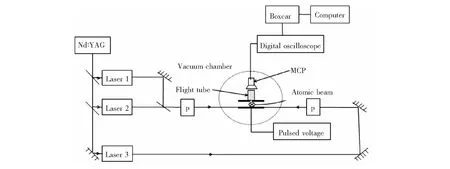
Fig.1 Experimental setup for spectrum-experiment
There are two sets of signal acquisition and analysis systems. The one for observing the spectra is much simpler as it is a typical apparatus. The experiments need some preparatory works. The first laser, fixed at a immobile wavelengthλ1, excites the Eu atom to intermediate state. The second laser, whose wavelengthλ2is scanned within a certain range to excite the atom to the high-lying state with even parity from the intermediate state,and then makes the atom ionized. For example,
Based on the detection, the energy levels of 4f76p2states are determined. Then the three-step resonance ionization schemes are applied, as described bellow:



The 4f76p7s autoionizing states decay to the 4f76s+(9S0), 4f76s+(7S0) and 4f75d+(9D0) final ionic states. The AD of ejected electrons and the BR of ions from the Eu 4f76p7s autoionizing states by detecting the products of autoionization mentioned above. How the VMI signal collecting system work is listed in the followed: The ejected electrons with same kinetic energy are electrostatic focused on the MCP of same radius by electron lens. The electrons are multiplied and accelerated by MCP then collide with PS. The fluorescence from PS is collected by CCD. The signal from a photo multiplier tube is integrated by boxcar and fed in computer for further analysis. The spatial intensity distribution from CCD reflects the projection of three dimensional velocity distribution of ejected electrons and can be reconstructed by inverse Abel transformation. The BR and AD can be obtained from three-dimensional velocity distribution.
3 Results and Discussion
As shown in Fig.2, there are two spectra by different polarization combinations, those are ΔM=0(π,π,π)and ΔM=1(σ,σ,σ). At first, the width of the autoionizing states is inversely proportional to the effective quantum number (n*)3.
Compared with different polarization combinations of the two spectra, it is found that the two polarization mode had a great influence on the ionization process. Making peak number 1 and 2 as a crew, number 3 and 4 as another crew to discuss, with different polarization combinations, peak ratios of each crew have significant change. For example, when ΔM=0, intensity of peak 2 is significantly higher than the peak 1; when |ΔM|=1, the intensity of the peak 1 is significantly higher than the peak 2. Clearly, the change of magnetic quantum number has influence at Eu autoionizing states, which is the same to the crew of peak 3 and 4. Especially at peak 5, when ΔM=0, there is a smooth transition; when |ΔM|=1, there is a peak. This phenomenon is similar to alkaline earth atom.
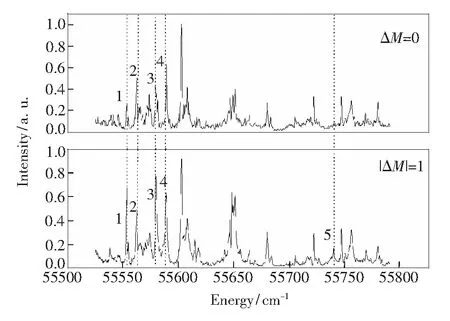
Fig.2 Spectra of the Eu atom 4f76p7s autoionizing states with different polarization combinations. The vertical solid and dashed lines mark the positions of main peaks,respectively.
The autoionzation spectra shown in Fig.3 are from different intermediate states 4f76p2(J=11/2,9/2), so the possibleJvalues can be determined.
Obviously, these two schemes are influenced by intermediate state 4f76p2. Because of the selection rules (ΔJ=0, ±1) of the two excitation schemes, some of the features in the two spectra can be identified. These identifications can be made by making a comparison of these spectra, and labeling denoting the peaks withJ=7/2, 9/2,11/2 or 13/2, as shown in Fig.3. The energy and possible total angular momentumJof the peaks are listed in the Tab.1.
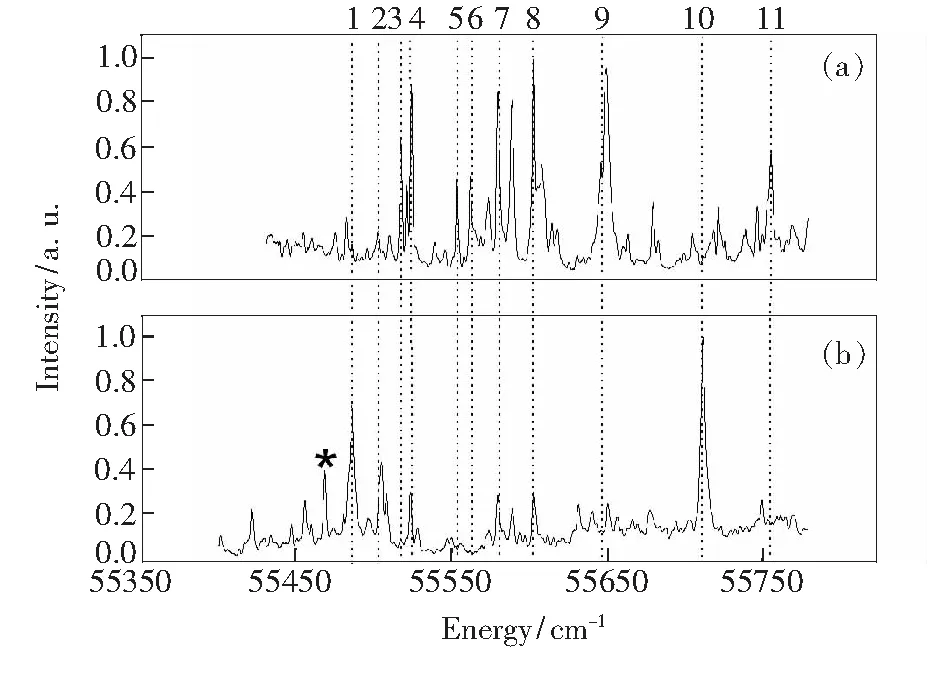
Fig.3 Spectra of the Eu atom 4f76p7s autoionizing states. (a) J=9/2, 11/2, 11/2. (b) J=7/2, 9/2, 11/2. The peak marked with * symbol is a frequency marker.
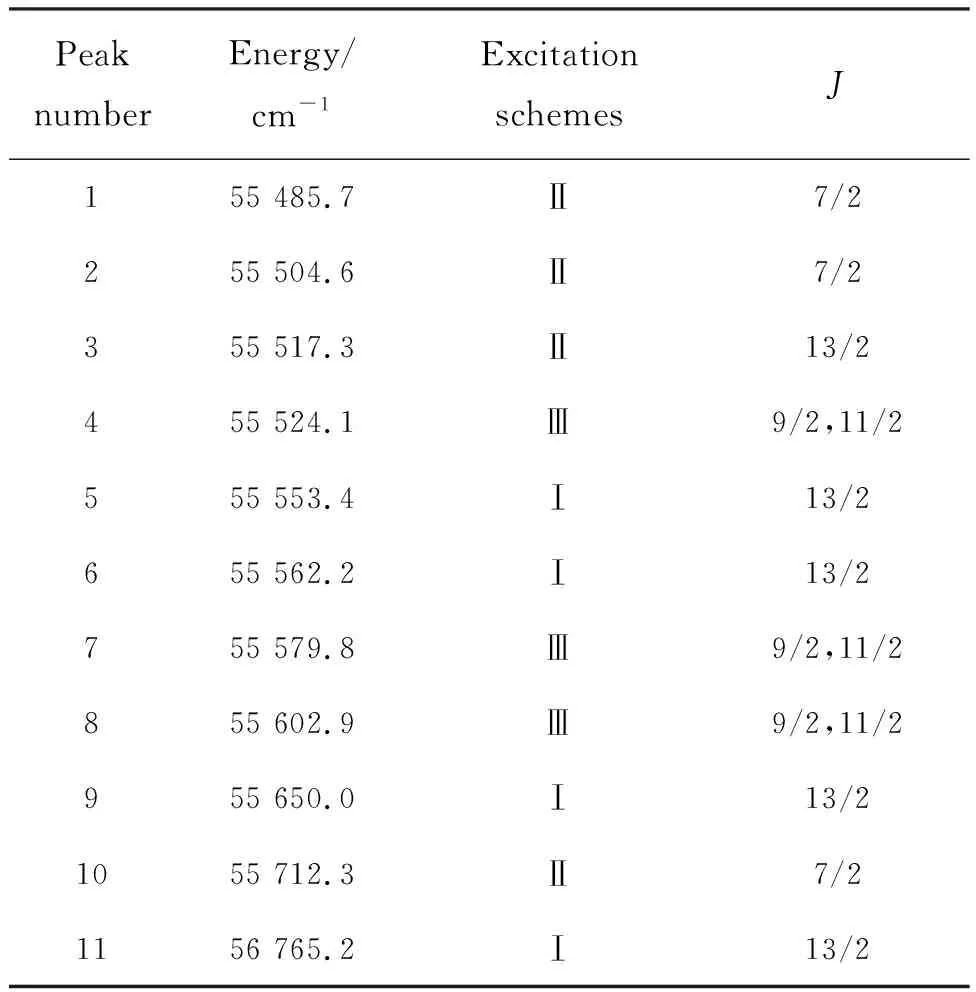
Tab.1 Energy and J-assignments of the peaks
Turning now to the line shapes of the 4f76p7s autoionizing states, which are the lowest members of 4f76pns autoionizing series, and the best candidates to test the validity of the well-known ICE technique. As a powerful three-step excitation method, the ICE scheme has been used extensively in studies to study the autoionizing states of alkaline-earth atoms[15]. However, this may not be the case for the Eu 4f76pns autoionizing states, since the 7s electron is very close to the core. The spectra have been gotten by using ICE technique. In the introduction it is mentioned: at lown, the validity of ICE technique does not achieve the desired Lorentz linear spectrum, the technical efficiency is destroyed, Fig.4 shows the spectra of scheme Ⅰ and ICE scheme Ⅳ[16]:

[J=3/2, 5/2, 7/2].
As seen in Fig.4, although ICE technique at lownstates can not get the symmetric Lorentzian line, compared with ordinary three-step excitation, there are obvious advantages. Spectrum obtained by schemes Ⅳ is much better for identifying the energy position; in the spectrum with schemeⅠ, the peaks are difficult to fit. By comparison of these two schemes, it is more obvious that ICE technique has more advantages. Because with ICE technique, every step is single electron dipole excitation[17]. On the other hand, in schemes Ⅳ mode, just change the region of third-step, a new series of autoionizing states can be observed. In the next part, the region of third-step laser is chan-ged, so spectrum of 4f76p8s autoionizing states is obtained.
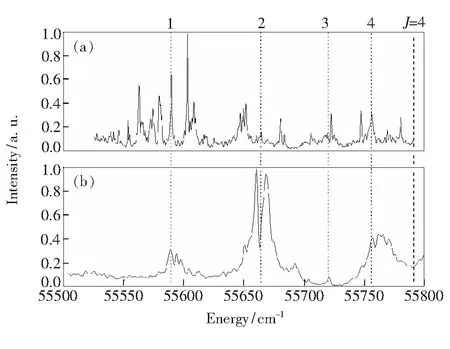
Fig.4 Spectra of the Eu 4f76p7s autoionizing states by different excitation schemes. (a) SchemeⅠwith RIS technique. (b) Scheme Ⅳ with ICE technique. The vertical dashed lines mark the ionic limit and the positions of main peaks, respectively.
As shown in Fig.5, it is the spectrum of 6p8s autoionizing states in the region 60 800-61 200 cm-1. The spectra obtained by ICE technique are a large envelope superimposed. But in this spectrum, there are many sharp peaks. The reason is that the intermediate state is 4f76p2. While 4f76p2is excited, interference effect is very strong. It is different from the 4f76p7s, there is a wide peak at the region of 61 000 cm-1in the spectrum of 4f76p8s autoionizing states. It means these states are less influenced by atomic core. It is note worthy that this spectrum is a mixture of 4f76p6d autoionizing states and 4f76p8s autoionizing states. With schemeⅢ, the third-step laser plays a role in exciting atom to the target autoionizing states. However, in the region of 60 800-61 200 cm-1, 4f76p8s autoionizing states degenerate with the 4f76p6d autoionizing states, leading to the simultaneous excitation to 4f76p6d autoionizing states due to the admixture. There is no evidence for distinguishing the 4f76p8s autoionizing states, so only 4f76p7s autoionizing states are obtained by VIM technique.
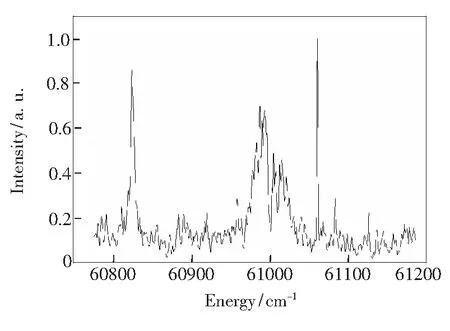
Fig.5 Spectrum of the Eu 4f76p8s autoionizing states by excitation scheme Ⅲ
All the characteristics discussed above have manifested a comprehensive configuration interaction among the different autoionization series, which may have significant influence on the autoionization process. Thus, the possible impact influence on the AD will be expected, which is described in next part.
As pointed out earlier, an autoionization spectrum represents total cross section of autoionization process, while the BR to final ionic states corresponds to the partial cross section of the same process. Thus, autoionization spectra of 4f76p7s states can not provide information of possible final ionic states, including their number and the BR, while the energy distribution of electrons ejected from autoionization is necessary to be explored. In other words, to know how many ionic states are involved and what the percentages of ion among them are, the ejected electrons from autoionization should be observed.
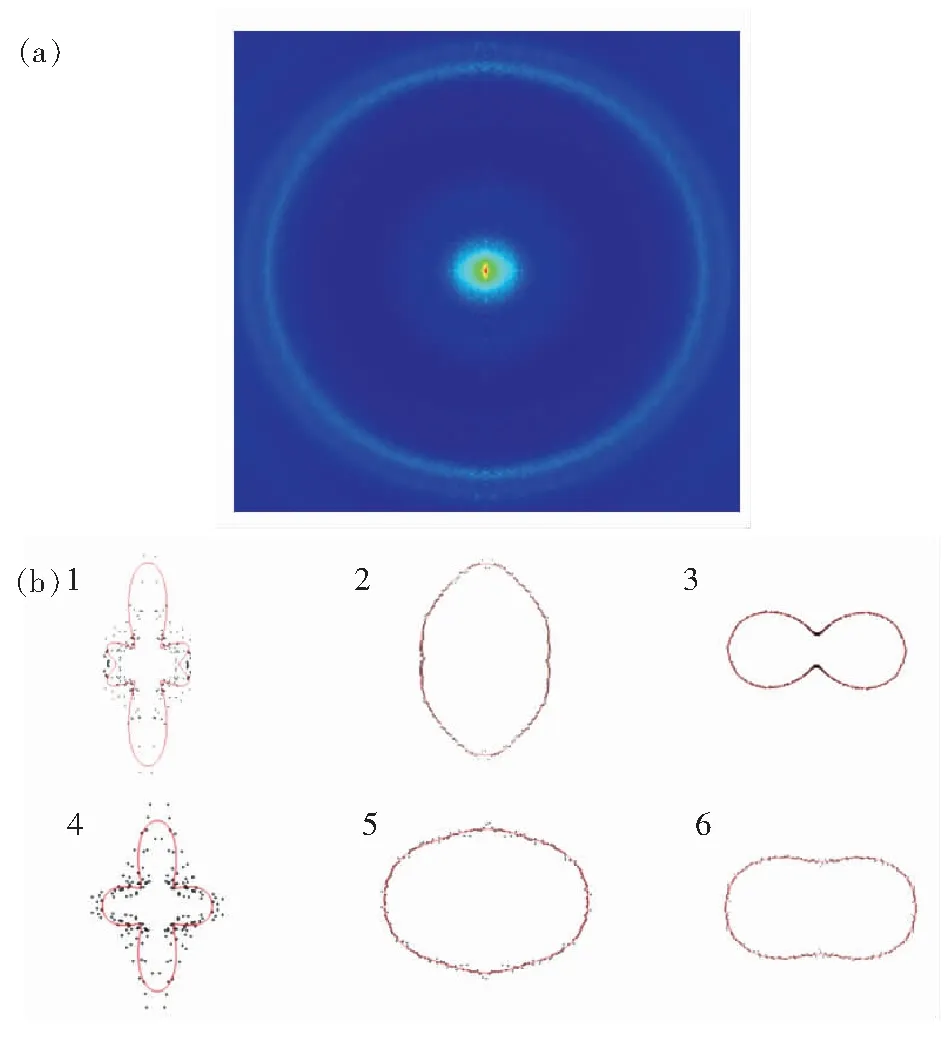
Fig.6 AD of electrons ejected from the 4f76p7s autoionizing states. (a) 3D Abel-invented image. (b) Some representative AD.
To carry out such an experiment, the VMI technique has been employed to obtain the images of ejected electrons from autoionization process, an example of which is shown in Fig.6. At a fixed energy, the AD of ejected electrons from the 4f76p7s autoionizing states can be extracted from fitting the Abel-inverted images.
According to the conservation of momentum and energy conservation, the center position corresponds to the zero of kinetic energy, namely the ejection of the electron kinetic energy is zero. In Fig.6(a), the outer ring represent ADs of ejected electrons corresponding to the decays to the 4f76s+(9S0) final ionic states, the middle ring for 4f76s+(7S0) final ionic states, and inner rings for 4f75d+final ionic states, respectively. It could be observed that, there are many electronic near zero kinetic energy. Probably due to the intermediate state 4f76p2, whose energy position is 41 443.7 cm-1. The energy of the first ionization limit is 45 734.9 cm-1. The energy position of 4f76p2states is close to the first ionization limit, so they are very easily ionized. By fitting the electronic image, information of AD is obtained. There are six representative AD in Fig.6(b). As we all known, the total cross section is dependent only on the amplitude of atomic wave function. The different AD patterns respect an intresting test to the wave function of the Eu atom in terms of their phase information, which is lost in any autoionization spectrum. In the next part, there are spectra of the anisotropy parameters relating to the 4f75d+ionization limit and autoionizing spectrum obtained with the schemeⅠ.
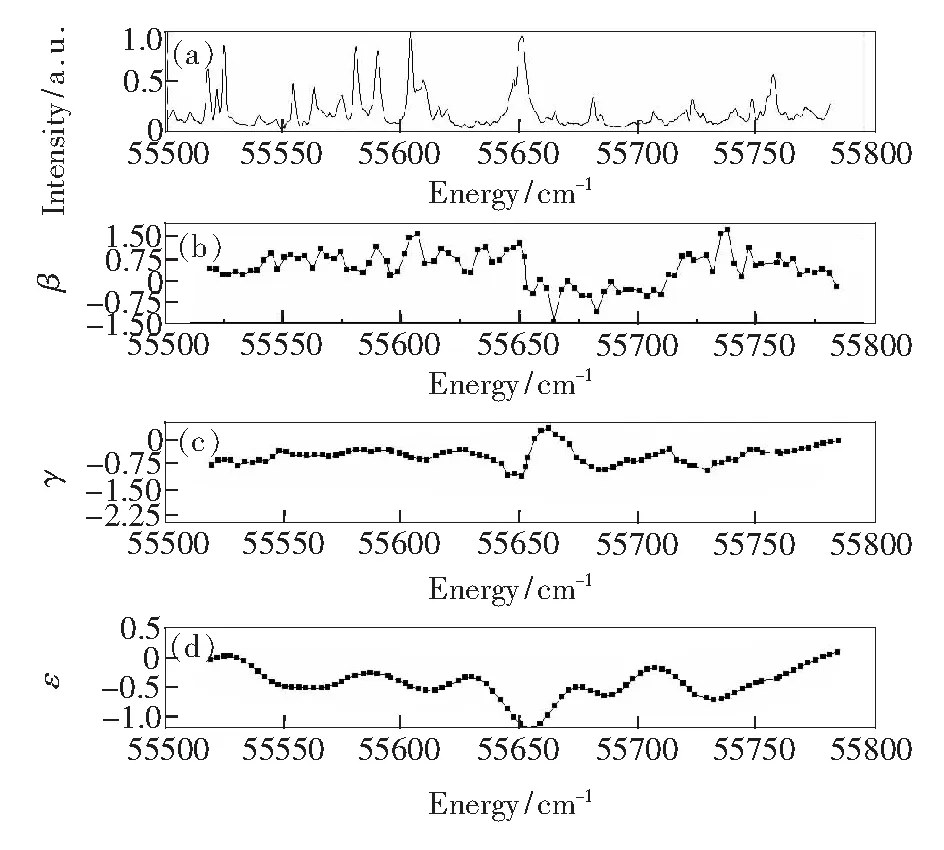
Fig.7 Spectra of the anisotropy parameters relating to the 5d+ ionization. (a) Spectrum with the schemeⅠ. (b) β. (c) γ. (d)ε.
As seen from Fig.7, the three anisotropy parameters characterizing the AD of the Eu 4f76p7s autoionizing state are dependent on energy. The general form of ejection electrons AD is wherePk(cosθ) isk-order Legendre function,k=0, 2, …, Theakexpression contains 4 3j symbols and a 6j symbol and the jump probability of the third step. In the process of fitting, it is found that the influence of high-order Legendre function on AD can not be reflected. Therefore, this experiment will only show the anisotropy parameters corresponding to the 6th order Legendre function, the specific form of AD is whereI0=4πa0represents the total cross section of autoionization, and the three anisotropic parameters change with the energy, they jointly characterize the autoionizing ejection electron AD. Letβ=a2/a0,γ=a4/a0, andε=a6/a0, whose variations with energy are the main concern here.
(1)
(2)
The parameterβhas an dependence of energy within the autoionization spectrum, and varies when the atom decays to different ionization limits. All the characteristics discussed above have manifested a comprehensive CI among the different autoionization series, which may have significant influence on the autoionization process. Thus, the possible impact influence on the autoionization BR will be expected, which is described in next subsection.

Fig.8 Autoionization BR and spectra of the 4f76p7s states. (a) Spectra. (b) BR1. (c) BR2. (d) BR3.
In Fig.8, the BR of autoionization from 4f76p7s autoionizing states to the 4f76s+(9S), 4f76s+(7S) and 4f75d+ionic states have been investigated comprehensively. Although the BR of the three states can be resolved and analyzed with the VMI technique, the fine-structures of the 4f75d+state are failed to be resolved in the measurement. As seen in Fig.8, the BR1and BR2are much larger than BR3, meaning that the Eu atom mainly autoionizes to the 4f76s+(9S) and 4f76s+(7S) ionic states in whole energy region. More interestingly, nearly 60%~80% of Eu atoms will autoionize to 4f76s+(9S). Only in region 55 630-55 670 cm-1, there is a population inversion between 4f76s+(9S) and 4f76s+(7S) ionic states.
4 Conclusion
In this paper, the spectral information of 4f76pns (n=7, 8) autoionizing states of Eu atom has been investigated with RIS technique. The energy dependence and variations with the total angular momentumJare studied. Moreover, because the Eu ground state is degenerated, the total angular momentum of the autoionizing states is difficult to identify with the different laser polarization combinations. Meanwhile, the AD and BR of ejected electrons from 4f76p7s autoionizing states are observed by VMI technique. It is found that the 4f76p7s autoionizing states mainly decay to the 4f76s+(9S0) and 4f76s+(7S0) ionic states. There is a population inversion in the energy region 55 630-55 670 cm-1between 4f76s+(9S0) and 4f76s+(7S0) ionic states.

- 發(fā)光學(xué)報(bào)的其它文章
- 基于優(yōu)選波長(zhǎng)的復(fù)合肥總氮含量可見/近紅外光譜分析
- 磁場(chǎng)對(duì)石墨烯中弱耦合極化子性質(zhì)的影響
- (Lu,Y)2SiO5∶Ce3+與SrSO4∶Dy3+材料低溫?zé)後尮饧捌錅y(cè)試儀器的研究
- Pyrene-functionalized Core-shell Magnetic Silica Nanospheres for Optical Sensing and Removal of Hg2+ in Aqueous Solution
- 同步熒光法探究硝苯地平與胃蛋白酶熒光基團(tuán)的作用機(jī)制
- 高光譜成像技術(shù)鑒別菠菜葉片農(nóng)藥殘留種類