
Time SensitiveNetworking TechnologyOverview andPerformance Analysis
2019-01-12 02:58:52FUShousaiZHANGHeshengandCHENJinghe
ZTE Communications 2018年4期
FU Shousai,ZHANG Hesheng,and CHEN Jinghe
(Beijing Jiaotong University,Beijing 100044,China)
Abstract Time sensitive networking(TSN)is a set of standards developed on the basis of audio video bridging(AVB).It has a promising future in the Industrial Internet of Things and vehicle-mounted multimedia,with such advantages as high bandwidth,interoperability and low cost.In this paper,the TSN protocol stack is described and key technologies of network operation are summarized,including time synchronization,scheduling and flow shaping,flow management and fault tolerant mechanism.The TSN network model is then established.Its performance is illustrated to show how the frame priority works and also show the influence of IEEE802.1Qbv time-aware shaper and IEEE802.1Qbu frame preemption on network and time-sensitive data.Finally,we briefly discuss the challenges faced by TSN and the focus of future research.
Key words TSN;AVB;the industrial internet of things(IIoT)
1 Introduction
W ith the development of the Industrial Internet of Things(IIoT),widely distributed network information needs to be shared and transmitted in time[1],[2].At present,the industrial system is being extended from small closed networks to the IIoT,which requires reliable,integrated,remote and secure access to all network components.Existing Ethernet will no longer apply to customers who want to integrate Internet of Things(IoT)concepts into their industrial systems to improve productivity,increasenormal runningtimeor reducemaintenance.
In addition,Ethernet for Control Automation Technology(EtherCAT),Process Field Net(PROFINET)and other industrial Ethernet protocols are typically developed for specific tasks or domains,and are formed by modifying or adding specific functions based on standard Ethernet protocols.These protocols meet the real-time and deterministic requirements of industrial control systems that can perform their specific tasks well in specific areas,but they are limited when combined with standard Ethernet networks and devices.Lack of bandwidth,lack of interoperability and high cost make it difficult to meet data transmission requirements of Industrial 4.0 presently.As a result,NI,Broadcom,Cisco,Harman,Intel,Xilinx and other well-known companies have jointly founded the Avnu Alliance.It aims at the promotion of the new Ethernet standard for time sensitive networking(TSN)applied to the IIoT[3].The core technology of TSN includes network bandwidth reservation,precise clock synchronization,and traffic shaping,which ensureslow latency,high reliability and other needs.
As it is a new field of study,there are few contributions in the domain of TSN.Related to the TSN research topics,[4]presents a model,called audio video bridging(AVB)scheduled traffic(AVB ST).The main difference between TSN and AVB ST lies in the way protected windows are created for timesensitive traffic.Paper[5]presents a delay analysis of AVB frames under hierarchical scheduling of credit-based shaping and time-aware shaping on TSN switches.Considering TSN's time-aware and peristaltic shapers and evaluating whether these shapers are able to fulfill these strict timing requirements,a formal timing analysis is presented in[6],which is a key requirement for the adoption of Ethernet in safety-critical real-time systems,to derive worst-case latency boundsfor each shaper.In[7],the equations are derived to perform worst-case response time analysis on Ethernet AVB switches by considering its credit-based shaping algorithm.Moreover,[8],[9]and[10]analyze the transmission delay of TSN network.Recently,an analysis is proposed to compute fully deterministic schedules(i.e.time aware shaper(TAS)scheduling tables)for TSN multi-hop switched networks,while identifying functional parametersthat affect communication behavior[11].
Our work is based on the IEEE 802.1Qbv TSN standard,which enhances Ethernet networks to support time sensitive applications in the automotive and industrial control domains.A key feature of TSN is the new traffic shaping mechanism TAS,which is capable of accommodating hard real-time streams with deterministic end-to-end delays.This paper describes the TSN protocol stack and summarizes the key technologies used in the process of network operation.A specific example is given to analyze how frame priority works and the impact of IEEE802.1Qbv time aware shaping and IEEE802.1Qbu frame preemption on network and time sensitive data.The current research statusand futuretrend of TSNarealsoanalyzed.
2 AVB and TSN
TSN is an extension of IEEE 802.1 Ethernet,which is a set of new standards developed by the Time Sensitive Networking Task Group of the IEEE 802.1 Working Group on the basis of existing standards.The TSN task force was established in November 2012,renaming the existing AVB task set,extending the scope of the AVB's work and supporting all standard AVB devices.In other words,TSN is actually an enhancement and improvement of AVB[12],[13].
2.1 Overview of AVB/TSN
AVB is a set of protocol sets for real-time audio and video transmission,which was developed in 2005 by the IEEE 802.1 Task Group[13],[14].It can effectively solve the problem of timing,low latency and traffic shaping in network transmission.At the same time,it guarantees 100%backward compatibility with traditional Ethernet.AVB is the potential next-generation audio/video transmission technology,including:
802.1AS:Precision Time Protocol(PTP)
802.1Qat:Stream Reservation Protocol(SRP)
802.1Qav:Queuingand Forwarding Protocol(Qav)
802.1BA:Audio Video Bridging Systems
1722:Audio/Video Bridging Transport Protocol(AVBTP)
1733:Real-Time Transport Protocol(RTP)
1722.1:Device Discovery,Enumeration,Connection Management and Control Protocol for 1722-Based Devices.
As shown in Fig.1,TSN is primarily aimed at the data link layer of ISOmodel,and it is a new standard that seeks to make Ethernet real-time(low latency)and deterministic(high reliability)[7],[15],[16].It mainly includes:
802.1AS(REV):Time Synchronization(Update timing and synchronization based on 802.1AS-2011)
802.1Qbv:Time Aware Shaper(Traffic scheduling was enhanced based on 802.1Qav)
802.1Qbu:Preemption(Update frame preemption based on 802.1Qav)
802.1Qci:Ingress Policing
802.1CB:Seamless Redundancy
802.1Qcc:Centralized Configuration(Enhancements and performanceimprovementsfor Stream Reservation Protocol).
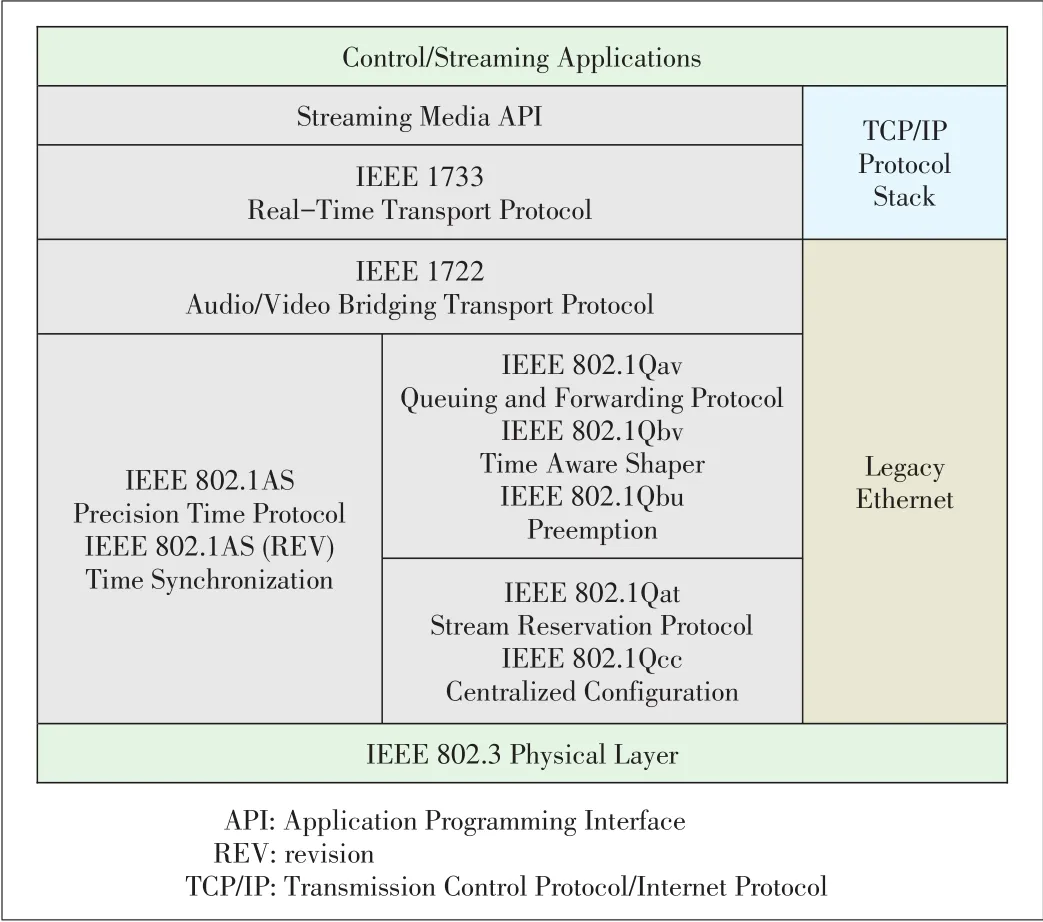
▲Figure1.Theaudio video bridging/timesensitivenetworking(AVB/TSN)protocol set in theopen systemsinterconnection(OSI)model hierarchy.
The protocols for TSN,such as OLE for Process Control(OPC)Unified Architecture(UA),Object Management Group(OMG)Data Distribution Service for Real-Time Systems(DDS),IEEE1722,PROFINET,IEC61850 and Ethernet/IP,and other industrial Ethernet protocols provide a common layer 2(data link layer)[17],which makes Ethernet transmission more reliable,jitter lower and delay shorter and meets all the requirements of real-time Ethernet.However,TSN will not and cannot replace the existing real-time protocols,because TSNis just a set of second level protocols,which provides all realtime features that are close to hardware,but does not provide a whole stack of second layers.In the long run,it may replace all second layers of extensions for PROFINET,EtherCAT,etc.,but therewill still be PROFINETor Ethernet/IP.
2.2 Basic Principles of AVB/TSN
In the case of insufficient bandwidth,the data from different devices overlap with each other.As shown inFig.2,the conflicting parts of all the data flows in this case are forwarded by the QoSpriority mechanism.On the one hand,network devices cannot tolerate too much delay forwarding.On the other hand,the physical port cache of switches is very small,which cannot effectively solve a large number of data packets arriving at the same time,so some data packets will be discarded.Typically,when a switch has a bandwidth occupancy rate of over 40%,it has to be expanded.The goal is to avoid congestion by increasing the bandwidth of thenetwork.
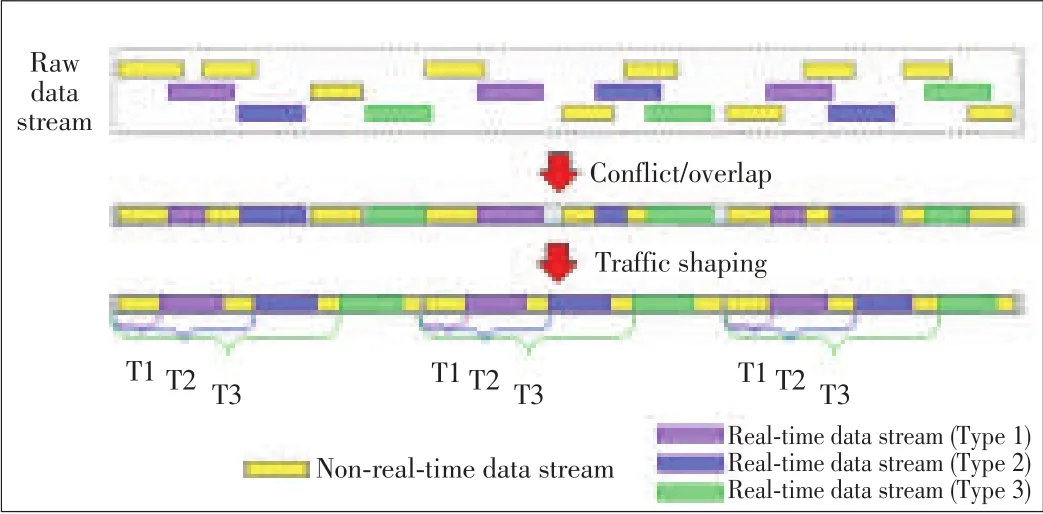
▲Figure2.Traffic shaping schematic.
In order to avoid the overlap of bandwidth,traffic shaping is carried out for different data streams to achieve the purpose of improving reliable delivery.As shown in Fig.2,after traffic shaping,the bandwidth occupied by each real-time stream is at the same time node,and all non-real-time streams consume other bandwidth,which will ensure reliable delivery of realtimedata.
The AVB/TSN can make traffic shaping for the sender,such asthenetwork portsof different audio/videoequipment,and also make the reshaping of each forwarding node in the switch.The basic principle of AVB/TSN is that each audio/video stream only occupies its own bandwidth and does not affect the transmission of other datastreams[18],[19].
2.3 Main Featuresand Typical Application of TSN
TSN has a lot of characteristics compared to existing standardsand proprietary industrial Ethernet protocols[20]:
1)Bandwidth:Advanced sensing applications generate large amounts of data,resulting in network bandwidth resource constraints.At present,the dedicated Ethernet protocol commonly used in industrial control is generally limited to 100 MBbandwidth and half duplex communication.TSNincorporates a variety of standard Ethernet rates(including 1 GB,10 GB and 400 GB currently in use)and support fullduplex transmissions.
2)Security:TSN extends the security of infrastructure for underlyingcontrol and integrates ITsecurity rules.
3)Interoperability:By using standard Ethernet components,TSN seamlessly integrates existing applications and standard IT networks to improve usability,such as HTTP interfaces and Web service,and realize the IIoT system for remotediagnosis,visualization,repair,and other functions.
4)Low cost:TSN uses standard Ethernet chipsets as mass-produced commercial silicon chips.This reduces component costs,which is particularly evident compared with the use of a special Ethernet protocol based on ASICchips.
5)Delay and synchronization:Fast response systems and closed-loop control applications require low latency communications.TSN achieves deterministic transmission of tens of microsecondsand time synchronization at dozensof nanoseconds between nodes,and provides automated configuration for high-reliability data transmission paths to provide losslesspath redundancy by copyingand mergingpackets.
TSN is a deterministic network with the following typical applications[1],[21]:
1)Professional audio and video(Pro AV):The main clock frequency is emphasized in the field of professional audio and video.In other words,all video network nodes must keep to thetimesynchronization mechanism.
2)Automotive control:Most automobile control systems are very complicated at present.In fact,all systemscan be managed with TSN that support low latency and real-time transport mechanisms,reducing the cost and complexity of adding network capabilities to automotive and professional audio/videodevices[22].
3)Industrial areas:TSN networks can be applied in the industrial areas that require real-time monitoring or real-time feedback,such as robotics industry,deepwater oil drilling,and banking.In addition,TSN can also be used to support largedatatransfer between servers.At present,theglobal industry has entered the IoT era.TSN is an effective way to improvetheefficiency of the IoT.
3 Key Technologiesof TSN
In order to provide a complete real-time communication solution,IEEE 802.1 has developed a TSN standard file,which can be divided into the following three basic components:time synchronization,scheduling and traffic shaping,and stream management and fault tolerance.
3.1 Time Synchronization
Time plays an important role in the TSN network compared with the IEEE 802.3 and IEEE 802.1Q standard Ethernet.By clock synchronization,the network devices can run consistently and perform the required operations at the specified point in time.
Time synchronization in TSN networks can be achieved with different technologies.Time in a TSN network is typically distributed from a central time source through the network itself.In most cases,this is done using the IEEE 1588 Precision Time Protocol,which utilizes Ethernet frames to distribute time synchronization information.In addition to the IEEE 1588 standard,the Time-Sensitive Task Group of the IEEE 802.1 Working Group has also developed a brief for IEEE 1588,called IEEE 802.1AS-2011,which is mainly applicable to Internet environments such as home,automotive,and industrial automation.
3.2 Scheduling and Traffic Shaping
The purpose of scheduling and traffic shaping isto allow different traffic classes to coexist in the same network.These traffic classes have different priorities and have different requirements for available bandwidth and end-to-end delay.In the field of industrial automation and cars,as a result of the existence of closed loop control and safety application,reliable and timely information delivery plays an important role,so the IEEE 802.1Qstrict priority scheduling mechanism needs to be strengthened.
3.2.1 TAS
TSN enhances standard Ethernet traffic by adding mechanisms.In order to maintain backward compatibility,TSN still maintainseight different virtual local area network(VLAN)pri-orities,which keeps the interoperability with existing infrastructure well and allows seamless migration to new technologies.IEEE 802.1Qbv Time-Aware Shaper separates the communication time on the Ethernet network into a fixed length and a repetitive cycle.In the cycle,different time slices may be configured,each of which is assigned with one or more of eight priorities.It is a time division multiple access(TDMA)scheme that separates time-critical traffic from non-critical background servicesby establishingavirtual channel for aspecific timeperiod[22].
1)IEEE 802.1Qbv Guard Bands Mechanism
Since the transmission of frames cannot be interrupted,this presents a challenge to the TDMA approach of IEEE 802.1Qbv scheduling.As shown inFig.3,if a new frame is transmitted before the end of the time slice 2 of cycle n,since the frame is too large and the transmission process cannot be interrupted,the frame invokes the subsequent time slice 1 of the next cycle n+1.Through partial or complete blocking,real-time frames in the subsequent time slices will be delayed,which cannot meet the needs of applications.What it has to do for the actual buffer effect isvery similar with ordinary Ethernet switches[11].
As shown inFig.4,the guard band in TAScan prevent this from happening.During this guard band,no new Ethernet frame transmission may be started,only already ongoing transmissions may be finished and the duration of this guard band has to be as long as it takes the maximum frame size to be safely transmitted.For an Ethernet frame,the maximum length is:1518 bytes(frames)+4 bytes(VLAN tag)+12 bytes(frame spacing)=1534 bytes.
While the guard bands manage to protect the time slices with high priority and critical traffic,they also have some significant drawbacks:The guard band can cause loss of bandwidth;the guard band affects the minimum achievable time slice length and cycle time.The standard IEEE 802.1Qbv contains a length-aware scheduling mechanism in order to partially reduce the bandwidth loss due to the presence of the guard band.Therefore,length-aware scheduling is an improvement,but cannot mitigate all drawbacks that are introduced by the guard band.
2)IEEE 802.1Qbu Frame Preemption for Minimizing Guard Band
To further mitigate the negative effects from the guard bands,the IEEE 802.1 and 802.3 Working Groups have specified the frame preemption technology. IEEE 802.1Qbu is used for bridging management components[24]and IEEE 802.3br for Ethernet MAC components[25].Fig.4 uses a basic example to show how frame preemption works.During the process of sending one best effort Ethernet frame,the MAC interrupts the frame transmission before the guard band.After the high priority traffic of time slice 1 passes,the period is switched back to time slice 2,and the interrupted frametransmission isresumed.
Frame preemption allows for a significant reduction of the guard band.The length of the guard band is dependent on the precision of the frame pre-emption mechanism.IEEE 802.3br specifies the best accuracy of 64 bytes for this mechanism,since this is the minimum size of a still valid Ethernet frame.In this case,the guard band can be reduced to the total of 127 byte:64 byte(the minimum frame)plus 63 byte(the minimum length that cannot be preempted).
3.2.2 Credit-Based Shaper(CBS)
We can achieve low latency for data transfer by configuring protected windows and prioritizing,but in some cases it is also important to eliminate jitter.The reason is that a certain time delay may be acceptable,but larger jitter will degrade the quality of communication service.For example,some delays do not make a difference when watching a video,but they may lead to frame skipping if the jitter is too high.Credit-based shaping can be used to transmit data more evenly in order to provide a continuousstream.Fig.5showsthe basic idea[26],[27].
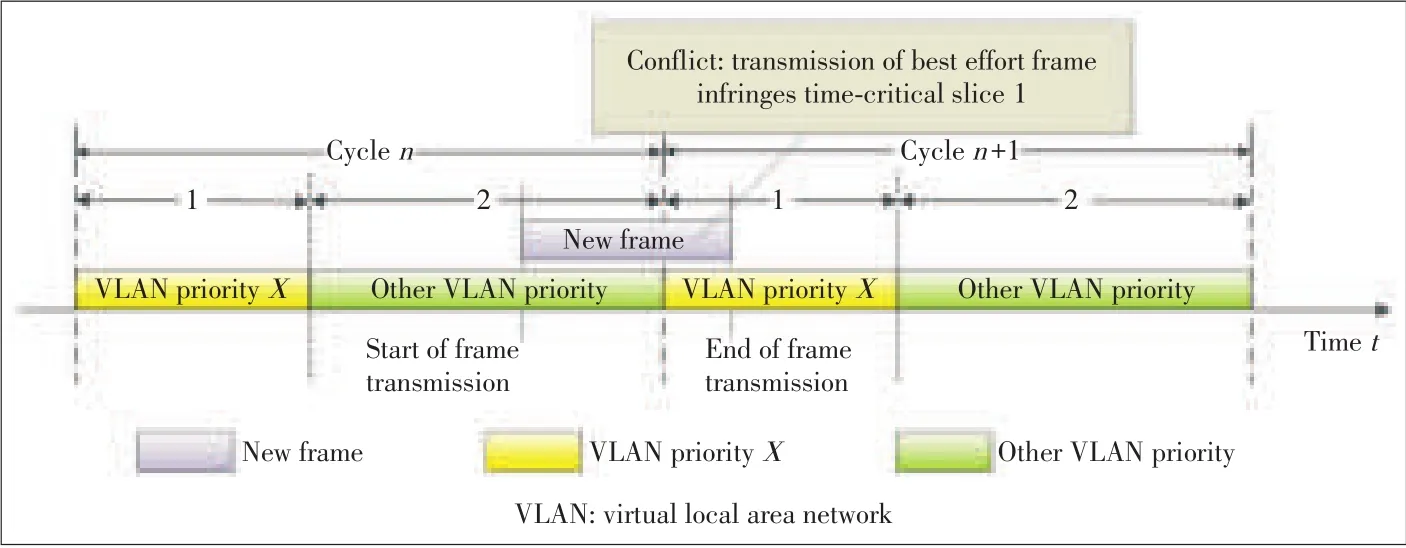
▲Figure3.Theframethat issent too latein thebest effort timesliceinfringesthehigh-priority timeslice.
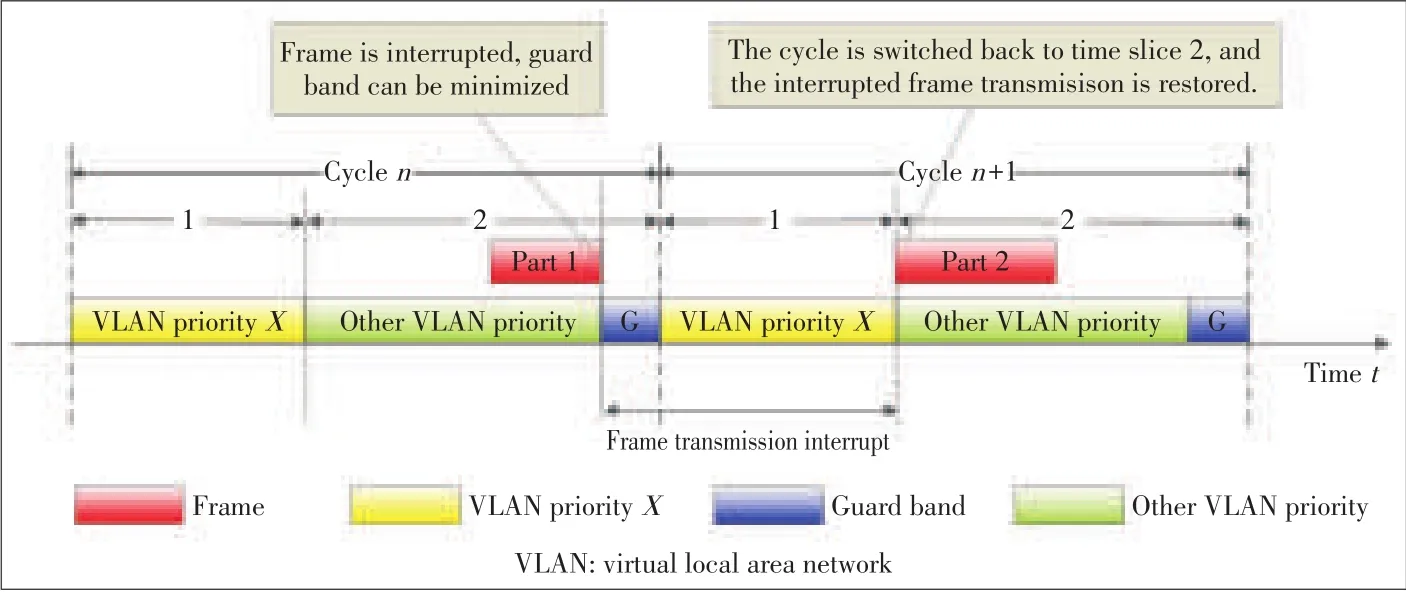
▲Figure4.Exampleof framepreemption.
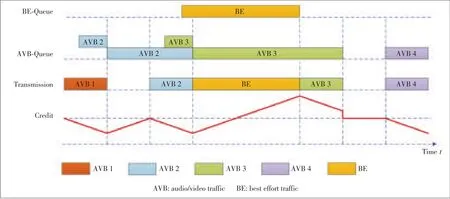
?Figure5.Credit-based shaper.
The transmission of Audio/Video traffic(AVB)is analyzed as an example:the queue starts to transmit when the credit is positive or zero and the credit decreases with a fixed slope during the transmission;when there is a frame waiting,the credit will accumulate with another fixed slope;the slope of the decrease or accumulation of credit can be configured according to the actual situation or experience.In addition,the credit will be set to zero when the credit is positive but the queue is emptied.It can be seen that the shaping mechanism of CBS can make the transmission of AVB data flow more uniform,thus reducing the jitter.It also makes the lower priority data streamshavetheopportunity tobetransmitted.
3.2.3 TAS+CBSScheduling Mechanism
There are many types of data streams in a communication system,such as control data traffic(CDT),audio/video traffic(AVB),and other background services traffic(best effort(BE)traffic).They have different characterization requirements:the real-time requirement of CDT transmission is higher;AVB transmission requires less jitter;BE traffic has lower priority.In view of the situation,we adopt TAS+CBSscheduling mechanism[28],[29].
The following example illustrates the scheduling mechanism of TAS+CBS.The IEEE TSN standard states that the credit will no longer increase for the duration of a class of data flows that is forbidden to be transmitted.To make it easier to understand,we only analyze the traffic transmission in a time period T=500 μs.As shown inFig.6,there are two AVB_A streams,one AVB_B stream and one BE stream for transmission in the TSN switch.The credits for AVB_A data streams are shown in blue,while the credits for AVB_B data streams are shown in red.The frames of AVB_A begin transmission at t=[0 μs,125 μs,250 μs],the frames of AVB_B and BE begin transmission at t=[0 μs,200 μs,400 μs],the guard band is activated at t=60 μs,and the CDT slot is activated at t=85 μs.We assume that all frames have the same size of 25 μs,so the guard band is alsodefined tobe 25μsand thesize of the CDTslot isspec-ified as100μs.
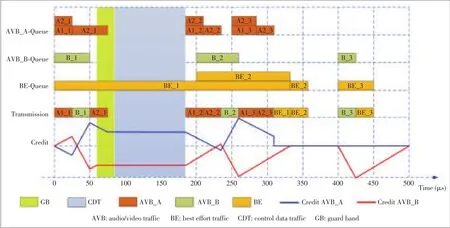
Figure6.?Time Aware Shaper+Credit-Based Shaper(TAS+CBS)scheduling mechanism.
It can be seen that at t=50 μs,stream AVB_A2 startstransmitting a frame,and it continues transmitting until t=75 μs.Between t=60 μs and t=75 μs,the number of credits of the AVB_A class flow continues to decline because the frame begins to transmit before the guard band.As opposed to class AVB_A,class AVB_B has a negative credit at t=50 μs,hence its credits are incremented according to its idle slope until t=60 μs,at which moment itsgateisclosed dueto theactivation of the guard band.The number of credits of class AVB_B stays constant during the guard band and the CDT-slot,even though it has a negative value.It is worth noting that at t=310 μs,the number of credits of AVB_A drops from positive to zero because there is no AVB_A frame waiting for sending at this time.From the example analysis,the TAS+CBS scheduling mechanism can effectively reduce the jitter of the audio/video traffic while ensuring the reliable and real-time transmission of thecontrol datatraffic.
3.3 Stream Management and Fault Tolerance
The core of TSN is its meeting the requirements of individual applications regarding timing behavior and reliability.In order to achieve the TSN characteristics,applications must register the corresponding data flows before their transmission.The identification,registration,and management of suitable paths can be a challenge,especially in larger networks and in conjunction with fixed transmission windows for different streams.To support the identification,registration,and management of suitable paths,TSN defines a set of mechanisms and interfaces in IEEEP802.1Qcc.
The reliability of data flows,especially in the event of errors,is also of great importance for many TSN application scenarios.For example,safety-related control loops or vehicle autonomous driving networks must be protected against failure in hardware or network media.Therefore,the TSN Task Group is currently providing the fault tolerance protocol IEEE 802.1CB for this purpose[30],and the mechanisms defined in IEEE P802.1CB and IEEE P802.1Qca allow replication and redundant transmission of data over several disjunctive paths.In addition to this agreement,existing high reliability protocols,such as Hierarchical State Routing(HSR)and Probabilistic Routing Protocol(PRP),as specified in IEC 62439-3,may also beused.
4 Modeling and Performance Analysisof Time Sensitive Networking
4.1 Modeling
The establishment of a simple network model is shown inFig.7[31],[32].A dataflow path dpiis an ordered sequence of links connecting one sender ESi∈ES to one receiver ESj∈ES.In Fig.7,wehave:
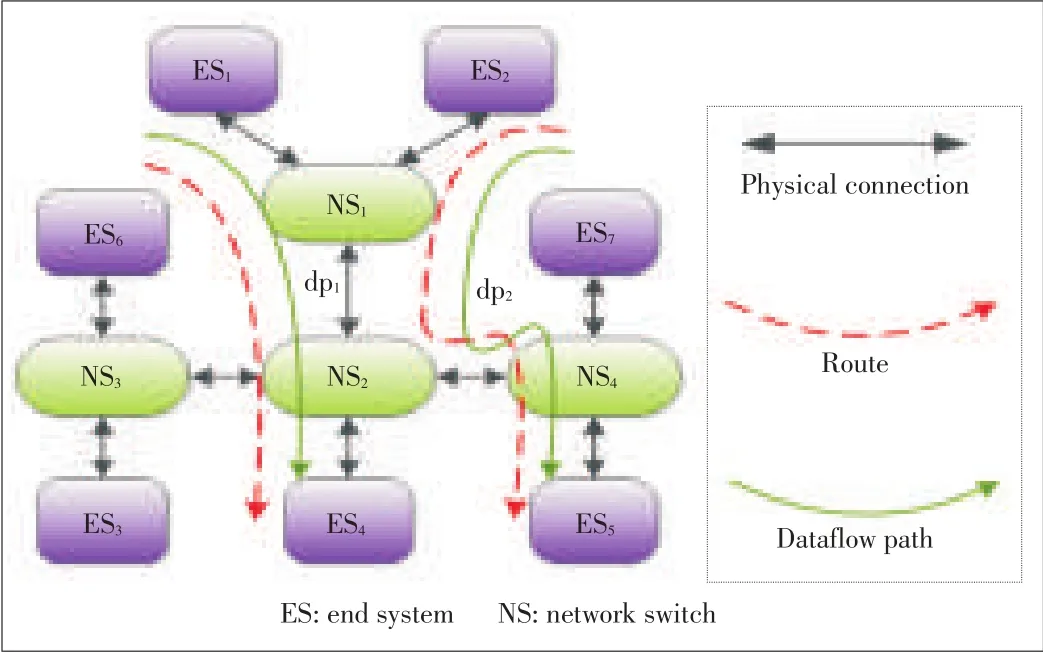
▲Figure7.ATSNtopology model.

4.2 Network Performance Analysis
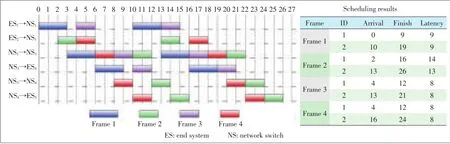
The TSN performance is analyzed by a specific example.We define a time unit as a step.The characteristics of the example frame are shown inTable 1,which explains why the time criticality problem may still occur in the case of defining a priority.Moreover,for easy understanding,we do not consider theexistenceof theguard band in thefollowinganalysis.
4.2.1 IEEE 802.1QStrict Priority Scheduling Mechanism
Based on the network topology model in Fig.7,we using the IEEE 802.1Q priority scheduling mode is used and the results are shown inFig.8.It is not difficult to see that even if these frames have different priorities,the frame delay time with high priority is not necessarily more stable.Frame 1 with the lowest priority has a stable delay of 9 steps,F(xiàn)rame 2 hasa delay of 14 or 13 steps,and Frames 3 and 4 have 8 steps of delay.The total delay time in the example is 77.
4.2.2 IEEE 802.1Qbv Time-Aware Shaper
If Frame 2 is considered to be a time-critical key frame,other features remain the same.In order to guarantee the low delay of Frame 2,the IEEE 802.1Qbv time-aware shaper mechanism is adopted and the resultsare shown inFig.9.
By comparison,it can be found that the total time of transmission of all frames increases from 77 to 82 steps.However,for the time-sensitive Frame 2,the delay is stable to 8 steps,which is ES2to ES5transmission of thebest time.
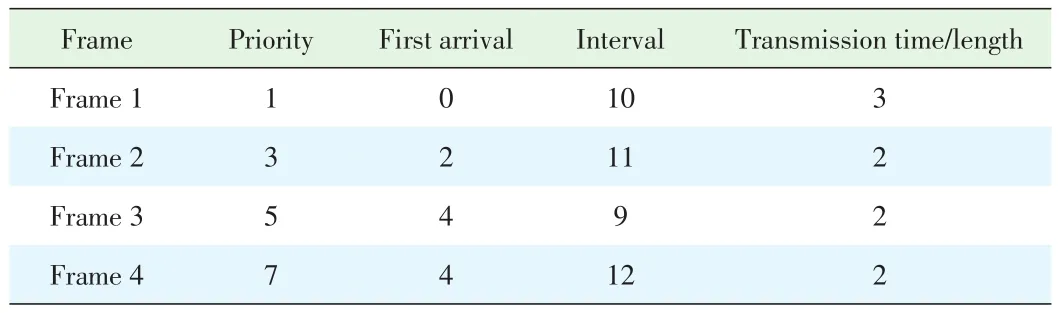
▼Table1.Exampleframefeatures
?Figure8.IEEE 802.1Qpriority scheduling and results.
4.2.3 IEEE 802.1Qbu Frame Preemption Scheduling Mechanism
Frame 2 is a critical frame for time requirement.The IEEE 802.1Qbu frame preemption mechanism is adopted here andFig.10shows the results.It can be found that this scheduling mechanism can guarantee the timely transmission of Frame 2 and overcome the shortcomings of IEEE 802.1Qbv Time-Aware Scheduling.It reduces the total time of transmission framefrom82 stepsto78 steps.
5 Conclusions
In this paper,the time sensitive networking is introduced.The key technologies of TSN are summarized.A concrete example is given to illustrate the unique performance of the time sensitivenetworking.Weobtain thefollowingresults:
1)IEEE802.1Qstrict priority scheduling is very easy to generate data conflict in the case of insufficient bandwidth,and cannot guaranteethetimely transmission of dataframes.
2)IEEE802.1Qbv Time-Aware Shaper can ensure the timely transmission of key frames,but the protected window and guard band mechanism will cause a certain degree of bandwidth waste at the downside.
3)IEEE802.1Qbu guarantees the timely transmission of data,and at the same time,uses the frame preemption mechanism to minimize the guard band to solve the problem of bandwidth wastein IEEE802.1Qbv Time-Aware Shaper.
Some TSN standards have not been formally released,and the related applications in automotive electronics and industries have not been widely promoted.Basically,TSN is still in the testing platform stage.The development of chips and prod-ucts for TSN will be the next focus of major manufacturers and related research institutes.

Figure9.?IEEE 802.1Qbv time-awarescheduling and results.
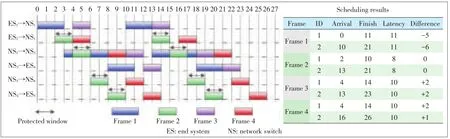
Figure10.?IEEE802.1Qbu frame preemption scheduling and results.
Biographies
FU Shousai(16121438@bjtu.edu.cn)received his bachelor's degree in electrical engineering from Inner Mongolia University of Technology,China.Now he is a master candidate in electrical engineering at Beijing Jiaotong University,China,and he engagesin research of fieldbusand industrial Ethernet.
ZHANG Hesheng(hszhang@bjtu.edu.cn)received his B.S.E.E.and M.S.degrees in electrical engineering from Northern Jiaotong University of China in 1992 and 1995,respectively.He received his PH.D.degree in automation science and technology from Tsinghua University,China in 2006.He is now a professor with School of Electrical Engineering,Beijing Jiaotong University,China.His research interests include fieldbus,sensor network,network communication performance,and intelligent control.He is a senior member of the CES and CCF.Dr.ZHANG has published more than 60 papers in the journals and conferences asthe first or second author,and hasapplied for nine national invention patentsasthefirst inventor.
CHEN Jinghe(16121422@bjtu.edu.cn)received her bachelor's degree in electrical engineering from Jinan University,China.Now she is a master candidate in electrical engineering at Beijing Jiaotong University,China,and she engages in research of fieldbusand industrial Ethernet.
- ZTE Communications的其它文章
- Portable AtmosphericTransfer of MicrowaveSignal Using Diode Laserwith Timing FluctuationSuppression
- Energy Efficiency forNPUSCH in NB-IoT withGuard Band
- Antenna Mechanical PoseMeasurement Based onStructure from Motion
- A New Direct Anonymous Attestation Scheme forTrusted NFV System
- Optimization Framework for Minimizing Rule Update Latency in SDN Switches
- SDN Based Security Services