埃森蒂森克虜伯樓,埃森,德國
2019-05-28 06:49:14建筑設計JSWD建筑事務所和查克斯莫雷爾事務所
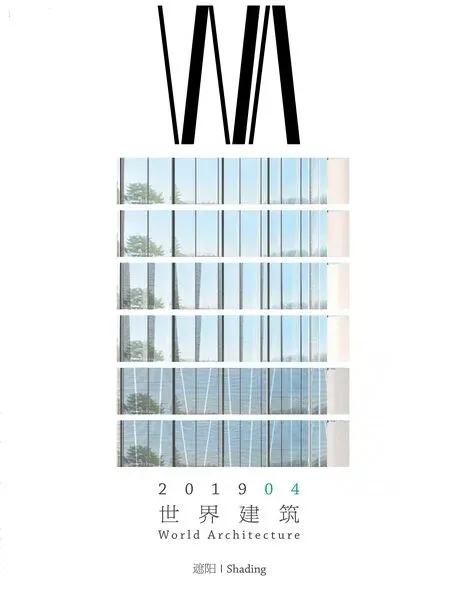
世界建筑 2019年4期
建筑設計:JSWD建筑事務所和查克斯&莫雷爾事務所

1 夜景/Night view
校園內的所有建筑的立面都是按照“外殼與內核”的原則進行設計的,表現為兩種立面類型:“外殼”界定了建筑體量朝向外部和開放空間的立面,而“內核”則是內院與中庭空間。這些設計旨在強調建筑之間的聚合感及同質性,強調超越建筑體量,可共享且形式化的建筑語言。
“外殼”由穿插在柱、梁或基本建筑結構中的通體合金玻璃幕墻組成,幕墻具有熱效應。合金外殼以不同間距安置在立面之外作為遮陽系統,這些系統因不同建筑而各異。為呈現統一的建筑風格,所有建筑外部都包覆著“不銹鋼”,且以垂直結構為主。因此樓層水平方向的線條得以融入背景,且使每個建筑的整體高度看起來均勻一致。這些層次豐富的立面使校園建筑看起來好似抽象的金屬體塊。首層局部嵌裝玻璃的單體和通體嵌裝玻璃的單體使校園各建筑之間有了更深層的呼應。
上文提到的合金“外殼”具有深淺各異的肌理,與校園建筑的色彩、平滑的“內核”形成對比。雖然外立面各不相同,但“內核”的設計卻相對統一。相似的色彩和不透明內核的表皮設計統一了整個校園,加強了建筑間的聯系。“內核”通體都覆蓋了合金板,這些有著線圈涂層的面板是專為蒂森克虜伯校區開發生產的。其表面反射了不同時間、不同光線條件下的日光,塑造出細微的顏色差別,與校園周圍綠化區域的自然之色形成對話。
以上述設計原則為基礎,我們為蒂森克虜伯樓(Q1大樓)立面的絕大部分開發了一種創新且高效的遮陽系統。除了建筑中部的全景窗口,這個遮陽系統成為Q1大樓的主要特征。
遮陽系統由約3150根垂直桿件組成,桿件設有不銹鋼雙向軸,約40萬個水平不銹鋼百葉纏繞其上,遠遠看去,好似合金羽毛。這些可旋轉和相互交織的元素呈現了一個最優系統,它結合了水平百葉(允許光線進入)和垂直可旋轉百葉(視野不受限制)的優點。1280多個由直線電機驅動、中央控制的獨立元件可以完成以下基本操作:
(1)緊閉(平行于隔熱玻璃層)
(2)隨太陽位置而調節(可變,垂直于太陽入射角)
(3)開啟(水平百葉纏繞在雙向軸上,垂直于隔熱玻璃層)
這些獨立元件有梯形、三角形和矩形3種,賦予立面一種能調節全天候陽光反射的結構,創造出一種近乎于人工調控的外觀。遮陽系統也是關乎建筑能源的一部分,該系統可以防止過熱。當其緊閉,會將自然光引入室內。可旋轉的百葉設計保證了從窗戶到開放空間的視野不受阻礙。從可持續性和能源效率的角度看,該系統將現代辦公領域的技術功能需求,在設計良好的建筑當中呈現出來。(天妮 譯)

2 動態立面/Dynamic fa?ade
All of the building fa?ades on the campus have been designed according to the "Shell and Core"principle, which is expressed in two fa?ade types:while the "shell" defines the fa?ades of the building volumes towards the exterior and the open spaces,the "core" is oriented towards the interior courtyards and atriums. The objective of these design leitmotifs is to underline cohesion between the buildings and thus the architectural homogeneity of this campus beyond the shared formal language of its building volumes.
The "shell" type consists of a thermally effective floor-to-ceiling metal-glass fa?ade in post,beam, or elemental building structure. A metallic shell has been placed in front of these at various distances to bear sun-shading systems, which differ from building to building. The material "stainless steel" defines the outer appearances of all of the building envelopes, to express a uniform corporate architecture. All of the fa?ades are characterised by a dominantly vertical structure, so that the horizontal lines of the story levels fade into the background,making the fa?ades look homogenous in appearance over the whole height of each building; these multilayered fa?ade surfaces thus make the campus buildings look like abstract metal volumes. The individual buildings' partly recessed glazed ground floor fa?ades and the glazed floor-to-ceiling building joints represent a further connecting element within the campus architecture.
The above-mentioned metallic-rough "shells",the reliefs of which differ in depth, stand in contrast to the coloured, smooth "core fa?ades" of the campus buildings. While the exterior-oriented fa?ades vary, the "core" fa?ades are designed identically.The homogenous colour and surface design of the opaque "core fa?ades" unifies the whole campus appearance, reinforcing the relationships between its buildings. The "core fa?ades" have been clad from floor to ceiling in sheet metal panels painted using coil coating, and developed and produced especially for the Thyssenkrupp Campus. Their surfaces reflect daylight depending on the time of day and the light entering, creating nuances of colour that stand in dialogue with the natural colours of the green areas around the campus.
An innovative, highly efficient sun shading system was developed for large parts of the Q1 fa?ade based on the design principles described above. Apart

3 元件隨太陽位置而調節/Following the position of the sun

4 細部/Details

5 細部/Details

6 細部/Details
項目信息/Credits and Data
客戶/Client: Thyssenkrupp AG
建筑面積/Ground Floor Area: 28,500m2
遮陽幕墻/Sunshade Fa?ade: Frener + Reifer
繪圖/Drawings and Diagrams: JSWD Architects and Chaix &Morel et Associés (fig. 3-6,8,10,11)
攝影/Photos: Christian Richters (fig. 1,2,12), Günter Wett and Frener + Reifer (fig. 7), JSWD Architects and Chaix &Morel et Associés (fig. 9)from the panorama window, this sun shading system defines the character of the Q1 building.
Its sun shading elements, which look like metal feathers from afar, consist of approximately 3150 routered vertical stalks; stainless steel double axes,onto which approximately 400,000 horizontal stainless steel louvers have been screwed. These rotatable and intertwineable elements represent an optimised system that combines the advantages of horizontal louvers (allowing light to enter) with those of vertical rotatable louvers (unrestricted views). The over 1280 lineal motor-driven, centrallycontrolled individual elements can perform the following basic operations:
(1) Closed (parallel to the thermal glazed envelope)
(2) Following the position of the sun (variable,perpendicular to the angle of entry of the sun)
(3) Open (the horizontal louvers intertwine over a double-axis, perpendicular to the thermal glazed envelope)
Their differentiation into trapezoidal,triangular, and rectangular individual elements gives the fa?ade a structure on which the changing play of reflecting sunlight throughout the day creates an almost artificial-looking orchestration of the architecture. The sun shading system is also part of the building's energy concept. It protects from overheating and when it is closed, it directs natural light into the interior spaces. Views from the windows to the open spaces are still guaranteed due to the rotational function of the system. This system has made it possible to transfer the technical and functional necessities of a modern office working world, from a sustainability and energy efficiency point of view, into well-designed architecture.

7 動態立面/Dynamic fa?ade

8 細部/Details

9 細部/Details

10 獨立元件可以完成上述基本操作/The individual elements can perform the above basic operations

11 分析圖/Diagram
評論
燕達:建筑師將對建筑內環境的控制巧妙地融合進建筑外觀設計里。考慮到校園建筑統一的建筑風格,建筑師以合金“外殼”和玻璃幕墻“內核”為基本元素,但肌理的組合又各自相異。合金外殼一方面通過不同的獨立元件和交織方式創造了更多外觀設計的可能性,另一方面也提供了可根據室外氣象條件主動調節的遮陽系統。水平百葉和垂直旋轉百葉交織,既考慮了全天太陽高度角的變化特點,同時也可以滿足室內人員的日照和視野需求。
張宇峰:“殼與核”的原則賦予了表皮更大的發揮空間。多性能的平衡與優化一直是遮陽設計的巨大挑戰。水平與垂直結合、材料光熱選型,以及多變的形體變化,都在促進熱、光和視野的相互協調。與太陽對話是遮陽設計的核心。通過單元形體的切換和太陽方位的追蹤控制,有效應對了不同朝向與時間顯現的矛盾和需求。與常見呆板單調和“侵占性”的遮陽設計相比,3種獨立元件的搭配組合讓表皮煥發生機,而“殼與核”的有序進退積極回應著內部使用空間的功能。雖然在冬季日照調控、技術復雜度、運維成本等方面留有改進空間,這仍不失為讓遮陽設計努力做到協調、完美的優秀范例。

12 內景/Interior view
Comments
YAN Da:The architects subtly integrate the control of the building's interior environment into the design of its exterior appearance. Considering the unified architectural style of the campus buildings, the architects take the alloy"shell" and the glass curtain wall "core surface" as the basic elements, but using different combinations of textures. On the one hand, the alloy shell creates more possibilities of the fa?ade design by using various independent components and the way they are interlaced, and on the other hand, it provides a shading system that can spontaneously adjust itself according to outdoor weather conditions.The horizontal louvers and the vertical rotating louvers are interwoven together.This not only refers to the changing solar altitude angle throughout the day but also meets people's requirements of sunlight and view while they are staying indoors. (Translated by CHEN Xi)
ZHANG Yufeng:The "Shell and Core" principle provides more spaces for fa?ade design.The balance and optimisation of multiple performances is always a big challenge for shading design. The horizontal and vertical combination, solar and thermal properties of the material, and the various forms' varieties all contribute to the coordination of heat,light and field of vision. Conversation with the sun is the core of shading design. The contradictions and requirements occurred in various orientation and time are effectively responded by switch of unit shape and sun-tracking control. Compared to the common rigid, monotonous and "invasive" design of shading, the combination of three types of independent units revitalises the fa?ade, while the orderly back and forth arrangement of"Shell and Core" responds positively to the internal space function. Although improvements exist in winter sunshine control, technical complexity, and operational and maintenance cost, it is definitely a good example for making shading design harmonious and perfect.
猜你喜歡
北方建筑(2021年6期)2021-12-31 03:03:54
文苑(2020年10期)2020-11-07 03:15:36
現代裝飾(2020年6期)2020-06-22 08:43:12
藝術啟蒙(2018年7期)2018-08-23 09:14:18
海峽姐妹(2017年7期)2017-07-31 19:08:17
Coco薇(2017年5期)2017-06-05 08:53:16
琴童(2017年3期)2017-04-05 14:49:04
小天使·二年級語數英綜合(2017年3期)2017-04-01 17:17:48
少兒科學周刊·兒童版(2015年6期)2015-11-24 03:49:38
中學生天地(A版)(2015年5期)2015-06-01 02:46:03