
數字孿生的模型、問題與進展研究
2019-06-11 08:27:44劉青劉濱王冠張宸梁知行張鵬
河北科技大學學報 2019年1期
劉青 劉濱 王冠 張宸 梁知行 張鵬

摘要:近年來,關于數字孿生的研究方興未艾。數字孿生作為一個新的范式或者方法體現出了巨大的潛力,但是,這一概念的內涵和范圍尚不確定,尤其是對數字孿生模型概念的界定很不清晰。根據模式類別可以將其分為通用模型和專用模型,其中專用模型仍是當前的研究熱點,研究內容主要體現為對具體項目使用數字孿生方法進行建模,也包括對專用模型進行開發。這些具體項目除了傳統制造業所涉及的零件測量和質量控制,增材制造,設計和工作過程,以及系統管理外,還包括在生物醫藥、石油工程領域的應用等。開發專用模型的工具和技術呈現多元化,有通用工業軟件、專用工業軟件、仿真平臺和自研二次開發工具等等。數字孿生通用模型的研究對象不針對某一具體項目,而是研究如何將模型受控元素表示為一組通用的對象以及這些對象之間的關系,從而在不同的環境之間為受控元素的管理和通信提供一種一致的方法。數字孿生通用模型的研究主要分為概念研究和通用模型的實現方法,兩者的研究熱度相當。其中概念研究從宏觀角度的產品生命周期管理,到描述系統行為,如一般系統行為和系統重新配置,再到具體工作流,如設計方法、產品構型管理、制造系統、制造過程等,研究內容較為發散,尚沒有出現特別突出的熱點。關于數字孿生通用模型實現方面,主要研究了建模語言的構建、模型開發方法的探索、具體工具的使用、元模型理念的植入和模型算法的探索。數字孿生模型是數字孿生研究的核心領域之一,其未來的研究重點是如何將不斷涌現的各不相同的數字孿生體的外部特征和內在屬性歸納為可集成、可交互、可擴展的模型,便于更高效地實現信息在物理世界和數字世界之間流動,從而實現數字孿生的普遍應用,繼而支持CPS(網絡物理空間)和CPPS(網絡物理生產系統)的建設。因此,數字孿生模型研究下一步需要解決的問題是如何對接標準參考架構,如德國提出的工業4.0參考架構模型RAMI4.0和中國的智能制造系統架構IMSA等;關于數字孿生模型需要建立統一的描述方法并確立一致的結論,以規范各自獨立發展建立起來的模型,從而改善模型的互操作性和可擴展性,否則,隨著系統規模的擴大模型效能會顯著下降;中國數字孿生模型的研究急需國產專業工業軟件和建模軟件的支持,以便中國學者深入開展更加符合國情的深入研究。
關鍵詞:系統建模;數字孿生模型;網絡物理空間;網絡物理生產系統;工業4.0
中圖分類號:TB497; TP301.6文獻標志碼:A
LIU Qing,LIU Bin,WANG Guan,et al.Research on Digital Twin: Model, problem and progress[J].Journal of Hebei University of Science and Technology,2019,40(1):68-78.Research on Digital Twin: Model, problem and progress
LIU Qing1, LIU Bin1, WANG Guan1, ZHANG Chen2,LIANG Zhixing3, ZHANG Peng4
(1.School of Economics and Management, Hebei University of Science and Technology, Shijiazhuang, Hebei 050018, China; 2.Ilmenau University of Technology, Department of Mechanical Engineering, Ilmenau D-98693, Germany;3.Jizhou Hebei Middle School,Jizhou,Hebei 053200, China;4.Department of Rail Transit, Beijing ?Jiaotong ?Vocational ?and ?Technical ?College, Bejing,102200,China)
Abstract:In recent years, the research on Digital Twin is in the ascendant. As a new paradigm or concept, it shows great potential. However, the connotation and scope of the Digital Twin concept is still uncertain, especially the Digital Twin Model definition is not clear.
河北科技大學學報2019年第1期劉青,等:數字孿生的模型、問題與進展研究According to the pattern category, the Digital Twin Model can be divided into general model and special model, in which the special model is still the focus of current research, and the research content is mainly embodied in the use of Digital Twin method to model specific projects. It also includes concept for developing specialized models. These specific projects in addition to the traditional manufacturing related to parts measurement and quality control, manufacturing, design and work processes, as well as system management, but also in the field of biomedical applications and applications for petroleum engineering and so on. There are many tools and techniques for developing special models, such as general industrial software, special industrial software, simulation platform and self-developed secondary development tools, etc.
The research object of the Digital Twin general model is not specific to a specific project, but how to represent the controlled elements of the model as a group of common objects and the relationships between these objects. This provides a consistent approach to the management and communication of controlled elements between different environments. The research on the general model is mainly divided into the conceptual research and the model implementation method; the research heat of the two directions is almost the same. Conceptual research ranges from product lifecycle management to system behavior description, such as general system behavior and system reconfiguration, and to product configuration management, to specific workflow, such as design methods, manufacturing systems and manufacturing processes. The research content is relatively divergent, and there is no particularly prominent hot spot. The research of Digital Twin general model implementation is mainly reflected in the modeling language construction, the model development methods exploration, the specific tools usage, the Meta-model concept implantation and the model algorithm exploration.
Digital Twin Model is one of the core areas of Digital Twin research. Its future research focuses on how to integrate the external features and intrinsic properties from different Digital Twin artifacts into a model with interoperability, interactivity and scalability for more efficiently realizing the information flow between the physical world and the digital world, thus achieving the universal Digital Twin application, and then supporting the CPS (Cyber Physical Space) and CPPS (Cyber Physical Production System) construction. To this end, the next problem in the Digital Twin Model needing to be solved first is how to dock the standard reference architecture, such as the RAMI4.0 (Reference Architecture Model Industrial 4.0) proposed by Germany and the IMSA (Intelligent Manufacturing System Architecture) by China, etc. Secondly, the Digital Twin Model needs a unified method to describe and it also needs consistent conclusions, in order to standardize the models established by independent development, thus improving the interoperability and scalability of the model. Otherwise, the performance of the model will decrease significantly as the system scales raise. Thirdly, the research on China's Digital Twin Model requires the support of domestic professional industrial software and modeling software, so that the Chinese scholars can carry out in-depth research that is more in line with national conditions.
Keywords:system modeling; Digital Twin Model; cyber-physical space; cyber-physical production system; industry 4.0
隨著信息技術水平的提高和數據處理能力的飛躍,將生產流程在內的各種物理實體數字化已是大勢所趨[1-2]。
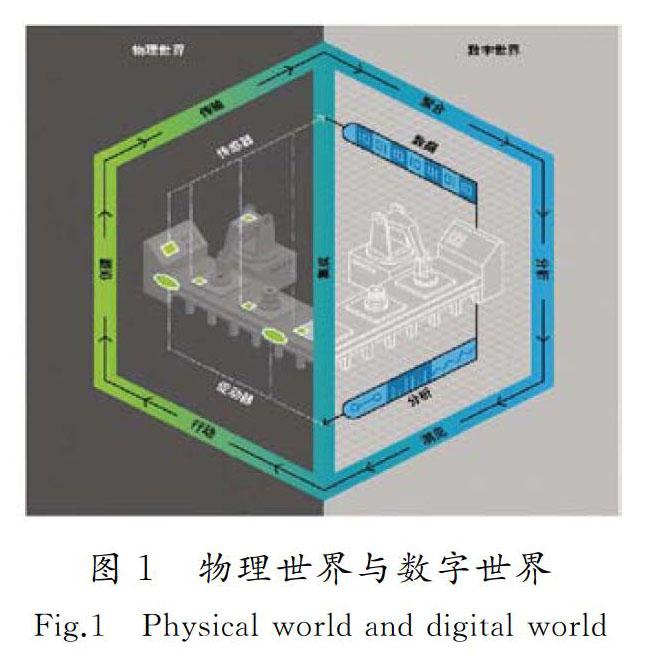
這一趨勢催生出的代表技術之一就是數字孿生(Digital Twin),經過十數年的發展,從2017年起相關研究出現爆炸性的增長,隨著研究熱度的提升,這一概念的外延和內涵不斷擴展,從最開始的針對工業生產過程的新管理范式,發展到現在作為智慧城市的關鍵技術,這個概念已經表現出了很大的研究價值和社會價值。但是對于數字孿生概念本身,學術界還沒形成一致的理解,較通行的解釋即數字孿生指在數字虛擬空間定義的一個或一組虛擬事物,其與物理實體空間中的現實事物具有映射關系,且這種映射具備包括形狀、形態、行為、材質等多維度、多角度上高度一致的信息[3-8],如圖1所示。在數字孿生的概念發展過程中,研究者們先后提出的各種模型還沒有得到明確界定,鑒于模型在數字孿生的關鍵技術,如:信息交換、信息儲存和信息處理中的突出作用,不加以辨析地使用容易造成混淆,故很有必要對已提出的各種模型進行比較研究。同樣,在探討數字孿生如何應用時,也發現了模型與具體應用相結合所產生的問題,關于其中一些問題的研究已經有所進展,這些工作同樣需要進行總結歸納,以期為后續研究提供借鑒。
1數字孿生的整體研究進展
不同于以往計算機輔助設計(CAD)為代表的數字化,也并非是以傳感器網絡為主要研究對象的物聯網解決方案,數字孿生有更廣泛的意涵和潛力[1]。數字孿生的發展以2017年劃界,可分為兩個階段:2017年以前,研究的數量較少,主要集中在概念的討論,提出了少數幾種模型,研究人員集中在歐美少數國家。2017年以后的研究數量有很大增長,中國也有一定數量的學者開始參與這項研究,研究者們除了繼續對概念進行討論外,還提出新的模型、使用案例對數字孿生進行驗證、提出新的應用框架與方式等等,也出現了對數字孿生成本問題的批評和反思。
河北科技大學學報2019年第1期劉青,等:數字孿生的模型、問題與進展研究數字孿生這一概念最早出現在2003年,由GRIEVES[9]在美國密歇根大學的產品全生命周期管理課程中提出,當時它只是一個與數字孿生涵義相近的描述。 隨后在2005年,GRIEVES[10]進一步引申提出數字孿生是2個空間之間的映射。繼而,包括GRIEVES本人在內開始有學者倡導將Digital Twin作為一種范式進行詮釋和應用[10-11]。2014年,CERRONE等[12]首次提出一種關于Digital Twin的有限元模型,2015年,第1個實現模型由GRIEVES[3]提出,稱作Digital Twin Implementation Model。同年,ROSEN等[13]提出Digital Twin的實現路徑應為Modularity-Connectivity-Autonomy-Digital Twin,即模塊化-連通性-自治-數字孿生。2016年,KRAFT[14]提出Digital Twin 這種新興范式能夠在產品生命周期集中應用建模能力、知識及工具管理。同年,SCHROEDER等[15]通過案例提出在網絡物理空間(cyber-physical system)使用Digital Twin概念模擬工業設備(傳感器、機器、CLPs)的虛擬部分,并提出一種基于Web服務的架構用于訪問數據,接著,SCHROEDER 等[16]進一步提出一種基于AutomationML(automation modelling language,自動化建模語言)的交換數據模型,用于在Digital Twin和其他系統之間交換數據。
2017年,ALAM等[17]提出了基于云的Digital Twin架構參考模型Cloud based CPS(C2PS)。BRENNER等[18]將Digital Twin用于ESB的物流智慧工廠。 同年,DEBROY等[19]開始嘗試將Digital Twin用于3D打印。FERGUSON等[20]引入西門子STAR CCM+作為工具,使用Digital Twin方法將設計方案在物理世界真實條件下的表現直接展示給設計者,從而增強產品開發組織的能力。GRAESSLER等[21]把數字孿生方法用于員工和生產系統之間的溝通協調。GRIEVES等[22]提出數字孿生的實質是把數字信息嵌入在物理系統本身內,并在整個系統生命周期內與該物理系統鏈接信息的“雙胞胎”,可以減輕復雜系統中不可預測的、不受歡迎的緊急情況。HEBER等[23]提出Digital Twin處理復雜性問題可以由區塊鏈進行賦能。IGLESIAS等[24]提出將數字孿生用于增強傳統系統的工程分析流程。LI等[25]提出使用動態貝葉斯網絡(DBN)的概念建立健康監測模型,用于每架飛機的診斷和預測,并且通過飛機機翼疲勞裂紋擴展實例說明了所提出的方法。MAGARGLE等[26]提出了將模型驅動開發用于Digital Twin。PLANA[27]提出對工業生產來說,Digital Twin的最大意義在于預測。RENZI等[28]提出將Digital Twin結合全局性能模型global performance model用于integrity mangagement(完整性管理),可以實現對資產進行自動連續評估。SCHLEICH等[29]把生產過程管理中Digital Twin的reference model方法進行歸納整理,認為Digital Twin應具有4種特性,即scalability,interoperability,expansibility,fidelity(可伸縮性、互操作性、可擴展性、保真度)。SESHADRI等[30]提出通過綜合結構健康管理(SHM)工具和多物理場模型實現Digital Twin,對航班在正常和不利條件下的受損情況進行準確檢測和預測。SOEDERBERG等[31]探討了在個性化生產中,如何從設計、生產前過程到生產過程中對產品物理幾何尺寸使用Digital Twin方法進行實時幾何保證(Geometry Assurance)。SUN等[32]提出使用數字雙胞胎在線分析,可以用于提高裝配流線的吞吐量。TAVARES等[33]基于Digital Twin方法開發了MVV Model(model-view-view model),通過使用SARKKIS robotics simulator構建模擬器從而試圖尋找一種能夠代表任何工業工作單元的解決方案。UHLEMANN等[34]分析了當前生產過程中多模態數據采集方法的實用方法、要求和限制,提出通過用于生產過程的Digital Twin方法來實現生產系統及其數字等效物的耦合,以此作為規劃方法優化的基礎,從而通過對Digital Twin的創造,將數據采集時間實現延遲最小化。他的后續研究還進一步提出了一個基于Digital Twin的學習工廠,來展示其實時數據采集和后續基于數據處理的潛力與優點[35]。 UM等[36]提出一套面向Digital Twin方法的實例化通用數據模型自動設置數字環境,該環境基于AutomationML且具備多個裝配模塊。VACHLEK等[37]在PS(prodution simulation,生產模擬)中使用Digital Twin的概念,對汽車行業內現有的生產結構如何通過增強生產和規劃策略來最有效地利用資源進行了探索。WAGNER等[38]提出一個通過Digital Twin實現滿足工業4.0條件的工廠架構。WERMEFJORD等[39]提出了用于實現幾何保證方向的Digital Twin所需要的檢查策略,描述了各個部件的形狀以及如何收集、存儲和利用該數據的必要輸入方法。YUN等[40]提出了一套結合Digital Twin方法的駕駛輔助系統。ZAKRAJSEK等[41]提出了一套Digital Twin Model,用于Touchdown Wear Testing 著陸磨損測試。ZHANG等[42]嘗試通過基于數據庫和3D圖形引擎進行二次開發建立仿真平臺,從而使用Digital Twin理念對一條中空玻璃生產線的設計進行多目標優化。陶飛等[43]將信息物理融合作為智能制造落地的關鍵技術,提出通過物理融合、模型融合、圖2以F15戰斗機為例的數字孿生模型
數據融合和服務融合來建立數字孿生車間。陶飛等[44]在后續研究中嘗試建立了一間基于Digital Twin的數字孿生車間。陶劍等[45]結合Digital Thread(數字線索)和Digital Twin對生產生命周期過程進行了歸納。于勇等[46]參考關于F15戰斗機的研究提出將構建基于本體的產品數字孿生模型可以與相應的構型數據關聯在一起,如圖2所示。實際的物理產品研制過程中的相關技術狀態數據也可以與之建立關聯關系。
2017年也有文獻對數字孿生進行另類思考,如WEST等[47]通過詳細的財務分析,質疑Digital Twin的成本和效益不成比例。
2018年后,研究的廣度和深度都有所提升,截至到本文收稿時,這一年的研究發表數量已超過2018年之前的歷史總和。其中ANDERL等[48]提出Digital Twin需要進行水平和垂直整合的理念。AYANI等[49]提出在機器修復過程中加入數字孿生方法進行仿真可提高效能。BOTKINA等[50]建立了針對切削工具的一個數字孿生體。BROSINSKY等[51]展望了電力系統控制中心的發展,提出了使用數字雙胞胎的新概念來設計控制中心架構。CORONADO等[52]描述了由Android設備和云計算工具提供支持的新MES(制造執行系統)的開發和實現,繼而將來自MES的數據與來自機器工具的MTConnect數據相關聯,以支持Digital Twin的發展。
DAWKINS等[53]考察了位于英國伊麗莎白女王奧林匹克公園的東部地區新的UCL校園的Digital Twin創建和使用過程。GERIS等[54]提出了將Digital Twin應用于醫學工程領域。GRAESSLER等[55]研究了同時包含一個工作場所和與一名員工互動的Digital Twin,探討了其對現有技術裝置控制系統產生影響的可能性。GUO等[56]提出了一種基于Digital Twin的工廠設計,以提升設計師快速評估不同的設計并找到設計缺陷的能力,由此節省時間并助益于設計項目的完善。HAAG等[57]構建了一個數字孿生體:cyber-physical bending beam test bench(網絡物理彎曲梁試驗臺)。HE等[58]將數字孿生方法應用到超高壓電力網格的管理監控。HU等[59]開發并研究了一種構建基于云的數字孿生(CB Digital Twin)的新方法,以適應數字孿生高效整合進入網絡-物理云制造(CPCM)系統,符合相應的要求如減少開銷及節省資源。KUNATH等[60]討論了一種基于制造系統的數字孿生決策支持系統,重點是該系統在訂單管理過程中的概念框架和潛在應用。 LIU等[61]提出了一種由Digital Twin驅動的設計方法,用于快速個性化設計自動化流水作業制造系統,通過該系統將位于現實世界的制造系統進行虛擬,使用虛擬模型驗證并彌合其設計與真實制造系統之間的差距。LIU等[62]探討了Digital Twin用于飛機預測性維護的概念和相關框架。LOHTANDER等[63]研究并描述了MMU(微制造單元)模型所需的主要特征和限制,繼而將MMU模型作為一個整體元素,通過使用Digital Twin方法,最終將微制造單元的真實行為表現在數字模型上。LUO等[64]提出了一個CNCMT(computer numerical control machine tool,計算機數控機器工具)面向Digital Twin建模和應用的框架,運用統一建模的多域建模方法提出了語言和制圖策略,利用Digital Twin策略研究故障診斷和預測,并借助案例進行了驗證。MACCHI等[65]研究了Digital Twin在資產生命周期管理中在支持決策方面的作用。MILLER等[66]提出使用一種空間增強計算機輔助設計模型,來改善與數字孿生模型互連性相關的非幾何數據。NAPLEKOV等[67]通過結合血流動力學和剪切應力的研究成果,成功創建出冠狀心臟血管的Digital Twin。PADOVANO等[68]研究了“服務導向的數字孿生”,將Digital Twin作為服務提供者。QI等[69]比較了大數據和數字孿生之間的差異、互補性以及如何將它們整合到一起。SAINI等[70]對石油鉆井的輸送過程進行了Digital Twin的創建、實施和測試。SCAGLIONI等[71]研究了作為機床工作過程的Digital Twin設置的基本組,并開發了機床動態模型Mandelli M5。SIERLA等[72]研究了使用Digital Twin自動執行裝配規劃并協調制造單元中的生產資源。TALKHESTANI等[73]提出了一個基于數字雙胞胎的模型集成在PLM(product lifecycle management,產品生命周期管理)中的工程概念,以及IT-Platform和Anchor-Point方法用于在數字模型和物理系統之間的協同,以檢測機電數據結構的差異。TAO等[74]針對復雜設備的預測和健康管理提出了5種模型,即Digital Twin包括PE,VE,Ss,DD,CN,其中PE是物理實體模型(physical entity model),VE是虛擬設備模型(virtual equipment model),Ss指服務模型(services model),DD指數字孿生數據模型(digital twin data model),CN是連接模型(connection model)。VATHOOPAN等[75]引入了一種新的模塊化糾正性維護方法,使用了數字雙胞胎自動化模塊。ZHENG等[76]探討了全參數虛擬建模的實現過程和Digital Twin應用與子系統的構建思路,建立并研究了焊接生產線的Digital Twin案例。ZHUANG等[77]提出了一個數字框架,用于構建復雜產品裝配車間的數字孿生智能生產管理和控制方法,并在此基礎上提出了在衛星裝配車間場景中的基于數字孿生對詳細實施過程進行智能生產管理和控制的方法。戴晟等[78]對數字孿生和數字樣機進行了比較,提出了數字孿生下一步的發展趨勢。德勤[1]分析了數字孿生蘊含的商業價值。郭東升等[79]以企業航天結構件制造車間為案例,展開數字孿生技術在制造車間的應用驗證,通過對案例結果的對比與分析,驗證了數字孿生制造車間可有效地提高生產效率。林雪萍等[80-81]分析梳理了Digital Twin相關的概念及其對制造業的意義。秦曉珠等[82]提出將Digital Twin理念用于物質文化遺產保護領域的框架。于勇等[83]探討了Digital Twin用于工藝設計的方法。張玉良等[84]探討了面向航天器在軌裝配的數字孿生技術。
除了上述針對個別問題的研究外,還有一些研究從不同角度對數字孿生進行了綜述。NEGRI等[4]分析了科學文獻中Digital Twin的定義,其從最初的航空領域概念轉化到制造領域的最新解釋,更具體地說,是在工業4.0和智能制造研究中的涵義。KRITZINGER等[5]對數字孿生文獻進行分析后,得出對數字孿生研究現狀的總結:大多數(55%)的評論文獻可歸類為“概念”類型,其中一些包含簡要的案例研究,但其主要部分是概念開發和描述,而且其中大部分概念表明,有關數字孿生的研究尚處于起步階段,許多研究人員目前正在推出各種概念。26%的文獻可歸類為案例研究,其中重點主要是描述案例研究本身以及討論其結果。陶飛等[6]分析了數字孿生的概念以及應用情況。張龍[7]分析了智能制造和數字孿生的關系。趙敏[8]研究分析了數字孿生的英文概念和中文概念的差異。
2數字孿生模型的理論研究進展
2.1數字孿生模型文獻比較
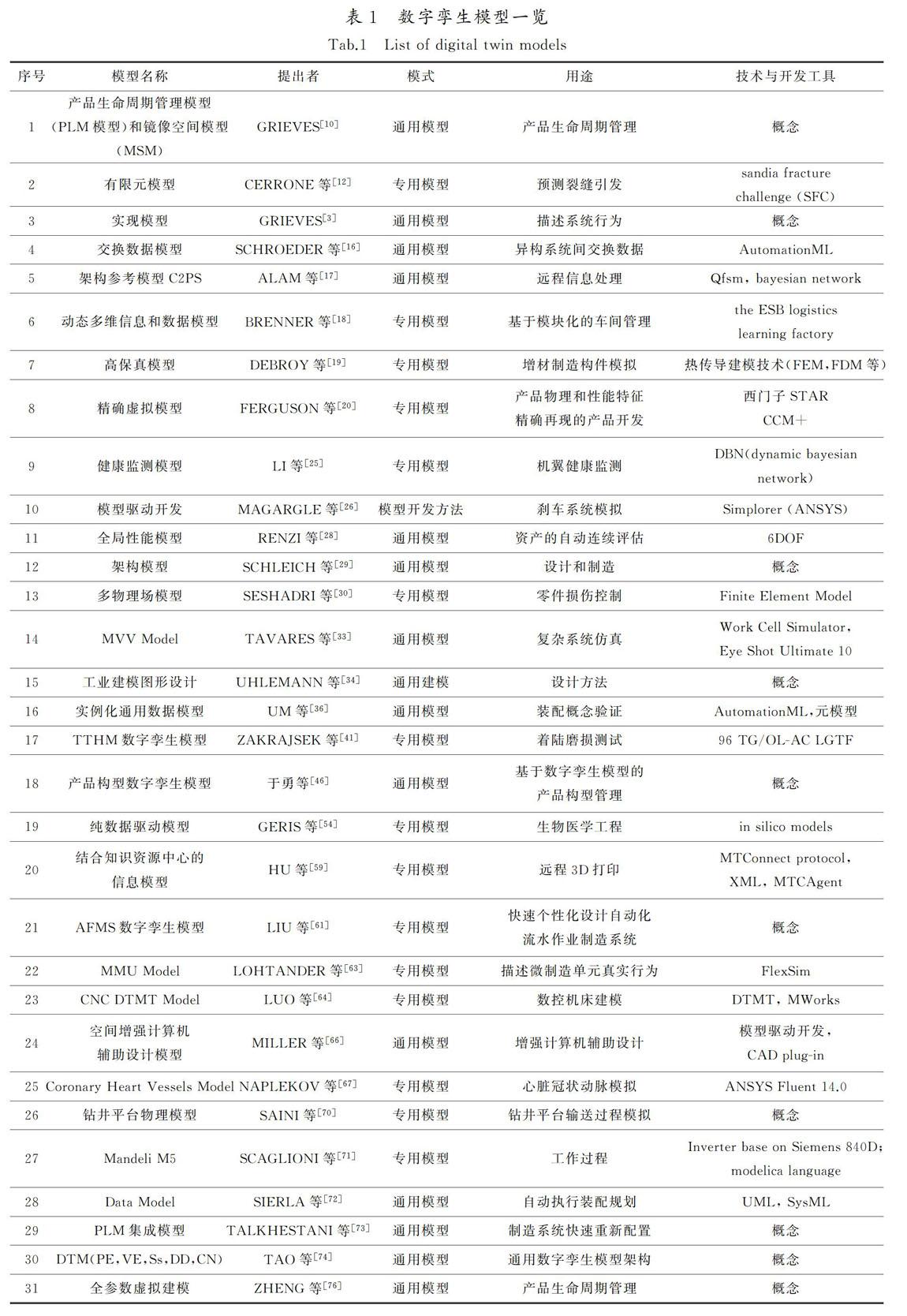
在上述82篇文獻中,有31篇涉及到了模型或模型開發,占總數的37.8%,說明模型的研究在數字孿生研究中比較受關注。表1中列出了對數字孿生模型相關文獻如模型名稱、提出者及模式等相關信息的比較。
2.2數字孿生模型研究的現狀分析
根據表1中論及的研究現狀,其中通用模型的概念研究有8篇,占全部模型研究的25.8%,這些研究各有側重點,從宏觀的產品生命周期管理到描述系統行為,如一般系統行為和系統重新配置,再到產品構型管理和具體工作流,如設計方法、制造系統、制造過程等。這些研究已取得一定進展,但在描述方法上還遠沒有達到統一,也不涉及真正的實現方法。
有7篇研究涉及了通用模型的實現方法,占全部研究的22.6%,是對未來模型在數字孿生領域如何進一步應用的有益探索,其中應用最多的建模語言是AutomationML,此外還有UML,SysML和XML,也進行了MBD(基于模型的開發方法)的應用探索,在具體工具的選擇上有直接基于CAD制作插件plug-in的研究,也有利用專用工具如Qfsm,6DOF,Work Cell Simulator和Eye Shot Ultimate 10等進行開發的研究。還有個別研究嘗試了使用元模型的理念。模型算法呈現多元化,涉及到的主要有貝葉斯網絡、模糊邏輯等。
剩余的16篇文獻都是以專用模型為研究重點,其中15篇文獻聚焦于對某個具體系統或工程項目實現數字孿生方法上,占專用模型研究的93.75%,在全部模型研究中占有一半數量,這說明當前模型實現的研究熱點在于具體項目使用數字孿生方法的建模上。這些專用模型的用途除了傳統的關于制造業的涉及零件測量和質量控制(3篇)、增材制造(2篇)、設計和工作過程(3篇)以及系統管理(3篇)外,已不僅僅限于制造業,如有2篇文獻探討在生物醫藥領域的應用,1篇文獻探討鉆井平臺上輸送過程的數字孿生,此外還有1篇文獻探討使用Simplorer (ANSYS, 2016)進行專用模型開發的方法。
專業模型研究使用的工具更加多元化,有西門子的STAR CCM +,Inverter base on Siemens 840D axis control scheme,ANSYS Fluent 14.0,MWorks, MTConnect protocol,MTCAgent,Flexsim等。使用到的模型和建模語言有Finite Element Model, Modelica Language,XML等。
綜上所述,關于數字孿生模型已經開展了一定的研究,取得較大進展的主要是各個方向的輔助技術,如物理行為研究、無損材料測定技術、量化誤差與置信評估研究以及參數的確定、行為約束的構建以及模型精度的驗證,但整體上還沒有形成一致的結論[6],對于作為數字孿生核心要素之一的模型目前也沒有統一的描述方法。
3數字孿生模型研究存在的問題
首先,數字孿生從它誕生以來就不是孤立存在的,而是建設CPS(網絡物理空間)和CPPS(網絡物理生產系統)的一部分[8],數字孿生模型也同樣如此。德國提出了工業4.0的參考架構模型RAMI4.0[85],如圖3所示。2018年中國出臺的國家智能制造體系建設標準指南中也提出了一種智能制造系統架構IMSA[86],如圖4所示。數字孿生模型需要符合上述架構模型的要求,這方面的研究目前還不多見。
其次,因為沒有統一的描述方法和一致的結論,在此背景下各自獨立發展建立起來的數字孿生模型不論是通用模型還是專用模型,在數字孿生的4大特征之中(可伸縮性、互操作性、可擴展性、保真度)[29],互操作性和可擴展性的實現是有難度的,這一問題將隨著系統規模的擴大而更加顯著。
再次,綜合研究現狀可以發現,中國數字孿生模型的研究嚴重缺乏國產專業工業軟件和建模軟件的支持,相關軟件是中國學者深入開展符合國情研究的一塊短板。
4未來研究展望
為了在理論和實踐中解決數字孿生模型研究存在的問題,需要繼續深入開展以下相關研究。
1)數字孿生模型與參考架構模型的融合
目前出現的各種參考架構模型普遍是宏觀結構和建設愿景,為了使數字孿生模型與其匹配,還需要從2個方向進行研究,即參考架構模型可操作性詳細模型的設計以及數字孿生模型的重構。
2)數字孿生模型的統一描述方法的構建
模型統一描述方法在一些領域,如計算機軟件開發等已經基本實現,通過使用UML,SYSML等統一建模語言以及從實踐中總結而來的面向對象開發、模型驅動開發等方法體系,可以高效地將反映現實世界具體需求的系統轉化為可集成、可交互、可擴展的抽象模型系統,其效率大大超過通過簡單代碼的堆疊而進行的具體系統的構建。數字孿生模型的進一步發展同樣需要對統一建模語言、統一建模方法進行探索。
3)建模工具軟件和工業軟件的開發
中國工業應用軟件的整體水平相對落后,尤其體現在涉及工業設計、生產制造系統、關鍵控制系統等的軟件方面。為數字孿生提供支持離不開建模工具軟件的進步,因此對相關軟件的研究不僅有著理論意義也有著重大現實意義。
5結語
應用數字孿生技術不但可以利用人類已有理論和知識建立虛擬模型,而且可以利用虛擬模型的仿真技術探討和預測未知世界,發現和尋找更好的方法與途徑[6]。作為一種新興的工具,數字孿生的進步依賴學術界和工業界對數字孿生模型的進一步探索。這種探索不僅對數字孿生的發展有著直接意義,還將有力地促進CPS和CPPS的形成,最終大大提升整個人類認識和改造物理世界的能力。
筆者總結了數字孿生理論研究的進展,也分析了其模型研究的現狀、問題和不足,同時從智能制造全局的角度出發,提出數字孿生模型下一步發展的重點,期望能為相關學者進一步開展數字孿生理論、模型開發和應用研究提供啟發及參考。
參考文獻/References:
[1]德勤. 制造業如虎添翼:工業4.0與數字孿生[R]. Deloitt:德勤大學出版社, 2018.
[2]王飛躍, 張軍, 張俊, 等. 工業智聯網:基本概念、關鍵技術與核心應用[J]. 自動化學報, 2018, 44(9): 1606-1617.
WANG Feiyue, ZHANG Jun, ZHANG Jun, et al. Industrial internet of minds: Concept, technology and application[J]. Acta Automa-tica Sinica, 2018, 44(9): 1606-1617.
[3]GRIEVES M. Mitigating systems complexity unintended systems emergent behaviors through NASA''s digital twin strategy[C]// PI Congress Dusseldorf.[S.l.]:[s.n.], 2015.
[4] NEGRI E, FUMAGALLI L, MACCHI M. A review of the roles of digital twin in CPS-based production systems[J]. Procedia Manufacturing, 2017, 11: 939-948.
[5]KRITZINGER W, KARNER M, TRAAR G, et al. Digital twin in manufacturing: A categorical literature review and classification[J]. IFAC-PapersOnLine, 2018, 51(11): 1016-1022.
[6] 陶飛, 劉蔚然, 劉檢華, 等. 數字孿生及其應用探索[J]. 計算機集成制造系統, 2018, 24(1): 1-18.
TAO Fei, LIU Weiran, LIU Jianhua, et al. Digital twin and its potential application exploration[J]. Computer Integrate Manufacturing Systems, 2018, 24(1): 1-18.
[7]張龍. 從智能制造發展看數字孿生[J]. 軟件和集成電路, 2018(9): 59-62.
[8]趙敏. 探求數字孿生的根源與深入應用[J]. 軟件和集成電路, 2018(9): 50-58.
[9] GRIEVES M. PLM-beyond lean manufacturing[J]. Manufacturing Engineering, 2003, 130(3): 23-25.
[10]GRIEVES M W. Product lifecycle management: The new paradigm for enterprises[J]. International Journal of Product Development, 2005, 2(1/2): 71-84.
[11]GLAESSGEN E, STARGEL D. The digital twin paradigm for future NASA and U.S. air force vehicles[C]// 53rd AIAA/ASME/ASCE/AHS/ASC Structures, Structural Dynamics and Materials Conference 20th AIAA/ASME/AHS Adaptive Structures Conference 14th AIAA.[S.l.]:[s.n.], 2012: 1818.
[12]CERRONE A, HOCHHALTER J, HEBER G, et al. On the effects of modeling as-manufactured geometry: Toward digital twin[J]. International Journal of Aerospace Engineering, 2014,2014:1-10.
[13]ROSEN R, von WICHERT G, LO G, et al. About the importance of autonomy and digital twins for the future of manufacturing[J]. IFAC-PapersOnLine, 2015, 48(3): 567-572.
[14]KRAFT E M. The air force digital thread/digital twin-life cycle integration and use of computational and experimental knowledge[C]// 54th AIAA Aerospace Sciences Meeting.[S.l.]:[s.n.], 2016: 0897.
[15]SCHROEDER G, STEINMETZ C, PEREIRA C E, et al. Visualising the digital twin using web services and augmented reality[C]// 2016 IEEE 14th International Conference on Industrial Informatics (INDIN). [S.l.]:[s.n.],2016: 522-527.
[16]SCHROEDER G N, STEINMETZ C, PEREIRA C E, et al. Digital twin data modeling with automationml and a communication methodology for data exchange[J]. IFAC-PapersOnLine, 2016, 49(30): 12-17.
[17]ALAM K M, SADDIK A E. C2ps: A digital twin architecture reference model for the cloud-based cyber-physical systems[J]. IEEE Access, 2017, 5: 2050-2062.
[18]BRENNER B, HUMMEL V. Digital twin as enabler for an innovative digital shopfloor management system in the ESB logistics learning factory at reutlingen-university[J]. Procedia Manufacturing, 2017, 9: 198-205.
[19]DEBROY T, ZHANG W, TURNER J, et al. Building digital twins of 3D printing machines[J]. Scripta Materialia, 2017, 135: 119-124.
[20]FERGUSON S, BENNETT E, IVASHCHENKO A. Digital twin tackles design challenges[J]. World Pumps, 2017(4): 26-28.
[21]GRAESSLER I, POEHLER A. Integration of a digital twin as human representation in a scheduling procedure of a cyber-physical production system[C]// 2017 IEEE International Conference on Industrial Engineering and Engineering Management (IEEM).[S.l.]:[s.n.], 2017: 289-293.
[22]GRIEVES M, VICKERS J.Digital twin: Mitigating unpredictable, undesirable emergent behavior in complex systems[J]. Transdisciplinary Perspectives on Complex Systems, 2017: 85-113.
[23]HEBER D, GROLL M. Towards a digital twin: How the blockchain can foster E/E-traceability in consideration of model-based systems engineering[C]// Proceedings of the 21st International Conference on Engineering Design (ICED 17). Vancouver:[s.n.], 2017: 321-330.
[24]IGLESIAS D, BUNTING P, ESQUEMBRI S, et al. Digital twin applications for the JET divertor[J]. Fusion Engineering Design, 2017, 125: 71-76.
[25]LI C, MAHADEVAN S, LING Y, et al. A dynamic bayesian network approach for digital twin[C]// 19th AIAA Non-Deterministic Approaches Conference.[S.l.]:[s.n.], 2017: 1566.
[26]MAGARGLE R, JOHNSON L, MANDLOI P, et al. A simulation-based digital twin for model-driven health monitoring and predictive maintenance of an automotive braking system[C]//The 12th International Modelica Conference. Prague:[s.n.], 2017: 35-46.
[27]PLANA R. 工業新宣言:數字孿生與生態系統[J]. 軟件和集成電路, 2017(8): 92-93.
[28]RENZI D, MANIAR D, MCNEILL S, et al. Developing a digital twin for floating production systems integrity management[C]// OTC Brasil.[S.l.]:[s.n.], 2017:10.4043/28012-MS.
[29]SCHLEICH B, ANWER N, MATHIEU L, et al. Shaping the digital twin for design and production engineering[J]. CIRP Annals, 2017, 66(1): 141-144.
[30]SESHADRI B R, KRISHNAMURTHY T. Structural health management of damaged aircraft structures using digital twin concept[C]// 25th AIAA/AHS Adaptive Structures Conference. [S.l.]:[s.n.], 2017: 1675.
[31]SOEDERBERG R, WAERMEFJORD K, CARLSON J S, et al. Toward a digital twin for real-time geometry assurance in individualized production[J]. CIRP Annals, 2017, 66(1): 137-140.
[32]SUN Heqing, LI Cheng, FANG Xinyu, et al. Optimized throughput improvement of assembly flow line with digital twin online analytics[C]// 2017 IEEE International Conference on Robotics and Biomimetics (ROBIO). [S.l.]:[s.n.], 2017: 1833-1837.
[33]TAVARES P, SILVA J A, COSTA P, et al. Flexible work cell simulator using digital twin methodology for highly complex systems in industry 4.0[C]// Iberian Robotics conference. [S.l.]:[s.n.], 2017: 541-552.
[34]UHLEMANN T H-J, LEHMANN C, STEINHILPER R. The digital twin: Realizing the cyber-physical production system for industry 4.0[J]. Procedia CIRP, 2017, 61: 335-340.
[35]UHLEMANN T H-J, SCHOCK C, LEHMANN C, et al. The digital twin: Demonstrating the potential of real time data acquisition in production systems[J]. Procedia Manufacturing, 2017, 9: 113-120.
[36]UM J, WEYER S, QUINT F. Plug-and-simulate within modular assembly line enabled by digital twins and the use of automationML[J]. IFAC-PapersOnLine, 2017, 50(1): 15904-15909.
[37]VACHLEK J, BARTALSKY L, ROVNY O, et al. The digital twin of an industrial production line within the industry 4.0 concept[C]// 2017 21st International Conference on Process Control (PC). [S.l.]:[s.n.] ,2017: 258-262.
[38]WAGNER C, GROTHOFF J, EPPLE U, et al. The role of the industry 4.0 asset administration shell and the digital twin during the life cycle of a plant[C]// 2017 22nd IEEE International Conference on Emerging Technologies and Factory Automation (ETFA). [S.l.]:[s.n.], 2017: 1-8.
[39]WERMEFJORD K, SODERBERG R, LINDKVIST L, et al. Inspection data to support a digital twin for geometry assurance[C]// ASME 2017 International Mechanical Engineering Congress and Exposition. [S.l.]:[s.n.],2017: 70398.
[40]YUN S, PARK J H, KIM W T. Data-centric middleware based digital twin platform for dependable cyber-physical systems[C]// 2017 Ninth International Conference on Ubiquitous and Future Networks (ICUFN). [S.l.]:[s.n.] ,2017: 922-926.
[41]ZAKRAJSEK A J, MALL S. The development and use of a digital twin model for tire touchdown health monitoring[C]// 58th AIAA/ASCE/AHS/ASC Structures, Structural Dynamics, and Materials Conference. [S.l.]:[s.n.], 2017: 0863.
[42]ZHANG Hao, LIU Qiang, CHEN Xin, et al. A digital twin-based approach for designing and multi-objective optimization of hollow glass production line[J]. IEEE Access, 2017, 5: 26901-26911.
[43]陶飛, 程穎, 程江峰, 等. 數字孿生車間信息物理融合理論與技術[J]. 計算機集成制造系統, 2017, 23(8): 1603-1611.
TAO Fei, CHENG Ying, CHENG Jiangfeng, et al.Theories and technologies for cyber-physical fusion in digital twin shop-floor[J].Computer Integrated Manufacturing Systems, 2017, 23(8): 1603-1611.
[44]陶飛, 張萌, 程江峰, 等. 數字孿生車間——一種未來車間運行新模式[J].計算機集成制造系統, 2017, 23(1): 1-9.
TAO Fej, ZHANG Meng, CHENG Jiangfeng, et al.Digital twin workshop: A new paradigm for future workshop[J]. Computer Integrated Manufacturing Systems, 2017, 23(1): 1-9.
[45]陶劍, 戴永長, 魏冉. 基于數字線索和數字孿生的生產生命周期研究[J].航空制造技術, 2017 (21): 26-31.
TAO Jian, DAI Yongchang, WEI Ran. Study on production lifecycle based on digital thread and digital twin[J]. Aeronautical Manufacturing Technology, 2017(21): 26-31.
[46]于勇, 范勝廷, 彭關偉,等. 數字孿生模型在產品構型管理中應用探討[J]. 航空制造技術, 2017(7): 41-45.
YU Yong, FAN Shengting, PENG Guanwei, et al. Study on application of ?digital twin model in product configuration management[J]. Aeronautical Manufacturing Technology, 2017(7): 41-45.
[47]WEST T D, BLACKBURN M. Is digital thread/digital twin affordable? A systemic assessment of the cost of DoDs latest manhattan project[J]. Procedia Computer Science, 2017,114:47-56.
[48]ANDERL R, HAAG S, SCHUETZER K, et al. Digital twin technology:An approach for industrie 4.0 vertical and horizontal lifecycle integration[J]. Information Technology, 2018, 60(3): 125-132.
[49]AYANI M, GANEBACK M, NG A H C. Digital twin: Applying emulation for machine reconditioning[J].Procedia CIRP,2018,72: 243-248.
[50]BOTKINA D, HEDLIND M, OLSSON B, et al. Digital twin of a cutting tool[J]. Procedia CIRP, 2018, 72: 215-218.
[51]BROSINSKY C, WESTERMANN D, KREBS R. Recent and prospective developments in power system control centers: Adapting the digital twin technology for application in power system control centers[C]// 2018 IEEE International Energy Conference (ENERGYCON). [S.l.]:[s.n.],2018: 1-6.
[52]CORONADO P D U, LYNN R, LOUHICHI W, et al. Part data integration in the shop floor digital twin: Mobile and cloud technologies to enable a manufacturing execution system[J]. Journal of Manufacturing Systems, 2018, 48:25-33.
[53]DAWKINS O, DENNETT A, HUDSON-SMITH A. Living with a Digital Twin: Operational Management and Engagement Using IoT and mixed realities at UCLs Here East Campus on the Queen Elizabeth Olympic Park[R]. [S.l.]:[s.n.], 2018.
[54]GERIS L, LAMBRECHTS T, CARLIER A, et al. The future is digital: In silico tissue engineering[J]. Current Opinion in Biomedical Engineering, 2018, 6:92-98.
[55]GRAESSLER I, POEHLER A. Intelligent control of an assembly station by integration of a digital twin for employees into the decentralized control system[J]. Procedia Manufacturing, 2018, 24: 185-189.
[56]GUO Jiapeng, ZHAO Ning, SUN Lin, et al. Modular based flexible digital twin for factory design[J]. Journal of Ambient Intelligence Humanized Computing, 2018: 1-12.
[57]HAAG S, ANDERL R. Digital twin:Proof of concept[J]. Manufacturing Letters, ?2018, 15: 64-66.
[58]HE Yuan, GUO Junchen, ZHENG Xiaolong. From surveillance to digital twin: Challenges and recent advances of signal processing for industrial internet of things[J]. IEEE Signal Processing Magazine, 2018, 35(5): 120-129.
[59]HU L, NGUYEN N T, TAO W, et al. Modeling of cloud-based digital twins for smart manufacturing with mt connect[J]. Procedia Manufacturing, 2018, 26: 1193-1203.
[60]KUNATH M, WINKLER H. Integrating the digital twin of the manufacturing system into a decision support system for improving the order management process[J]. Procedia CIRP, 2018, 72(1): 225-231.
[61]LIU Qiang, ZHANG Hao, LENG Jiewu, et al. Digital twin-driven rapid individualised designing of automated flow-shop manufacturing system[J]. International Journal of Production Research, 2018: 1471243.
[62]LIU Z, MEYENDORF N, MRAD N. The role of data fusion in predictive maintenance using digital twin[C]// AIP Conference Proceedings.[S.l.]:[s.n.], 2018: 020023.
[63]LOHTANDER M, AHONEN N, LANZ M, et al. Micro manufacturing unit and the corresponding 3D-model for the digital twin[J]. Procedia Manufacturing, 2018, 25: 55-61.
[64]LUO Weichao, HU Tianliang, ZHANG Chengrui, et al. Digital twin for CNC machine tool: Modeling and using strategy[J]. Journal of Ambient Intelligence Humanized Computing, 2018: 1-12.
[65]MACCHI M, RODA I, NEGRI E, et al. Exploring the role of digital twin for asset lifecycle management[J]. IFAC-PapersOnLine, 2018, 51(11): 790-795.
[66]MILLER A M, ALVAREZ R, HARTMAN N. Towards an extended model-based definition for the digital twin[J]. Computer-Aided DesignApplications, 2018: 1-12.
[67]NAPLEKOV I, ZHELEZNIKOV I, PASHCHENKO D, et al. Methods of computational modeling of coronary heart vessels for its digital twin[C]// MATEC Web of Conferences.[S.l.]:[s.n.], 2018: 01009.
[68]PADOVANO A, LONGO F, NICOLETTI L, et al. A digital twin based service oriented application for a 4.0 knowledge navigation in the smart factory[J]. IFAC-PapersOnLine, 2018, 51(11): 631-636.
[69]QI Qinglin, TAO Fei. Digital twin and big data towards smart manufacturing and industry 4.0: 360 degree comparison[J]. IEEE Access, 2018, 6: 3585-3593.
[70]SAINI G, ASHOK P, VAN OORT E, et al. Accelerating well construction using a digital twin demonstrated on unconventional well data in north america[C]// Unconventional Resources Technology Conference. Houston:[s.n.],2018: 3264-3276.
[71]SCAGLIONI B, FERRETTI G. Towards digital twins through object-oriented modelling: A machine tool case study[J]. IFAC-PapersOnLine, 2018,51(2): 613-618.
[72]SIERLA S, KYRKI V, AARNIO P, et al. Automatic assembly planning based on digital product descriptions[J]. Computers in Industry, 2018, 97: 34-46.
[73]TALKHESTANI B A, JAZDI N, SCHLOEGL W, et al. Consistency check to synchronize the digital twin of manufacturing automation based on anchor points[J]. Procedia CIRP, 2018, 72: 159-164.
[74]TAO Fei, ZHANG Meng, LIU Yushan, et al. Digital twin driven prognostics and health management for complex equipment[J]. CIRP Annals, 2018,67(1): 169-172.
[75]VATHOOPAN M, JOHNY M, ZOITL A, et al. Modular fault ascription and corrective maintenance using a digital twin[J]. IFAC-PapersOnLine, 2018, 51(11): 1041-1046.
[76]ZHENG Yu, YANG Sen, CHENG Huanchong. An application framework of digital twin and its case study[J]. Journal of Ambient Intelligence Humanized Computing, 2018: 1-13.
[77]ZHUANG Cunbo, LIU Jianhua, XIONG Hui. Digital twin-?based smart production management and control framework for the complex product assembly shop-floor[J]. International Journal of Advanced Manufacturing Technology, 2018, 96(1/2/3/4): 1149-1163.
[78]戴晟, 趙罡, 于勇, 等. 數字化產品定義發展趨勢:從樣機到孿生[J]. 計算機輔助設計與圖形學學報, 2018, 30(8): 1554-1562.
DAI Sheng, ZHAO Gang, YU Yong, et al. Trend of digital product definition: From mock-up to twin[J]. Journal of Computer-Aided Design & Computer Graphics, 2018, 30(8): 1554-1562.
[79]郭東升, 鮑勁松, 史恭威, 等. 基于數字孿生的航天結構件制造車間建模研究[J]. 東華大學學報(自然科學版), 2018, 44(4): 578-585.
GUO Dongsheng, BAO Jinsong, SHI Gongwei, et al. Research on modeling of aerospace structural parts manufacturing workshop based on digital twin[J]. Journal of Donghua University(Natural Science), 2018, 44(4): 578-585.
[80]林雪萍. 數字孿生,神助制造業[J]. 企業研究, 2018 (10): 12-15.
[81]林雪萍, 趙光. CIO必讀:論數字孿生的十大關系[J].軟件和集成電路, 2018 (9): 34-41.
[82]秦曉珠, 張興旺. 數字孿生技術在物質文化遺產數字化建設中的應用[J]. 情報資料工作, 2018(2): 103-111.
QIN Xiaozhu, ZHANG Xingwang. Application of digital twin technology in the digital construction of material cultural heritage[J]. Information and Documentation Services, 2018(2): 103-111.
[83]于勇, 胡德雨, 戴晟, 等. 數字孿生在工藝設計中的應用探討[J]. 航空制造技術, 2018, 61(18): 26-33.
YU Yong, HU Deyu, DAI Sheng, et al. Study on application of digital twin in process planning[J]. Aeronautical Manufacturing Technology, 2018, 61(18): 26-33.
[84]張玉良, 張佳朋, 王小丹, 等. 面向航天器在軌裝配的數字孿生技術[J]. 導航與控制, 2018, 17(3): 75-82.
ZHANG Yuliang, ZHANG Jiapeng, WANG Xiaodan, et al. Digital twin technology for spacecraft on-orbit assembly[J]. Navigation and Control, 2018,17(3): 75-82.
[85]ZVEI. The Reference Architectural Model Industrie 4.0 (RAMI 4.0)[EB/OL]. https://www.zvei.org/en/press-media/publications/the-reference-architectural-model-industrie-40-rami-40/, 2015-04.
[86]工業和信息化部、國家標準化管理委員會.國家智能制造標準體系建設指南[EB/OL]. http://www.miit.gov.cn/n1146285/n1146352/n3054355/n3057585/n3057589/c6013753/part/6013772.pdf,2018-10-12.
猜你喜歡
童話王國·奇妙邏輯推理(2024年5期)2024-06-19 16:03:38
工業設計(2022年8期)2022-09-09 07:43:20
軍民兩用技術與產品(2021年10期)2021-03-16 06:05:30
北京測繪(2020年12期)2020-12-29 01:33:58
中學生數理化·七年級數學人教版(2020年10期)2020-11-26 08:24:50
數學物理學報(2020年2期)2020-06-02 11:29:24
家庭影院技術(2017年9期)2017-09-26 03:41:45
光學精密工程(2016年6期)2016-11-07 09:07:19
Coco薇(2016年2期)2016-03-22 02:42:52
Coco薇(2015年1期)2015-08-13 02:47:34
