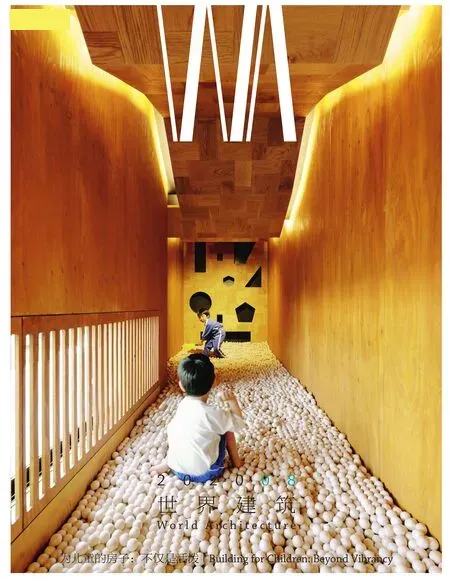
以兒童的名義
2020-01-01 23:27:28張利ZHANGLi
世界建筑 2020年8期
張利/ZHANG Li
在當今價值沖突紛呈的世界中,也許至少有一件事是為所有人所認同的:我們透過兒童的無邪洞見未來,我們憑借兒童的率真寄托希望。
這也是為什么沒有哪個建筑師會拒絕給兒童做房子,也沒有哪個為兒童做房子的建筑師不試圖在其中承載自己對真與善的最完整想象。我們甚至可以說,為兒童做的房子是建筑師作品中最用心、最真誠的一部分。也正緣于這種用心與真誠,這些作品以一種美好的方式清晰呈現(xiàn)了建筑學自身的矛盾與復雜——在實證與詮釋、倫理與美學、利他與個性之間的選擇與躊躇。
曾幾何時僅靠眩目色彩和卡通人物來營造廉價的兒童場所感的時代,已經(jīng)一去不返了。時代要求更高質(zhì)量的兒童空間,從而也要求建筑師更多地理解兒童的需求。但建筑師無法回到自己的兒童時代,也不具備深入了解兒童的職業(yè)訓練。他/她只能通過設身處地的想象和角色轉(zhuǎn)換來以某種方式揣測、趨近兒童的真正需求,從而為自己的作品提供一種可被理解(或可被證明)的“建筑幫助兒童成長”的邏輯。這個角色轉(zhuǎn)換過程通常是建筑師把自己暫時轉(zhuǎn)換成其他與兒童更接近的成年人:教師、家長,或者大玩伴。
當建筑師以教師的角色來為兒童做設計時,其核心訴求是知識或價值觀,其空間的邏輯來源于兒童心理學或幼教理論,其說服力也自然受到理論本身說服力的制約。兒童建筑在此既是課堂, 又是教具。Crossboundaries建筑事務所設計的江蘇北沙幼兒園,以“迷你村莊”的方式來對中國幼教大師陳鶴琴的“自然教育”理論給出自己的詮釋:通過打散的體量與切削的屋頂減小空間尺度,通過形體組合的扭轉(zhuǎn)消解正交透視的可預測性,通過類自發(fā)性空間系統(tǒng)組織來創(chuàng)造孩子對空間認知的探索。雖然我們無從判斷這種空間系統(tǒng)與陳鶴琴理論的契合程度,但至少可以從平剖面圖上以及實際照片上閱讀出它與孩子生活方式的契合程度。與之形成的對比的是武重義建筑事務所的同奈農(nóng)業(yè)幼兒園,它集多種我們時代西方語境的“正確”于一身: 為低收入藍領工人的子女而建、以極低的造價與本地材料技術(shù)實現(xiàn)被動式的綠色建筑、在屋頂加載生產(chǎn)性的農(nóng)業(yè)種植。這一切被建筑師通過嫻熟的形式技巧融合到一個標志性三叉閉環(huán)之中,有如一段流暢的宣言。建筑價值觀立場的重要性已經(jīng)超過了對兒童日常生活參與的重要性。
當建筑師以家長的角色來為兒童做設計時,其核心訴求是親子的體貼或家庭式的關愛,其空間架構(gòu)來自于對家庭或家園的模仿。安全、溫暖與歸屬感是最重要的目標,因而從內(nèi)至外的生活體驗遠比從外至內(nèi)的造型更受重視。綜合工坊建筑事務所在安蒂奧基亞的未來兒童中心的說服力來自于建筑師的冷靜與理性,我們看到20世紀中期的“問題導向”式的設計方法在今天仍然有著重要的意義。得之有據(jù)、行之有效的指形平面將基本單元平行布局,在有限的場地內(nèi)實現(xiàn)了良好的自然采光、通風與交通聯(lián)絡。每個基本單元包含了若干具備雙重職能的構(gòu)件:拱頂形成合理的跨度并創(chuàng)造空間的溫和感;磚墻用于承重并分割班級;盡端的組合窗則是上半部用于采光與景觀,下半部用于照顧兒童的身體尺度,提供更多活動的可能性。烏爾科·桑切斯建筑師事務所設計位于塔朱拉的SOS兒童村可以說是喬吉斯·岡迪利斯膾炙人口的卡薩布蘭卡住宅的服務于未成年人的版本。建筑對炎熱氣候的適應性與共享邊界的安全家園的創(chuàng)造得益于對吉布提海岸傳統(tǒng)民居聚落的解讀。捕風塔、方院和內(nèi)巷標識出這個“大院”社區(qū)的內(nèi)部節(jié)奏,定義出多個類似“戶”的子群組,不僅方便“母親”們的管理,更給其收容的孤弱兒童以家庭化的歸屬感。feld72建筑事務所在瓦爾道拉的低地幼兒園雖然沒有發(fā)展中國家項目面對的那些明顯的社會挑戰(zhàn),但其在山地城鎮(zhèn)中創(chuàng)立出一個安適的兒童家園的想法仍然清晰可辨。墻與坡地的對話是這一傳統(tǒng)小鎮(zhèn)空間肌理的基本詞匯,建筑師在此用兩種材料進一步把它發(fā)展為兒童家園邊界的雙向定義:用木柵圍合多邊形兒童游戲場而成內(nèi)界,用白色涂料圍繞連續(xù)折轉(zhuǎn)的建筑體和墻體而成外邊界。
當建筑師以大玩伴的角色來為兒童做設計時,其核心訴求是專屬兒童的身體空間,以及此類空間在全部建筑功能空間當中的滲透。兒童的人體工學在此成為建筑師的主要空間邏輯。愛媛的KO幼兒園是日比野設計、幼兒之城與兒童設計實驗室共同的成果,這一翻建項目是兒童空間人因工程學的教科書式的案例。在設計之初,其核心問題就被定義成在互聯(lián)網(wǎng)與電子游戲的時代讓孩子通過身體參與的游戲而健康成長。山梨大學中村和彥教授的研究成果與數(shù)據(jù)被以工程學的精確方式轉(zhuǎn)譯到建成環(huán)境之中,并得到令人愉悅的空間表達。在所有的室內(nèi)空間中,遍布著對兒童的36個基本動作、特別是“拋”“鉆”“爬”“騎”等一般建筑中難于實現(xiàn)的動作的鼓勵與誘導,它們與孩子日常生活中的必要移動無縫融合,給予了這一貌不驚人的建筑以極其豐富的體驗內(nèi)涵,使其成為了一座名符其實的幼兒主動式身體健康的引領性實驗室。手冢建筑研究所在東京藤幼兒園的“兒童露臺”雖然沒有同樣強大的科學系統(tǒng)性支撐,但建筑師與園長的直覺還是讓他們成功攜手打造了又一座突出兒童身體特點的建筑。在與食物相關的參與性主題的組織下,露臺的水平性空間被家具和裝飾分解降低到兒童的身體尺度,微觀領域內(nèi)近身表面材料的選擇與搭配創(chuàng)造了豐富的觸覺感受。
看到兒童建筑開始擺脫表層的活潑,而轉(zhuǎn)向深層的兒童教育學、兒童心理學和兒童生理學是令人振奮的。這正是本期《世界建筑》想要傳遞的信息。以兒童的名義,我們要感謝建筑師在兒童建筑中所做的努力。以兒童的名義,我們要懇請建筑師更多地理解兒童,更多地與熟悉兒童的專業(yè)群體合作。以兒童的名義,我們還要呼吁所有的建筑師一起努力,暫時忘卻建筑師的自我,更多地讓建筑成為兒童生活記憶的背景,而不是讓兒童成為建筑故事的演員。
In a world of divided and conflicting values,there is at least something that most people would agree on: we see future through the ignorance of children and we see hope through their honesty.
That is why no architect would refuse to do a kindergarten. That is why no architect doing a kindergarten would not try to make it a true incarnation of human kindness. It is fair to say that buildings for children represent some of the most serious, most honest architectural works. It is exactly through this seriousness and honesty that these buildings beautifully demonstrate the complexity and contradictions of architecture: the oscillation and anxiety when it comes to the choice between the positive and the interpretive, between ethics and aesthetics, between altruism and individualism.
The time of making kindergarten with cheap vibrant colours and cartoon figures has gone. There is a growing demand for quality spaces for children,with it a demand of architects' better understanding of children. But architects can no longer be children themselves, nor are they good at knowing children by training. An architect can only speculate, or simply guess the real needs of children through some sort of role playing, temporarily making themselves people of other professions who understands children better: teachers, parents, or older playmates.
When an architect takes the role of an educator,the primary architectural concern is the knowledge or the value being carried through. Spaces become explicit interpretations of the psychological or pedagogical theories. The convincing power of the result is partially a function of the solidness of those theories. Here, buildings are not only classrooms,but teaching tools themselves. Crossboundaries'Beisha Kindergarten uses the micro-village fabric to present the "natural education" theory of CHEN Heqin, a Chinese master in this field. Scattered volumes and trimmed roofs reduce the scale of the complex. Carefully planned rotations and deliberate mis-alignments help to eliminate the predictability of orthographic layouts, forming a reasonably spontaneous spatial system for children to adventure in. We are not in a position to judge the logical link between CHEN's theory and Crossboundaries' building. We can, however,read from the plans and sections how many extra nuances Crossboundaries have created in children's daily lives. VTN Architects' Farming Kindergarten in Dongnai takes a more ideological approach. Its narrative is a potpourri of "correctness": building for working class children, incredibly low cost and passive building with local materials, productive landscape in the roof. Everything is organised effortlessly into a triad loop, delivering impressive looks. The building is more of a catchy manifesto of values than a space for early education. The life of children becomes the means, not the end.
When an architect takes the role of a parent, the biggest architectural concern is the sense of being taken care and belonging. Spaces are made upon the framework of families or neighbourhoods. Safety,warmth and home community are the primary objectives. What matters is how a child feels and perceive inside, not how the building looks from outside. Taller Síntesis' El Porvenir Children Centre in Antioquia is a convincing project done with calm and rationality, which demonstrates that the problemsolving design thinkings of mid-20th century still makes great sense today. Tried and tested fingershaped modular plan ensures good natural lighting and ventilation, as well as circulation. Each module comprises several components, each with a pair of clear purposes, one technical, one architectural: the arched roof for the span and for the sense of warmth;brick wall for load bearing and for unit divisions;glazed end walls for daylighting (upper half) and for body spaces (lower half). Urko Sanchez Architects'SOS Children's village in Tadjourah can be regarded as a built-for-children version of Georges Candilis's famous housing work in Casablanca. A thorough understanding of Djiboutian traditional housing prototypes enables the architect both to speak to the local climate and to define a boundary of shared safety. Cupolas, courtyards, and inner alleys articulate the bigger complex in smaller clusters, giving "moms"working here the convenience of managing daily routines, as well as giving children adopted here, who are usually orphans, the sense of living in a family.feld72's Kindergarten Niederolang in Valdaora may not have all the social challenges of similar projects in the developing countries. But the underlying concept of creating a sunken harbour for children in this mountain village is still obvious. The local architectural vocabulary of walls interacting with slopes is reinterpreted. Two contrasting materials defining two kinds of boundaries on two sides: on the inside, the polygonal boundary of children's activity is circled by wood; on the outside, the perimetre of the entire complex is depicted by white walls.
When an architect takes the role of an older playmate, the primary concern is the body-space for children, and its permeation through every corner of the building. Children's ergonomics drives architectural decision in this approach. The rebuilt KO Kindergarten in Ehime is an exemplary collaborative work by HIBINOSEKKEI, Youji no Shiro, and KIDS DESIGN LABO, a textbook case of human factor engineering for children. In the very early design phase, the core design problem has been fixed at "making health from playing" in the age of smart phones and video games. Science and art are fused in this project. Professor Kazuhiko Nakamura's pioneering research in children's body movement,including data, methodology and solution, were seamlessly integrated into the built environment,and were given delightful implementations. Through every quarter of the building, 36 basic body motions of children, including those that are difficult to accomplish in normal buildings such as throw, go through, creep, ride, are encouraged and facilitated.Kids move around the building on a day-to-day basis incorporating some or all of these motions.The richness of body experiences of the children is an unrivalled feature of this otherwise normal building. Since its inauguration, the building has become a de-facto leading laboratory in children's active health. There is much less science in TEZUKA ARCHITECTS' Fuji Kindergarten, or "Kids Terrace".But the intuition of the architect and the head teacher has ensured another special design for children's body nevertheless. With the involvement in food preparation as the dominant activity theme,the horizontal spaces of terraces are sub-divided by furnitures and fixtures, scaled down for the kids,presented with diverse materials delivering diverse haptic experiences.
It is encouraging to see kindergarten buildings giving up superficial vibrancy, shifting focus to deeper issues such as children's pedagogy, children's psychology, and children's physiology. This is exactly the message this number ofWAtries to get across.In the name of children, we thank all the efforts architects have taken to make kindergartens better.In the name of children, we kindly ask architects to reach out to other professions that bear better understandings of children. In the name of children,we appeal to all architects to make kindergartens better backgrounds of children's memories, not to make children actors of architecture dramas.
猜你喜歡
北方建筑(2021年6期)2021-12-31 03:03:54
文苑(2020年10期)2020-11-07 03:15:36
現(xiàn)代裝飾(2020年6期)2020-06-22 08:43:12
藝術(shù)啟蒙(2018年7期)2018-08-23 09:14:18
海峽姐妹(2017年7期)2017-07-31 19:08:17
Coco薇(2017年5期)2017-06-05 08:53:16
雜文選刊(2016年7期)2016-08-02 08:39:56
小天使·一年級語數(shù)英綜合(2016年6期)2016-05-14 12:21:05
少兒科學周刊·兒童版(2015年6期)2015-11-24 03:49:38
舒適廣告(2008年9期)2008-09-22 10:02:48