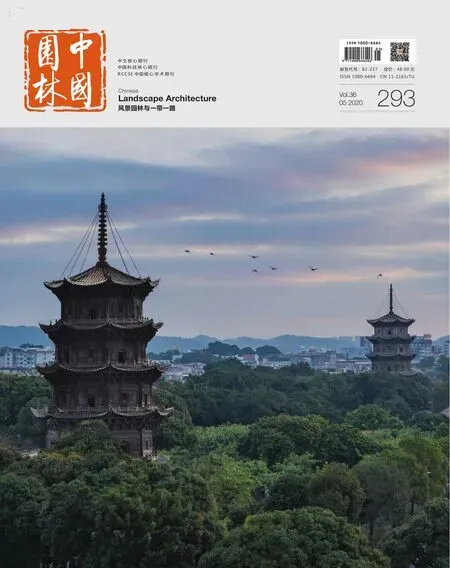
Spanning the Boundless Sand and the Vast Sea-Garden Culture Exchanges along the Silk Road
2020-01-18 07:43:44
中國園林 2020年5期
In 1271, Marco Polo left Venice by boat to reach the east coast of the Mediterranean Sea, then headed east, sometimes riding horses and sometimes on camels, crossing oasis and Gobi, tramping over hill and dale, and entered China. This commercial road that traversed the Asian continent had existed for more than 1,000 years before Marco Polo came to China. It was only because of the war that the commercial road was opened or closed intermittently. In the 13thcentury, the Mongolians galloped across the Asian continent and established a vast Mongolian empire, and the road became unimpeded after a period of interruption, so Marco Polo arrived in China smoothly.
China-Ergebnisse eigener Reisen und darauf gegründeter Studien, published by the German geographer Ferdinand von Richthofen in 1877, first proposed the concept of Silk Road (Seidenstrasse). He named the trade route opened in the Han Dynasty to connect Chang'an with the Central Asia and India as the Silk Road, and this name has been widely used since then.
Before the Han Dynasty, due to economic exchanges and the impact of war, there were considerable water and land routes between the Mediterranean coast and the West Asia. The Phoenician ships had reached every corner of the Mediterranean Sea, the ancient Persian roads had linked the Central Asia, the Tigris and Euphrates, the Minor Asia and the Crescent, and the ancient Roman roads had connected every town of the empire. However, due to the obstruction of high mountains and vast deserts, China, located at the eastern end of the Eurasian continent, did not open the passage from Chang'an to the Central Asia through Zhang Qian's envoy trip to the Western Regions until the middle of the second century BC. In the east of Chang'an at that time, the transportation network composed of royal roads and rural roads, as well as waterways along rivers and canals, already covered the Han Dynasty's territory, so after the opening of the Silk Road, the entire China was connected to the outside world together.
The early people who entered China along the Silk Road were mainly peoples living in the West Asia and India. Marco Polo is the earliest European to travel to China by land, and you can imagine how what he saw in China surprised him. In his oralThe Travels of Marco Polo, he made a comprehensive record of China, including landforms, cities, society and economy. He also described Qionghua Island in the Great Capital of the Yuan Dynasty and the West Lake in Hangzhou, and even talked about the relationship between the West Lake and Hangzhou City, although not accurate. Marco Polo should be the first European to introduce Chinese gardens to the world.
After more than 20 years of traveling to the east, Marco Polo left China. He departed from Quanzhou by ship, took the South China Sea, crossed the Strait of Malacca to the Indian Ocean, then went ashore after the Persian Gulf, and then arrived at the south bank of the Black Sea by land, then boarded the ship across the Bosphorus Strait and returned to Venice. This waterway connecting the coastal cities of China with the Persian Gulf or the Red Sea is the Maritime Silk Road, and Marco Polo has also been the earliest European to take the Maritime Silk Road from China to Europe in records.
This Maritime Silk Road was pioneered by the Arabs during the Tang Dynasty. After the Song Dynasty, with the development of shipbuilding industry and the advancement of nautical technology, coupled with the southward movement of China's economic center, the maritime Silk Road became more prosperous and became the dominant channel for East-West trade links, while the land-based Silk Road gradually declined. Guangzhou, Quanzhou and Mingzhou had world-class commercial ports then.
The Muslim traveler Ibn Battuta came to China in 1345 along the Maritime Silk Road and traveled to Guangzhou, Hangzhou and Quanzhou. Like Marco Polo, he also published an oral travel notes namedIbn Battuta Travels. The book described China's customs, urban life and rural sceneries. The travels of Marco Polo and Battuta both documented the cities along the Silk Road. It can be seen that the Silk Road is a commercial channel, whether it is on land or at sea, but accompanied by the distribution of goods and the exchange of people, the impact far exceeded the economic function. The Silk Road has promoted the urban development of China and the countries along the Silk Road, and has also spread the experience and technology of urban development and building construction of different nationalities.
The Silk Road connects the world's most important birthplaces of civilizations, and the spread of various religions here through the Silk Road has also changed people's ideas and beliefs and spawned new art forms. Among these religions, Buddhism is undoubtedly the one with the biggest influence on China. Since the Han Dynasty, many Indian Buddhist monks followed the land-based Silk Road to China to preach Buddhism, and many Chinese monks also went westwards on the pilgrimage for Buddhist scriptures, and the spread of Buddhism once made the Silk Road full of vitality. "Passersby walked across the turbulent streams, and the grottoes built on the cliffs are very reliable." From the Mogao Grottoes in Dunhuang to the Binglingsi Grottoes to the Maiji Mountain Grottoes, the grotto corridor stretched for thousands of miles in Gansu alone. The statues and murals in these grottoes, as well as the dance, music and architecture expressed in the murals, convey the profound influence of Western culture on Chinese art.
"Among the countless temples in the Southern Dynasties, how many are in the hazy smoke?" The introduction of Buddhism made China's famous mountains and rivers more prominent in spirituality and mystery. "The bamboo path leads to the secluded place, and the Zen house is deep in flowers and trees." The construction of temples bought the new type of garden to China - temple gardens. The Zen Buddhism brought a pure, peaceful and natural environment to Chinese literati gardens, just like "the sunset glow back into the deep forest casting again on the moss" in the Buddhist follower Wang Wei's poem in Wangchuan, or "the moss on the steps are bright and green, the grass color overflows through the curtain" in the Buddhism-studying Liu Yuxi'sMotto on my Humble Room.This kind of Zen concept spread into Japan with the Zen Buddhism and tea ceremony, and profoundly influenced Japanese gardens, giving Japanese gardens an ethereal and deep artistic conception.
In the Tang Dynasty, Islam was introduced to the southeastern coastal area of China by the Maritime Silk Road. The eastward expedition of the Islamic peoples in the Western Regions and the westward expedition of the Mongolian Empire also contributed to the eastward spread of Islam, and many Buddhist-embracing regions of the northwest China gradually became the Islamic world.
There are many exquisite gardens in the Islamic world. However, in China, although there are 10 ethnic groups who believe in Islam, there is no obvious Islamic-style garden in the vast areas where these Muslims live. But Islam has been integrated into the daily life of the Chinese Muslim nation, and there are mosques in the areas where they live. It's just that in the process of the formation and development of Chinese Islamic culture, the inherent culture of various ethnic groups is merged to form an Islamic belief system with various national characteristics and regional characteristics, so the style of the mosque is different.
During the Tang Dynasty, Nestorianism was introduced to China through Persia. This is a Christian sect split from the Orthodox Church, but it soon declined. At different times after this, missionaries sometimes came to China to preach. Since Matteo Ricci came to China in 1582, more and more missionaries came to China. They brought not only the Christian culture, but also the European science and art, and also introduce the Chinese culture, including garden culture, to Europe.
In 1710, the Italian missionary Matteo Ripa arrived in Macau from the Maritime Silk Road, set off for Beijing and became a royal painter. Since Emperor Kangxi discovered that he had the special skills of copperplate etching, he was sent to Rehe to paint the 36 scenes of the summer resort. In 1724, Matteo Ripa returned to Italy with a volume of the 36 scenes paintings via London. Today the British Museum and some important libraries in Europe have these batches of copperplate prints. Through the study of Matteo Ripa's communication circle, later generations generally believed that the British gardener William Kent had seen these batches of copperplate etching, and the garden he designed should be inspired by these paintings. In the 18thcentury, British gardens were transformed from geometric gardens to landscape gardens by designers such as Kent and his successor Lancelot Brown, and Chinese gardens greatly promoted this style change. In 1793, when George Macartney led the British mission to China, he visited the summer resort and saw the sceneries in front of him. He said: "This is a charming garden and will surely give Brown a lot of inspiration."
The missionaries, like messengers at the time, introduced Chinese society, thoughts and art to Europe. A large amount of information about China triggered the 18thcentury Chinese fashion in Europe. European nobles rushed to collect Chinese porcelain, furniture and crafts, and also collected Chinese gardens. At that time, almost all large-scale gardens in Europe were decorated with Chinese garden architecture, including towers, pavilions, bridges and rockeries. These missionaries also introduced European science and technology and art to China, and built churches in China. They also built the European Palaces in the Old Summer Palace. However, compared with the fact that Chinese gardens had a substantial impact on European gardens, the purpose of the Baroque-style European Palaces was more out of curiosity and novelty, and European gardens did not have much impact on Chinese gardens.
Plants of Chinese origin had a more direct impact on European gardens. Polish missionary Michel Boym preached in the middle of the 17thcentury along the Maritime Silk Road to Hainan Island and Macau. Later he wrote a series of books on Chinese studies, includingFlora Sinensis, which aroused strong European attention to Chinese plant resources. Before that, the Portuguese had come to China by sea and brought the citrus back to Portugal, which was the first in Europe to collect and introduce Chinese plants.
Since 1698, the Scottish James Cunningham visited China twice and collected seeds of more than 600 plants in East China. From the 18thcentury to the 19thcentury, some professional plant collectors in Europe came to China continuously to introduce beautiful Chinese plants. There were two gardeners in the British mission of Macartney, who specialized in collecting Chinese plants. Among these plant hunters, the most famous was the English botanist Henry Wilson. Since 1899, he came to China for five times and introduced more than 1,000 plants such as Rhododendron, Davidia involucrata, Eucommia, Lily and Magnolia that originated in China to Europe, while before that the England-origin plants were no more than 2,000 species. Wilson wrote in the preface of the bookChina: Mother of Gardens: "China is the mother of the world's gardens. Among the countries that have greatly benefited our gardens, China tops the list… In the gardens of the United States and European countries, among the most beautiful trees, shrubs, herbs, and vines, there are no representative plants that are not from China." It can be said that if there were no plants introduced from China, there would be no beautiful gardens in Europe, and the plant landscape would not be what it is today.
In sharp contrast to this, there are not many types of exotic ornamental plants introduced in China, and most of the introduced and cultivated are vegetables, spices or fruit trees, such as cucumber, mung bean, carrot, sesame, coriander, pepper, garlic, melon, grape, pomegranate and fig etc. Despite the vast wild plant resources in China, Chinese people are more interested in selecting plants with specific symbolic meanings in their gardens. Therefore, not only do Chinese people only use quite limited types of plants in their gardens, they do not seem to be interested in introducing exotic ornamental plants.
Perhaps it is because our ancestors occupied a vast land on the Asian continent that is very suitable for human survival. As a farming nation deeply influenced by the Confucian culture, the attachment to the homeland has been the constant life standard of the Chinese for thousands of years. From the long history of Silk Road, it can be seen that before the mid-20thcentury, there were far more Persians and Central Asians people walking on the land-based Silk Road than Chinese; Arabic and European people sailing on the sea along the Maritime Silk Road were also far more than Chinese. Most of China's imported things were brought by foreign peoples, and most of China's exported things were also taken away by foreign peoples. In terms of garden culture, just like plants of China, foreign countries knew more about China than China knowing other countries, and China's influence on foreign countries was far greater than that of foreign countries on China.
However, since the 1980s, all of the above have been completely different. China has gradually become the leading country for economic and trade cooperation and cultural exchange along the Silk Road. The development of the ancient Silk Road is the process of advancing the earliest globalization. In this process, the Chinese civilization presents a long-standing and inclusive civilization. While exporting its own civilization achievements, it also absorbs the achievements of foreign civilizations. The Chinese civilization is not exclusive, but it is also not assimilated by the outside world.
The land-based Silk Road has gone through more than 2,000 years, and the maritime Silk Road has gone through more than 1,000 years. Sino-foreign economic contacts and cultural exchanges that have spanned the boundless sand and the vast sea have continued. The world today is facing an unprecedented change. In face of the globalization and de-globalization debates in today's world, how will China develop? What kind of changes will Chinese landscape architecture have? Just let me use a famous quote to arouse everyone's imagination, "the past that cannot be forgotten is the best guide for the future."