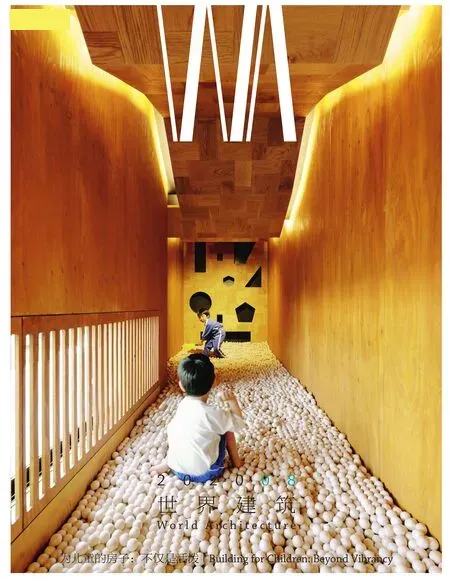
低地瓦爾道拉幼兒園,瓦爾道拉,意大利
2020-08-24 13:33:44建筑設(shè)計(jì)feld72建筑事務(wù)所
世界建筑 2020年8期
建筑設(shè)計(jì):feld72建筑事務(wù)所
Architects: feld72

1 外景/Exterior view
擁抱傳統(tǒng)與現(xiàn)代
這座幼兒園位于南蒂羅爾的瓦爾道拉迪索托,在發(fā)展緩慢的村莊結(jié)構(gòu)里與當(dāng)?shù)貍鹘y(tǒng)文化、現(xiàn)代生活及大自然相互交融。該項(xiàng)目是feld72建筑事務(wù)所設(shè)計(jì)的第三座幼兒園,其雖融入周圍環(huán)境,卻不服從于周遭。建筑巧妙的位置讓其與醒目的教區(qū)教堂及其墓園禮拜堂、村莊中心的小學(xué)相呼應(yīng)。這棟木制建筑由堅(jiān)實(shí)的墻體環(huán)繞,猶如置身于箱內(nèi)——是一處隱蔽之所。
邊界和籬笆決定了村莊的肌理,如同一條明確的邊界將私人空間和公共空間分隔而開(kāi)。幼兒園作為一種建筑介入,通過(guò)將各種不同強(qiáng)度的邊界放置在其封閉的各式墻體內(nèi),與邊界相互作用,以流行元素在建成環(huán)境中激發(fā)出令人興奮的情景交融。四周的圍墻在村莊內(nèi)清楚地劃出獨(dú)特的空間邊界。房子與院子一同嵌入傳統(tǒng)的文脈,賦予了幼兒園安全自由的建筑條件。緊湊的房子坐落在幼兒園的北部邊界,擁有陽(yáng)光明媚的花園。該項(xiàng)目利用周圍的建筑在視覺(jué)與功能上將孩童的自由活動(dòng)空間與馬路隔開(kāi)。
由于墻體的概念從花園圍欄變至邊界墻,因此其材料與體量均有所差異——是對(duì)現(xiàn)有事物的闡釋及詳細(xì)解說(shuō)。在庭院內(nèi)部,它不僅以木材的形式自我呈現(xiàn),還以友好的姿態(tài)擁抱花園。
前往建筑的通道上,帶屋頂?shù)膮^(qū)域可幫助遮擋惡劣天氣。墻體作為建筑元素以有趣的方式呈現(xiàn)出來(lái),讓建筑和游戲場(chǎng)相互融合。“將幼兒園用柵欄圍起來(lái)”這一傳統(tǒng)元素在復(fù)雜性和質(zhì)量上均已翻然改進(jìn)——它保護(hù)、圍繞、邀請(qǐng)孩子在此嬉戲,既呈現(xiàn)了內(nèi)部景致又展現(xiàn)了外部景觀。同時(shí),建筑本身也較為清晰且多樣化。
統(tǒng)一的材料體現(xiàn)出簡(jiǎn)約性。幼兒園內(nèi)隨處可見(jiàn)的灰泥磚和木材營(yíng)造出認(rèn)同感和歸屬感。在巧妙且復(fù)雜地處理過(guò)當(dāng)?shù)啬静暮螅覂?nèi)溫暖輕松的氛圍油然而生。對(duì)于孩子們來(lái)說(shuō),團(tuán)體活動(dòng)室便是他們?nèi)粘L剿鞯钠瘘c(diǎn)。房間的設(shè)計(jì)樸實(shí)而溫和,為個(gè)體變化提供空間。小型休閑區(qū)位于大型窗壁凹處或便于出入的隔斷家具(可通往衣帽間)。禮堂與多功能室可連通后使用或單獨(dú)使用。在這兩個(gè)層面上,推薦的空間概念使得教育方法富有不同的吸引力。這座為兒童和鄉(xiāng)村社區(qū)服務(wù)的幼兒園已然成為現(xiàn)代與傳統(tǒng)之間的媒介,在瓦爾道拉迪索托打造了一處平凡與非凡的結(jié)合體。 (王單單 譯)

2 外景/Exterior view
An Embracing Gesture Between Tradition and Modernity
The house for a kindergarten in Valdaora di Sotto, South Tyrol, illustrates the local mesh of tradition, contemporary life and nature within the slowly grown village structure. This third kindergarten designed by feld72 aligns itself to the setting, without being subordinate to it. Subtly placed, the structure responds to the predominant presence of the parish church with its cemetery chapel and the elementary school in the village centre. The timber building is surrounded by a solid wall, as if it were sitting in a cage. Together they provide a hideaway.
Boundaries and fences determine the village fabric. It is a settlement of clear-cut edges separating private and public space. The kindergarten as an architectural intervention plays with the boundaries' diverse intensities by putting them into its enclosing multiform wall. That effects an exciting contextual merge with a prevailing element of the built environment. The surrounding wall creates distinct spatial edges within the village ensemble.The unity of house and court is embedded in the traditional context and grants the kindergarten the architectural conditions for nest security and freedom alike. Located on the northern boundary of the property, the compact house offers space for a sunny garden. Free space for the children is optically and functionally separated from the road by the ambient structure.
The wall is of varied materiality and volume,since it changes from garden fence to boundary wall,an interpretation as much as an elaboration of the existing. Inside the courtyard it shows itself entirely in wood and in a friendly gesture embraces the garden.
Roofed, weather-protected areas are set up in the passage to the building. The handling of the wall as an architectural element unfolds in a playful way,architecture and playground fuse. The traditional element of fencing-in a property gains in complexity and quality - it shelters, frames, invites the audience to play and presents insights and outlooks. The building itself remains clear and yet manifold.

3 總平面/Site plan
4 東立面/East elevation
5 剖面/Section
6 地下層平面/Basement floor plan
7 首層平面/Ground floor plan
8 二層平面/First floor plan
Uniform materiality displays simplicity.Plastered brickwork and wood prevalent inside the kindergarten create identity and a sense of belonging. A warm and easy atmosphere is generated within the interiors thanks to the subtly complex use of local timber. For the children,the group rooms represent the starting point of their daily explorations. The rooms are designed to be unpretentious and calm, providing space for individual changes. Small areas for retreat are offered by the large window recess or the accessible partition furniture leading to the cloakroom. The assembly room and multi-function rooms can be used connected or individually. On both levels,the suggested spatial concept enables attractive variations in the educational approach. Here, a place for children and the village community is the interface for tradition and modernity. The familiar and the exceptional together find a home in Valdaora di Sotto.
項(xiàng)目信息/Credits and Data
客戶/Client: 瓦爾道拉政府/Municipality of Olang
設(shè)計(jì)團(tuán)隊(duì)/Design Team: 馬里諾·法伊,卡爾·弗里德里希,達(dá)維德·科瓦日克,特蕾澤·萊克,格哈德·邁爾,愛(ài)德華多·諾比利/Marino Fei, Carl Friedrich, David Kova?ík,Therese Leick, Gerhard Mair, Edoardo Nobili
工程顧問(wèn)/Engineering Consultant: Ingenieurteam Bergmeister
照明設(shè)計(jì)/Lighting Design: Lichtraum2
聲學(xué)設(shè)計(jì)/Acoustics: Archacustica
總建筑面積/Gross Floor Area: 950 m2
攝影/Photos: 赫塔·赫爾瑙斯/Hertha Hurnaus

9 庭院/Courtyard

10 內(nèi)景/Interior view
評(píng)論
唐芃:這是一座雙面的幼兒園。這座坐落在意大利古老的村莊中的幼兒園,一方面是為孩子們營(yíng)造的樂(lè)園,一方面又是村莊的中心,面向傳統(tǒng)文化、面向村莊的自然與人文肌理,同時(shí)又要傳達(dá)給孩子們現(xiàn)代生活的氣息與未來(lái)的遐想。建筑師在這里運(yùn)用折線墻體的內(nèi)外表情來(lái)結(jié)合傳統(tǒng)與現(xiàn)代、過(guò)去與未來(lái)。朝外的白色墻面與村莊里的建筑匹配,有公共建筑的姿態(tài);朝內(nèi)的木構(gòu)裝飾向孩子們敞開(kāi)柔和而溫暖的懷抱。
薩拉·斯科特:這座幼兒園位于南蒂羅爾的瓦爾道拉迪索托,與場(chǎng)地及項(xiàng)目緊密關(guān)聯(lián)。該木結(jié)構(gòu)建筑借鑒了當(dāng)?shù)丶±砗突h笆的概念,置身于堅(jiān)固的磚石結(jié)構(gòu)內(nèi)——向村里的傳統(tǒng)建筑致意。從街道一旁看去,幼兒園低調(diào)且隱蔽。室內(nèi)及室外游樂(lè)區(qū)那近乎單調(diào)的溫暖木色調(diào)為兒童的生活與日常活動(dòng)提供了格外平靜的中性背景。縱深的凸窗和小房間似乎是從堅(jiān)實(shí)的墻壁上雕刻而出,而細(xì)木工則為孩子們創(chuàng)造了玩耍的休閑小空間——不失為該項(xiàng)目的兩大特色。(王單單 譯)

11 內(nèi)景/Interior view
Comments
TANG Peng: This is a two-sided kindergarten located in an ancient village in Italy: on the one hand, it is a paradise for children, whilst on the other hand, it is the centre of the village, facing the natural and human textures of the village with traditional culture.Meanwhile, it should convey the atmosphere of modern life and reveries about future to the children. The architects employed the interior and exterior expressions of the broken-line wall to combine tradition and modernity, past and future. The outward-facing white walls match the buildings in the village with the gesture of a public building, while the inward-facing decoration of the wooden structure offers a soft and warm embrace for the children. (Translated by Dandan Wang)
Sarah Scott: The house for a kindergarten in Valdaora di Sotto, South Tyrol is distinctly contextual as a response to site and programme. A timber building,drawing on the local typography and the idea of the fence, is nested within a solid masonry structure that compliments the traditional architecture of the village. The form is discreet and low when viewed from the street. The warmth of the almost monotone timber palette both inside and in the outdoor play area provides a very calming neutral backdrop to the life and activities of the children. Features are the deep bay windows and cubby spaces seemingly carved out of the solid mass of wall and joinery to create playful cubby retreat spaces for the children to play in.
猜你喜歡
娃娃樂(lè)園·綜合智能(2022年3期)2022-04-19 12:57:08
北方建筑(2021年6期)2021-12-31 03:03:54
幼兒園(2020年14期)2020-11-10 09:06:24
文苑(2020年10期)2020-11-07 03:15:36
現(xiàn)代裝飾(2020年6期)2020-06-22 08:43:12
現(xiàn)代裝飾(2020年4期)2020-05-20 08:55:08
幼兒園(2020年22期)2020-03-29 02:17:52
幼兒園(2020年22期)2020-03-29 02:17:44
大灰狼(2018年9期)2018-10-25 20:56:42
動(dòng)漫界·幼教365(大班)(2018年9期)2018-05-14 11:50:49