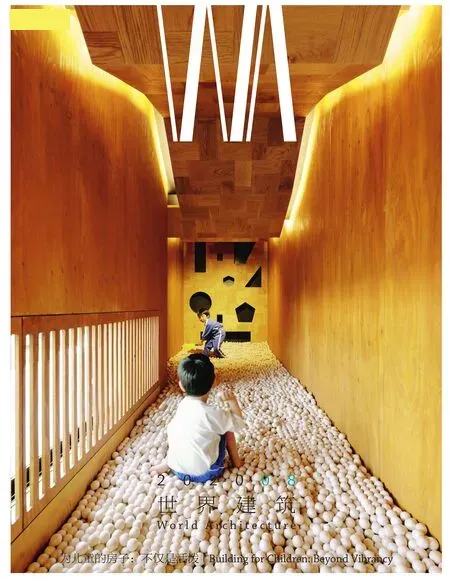
北沙幼兒園,江蘇,中國
2020-08-24 13:33:46建筑設計Crossboundaries建筑事務所
世界建筑 2020年8期
建筑設計:Crossboundaries建筑事務所
Architects: Crossboundaries
村莊里的“村莊”
近年來,江蘇省率先開始在全省推動高質量學前教育的發展,包括教育資源一度欠缺的鄉村地區。2015年,阜寧縣政府委托Crossboundaries建筑事務所為其下轄的北沙村設計一所中心幼兒園,以緩解當地幼教資源不足的問題。
阜寧縣背倚蘇北平原,面臨蘇中水網,自古崇文重教、尊道厚德,素有“江淮樂地”之稱。如今,四時變化的農事仍是當地人主要的生產、生活內容之一。廣闊的沃野托舉起其上星羅棋布的房屋和其他人工建造物。
前往北沙的一路上,窗外是一望無際的豐饒平原,薄霧籠罩的地平線偶爾被成排的樹木和房屋中斷。這就是江蘇農村大體的面貌:平坦、無邊的風景,正如其上的天空一樣廣袤無垠。而一旦你步入村中,一馬平川的感覺立時就被消解。隨處可見的高大樹木將天空與田野切割成拼貼畫般的背景;通過這些天然“柱廊”走向村中房舍時,會有桃源探秘般的新奇感。村莊周邊的林木,同那些坡頂、磚墻的兩三層農舍搭配起來,是那么和諧。
如此景致,就成為Crossboundaries建筑事務所設計的北沙幼兒園生長、扎根的微觀環境。
“迷你村莊”
本次設計的關鍵點是對尺度的把控。我們設計的組團式建筑,用若干“小屋式”結構分解了幼兒園所需的總建筑體量,并以一片多功能的戶外活動場將每棟“小屋”集結在一起。這種室內外密切銜接、高度混合的空間關系,不僅呼應了鄉村的原生肌理,對兒童早期教育而言更是十分重要的場所環境。正如“中國現代幼教之父”陳鶴琴所言:“大自然、大社會都是活教材”,兒童需要在與自然和社會的直接接觸中、在親身觀察中獲取經驗和知識。而空間的設計者要為孩子們營造這種環境,創造這些機會。
這座“小屋式”幼兒園更像縮小版的村莊,親切的尺度帶給孩子們自小熟悉的感覺;趣味的空間關系又帶來新奇感,鼓勵孩子好奇探索。來到幼兒園,他們或許首先會注意到中央的主活動場;隨后,當他們漫步到“小屋”之間,就會發現房前屋后到處都是小小的神秘樂園,可以自由自在地學知識或捉迷藏,就像在村里一樣。

1 外景/Exterior view
在附近村鎮考察時,我們也曾見到很多典型的“教學樓式”幼兒園——隔絕環境、局限視野的大體量高層立方體,以及高度重復的單調立面,將一種相對孤立的“都市邏輯”植入了鄉村既有的空間語境,像個外來的闖入者,而不是令孩子們感到熟稔、自在和溫暖的“第二家園”。當地眾多留守兒童的父母同當今全國各地的鄉村青壯年一樣,選擇季節性地外出打工,錯過了自己孩子成長的大部分時光。所以對于這些孩子而言,幼兒園確實就是他們的第二個家。
探索之樂
二層步道的功能,不僅連通著各個區域,也是孩子們的活動平臺。上到二層平臺,孩子們的目光會立刻被起伏的坡屋頂吸引,忽有置身山谷的感覺,樹冠也幾乎觸手可及。視角的小小轉變,就能使孩子們換一個角度去觀察自己周圍的一切,拓展他們日常的空間體驗。
立面材料選用了本地隨處可得的老青磚和白色灰泥,每棟“小屋”的面貌都不盡相同。在房屋的底層開設了多處相互對望的方窗,為每棟建筑與每處小庭院之間建立起視覺聯系,移步換景,將別處的活動引入視野,形成通透、有趣的室內外關系。
自2018年建成以來,這座幼兒園不僅是孩子們的樂土,亦成為村中居民喜歡的社交場所。父母或祖父母們聚集在此,在接送孩子之余,有了更多融洽的交流。


2 呼應江蘇平原鄉村的原生肌理/Echo to the original texture of countryside in Jiangsu plain
3 外景/Exterior view
Second Home for the Left-behind Children
On the initiative of the local government facing shortage of preschool education in rural area,Crossboundaries was commissioned in 2015 to design a kindergarten for the Beisha Village in Fu'ning County, Jiangsu, the first province in China that has accelerated the development of high-quality preschool education throughout urban and rural areas.
Fu'ning County has been well-known for its tradition of advocating education, culture and morality. Located in-between the North plain and the central water network in Jiangsu Province,the county's seasonal dynamics of agricultural produce still takes up most of space and dominates as an activity and as a way of making a living,putting dwellings and all built environment in the background.
Approaching to Beisha, you would be greeted by the endless fertile plain, its horizon deluded by the mist and just occasionally interrupted by the linearly arranged trees and houses. This is how most of rural Jiangsu is: flat, boundless landscape,as infinite as the skies above it. Once you arrive in the village, the feeling of overwhelming flatness somewhat disintegrates, the skies and soil become just a background collage, sliced in pieces by the tall trees that now dominate the scenery. Approaching the buildings through this natural colonnade feels like a discovery, a special framework that works well with the small, 2-3 storied houses with pitched roofs and brick fa?ades.
And it is exactly this setting, the zoomedin rural landscape of the Jiangsu flatland that the kindergarten designed by Crossboundaries grew from and ultimately belong to.

4.5 組團空間特色/Scale and interaction
6 軸測/Axonometric drawing
"Mini Village"
Appropriate scale of the project was a crucial starting point of this design and led us in creating a building cluster for Beisha, with required building volume broken down to house-like pieces, integrated by the central multifunctional open space. This integration of the outdoor and indoor is crucial to the early education environment and innate to the rural context.
This Beisha kindergarten functions as a smaller,slightly modified version of village, of which the scale gives the children a sense of familiarity and the interesting building relationships introduce novelty and encourage curiosity. Entering into the gate,children would first discover the main central space and the overall "settlement" surrounded by the trees and then, as they meander in between the "houses"they discover small, secret places tucked away from the main square, perfect for outdoor learning activities and playing Hide-and-Seek, just like what they always do in the villages.
In contrast, a typical school form, a courtyard enclosed by the prismatic volumes and repetitive fa?ade that blocks off the surrounding and limits the view, with its protective, city logic would be a foreign object in this setting, an intruder in existing context, a symbol of inserted institutional architecture, rather than a place where children would feel familiar and free, and identify it as their second home. A second home is exactly what the kindergarten for many of these children is, in quite litreal sense considering that many young parents of rural area seasonally migrate to big cities for work and miss out on big periods of their children growing up.
Fun of Exploration
In Beisha kindergarten, pathways on the second floor are not just connections between areas,they are also combined together into a platform of explorations for children. Once you are up on the second floor platform your experience is suddenly overtaken by the dynamic slopes of the roofs. The endless plain suddenly feels like a mountain gorge and the treetops are within a hand's reach. This little shift of perspective enables the children to see their surrounding in a different frame and expand their everyday spatial experience.
The materials used on fa?ades are locally available recycled bricks combined with white plaster, creating different faces of each "house".The window placement on the ground floor, with several square windows of the houses facing each other, establish the visual connection between the buildings through the yards, constantly reframing the views and integrating activities and connecting inside with outside.
Since its completion in 2018, the kindergarten became not only a pleasure land for children but an easy gathering place of their communities. Parents and grandparents tend to chat and share more time during sending and picking up their children.

7 首層平面/Ground floor plan
8 二層平面/First floor plan
項目信息/Credits and Data
地點/Location: 中國江蘇阜寧縣北沙村/Beisha Village,Fu'ning County, Jiangsu, China
客戶/Client: 江蘇省阜寧縣教育局/Education Bureau of Fu'ning county, Jiangsu
主持建筑師/Principal Architects: 藍冰可,董灝/Binke Lenhardt, DONG Hao
設計團隊/Design Team: 特蕾西·隆特恩斯,周業倫,安德拉·喬科尤,郝洪漪/Tracey Loontjens, Alan Chou, Andra Ciocoiu, HAO Hongyi
總建筑面積/Total Floor Area: 2815.4 m2
學生人數/Number of students: 300
設計時間/Design Period: 2015.12-2016.09
施工時間/Construction Period: 2017.04-2018.08
竣工時間/Completion Time: 2018.08
攝影/Photos: 吳清山/WU Qingshan (fig.1-3, 9-11),郝洪漪/HAO Hongyi (fig.12,13)
評論
唐芃:將一個幼兒園所需要的體量切成很多個小塊并進行扭轉,就形成了北沙幼兒園的空間格局。在扭動過的體塊之間產生了豐富的空間,仿佛村落中鄰里之間的空地,是孩子和村民們熟悉的場所。屋頂平臺連接了建筑的上下戶外空間,對于孩子來說是絕好的探險樂園。遺憾的是二層室外連廊并未全部連通,視線上有過多遮擋,孩子們在奔跑中會遇到死角因而可能也不能放開手腳奔跑。
袁野:北沙幼兒園如同被孩子打碎的一面鏡子,每一片玻璃都反射著天空。抽象的村落格局和風景意象成為建筑尺度分解與聚合的出發點。幼兒園平面呈現出清晰的空間邏輯和活潑有趣的整體特征。環形連廊雖然是隱性的,但卻是關鍵要素,整合了建筑體量、交通流線和室內公共空間,并通過二層空中步道提供給孩子們更立體的視角和更豐富的空間體驗。
盡管源自民居的意象,但單體屋頂對角線的分坡方式給予每個“小屋”以強烈的幾何特征,從而和周圍的鄉土民居形成一種反差,凸顯了建筑自身的個性。教室內的傾斜吊頂和方形天窗為兒童營造了充滿光線變化、具有幻想性的純凈空間,這在鄉村的環境之中顯得尤為寶貴。

9 起伏的屋頂如置身山谷,讓孩子們換一個角度去觀察周圍/The undulating roofs make the children like standing in the valley, let them look around from another angle
10 房前屋后到處都可以學知識或捉迷藏,就像在村里一樣/The children can learn knowledge or play hide and seek everywhere,just like in the village

11 內景/Interior view
12 立面材料選用了本地隨處可得的老青磚和白色灰泥,每棟“小屋”都不盡相同/The fa?ade is made of old green bricks and white plaster, which are available to get everywhere. Each"hut" is unique
13 起伏多變的屋頂/Undulating varied roofs
Comments
TANG Peng: The spatial pattern of Beisha Kindergarten is formed by cutting the required volume of the building into smaller spaces by twisting them together. Numerous spaces are created between the twisted volumes as if they are open spaces between neighbours in a village - a place which is familiar to children and villagers. The roof terrace connects the building's upper and lower outdoor spaces,making it an ideal adventure playground for children.Unfortunately, the outdoor corridor on the second floor is not fully connected, with too many shields in sight. Thus, children may run into dead ends, so they may not be able to run freely. (Translated by Dandan Wang)
YUAN Ye: The kindergarten is like a mirror broken by children. Every piece of glass reflects the sky.Abstract village pattern and landscape image become the starting point of architectural scale decomposition and aggregation. Kindergarten plan presents a clear spatial logic and lively overall characteristics. Although the circular corridor is recessive, it is a key element to integrate the building volume, paths and indoor public space, and provides children with a three-dimensional perspective and a richer space experience through the air trail on the second floor.
Although it is derived from the image of residential buildings, the diagonal slope of the single roof gives each "cottage" a strong geometric characteristics, which forms a contrast with the surrounding vernacular houses and highlights the building's own personality. The tilted ceiling and square skylight of the classroom create a pure space full of mysterious light changes for children, which is particularly valuable in the rural environment.
猜你喜歡
娃娃樂園·綜合智能(2022年3期)2022-04-19 12:57:08
北方建筑(2021年6期)2021-12-31 03:03:54
幼兒園(2020年14期)2020-11-10 09:06:24
文苑(2020年10期)2020-11-07 03:15:36
現代裝飾(2020年6期)2020-06-22 08:43:12
現代裝飾(2020年4期)2020-05-20 08:55:08
幼兒園(2020年22期)2020-03-29 02:17:52
幼兒園(2020年22期)2020-03-29 02:17:44
大灰狼(2018年9期)2018-10-25 20:56:42
動漫界·幼教365(大班)(2018年9期)2018-05-14 11:50:49