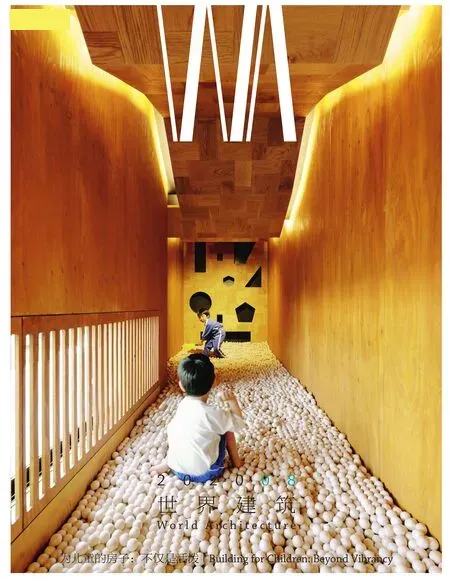
四合院幼兒園,北京,中國
2020-08-24 13:33:56建筑設計MAD建筑事務所
世界建筑 2020年8期
建筑設計:MAD建筑事務所
Architects: MAD Architects
MAD圍繞一座自1725年已有歷史記載的四合院建造了一片漂浮的屋頂,將文物進行保護和利用的同時,也和周邊已建成的現代建筑進行了連接,展現出多層的城市歷史和諧并存的場景。
MAD馬巖松:“老北京有句形容孩子淘氣的俗話,‘三天不打,上房揭瓦’。屋頂對孩子來說是充滿魔力的。在四合院空間中,屋頂就像是一片新的大地,是無拘無束、自由的象征。”
“漂浮的屋頂”以低矮平緩的姿態水平展開,將不同建筑間有限的空間最大限度地轉化成為一個戶外運動和活動的平臺。 二層是一片廣闊的色彩斑斕的戶外平臺,這里是孩子們室外運動、課余互動玩耍的主要場所。平臺的西南側,像是一個個“小山丘”與“平原”相互交錯,地形高低起伏。
漂浮的屋頂下方則是開放布局的教學空間、圖書館、小劇場、室內運動場等,將是400名2~5歲孩子的日常教育空間。 流動的空間布局提供了一種自由、共融的空間氛圍;新空間與古四合院相鄰相望,新舊交替,孩子們隨時能近觀、接觸歷史,幫助他們加深對時間維度和歷史的認知。新建部分圍繞3棵古樹設計了新的院落,與四合院的院落空間呼應,為教學空間提供了戶外的延展和采光通風。
幾棟看似互不相干,甚至從某些角度看從互為矛盾的歷史時期而來的建筑元素,不但可以在保持各自真實性的前提下和諧共存,還相互作用產生了一種新的開放性和豐富性,這使孩子們對他們所處的環境有一個客觀真實的認知。對自然、對歷史的理解可以帶給新的場所一種包容性,塑造社區的獨特共識和價值。
馬巖松說:“我理想中的幼兒園,不應該是主題樂園或者寵物店,首先它應該是客觀真實的,然后它還應該超越現實,提供給未知和想象力一些空間。”

1 外景/Exterior view

2 俯瞰/Overlook view
Located on the site of a traditional siheyuan courtyard that dates back to 1725, MAD's scheme inserts a new building that protects the existing buildings, and also restores them for use. The design features a dynamic floating roof that surrounds the historic courtyard. While preserving the cultural heritage of the site, it forms a multi-layered urban narrative, where old and new co-exist.
"There is a saying in old Beijing when children are naughty: 'if you go three days without being punished, the roof will cave in," says MAD principal,MA Yansong. Playing on this, MAD envisions the rooftop of the Courtyard Kindergarten as a place full of magic - a playful escape for the children that is a symbol of freedom and endless imagination.
Unfolding onto the site with a low and gentle posture, the roof transforms the limited space between the various buildings, into a colourful playground that functions as the main place for children to engage in outdoor sports and activities.On the southwest side of the roof, a subtly undulating surface of several small "hills" and"plains" creates a high and low terrain, forming a playful landscape.
Below the floating roof, MAD has designed the interior of the kindergarten as an open-concept layout that serves as a teaching space, library,small theater, and gymnasium. The openness of the space offers a free and inclusive atmosphere,and functions as the daily education space for 400 children between the ages of 2-5. Positioned adjacent to the old courtyard, the new learning space opens towards the historic buildings. This gives the children alternating views between old and new, deepening their understanding of time and dimension. In turn, the new building also has been realised to respect three, ancient trees on the site. It envelopes them in a way that while preserving their presence, also echoes the existing courtyard space,bringing the outdoors in, and flooding the interior with natural sunlight.

3 首層平面/Ground floor plan
4.5 剖面/Sections
In its entirety, the Courtyard Kindergarten reveals several architectural elements - a modern building from the 1990s, and a traditional courtyard from 400 years ago - that initially seem to be conflicting. MAD's design retains the authenticity of the original buildings, while allowing them to co-exist with one another, creating a new kind of interaction between them. The openness and richness of the design allows the children to have an objective and true comprehension of the environment that surrounds them. It offers them an understanding of history and place, and the preservation of nature, bringing an inclusiveness between the old and new design - one that adds value to the community.
"My ideal kindergarten is not a theme park, or a place of shelter. It should be objective and real, but go beyond reality and provide some space for the unknown and imagination", said MA Yansong.

6 外景/Exterior view
7-9 內景/Interior views
項目信息/Credits and Data
業主/Client: 樂成集團有限公司/Yuecheng Group
主持建筑師/Principal Architects: 馬巖松,黨群,早野洋介/MA Yansong, DANG Qun, Yosuke Hayano
設計團隊/Design Team: 何威,傅昌瑞,肖瑩,傅曉毅,陳竑賓,尹建峰,趙孟,楊雪兵,宮本一志,德米特里·塞雷金,張龍,賁禹強,曹溪,馬悅,藤野大樹/HE Wei,FU Changrui, XIAO Ying, FU Xiaoyi, CHEN Hungpin, YIN Jianfeng, ZHAO Meng, YANG Xuebing, Kazushi Miyamoto,Dmitry Seregin, ZHANG Long, BEN Yuqiang, CAO Xi, MA Yue, Hiroki Fujino
甲級設計院/Executive Architect: 中國建筑科學研究院/China Academy of Building Research
室內設計/Interior Design: MAD建筑事務所,蘑菇云設計工作室/MAD Architects, Supercloud Studio
景觀設計/Landscape Architect: MAD建筑事務所,易蘭(北京)規劃設計股份有限公司/MAD Architects,ECOLAND Planning and Design Corporation
場地面積/Site Area: 9275 m2
建筑面積/Floor Area: 10,778 m2
施工周期/Completion Period: 2017-2020
攝影/Photos: 存在建筑/Arch-Exist (fig.1,2,6,11,12),Hufton+Crow (fig.7,8,10),田方方/TIAN Fangfang (fig.9)
評論
程曉青:在每一位北京胡同中長大的孩子心目中,屋頂都是快樂的源泉,在屋頂上看煙花、放鴿子、打棗、眺望連綿不斷的四合院。以“漂浮的屋頂”為題的四合院幼兒園最大化地整合了各建筑屋頂,解決了用地面積不足、相鄰建筑遮擋等不利條件,既是色彩斑斕、高低起伏的游戲場,也提供了欣賞北京城市之美的絕佳視角。位于屋頂之下的空間圍繞3棵樹展開,打破幼兒園常見的單元式格局,除了必要的服務用房以外,都采用開放、流動的空間形式,營造出豐富多元的環境體驗,希望孩子們能在這樣不受拘束的空間中盡情享受自由自在的童年。
傅筱:中國的幼兒園用地幾乎都是住宅開發留下的邊角地。一個有中國傳統文脈的幼兒園地塊,對孩子們來說,是幸福的,也是幸運的。四合院幼兒園對當前的城市管理、文物保護、特別是文物利用來說充滿挑戰。與MAD的一些地標性建筑不同,這個幼兒園外部策略十分克制,僅在紅色飄帶的最北端有一個謹慎的突出體量,高度和位置顯然是經過仔細考量,以表達對近300年歷史的四合院的敬意。外部形態的克制,讓設計轉向了內部空間與四合院關系的推敲,這樣的策略無疑是適宜的。四合院幼兒園設計可能會成為一個話題,引發我們諸多的討論和思考。

10 庭院/Courtyard

11.12 外景/Exterior views
Comments
CHENG Xiaoqing: In the heart of every child who grows up in hutongs, rooftop is the source of their happiness. On the rooftop,they watch fireworks, raise pigeons, pick dates, and look over countless courtyards.Themed "floating roof", the Courtyard Kindergarten maximises the integration of various building roofs, solves the disadvantages such as insufficient land and shade of adjacent buildings. It is not only a colourful and undulating playground, but also an excellent angle to appreciate the beauty of Beijing. The space under roof spreads out centring around three trees, breaking the regulation of unit layout of kindergarten.Except for the necessary service rooms, open space is adopted everywhere to create rich and diverse environmental experience, hoping that children can enjoy their free childhood in such an unrestrained space. (Translated by PANG Lingbo)
FU Xiao: In China, the land for kindergarten is almost always the leftover from residential development. A plot with traditional Chinese context is happy and fortunate for children.Courtyard Kindergarten is full of challenges to the current urban management, cultural heritage conservation, especially the use of cultural heritage. Unlike some of landmarks designed by MAD, the kindergarten's external strategy is very restrained, with a discreet projecting volume at the northernmost end of the red ribbon. Its height and position apparently is well considered, to respect the courtyard of nearly 300 years. The restrain of external form, let the design turn to elaborate the relationship between its internal space and the courtyard. The design strategy is undoubtedly appropriate. Courtyard Kindergarten design perhaps becomes a topic,triggering a lot of discussion and thoughts.(Translated by PANG Lingbo)
猜你喜歡
北方建筑(2021年6期)2021-12-31 03:03:54
幼兒園(2020年14期)2020-11-10 09:06:24
文苑(2020年10期)2020-11-07 03:15:36
現代裝飾(2020年6期)2020-06-22 08:43:12
幼兒園(2020年22期)2020-03-29 02:17:52
大灰狼(2018年9期)2018-10-25 20:56:42
動漫界·幼教365(大班)(2018年9期)2018-05-14 11:50:49
全體育(2016年4期)2016-11-02 18:57:28
少兒科學周刊·兒童版(2015年6期)2015-11-24 03:49:38
科普童話·百科探秘(2015年6期)2015-10-13 07:21:18