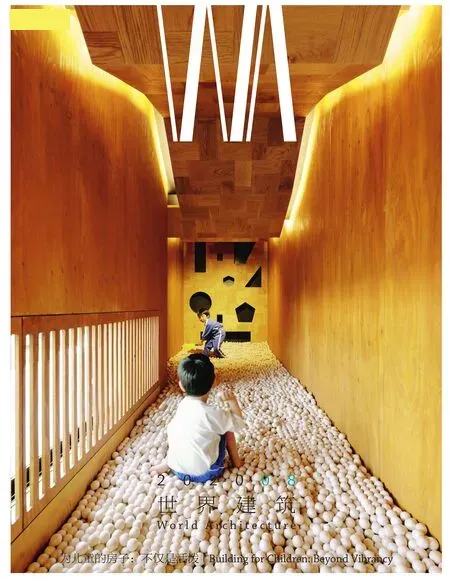
Muku托兒所,靜岡,日本
2020-08-24 13:34:06建筑設(shè)計(jì)手冢建筑研究所
世界建筑 2020年8期
建筑設(shè)計(jì):手冢建筑研究所
Architects: TEZUKA ARCHITECTS


1 全景/Overall view
2 俯瞰/Overlook view
(1.2 攝影/Photos: 木田勝久/Katsuhisa Kida)
比起圓圈式平面,這一項(xiàng)目的平面可能稱之為氣泡式平面更合適。它的平面看上去像是一連串的氣泡在空氣中緩慢上升,與此同時(shí),彼此之前保持著最佳距離。每個(gè)泡泡只包含一個(gè)使用功能,內(nèi)部沒(méi)有墻體分隔,托兒所整體就像一個(gè)由細(xì)胞器、線粒體、核糖體等共同支撐的單細(xì)胞有機(jī)體一樣,每個(gè)氣泡由家具和低矮的隔板支撐。像這種圓形的平面經(jīng)常會(huì)收獲一些批評(píng)的聲音,因?yàn)樗鼘?duì)于家具的排布而言并不容易,結(jié)構(gòu)也非常復(fù)雜。我同意這些觀點(diǎn),只是我們發(fā)現(xiàn),相比于傳統(tǒng)的模塊化平面,這種圓形平面也有其顯著的優(yōu)勢(shì)。
首先,每個(gè)功能的排布是完全不受幾何形式的限制的。每個(gè)房間都可以按照?qǐng)D解分析的那樣排布。每個(gè)房間的尺度也能夠自由地進(jìn)行調(diào)整。
第二,它的視線可達(dá)性是絕佳的,這是幼兒園和托兒所建筑中最重要的需求之一。圓形的外形自然實(shí)現(xiàn)了360°的視野,氣泡之間的縫隙則使得無(wú)意的一瞥能夠貫穿場(chǎng)地。從辦公室看出去的視野和艦橋上看出去的視野一樣開(kāi)闊。
第三,圓形激發(fā)了兒童不斷的跑圈運(yùn)動(dòng)。這是無(wú)休止的本能運(yùn)動(dòng)。這些圓圈彼此相連,形成多重組合形式。其中只有一個(gè)圓圈是孩子們可以穿過(guò)的,是一片水洼。它沒(méi)有臺(tái)階,只有平緩的斜坡,水深僅30cm。在冬天,水會(huì)被抽干,池塘則變成了一片空洼地,孩子們可以在這里列隊(duì)玩耍。 (龐凌波 譯)

3.4 庭院/Courtyard(攝影/Photos: 木田勝久/Katsuhisa Kida)
The layout of the project should be named as bubble rather than circle planning. The plan is looking like bubbles slowly rising up in air keeping optimum distance between each other. Each bubble has only one function. There is no wall inside. Like a single cell organism supported by organelles,mitochondria,ribosome and etc., each bubble is supported by furniture and low partitions. There is always criticism about the plan in circular shape.It is not easy to arrange furniture. Structure is complicated. I have no objection against those, yet we found there are significant advantages on this circle planning comparing to conventional modular planning.
First of all, the positioning of each function is completely free from geometrical restrictions. Each room can be located as it is analysed on diagram.The size of each room can be adjusted flexibly.
Secondly, the visibility is excellent. Visibility is one of the most important requirements of a kindergarten and nursery school. The round shape brings 360 degree visibility naturally. The gap formed between bubbles provides glimpses from one end to another side. The view from the office is very close to the one from the bridge of a ship.
Thirdly, the round shape provokes the endless circular movement of children. It is endless instinctive movement. The circles are linked with each other and create infinite combinations. There is only one circle which allows children to cross. It is a dish of water for children. There is no step but only a gentle slope and the depth is only 30 cm. In the winter, the water is drained and the pool becomes an empty dish where children show motion of procession. (Text by Takaharu Tezuka)
項(xiàng)目信息/Credits and Data
主要功能/Pricipal Use: 托兒所/Nursery
地點(diǎn)/Location: 日本靜岡縣富士市/Fuji City, Shizuoka Prefecture, Japan
建筑設(shè)計(jì)/Architects: 手冢貴晴,手冢由比,矢野健太(手冢建筑研究所)/Takaharu Tezuka, Yui Tezuka, Kenta Yano (TEZUKA ARCHITECTS)
景觀設(shè)計(jì)/Landscape: 石川圭一(10景)/Keiichi Ishikawa(10 kei)
結(jié)構(gòu)設(shè)計(jì)/Structure: 大野博史,藤本智(Ohno日本)/Hirofumi Ohno, Satoshi Fujimoto (Ohno JAPAN)
設(shè)備/Facility: 人見(jiàn)庸介,南佑彌,大島正巳(May工作室)/Yousuke Hitomi, Yuya Minami, Masami Oshima(Office May)
照明/Lighting: 角館政英,竹內(nèi)俊雄(Bonbori光環(huán)境規(guī)劃)/Masahide Kakudate, Toshio Takeuchi (Bonbori Lighting Architect & Associates, inc)
施工/Constructors: 輕石真護(hù),兒島武瑠(佐藤建設(shè))/Shingo Karuishi, Takeru Kojima (Sato Construction)
藝術(shù)指導(dǎo)/Art Director: 岡田英明,菅野麻衣,山岸繪里香(Marukin廣告)/Hideaki Okada, Mai Kanno, Erika Yamagishi (Marukin Ad)
結(jié)構(gòu)/Structure: 木結(jié)構(gòu)/Wooden
場(chǎng)地面積/Site Area: 5497.99 m2
基底面積/Building Area: 537.19 m2
總建筑面積/Total Floor Area: 403.51 m2
層數(shù)/Number of Stories: 地上1層/One-storey
設(shè)計(jì)時(shí)間/Design Period: 2016.11-2017.06
施工時(shí)間/Construction Period: 2017.07-2018.02
攝影/Photos: 木田勝久/Katsuhisa Kida

5 平面/Plan

6 草圖/Sketches
7 剖面/Section
評(píng)論
唐芃:Muku托兒所擁有一系列平緩的圓錐形屋面應(yīng)和遠(yuǎn)處的富士山,層層疊疊的蘑菇狀屋頂下面,孩子們可以將視線穿過(guò)木構(gòu)件望向遠(yuǎn)方,也可以在屋檐下奔跑和穿梭。與東京的藤幼兒園不同,這個(gè)托兒所場(chǎng)地充足,環(huán)境條件優(yōu)越。設(shè)計(jì)師在每一個(gè)圓形體量之間都設(shè)計(jì)有充足的檐下空間,使得作為幼兒園設(shè)計(jì)中最重要的活動(dòng)空間不再是非內(nèi)即外的模式,而是擁有了從室內(nèi)到半室外再到室外的多個(gè)層級(jí)。更多的空間層次,多變的室內(nèi)設(shè)計(jì),無(wú)方向性的空間設(shè)定,在這樣的幼兒園里也許孩子們每天都在想象自己是森林里的精靈吧。
馬笑漪:以富士山為背景,這個(gè)幼兒園好像一個(gè)度假營(yíng)地,各個(gè)房間與配套空間完全通過(guò)室外連接。這種空間組織方式,在通風(fēng)、采光和視線通透等多方面具有明顯的優(yōu)勢(shì);由于日本的小孩子在冬天都穿短褲,室外流線不成問(wèn)題。然而在相似氣候條件的中國(guó)北方,這卻是無(wú)論如何都無(wú)法被接受的。
教育建筑的魅力在于其純粹感。成功的教育建筑能將教育理念直接投射于空間形式。日本的磨練型教育理念、木建筑的精美工藝、對(duì)自然風(fēng)景園林的鐘愛(ài),都在這個(gè)項(xiàng)目中成功地直接體現(xiàn)出來(lái)。


8 水上游樂(lè)場(chǎng)/Water playground
9 庭院/Courtyard
(8.9 攝影/Photos: 木田勝久/Katsuhisa Kida)

10 內(nèi)景/Interior view(攝影/Photo: 木田勝久/Katsuhisa Kida)
Comments
TANG Peng: Muku Nursery's series of gentle coneshaped roofs echo to Mount Fuji in the distance, and under these mushroom-shaped roofs are children viewing through wooden structures to the distance,and running and shuttling. Different from Fuji Kindergarten in Tokyo, this nursery has ample site in an excellent environment. Between each two circle volumes was designed to be sufficient space under eaves, allowing the most important active space in kindergarten no longer to be either inside or outside, but rather multiple levels from indoor to semi-outdoor then to outdoor. With more spatial levels, varied interior design, and directionless space setting, children in such nursery school may imagine themselves as elves in the forest every day. (Translated by PANG Lingbo)
MA Xiaoyi: With Mount Fuji as the background, this nursery looks like a resort camp, with rooms fully connected to the supporting space through outdoor space. This way of spatial organisation has its obvious advantages in ventilation, lighting, views, so on and so forth. Since Japanese children wearing shorts in winter, outdoor connection may not be a problem here,while in northern China with the similar climate, this is unacceptable.
The charm of educational architecture lies in its purity. A successful education building can project its educational ideas into the form of space. The honed educational concept, the exquisite craftsmanship of wooden architecture, the love for natural landscape of Japan are all directly reflected in this project successfully. (Translated by PANG Lingbo)
猜你喜歡
娃娃樂(lè)園·綜合智能(2022年3期)2022-04-19 12:57:08
北方建筑(2021年6期)2021-12-31 03:03:54
幼兒園(2020年14期)2020-11-10 09:06:24
文苑(2020年10期)2020-11-07 03:15:36
現(xiàn)代裝飾(2020年6期)2020-06-22 08:43:12
現(xiàn)代裝飾(2020年4期)2020-05-20 08:55:08
幼兒園(2020年22期)2020-03-29 02:17:52
幼兒園(2020年22期)2020-03-29 02:17:44
大灰狼(2018年9期)2018-10-25 20:56:42
動(dòng)漫界·幼教365(大班)(2018年9期)2018-05-14 11:50:49