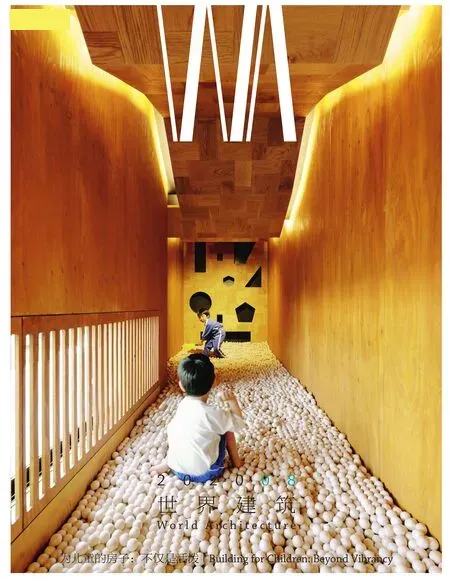
手冢建筑研究所訪談
2020-08-24 13:34:08潘奕PANYi
世界建筑 2020年8期
潘奕/PAN Yi
位于日本東京的藤幼兒園于2007年竣工,因其橢圓形建筑的無邊界空間設計而備受關注(詳見《世界建筑》201809期),建筑師手冢貴晴與手冢由比自此開始專注各類有關兒童教育空間的建筑,與兒童相關的建筑至今已建成13所,其中還包括癌癥患兒療愈設施。藤幼兒園分別在2011年(Ring Around a Tree)與2014年(兒童露臺)增設了兩座新建建筑。出于對這家幼兒園使用現狀的好奇,與對兒童建筑領域的關注,2020年5月,《世界建筑》對建筑師手冢夫婦進行了簡短的采訪。

手冢貴晴/Takaharu Tezuka
手冢由比/Yui Tezuka
手冢建筑研究所創始人、主持
建筑師/Founders, Principal
Architects, TEZUKA ARCHITECTS
WA:您認為兒童這一群體作為建筑的使用者有何獨特之處?
手冢貴晴:孩子們非常誠實,而且不會違背自己的原則。他們不具任何帶有立場的觀點,只會根據他們的感受做出反應。因此,你可以完全信任他們做出的評價。如果他們不喜歡一個建筑,那只是單純因為這個建筑不夠好。我們曾向孩子們提出種種問題,如果他們表示不喜歡,我們就不會去做。
手冢由比:孩子們總是在尋找他們樂意去玩的地方,所以他們很善于找到讓自己舒適的場所。
手冢貴晴:他們不會有偏見和成見。他們遵循自己的直覺,遵從人類的基本需求。有時學校或幼兒園傾向于以專用器材裝點操場,但我們發現這些器材不入孩子們的法眼,他們不需要這些。他們的行動自然而然且不經思考,這也是成年人與兒童之間的區別。當你同成年人交談時,他們會傾向于談論商業品牌或他們的生活經歷。所以說,孩子與生俱來的需求來自于他們的身體。
WA:您如何定義面向兒童的空間?這樣的空間在城市中會扮演怎樣的角色?
手冢貴晴:本質上來說,人類是為了下一代而活的。建設一座好的城市,需要從一所好的學校開始。父母往往不介意長途通勤,只為讓孩子入讀好學校。因此,學校實際上是城市的基本需求,或本質。過去,城市設計是將市政廳、購物中心或商業區作為城市規劃的核心,但是世界正在改變。你知道你曾經是個孩子,世界上每個人也都曾經是孩子。這意味著只要人類存在,學校就會是城市的原點和起始。
手冢由比:一座對兒童友好的城市會吸引許多好父母和好市民。兒童是建設好城市的關鍵。
WA:為什么應當創造面向兒童的空間?在創造這樣的空間的過程中,必須注意什么?必須避免什么?如何評價兒童空間的好與不好?
手冢貴晴:基本上,孩子們是了解危險的。只有在他們做好準備要爬一棵樹的時候,他們才會爬;而當他們覺得爬這棵樹有危險的時候,他們就不會去爬了。所以,關鍵在于時機。他們知道什么是危險,我們并不需要嚴格的安全界線。有些時候,如果你指示兒童做了太多事情,他們可能會無法完成任務。但如果由他們自己去探索,他們可以靠自己順利完成。這就是安全的基本要素。
其次,我們不應該去定制一個如何使用游戲工具的說明書。這是說,不應由我們去規定他們該做什么,而應由他們自己去發現自我。這種策略叫做自發性運動。比方說,一棵樹不會是為了孩子們的需求才長大的,各類城市家具也不是為了他們的娛樂而設計的,但孩子們總會尋找各種方法來享受這些城市里的物體,比如那些樹木、巖石和公共物品。
即使他們理解安全的基本要素,有些方面也仍需小心設計,以避免對他們的安全構成威脅。例如,如果你設計的平臺高差超過1.5m,沒有安全護欄就可能會使兒童面臨危險。但這并不意味著我們必須到處去建2m高的圍欄。在某些情況下,2m的高差并不會對孩子構成威脅,也許是因為他們習慣于從3m的高度跳下去。我以前也經常這樣做,所以不用太擔心。孩子們的復原能力比你想象的更好。即使他們摔斷了腿或胳膊,也會痊愈。人只有跌倒才能學會如何爬起來。
手冢由比:在我們設計Ring Around a Tree的時候,我們研究了我們的孩子,試了試他們可以安全跳下的最大高差,然后我們發現1.1m的高差是安全的。這些危險對他們挑戰自己很重要。
手冢貴晴:我們過去常說,小“劑量”的危險對每個孩子都有好處。而為了估算這個“劑量”,需要進行測試。這就是為什么最好的方法是利用你自己的孩子:因為不會被孩子父母起訴。你就是他們的父母。
WA:為人父母的身份轉變對您的上述思考是否產生了影響?
手冢貴晴:為人父母之前,我們的生活更加苦修、更追求完美主義。那時我們只追求完美,錙銖必較。但當你和自己的孩子們打交道時,一切都會背離預期。同時,我們發現所有的錯誤都不是無用的,因為錯誤能讓人成長。有了孩子之后,我們在很多方面都變得更加慷慨和寬容了。
因為失敗帶來的可能性,我們比以前收獲得更多。比方說,如果你想按照一種預期在街上走,那么除了你的主要目標之外,你會什么都看不到。然而如果你不預設目標而只是隨意游蕩,你會開始看到街道的另一面。這些事情在建筑中經常發生。一開始,當一個項目突然出現意外的麻煩時,我們會感到害怕。現在我們不再因此而害怕了,因為我們懂得了失敗只是提供發展機會的另一個轉折點。
手冢由比:有孩子之前,我們總會去努力為我們自己創造一個舒適的空間。而在有孩子之后,我覺得建筑應該更有趣。這些空間應該更多樣、更好玩、更加不正式。
手冢貴晴:首先,我們變得更加寬容;其次,我們了解了現實生活。這使我相信人類是為了下一代而存在的。生物種群是生命的主要追求,我們生命的每一刻都是為了下一代。這不僅是說為了我們的孩子,為了其他孩子也一樣。不僅是日本兒童、中國兒童、新加坡兒童或者非洲兒童、歐洲兒童、美洲兒童,世界各地的孩子都是一樣的,不論國籍。在我有孩子之前,我從未理解過這種感覺。
但當我看到一個孩子在學校活動中取得了驚人的成就,我會很受觸動。這種事會打動我,眼淚會自然流出來。能和孩子們相處是一種奇妙的感覺,如果我沒有孩子,我是不會這么敏感的。
WA:您認為針對特殊兒童群體的空間有怎樣的設計要點?如何以空間療愈兒童?
手冢貴晴:我們應該像對待普通兒童一樣對待他們。唯一的區別在于我們需要進行無障礙設計,比如電梯和坡道,但也僅此而已。這些特殊的孩子們想做一個普通的孩子,我不認為這些孩子應該被單獨對待。社會傾向于專門為這些孩子們創造一些特殊學校,這是一種將這些人隱藏起來的策略,我不認為這是個好主意。這些孩子也是社會生活的一部分,當他們離開舒適的特殊學校,就必須融入社會。因此,我們需要學會如何與他們一起生活和工作,而不是過度保護他們。我去巴厘島的時候見到了烏布的國王,他發表了一個有趣的評論,讓我很有共鳴。他說:“我不需要到處建斜坡,因為在我們發現殘疾兒童時,我們可以和他們同行并關照他們。”這就是一個理想社會應該成為的樣子。
手冢由比:我的兒子上幼兒園時,曾和一個確診唐氏綜合癥的孩子在一起玩。那家幼兒園會把殘疾兒童和非殘疾兒童安排在一起上課,這是有益的,因為每個人都學會了互相交流。
手冢貴晴:在我看來,社會不應該建設特定的特殊學校,這些孩子應該上普通的學校。盡管他們需要特定的老師,但重要的是要讓他們和其他孩子融為一體。
WA:建筑師可以為兒童發展做些什么?
手冢貴晴:很不巧,建筑師無能為力。不過,我們可以為兒童提供機會。例如,當一個小孩自己探索到了一些東西,他往往會很珍視。在海灘上撿起一塊小石頭,在孩子眼中可能會是一場淘金。而如果你為他們買了點什么,那種易得性會導致物品對他們的重要性降低。生命中的每一刻都是學習的機會。作為建筑師,我們的工作就是為他們提供一個可以進行探索的環境。
手冢由比:就像尋寶一樣,我們的目的就是把這些寶貴的生命珍寶藏在任何地方,而孩子們必須靠自己找到。這并不難,因為這些珍寶不會是昂貴的東西。
手冢貴晴:但這也不是炫技。我就不喜歡故意把恐龍藏在什么東西后面。就像藤幼兒園的屋頂是傾斜的,但我沒有告訴人們那到底有多傾斜。可當你仔細觀察孩子們,就會發現他們正像我們所設想的那樣利用著空間。這是一種魔術,而魔術師從不會亮明他的招式。
WA:繼藤幼兒園與Ring Around a Tree之后在同一場地建成的兒童露臺,為什么不再如前者一樣采用弧形的母題?
手冢貴晴:因為吃多了甜甜圈之后,你總會想吃點別的東西(開玩笑的)。而且,他們本來就是功能各自不同的項目。在藤幼兒園中,我們依托鄉村類型學進行設計,它具有高互動性的環狀空間,以一種禪宗的生活方式包容一切。但兒童露臺是以餐館立項的。最初,園長希望我們設計類似于“星巴克的孩子們”的主題餐廳。讓孩子們留在餐廳里可是很困難的,因為有些餐廳就不適合兒童入內。但我意識到孩子們其實懂得如何欣賞高品質美食。有一次我帶著我的女兒去一家昂貴的餐廳,那時她都不到一歲,但她全程都很安靜。因此,園長想要我們設計“星巴克的孩子們”的概念沒有成功,但他的概念本身很簡單。
藤幼兒園聲名鵲起后,許多居住地很遠的兒童前往就學。在把孩子送到幼兒園后,他們的母親無法再往返一次家中,最終只能在車站周圍消磨時間。我們開始意識到,如果我們設計一個能容納她們消磨時間的兒童露臺,那對園方來說會更好。不過,最近越來越多的人搬得離幼兒園更近了,也就是說在車站周圍等待的人已經不多了,所以園方決定把兒童露臺改造成英語學校。而首層則被用作廚房,為1000個孩子準備飯菜。
我們的設計概念旨在為7名教師提供7個房間。我們想把兒童露臺設計成一個集市。當你去市場時,你走向每一個店鋪,而每個店鋪都有自己的門面。通常市場上的商店就是這樣各不相同的,所以我們盡量使每個房間都不相同。下雨天想去,你就只能帶把傘,這是有些麻煩,但正是這些不便之處給生活增添了樂趣和現實元素。
藤幼兒園聘請的教師不僅富有魅力,他們大多數人在白天還有副業。其中一人是舞蹈演員,一人是廚師,還有一人是音樂家。這是很好的,因為這些副業能讓老師將他們的專業能力帶入教育之中。就像是你教你的孩子說話,你不會單純地只教語言本身,而是言傳身教。例如在你做飯的時候,你用語言給他們演示如何給蛋翻面,所有的詞匯和語法都自然緊隨著這些動作教給了孩子。這給我帶來了對城市規劃的思考,學校教育是這種經驗的一部分。如果所有事都處理得當,那就沒有什么值得發現和學習的東西了。這就是為什么我說不便是有益處的,因為順境之中你不需要奮斗和學習。這是不便之處的好處。
手冢由比:盡管兒童露臺的形狀不同于藤幼兒園,但概念是一致的。孩子們必須通過室外走廊空間才能進入教室,這種動線也是在做圓周運動。
WA:與兒童露臺相隔4年的Muku托兒所,二者間的設計思路有怎樣的異同?
手冢貴晴:這兩個項目的規模不同。如果說兒童露臺是藤幼兒園的廚房,那Muku托兒所就是挨著一個大廚房設計的幼兒園。Muku托兒所的業主是一家便當公司的老板,她想為她的員工以及附近居民提供一所托幼機構。她的便當公司每天要生產5000~10,000份盒飯,想要將他們對于食物的理念傳遞給社區,哺育孩子會是實現這一目標的最佳起點。如前所述,藤幼兒園類似于一座村莊,兒童露臺是其功能的一部分。Muku托兒所則不同,它類似于直銷商店,就像你為了推銷一輛車而打出了餐廳用車的概念。因此,這二者的設計意圖就有很大的不同。其次,在我們設計藤幼兒園時嘗試將所有事物都包含在一個環里,但Muku托兒所的概念源自泡沫。泡沫的好處是你想要多少就能做多少,就是說,你吹出一些泡泡會帶出更多的泡泡,而一個環(藤幼兒園)是獨立完整的。因此,Muku托兒所將來還有擴建的可能性。
手冢由比:Muku托兒所和藤幼兒園的年齡構成不一樣。Muku托兒所的年齡組為0~3歲,而兒童露臺則面向3歲及以上兒童。孩子們從藤幼兒園畢業之后,還能回到兒童露臺接受英語課程。因此,兒童露臺像是連接藤幼兒園與外部世界的門戶。
WA:如今回看藤幼兒園3個建筑單體設計,您認為它們的使用是否符合設計預期?有沒有意料之外的收獲或者經驗教訓?
手冢貴晴:所有這些建筑都超出了我們的預期。每天都有意外驚喜在發生。在設計藤幼兒園時,我們還沒有無邊界空間的理念。我也從沒想過我的TED演講會有400萬次的播放量1)。所以我意識到,每個人對我們的設計理念都抱著相同的態度。其次,我發現這些建筑影響了很多人的生活。為了闡釋這些影響,我將用沖浪做比喻,談談藤幼兒園的園長與我的關系。
舉例來說,園長是沖浪者,而我是沖浪板制作者。在我們相遇的時候,他還沒有一塊好的沖浪板,所以也不能很好地沖浪。為了乘風破浪,就需要好沖浪板。而在我們的交往過程中,我一直在觀察他的沖浪姿勢,這讓我意識到我可以追隨一名沖浪者獲得許多收獲。在得到了我的支持后,他便弄潮踏浪。由此,他掌握的新姿勢啟發我去創造了更多創新沖浪板。如果我沒有遇見他,也許我也會像其他建筑師一樣設計著平凡的幼兒園。
通過他,我學會了如何觀察和與孩子互動,我們從幼兒園得到的是學習的機會。他們不是通過教導而是以他們的沖浪姿勢給我們靈感。即便我不會沖浪,但我可以教導其他沖浪者如何乘風破浪,因為我在岸上,我在觀察沖浪者。在建筑的語境下,我學會了聯合使用者一起賦予建筑生命的技巧。例如,如果兒童露臺被設計成一個普通的星巴克店鋪,那么它對孩子來說就沒有意義了;如果沒有孩子們使用這些空間,藤幼兒園的功能也就不一樣了;如果孩子們不去攀爬,Ring Around a Tree就只能作為一個裝置存在。這種對建筑的態度,在我們多年的工作中已經相當突出。
注釋/Note
1)2014年9月,手冢貴晴在TED平臺進行題為《你見過最好的幼兒園》(The Best Kindergarten You've Ever Seen)的演講,截至收稿時,該視頻觀看數已超過500萬次,詳情參見:https://www.ted.com/talks/takaharu_tezuka_the_best_kindergarten_you_ve_ever_seen?language=zh-cn。
WA:What do you think is unique about the child as building users?
Takaharu Tezuka:Children are very honest and do not compromise. They do not have any political opinion and response as how they feel. Therefore,you can trust their comments completely. If they do not like the architecture, it simply means that the architecture is not good. We used to pose questions to kids and if they do not like it, we do not build it.
Yui Tezuka:Children always find places that they like to play so they are quite good at finding comfortable places for themselves.
TT:They have no prejudices and preconception.They follow their own instincts and abide to the fundamental needs of the human being. Sometimes schools or kindergartens tend to design playgrounds with special tools but we found out that it has nothing to do with them. They do not need anything like that. They do not think and just act naturally without reason. That is the difference between a grown up and a child. When you speak to grown-ups,they tend to talk about commercialised brands as well as their life experiences. Therefore, a child's innate needs come from their bodies.
WA: How do you define the spaces for children? What role will such a space play in the city?
TT:Basically, human beings are living for the next generation. In order to build a good city, you need to start from a good school. Sometimes parents do not mind commuting long distances in order to enroll their child into good schools. Therefore, schools are actually the fundamental needs or essence of the city.In the past, urban cities are designed with the city hall, shopping malls or business district as the core of the urban planning. But the world is changing.You know, you used to be a kid and everybody in the world used to be kids. This means that as long as human beings exists, schools are the starting point and beginning of the city.
YT:A city which does good for children attracts many good parents and citizens. Children are the key to making good cities.
WA: Why should we create spaces for children? In the process of creating such a space, what should we pay attention to? What must be avoided? How to evaluate the beneficial and harmful of spaces for children?
TT:Basically, children know about the risks. When they are ready to climb the tree, they will climb it. When they feel that it is risky to climb the tree, they will not climb it. Therefore, it is all about the timing. This means that they know what risk is and that we do not need a strict safety line. Sometimes if you force children to do too many things, they might fail the task. But when they are discovering by themselves, they tend to be fine on their own. That is the basis of safety.
Secondly, we should not make a manual on how to use the playing tool. This means that we should not dictate what they should do and that they should find out on their own. This strategy is called "spontaneous movement". For example, the tree is not growing for the children's needs. These city objects are not designed for their entertainment but the kids are constantly finding ways to have fun with these existing city objects such as trees, rocks and public goods.
Even though they know the basis of safety,there are things that have to be carefully designed to avoid posing a threat to their safety. For example,if you design a platform with a height difference of more than 1.5 metres. Without a safety barrier,it may pose a danger to children. But this does not mean that we have to build a 2 metres fence everywhere. In certain situations, a height difference of 2 metres would not pose as a threat to children maybe because they are used to jumping off 3 metres. I used to do that so do not worry too much.Kids are more resilient than you think. Even if they broke their legs or arms, it can be fixed. When people fall, they learn how to climb back up.
YT:When we designed the Ring around the Tree, we studied our kids to test the optimum height that they can jump without danger. Thereafter, we found out that the height of 1.1 metres is safe. These kinds of danger are important for them to challenge themselves.
TT:We used to always say that a light dosage of danger would be good for every child. And in order to gauge the dosage, you need to test it. That is why the best way is to use your own kids because their parents are not going to sue you. You are their parent.
WA: Has parenthood influenced your thinking above?
TT:We used to be more stoic and perfectionist. Back then, we demanded only for perfection and nothing less. But when you are dealing with your own kids,nothing goes as expected. At the same time, we found out that no mistakes were wasted. Because mistakes are for growth. After having kids, we became more generous and forgiving in many ways.
We are gaining more than before, because failure may bring more possibilities. For example,if you think about walking down the street as expected, you do not see anything else but your main objective. However, if you walk without having a set of objectives and you start to wander somewhere, you will start to see the street in a different light. These things happen in architecture all the time. Initially, we used to be scared when unexpected trouble crops up in a project. But we are no longer scared anymore because we understand that failure is just another turning point which provides an opportunity for growth.
YT:Before we have kids, we always try to make spaces that are comfortable for ourselves. After we have gotten kids, I feel that architecture should have more fun. These spaces should be more divers, playful and less formal.
TT:First of all, we become more forgiving. Secondly, we learnt about real life. This made me believe that human beings exist for the next generation. Living species are the main purpose of life and that every moment in our life is for the next generation. This does not only apply to our kids, but every other kid as well. It is not only Japanese kids, Chinese kids, Singaporean kids, African kids, European kids, and American kids. Kids around the world are same no matter the nationality. Before I have kids, I never understood the feeling.
However, whenever I see a child achieving amazing things in a school activity, I feel touched. It moves my emotion and tears flow out naturally. It is an amazing sensation to be able to relate to kids in which this is a sensitivity that I would not have possessed if I did not have kids.
WA: What do you think are the key points of spatial design for special groups of children? How to treat children with space?
TT:We should treat them all the same as normal children. The only difference is that we need to design accessibility features like elevators and ramps but nothing more. These special children want to act as an ordinary child and that I do not believe these children should be left alone. Society tend to create these special schools specifically for these kids in which I do not think that it is a good idea, it is a kind of strategy to hide these people away. These children are part of life and that they would have to integrate within the society once they leave the comfort of their special school. Therefore, we need to learn how to live and work with them and not to overly protect them too much. When I went to Bali Island, I met with the king of Ubud. He made an interesting comment that hit me. He said, "I do not need to make ramps all over the place because when we find disabled kids, we can carry them and to care for them." This is how an ideal society is supposed to be.
YT:When my son was in nursery school, he mingled with a child who was diagnosed with down syndrome.The nursery school grouped disabled children with non-disabled children together during lessons and this was beneficial because everybody learnt to mingle with one another.
TT:In my opinion, society should not develop specific special schools. These kids should be enrolled into a normal school. Even though they would require specialised teachers, it is important to integrated them with the other children.
WA: What can architects do for children's development?
TT:Unfortunately, architects are unable to do anything. However, we can provide opportunities for children. For example, when a child picks discovers something, they tend to treat it with care. Picking up a small stone on the beach may turn into a discovery of gold in a child's eyes. But when you buy something for them, the ease of attainability causes the importance of the object to depreciate. Every moment of life is an opportunity to learn. Our job as architects is to provide the environment for them to discover.
YT:Like a treasure hunt, our purpose is to hide these valuable life treasures everywhere. And the kids have to find it by themselves. It is not difficult as the treasure is not something expensive.
TT:However, it is not something ostentatious.I do not like to intentionally hide dinosaurs behind stuffs. For example, the roof of the Fuji Kindergarten is inclined but I do not informed people how much it is inclined. However, if you observe the kids carefully, they are using the space as to how we have expected. It is a kind of magic trick which the magician never shows his tricks.
WA: Why does not the Kids Terrace, built on the same site after Fuji Kindergarten and Ring Around a Tree, adopt arc motif?
TT:Because after eating big donuts, you want to eat something else (Joke). And also, these two projects have got different functions. For the Fuji Kindergarten, it is designed with a village typology which has highly interactive spaces along with the ring to that contains everything with a Zen lifestyle.But the Kids Terrace started out as a restaurant.Originally, the principal came to us in hopes of designing some sort of "Starbuck's kids" themed restaurant. It was very difficult to keep kids in restaurants because restaurants do not allow young children into restaurants. However, I realised that kids actually know how to appreciate high quality food. There was once when I took my daughter to a very expensive restaurant, she was barely a year old and she finished everything quietly. So, when the principal asked us to design the “Starbucks' kids”, it did not happen. But his concept was very simple.
After Fuji Kindergarten attained a reputation,many children that were enrolled lived quite far from the kindergarten. After dropping their kids in the kindergarten, these mothers were unable to make a trip to and fro from their homes in which they ended up spending time around the stations.We started to realise that if we can design a space where they could spend time inside the Kids Terrace,it will be better for them. Yet, recently more people are moving in to close distances. This meant that not many people were waiting around the stations anymore, so they decided to convert it into an English learning school. As for the ground level, it is used as a kitchen to prepare meals for 1000 kids.
The concept of our design is 7 rooms for 7 teachers.We wanted to design the Kids Terrace to feel like a marketplace. When you go to the market, you walk into each shop and each shop have their own fa?ade. Usually the shops in the marketplace are all different so we try to make each room to be different. On rainy days, you would have to bring an umbrella which is somewhat troublesome. But with that inconvenience adds an element of fun and reality towards life.
Fuji Kindergarten does not just hire special glamourous teachers. Most of them have a second job during the day time. One of them is a dancer, one of them is a cook and one of them is a musician. This is good because having a secondary job allows teachers to bring in their own specialties in their education.Like when you teach your own language to your kids,you do not purely teach the language in itself but to pair it with an activity. For instance, when you are cooking, you use language show them how to turn over the eggs. All these vocabulary and grammar flows naturally with these actions. This brings me to my point about planning for cities, going to school is part of the experience. If everything is well taken care of, there is nothing much to discover and to learn about. That is why we always say that inconvenience is a benefit because when everything is convenient,you do not need to struggle and learn. This is the benefit of inconvenience.
YT:Even though Kids Terrace's shape is different from Fuji Kindergarten, the concept is similar.Children have to use the outdoor corridor spaces to access the classrooms and that this circulation is in a circular movement as well.
WA: What are the similarities and differences between the design ideas of Muku Nursery which is built 4 years later than Kids Terrace?
TT:The scale of these two projects are different. Kids Terrace is a kitchen for Fuji Kindergarten but Muku Nursery is designed next to a big kitchen. Muku Nursery's client is the owner of a bento box company and that her intent was to provide a nursery catered for her employees as well as the neighbouring public.Her bento box company are making 5 to 10 thousand meals per day. In order to provide the feeling of their food to the community, feeding the kids is the best starting point to achieve it. As I have previously mentioned, Fuji Kindergarten is a kind of village with Kids Terrace as one of these facilities. Muku Nursery is different because it is a kind of antenna shop.For example, when you want to sell a car, you want to make the concept of the car for the restaurant.Therefore, the intent of the design is largely different.Secondly, when we design Fuji kindergarten, we try to contain everything in a ring but Muku nursery has the concept of the bubble. The good thing about the bubble is that you can make as many as you like. This means that when you blow bubbles you can make more bubbles whereas a ring (Fuji Kindergarten) is complete. Therefore, there may be possible expansion of Muku Nursery in the future.
YT:The difference between Muku Nursery and Fuji Kindergarten are the age groups. Muku nursery has an age group of 0-3 while Kids Terrace has an age group of 3 years and older. And after the kids graduated from Fuji Kindergarten, they would continue to return to Kids Terrace to attend the English lessons provided.Therefore, Kids Terrace is a kind of gateway between the outside world and Fuji Kindergarten.
WA: Now looking back at the design of three single buildings in Fuji Kindergarten, do you think they meet design expectation? Are there any unexpected gains or lessons?
TT:All these buildings exceeded all of our expectation. And unexpected things are happening every day. When we are designing Fuji kindergarten,we do not know the meaning of spaces without boundary. I have also never expected my TED Talk to have 4 million views1). That is how I realised that everyone shares the same attitude towards our design philosophy. Secondly, I found out that these buildings have impacted a lot of lives. In order to explain about the impacts, I need to talk about the relationship between Fuji Kindergarten's owner and me. I will explain this with a metaphor about surfing.
Take for example that the principal is the surfer and I am the surfboard maker. When I met him for the first time, he did not have a good surfboard so he could not surf well. In order to ride a good wave,you need a good surfboard. During our encounters,I have been observing his riding form. This made me I realised that I could achieve many things with him as a surfer. After he gained my support, he surfed extremely well. Through this, his new riding form inspired me to create more innovative surfboards.If I have never met him, maybe I will be designing ordinary kindergarten buildings like other architects.
Through him, I learnt how observe and interact with kids. What we are gaining from the kindergarten is the opportunity to learn. They did not teach us but their riding form gave us a lot of inspiration. And because I cannot surf, I can tell how other surfers how to ride the wave because I’m off-shore and I am observing the surfers. In the architectural context,I have learnt techniques to include users and to give life to the building. For example, Kids Terrace would not be meaningful to kids if it is designed just as an ordinary Starbucks mall. Fuji Kindergarten would not function the same without kids using the spaces. Ring Around a Tree would just exist as an object if kids are not climbing through it. This kind of attitude towards architecture has become so prominent in our working style throughout the years.
猜你喜歡
北方建筑(2021年6期)2021-12-31 03:03:54
幼兒園(2020年14期)2020-11-10 09:06:24
文苑(2020年10期)2020-11-07 03:15:36
現代裝飾(2020年6期)2020-06-22 08:43:12
幼兒園(2020年22期)2020-03-29 02:17:52
大灰狼(2018年9期)2018-10-25 20:56:42
動漫界·幼教365(大班)(2018年9期)2018-05-14 11:50:49
雜文選刊(2016年7期)2016-08-02 08:39:56
小天使·一年級語數英綜合(2016年6期)2016-05-14 12:21:05
少兒科學周刊·兒童版(2015年6期)2015-11-24 03:49:38