拉波夫敘事結(jié)構(gòu)模式下的讀后續(xù)寫情節(jié)構(gòu)思
2020-10-09 11:16:08涂美媚
廣東教育·高中 2020年9期
關(guān)鍵詞:內(nèi)容
涂美媚
一篇好的讀后續(xù)寫應(yīng)該是“跟優(yōu)質(zhì)的語言協(xié)同,跟精彩的思想?yún)f(xié)同,跟嚴(yán)謹(jǐn)?shù)倪壿媴f(xié)同”(王初明,2017)。但讀后續(xù)寫的實(shí)踐過程中,一個(gè)比較突出的問題是續(xù)寫時(shí)缺乏內(nèi)容構(gòu)思,情節(jié)缺乏邏輯性,與前文不連接。鑒于此,我們借助拉波夫敘事結(jié)構(gòu)來梳理原文信息,從而可以清晰地把握原文主旨和脈絡(luò)。
一、拉波夫敘事結(jié)構(gòu)模式
拉波夫(W. Labov,1972)在他的《Language in the Inner City》一書中總結(jié)出有關(guān)個(gè)人經(jīng)歷敘事的六項(xiàng)要素:點(diǎn)題(abstract)、指向(orientation)、進(jìn)展(complicating action)、評議(evaluation)、結(jié)局(resolution)、回應(yīng)(coda)。
(1)點(diǎn)題,即敘述者在敘述前對故事的簡要概括。
(2)指向,交代了故事發(fā)生的時(shí)間、地點(diǎn)、人物和情景等。
(3)進(jìn)展,即敘述過程。
(4)評議,是敘述者對敘述中出現(xiàn)的情況的看法和評論。
(5)結(jié)局,即故事的結(jié)局。
(6)回應(yīng),則接應(yīng)主題,總結(jié)故事的寓意。
指向、進(jìn)展和結(jié)局是一篇記敘文所必須的要素,而點(diǎn)題、評議和回應(yīng)則是選擇性的。
二、基于拉波夫敘事結(jié)構(gòu)模式的記敘文要素圖
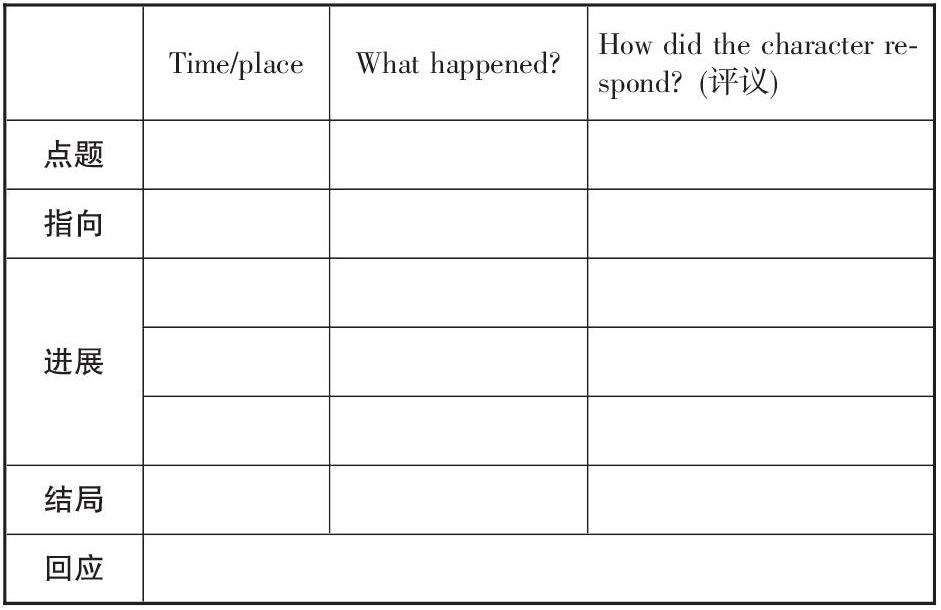
根據(jù)拉波夫敘事結(jié)構(gòu),我們可以將記敘文的敘事模式的六個(gè)要素設(shè)置為如下表格。
該表格清晰地顯示了記敘文的各個(gè)要素。續(xù)寫的兩段內(nèi)容一般是“進(jìn)展 + 結(jié)局”或者“結(jié)局 + 回應(yīng)”部分。
在續(xù)寫時(shí),我們可以根據(jù)這些要素續(xù)寫出與原文情節(jié)融合度較高的內(nèi)容。文章一開頭如有點(diǎn)題的部分,我們在情節(jié)構(gòu)思上可根據(jù)該部分內(nèi)容來構(gòu)思。如開頭部分沒有點(diǎn)題,直接是指向部分,我們可以根據(jù)指向部分的內(nèi)容,在情節(jié)的構(gòu)思上與指向的內(nèi)容進(jìn)行呼應(yīng)。
下面以一篇讀后續(xù)寫題型為例具體闡釋如何運(yùn)用拉波夫敘事結(jié)構(gòu)來構(gòu)思情節(jié)。
三、情節(jié)構(gòu)思示例
A young man was getting ready to graduate from college. For many months he had admired a beautiful sports car in a dealers showroom, and knowing his father could well afford it, he told him that was all he wanted.
As Graduation Day approached, the young man awaited signs that his father had purchased the car. Finally, on the morning of his graduation, his father called him into his private study. His father told him how proud he was to have such a fine son, and told him how much he loved him. He handed his son a beautiful wrapped gift box. Curious, but somewhat disappointed, the young man opened the box and found a lovely, leather-bound Bible, with the young mans name embossed(飾有浮凸的)in gold.
Angrily, he raised his voice to his father and said,“With all your money you give me a Bible?”He then stormed out of the house, leaving the Bible.
Many years passed and the young man was very successful in business. He had a beautiful home and a wonderful family, but realizing his father was very old, he thought perhaps he should go to see him. He had not seen him since that graduation day. Before he could make the arrangements, he received a telegram telling him his father had passed away, and willed all of his possessions to his son. He needed to come home immediately and take care of things.
When he arrived at his fathers house, sudden sadness and regret filled his heart. He began to search through his fathers important papers and saw the still new Bible, just as he had left it years ago.
注意:
1. 所續(xù)寫短文的詞數(shù)應(yīng)為150左右;
2. 續(xù)寫部分分為兩段,每段的開頭語已為你寫好;
Paragraph 1
With tears, he opened the Bible and began to turn the pages. ___________________________
Paragraph 2
How many times do we miss blessings because they are not packaged as we expected? _______
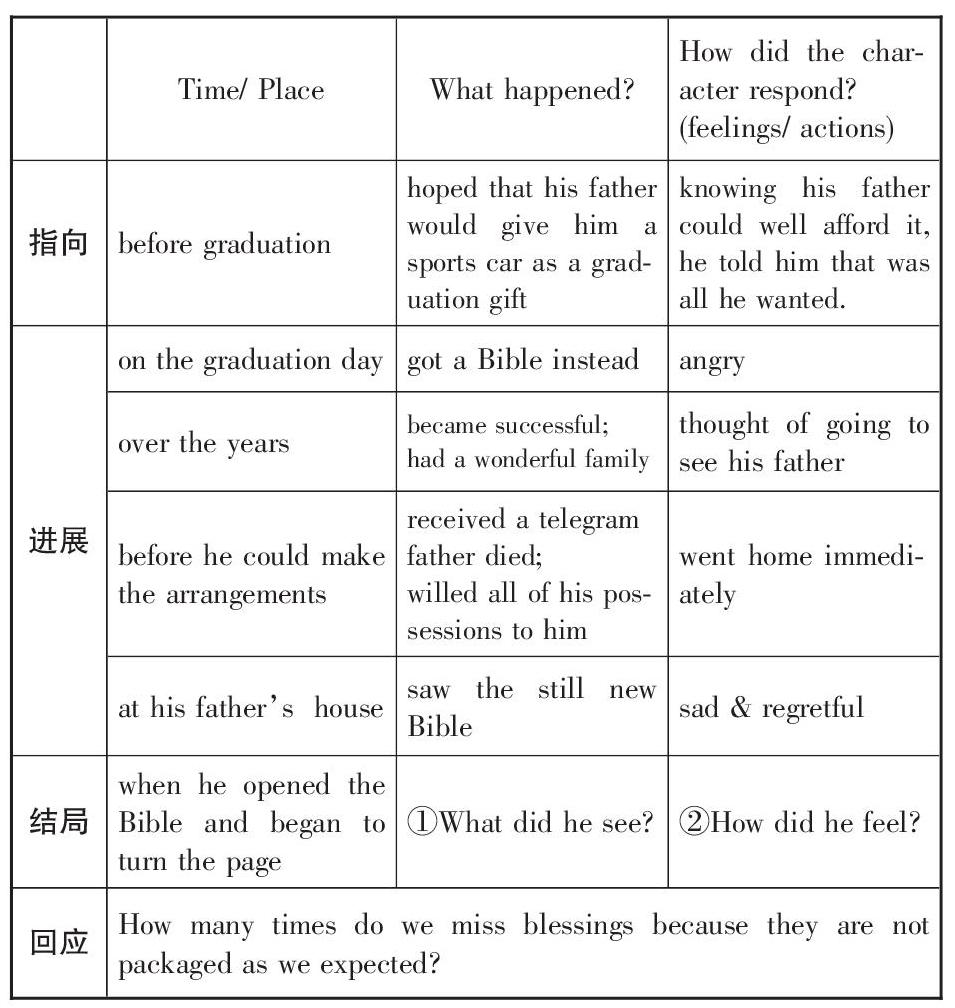
第一步,根據(jù)拉波夫敘事結(jié)構(gòu)圖,梳理原文情節(jié)。
根據(jù)拉波夫敘事結(jié)構(gòu),可以看出,該文沒有點(diǎn)題部分,但有回應(yīng)部分。因此,續(xù)寫的兩段,第一段屬于結(jié)局,第二段則屬于回應(yīng)部分,即總結(jié)故事的寓意。
第二步,構(gòu)思續(xù)寫情節(jié)。
原文的指向部分是:年輕人想要一輛跑車作為畢業(yè)禮物。
回應(yīng)部分的內(nèi)容是:有多少次因?yàn)樾腋2皇前次覀兿胍陌b的樣子,我們與幸福擦肩而過。
據(jù)此,我們可以讀出以下幾點(diǎn):
(1)年輕人期待的blessing是a sports car ;
(2)父親給他的禮物也是blessing, 只是沒有按照他希望的包裝的樣子,而是一本Bible, 因而兒子錯(cuò)過了blessing。
基于指向部分(兒子認(rèn)為的blessing 是一輛跑車)和回應(yīng)部分(父親給的blessing: a Bible),在回答上表①②兩個(gè)問題時(shí),我們可以構(gòu)思誤會(huì)情節(jié),即父親送的Bible里面有車鑰匙,兒子一直沒打開過,或者父親送的Bible里面解釋了送Bible的原因。因而有兩種情節(jié)構(gòu)思:
A. 年輕人打開圣經(jīng)后看到了他當(dāng)年想要的車的鑰匙——痛苦回憶與父親的點(diǎn)滴——后悔;
B. 年輕人打開圣經(jīng)后看到了父親寫給他的信——了解父親沒有送sports car的原因——后悔
第三步,續(xù)寫文章。
參考范文
Paragraph 1
(參考范文A)With tears, he opened the Bible and began to turn the pages. All of a sudden, he heard something drop on the ground. It was a key. Looking closer, he realized it was a key to a car that he had eagerly desired on his Graduation Day.(看到曾經(jīng)夢想的車鑰匙)His heart ached.(感受)Memories of his father flooded into his mind. He remembered being taught how to drive by his father. He remembered drinking beer with him the day he turned 18.(回憶)How he wished that he could tell his father how much he loved him. But he would never be able to do that now. His heart hurt at the thought.(后悔)
(參考范文B)With tears, he opened the Bible and began to turn the pages. Suddenly an envelope caught his attention. He opened it with trembling hands. It was a neatly folded letter, which read,“My dear son, as I am writing this letter, I am filled with pride. Ive been thinking a lot about what life lesson I can share with you. After thoughtful consideration, I will give you three words: love, forgiveness and safety. I hope these words could help you harvest happiness. Inside the envelope, there is a 30,000-dollar check. I hope this will be a seed you plant for your happiness.”(書信內(nèi)容)It was at that moment that he realized he had missed the greatest blessing in his life.(后悔錯(cuò)失愛)
Paragraph 2
How many times do we miss blessings because they are not packaged as we expected? If the young man had learned that lesson earlier, he would not have missed the greatest blessing in his life.(就原文故事點(diǎn)評)But like the young man, we too often take love for granted, and we believe love is getting what we want, only to realize that love comes in many forms when it is too late.(拓展)So learn to count our blessings and appreciate the smallest blessings in our life, no matter how they are packaged.(總結(jié)寓意)
范文點(diǎn)評
情節(jié)構(gòu)思:根據(jù)原文的點(diǎn)題部分“want a sports car”和回應(yīng)部分,即續(xù)寫第二段給出的開頭部分的“missed blessings”,續(xù)寫部分設(shè)置了誤會(huì)情節(jié)。第一段參考范文A設(shè)置的情節(jié)是《圣經(jīng)》里有鑰匙,參考范文B設(shè)置的情節(jié)是《圣經(jīng)》里有爸爸在兒子畢業(yè)那天給他的祝福,爸爸送了兒子三個(gè)字“愛、原諒和安全”,并附上了一張30,000美金的支票希望這成為播撒兒子未來幸福的一粒種子。兩個(gè)范文在情節(jié)構(gòu)思上都圍繞了“missed blessing”這個(gè)主題,并呼應(yīng)了點(diǎn)題部分“want a sports car”的情節(jié)。
第二段參考范文是文章的回應(yīng)部分。這部分續(xù)寫主要內(nèi)容是這個(gè)故事給我們的啟示。構(gòu)思從年輕人的故事點(diǎn)評,進(jìn)而擴(kuò)展到對所有人的啟示,最后總結(jié)寓意,給出建議:要保持感恩的心,珍惜生命里的每一個(gè)幸福。
語言:本范文使用了以下語法和句型:
分詞:He opened it with trembling hands.
虛擬語氣:If the young man had learned that lesson earlier, he would not have missed the greatest blessing in his life.
強(qiáng)調(diào)句:It was at that moment that he realized he had missed the biggest blessing in his life.
總之,拉波夫敘事結(jié)構(gòu)有助于我們了解記敘文的結(jié)構(gòu),根據(jù)點(diǎn)題、指向和回應(yīng)部分的內(nèi)容更加合理地進(jìn)行續(xù)寫,從而實(shí)現(xiàn)與原文在思想和邏輯上的協(xié)同。
責(zé)任編輯 蔣小青
猜你喜歡
科學(xué)大眾(2022年11期)2022-06-21 09:20:52
科學(xué)大眾(2021年21期)2022-01-18 05:53:48
科學(xué)大眾(2021年17期)2021-10-14 08:34:02
科學(xué)大眾(2021年19期)2021-10-14 08:33:02
科學(xué)大眾(2021年9期)2021-07-16 07:02:52
科學(xué)大眾(2020年23期)2021-01-18 03:09:18
科學(xué)大眾(2020年17期)2020-10-27 02:49:04
中國現(xiàn)代醫(yī)藥雜志(2020年12期)2020-01-08 16:42:06
中國現(xiàn)代醫(yī)藥雜志(2020年10期)2020-01-08 06:42:11
臺聲(2016年2期)2016-09-16 01:06:53