
Gender representation in Beauty and the Beast: A comparison between version 1991 and 2017
2020-11-16 08:44:32HANJing
文藝生活·中旬刊 2020年10期
HAN Jing

Abstract:AsoneofDisneysmostpopularanimations,BeautyandtheBeastwasadaptedintoalive-action movie in 2017. The current study, from a gender and language lens, attempts to uncover whether the gender construction in these two versions has changed after 26 years. Under the theoretical framework of Critical Discourse Analysis, two specific approaches were used: pragmatics and linguistic analysis. It has been found that although the depiction of the protagonists improves from a feminist perspective, gendered dis- courses can still be easily identified and remain almost unchanged.
關鍵詞:Beauty and the Beast; gender and language; CDA
Key words:J9
文獻標識碼:A
文章編號:1005-5312(2020)29-0111-03
DOI:10.12228/j.issn.1005-5312.2020.29.072
一、Introduction
The live-action movie Beauty and the Beast, based on the award-winning animation of the same name pro- duced by Walt Disney Pictures in 1991,was one of the most popular films in 2017. Adapted from an eigh- teenth-century French fairy tale, it is a romantic story between a brave village girl and a prince who has been magically turned into a beast.
To explore how both genders are constructed in these two versions, the theoretical framework of Crit- ical Discourse Analysis (CDA) is employed. As a typi- cally interdisciplinary and “problem-oriented” ap- proach, CDA aims to uncover hidden social problems and inequality in “language, discourse and communication” [1]. The critical interpretation can be conducted to all linguistic levels and various semiotic resources of spoken and written discourses [1].Specifically, two approaches are employedin this study: pragmaticsand linguistic analysis.
二、Pragmatics analysis
Two similar extracts are selected from the films: the second time Belle meets Gaston who plans to make a proposal to Belle but fails. From a pragmatics per- spective, the salient features of politeness and di- rectness can be identified. According to Brown and Levinsons classic politeness theory, certain kinds of speech acts may threaten the positive and/or negative faces of the addressee and/or the hearer (FTAs)[2]. To minimize the damage of FTAs, positive and/or negative politeness strategies will be employed by competent members of a society based on three social factors (i. e. power, distance, ranking)[2].
The major speech acts in each extract are propos- ing request by Gaston and refusal by Belle, which are both intrinsically face-threatening. It is found that Belle in the animation performs more positive polite- ness, avoiding to say “no”directly to Gaston. She is always applying positive politeness strategies such as disagreeingwithmitigation(e.g.“Imspeechless.I really dont know what to say”), giving a reason for refusal by downgrading herself (e.g. “Im very sorry Gastonbut...butIjustdontdeserveyou”),pretending toexpressinterestsinGastonsutterances.However, Belle in the 2017 version conducts rejection speech acts that damage Gastons positive face. When Gaston first makes the implicit proposal, Belle uses certain positive politeness strategies such as giving a reason and using in-group identity marker “we” (i.e.“we could never make each other happy.”). When Gaston hints at Belles “miserable”future if she doesnt marry him, she turns him down in a direct and bald way (i.e.“Im never going to marry you Gaston.”), showing her assertiveness and determination.
On the other hand, Gaston changes the other way around in terms of politeness. In the 1991 version, Gaston is always direct, rude and coercive. He first gives Belle a compliment and makes assumptions about her wants (i.e.“...my little wife massaging my feet.. .”), then makes an implicit proposal (i.e.“Do you know who that little wife will be?”), and lastly orders Belle to consent after she hesitates (i.e.“Say youll marry me”). Thus, he threatens Belles negative face and freedom of choice. However, Gaston in the latest film sounds less aggressive and gentler. The new Gas- ton, instead of making direct proposal, is always im- plying that Belle should marry someone and have chil- dren (e.g.“Maybe you havent met the right man.”). He even applies hedging devices such as “maybe”and“a little” (e.g. “Can I give you a little advice about the villagers though?”) to mitigate the effects of FTAs against Belles negative face. After the first attempt fails, he warns Belle about the consequence of not getting married, which impedes Belles negative face again.
Therefore, it seems that Belle becomes more di- rect, assertive and courageous in the live-action ver- sion, whereas the old Belle displays more conventional feminine characteristics such as being powerless,car- ing and ladylike. Conversely, the new Gaston is de- picted as politer and less coercive. However, it is probably too early to celebrate the minor triumph of feminism over patriarchy. In fact, after over two decades, the characterization of both genders remains stereotypical from a linguistic lens.
三、Linguistic analysis
The linguistic analysis will be conducted from two aspects: processes and evaluative adjectives. The for- mer aspect is related to Hallidays systemic function- al linguistics (SFL). The close association of SFL and CDA can be explained by the congruence of their theo- retical frameworks [3]. The three metafunctions of SFL are congenial with CDAs characteristics of investi- gating language, power and ideologies in social con- texts[3]. Moreover, SFL enables CDA to deconstruct lan- guage use in a systematic, detailed and even quantita- tive way by using “explicit and precise”terms“that can be shared by others”[3].
For CDA analysts, one aspect of language worth special attention is transitivity which mainly con- sists of participants, processesand circumstances[3]. Due to the constraint of word length, this study only focuses on process types. Each of the six types (i.e. material, verbal, mental, relational, behavioral, ex- istential) indicates a particular category of actions in which the participants are involved[4]. For example, material processes represent what is happening or what is done to the external world, while the relational processes provide information about a participants attributes and identities[4].
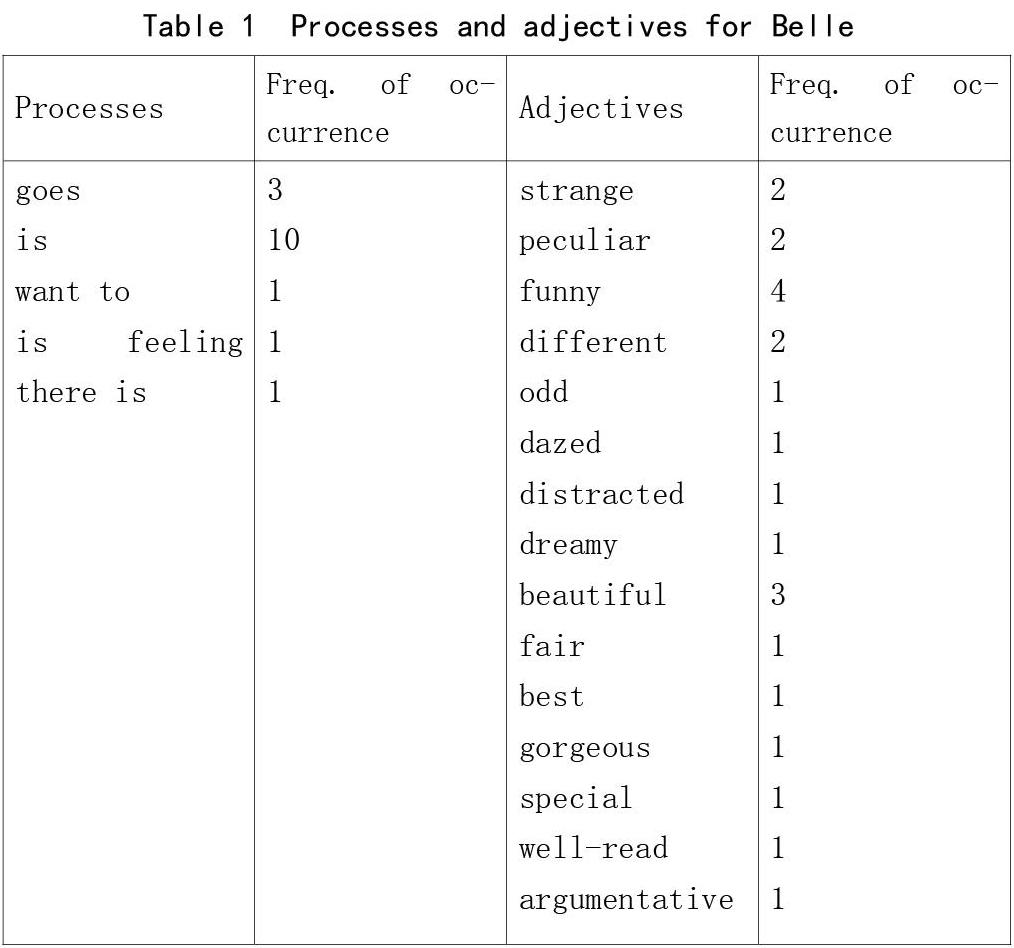
There are two separate extracts in which the vil- lagers sing of Gaston and Belle who both have a fame in the local village. Since there is no significant change of lyrics in version 1991 and 2017, the author will choose the latest one for further analysis. Pro- cesses and adjectives for the female and male charac- ters have been qualitatively identified below.
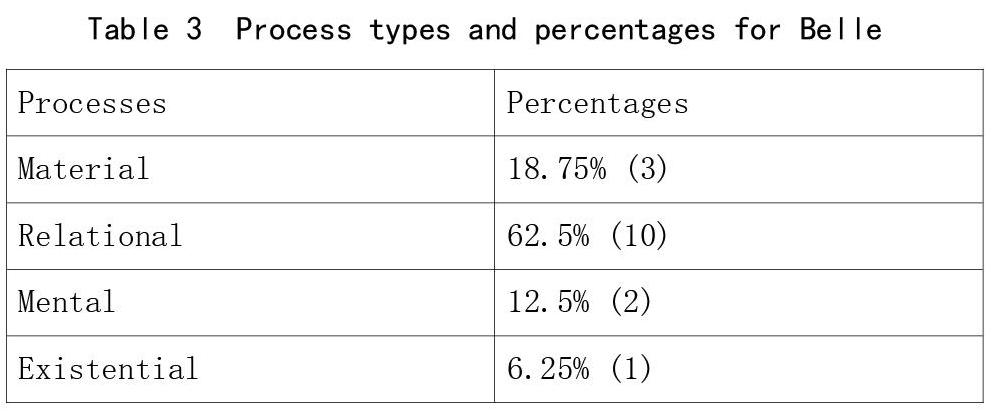
The quantified results are presented in Table 3 and 4, showing the types and percentages of actions that Belle and Gaston undertake.
One feature shared by both genders is the relative scarcity of mental and existential processes, with the former accounting for 12.5% and 6.9%and the latter for merely 6.25% and 3.4% respectively. According to Table 2 and 4, actions performed by Gaston are domi- nated by a variety of material processes, accounting for 62.1%. It suggests that Gaston is having consider- able and varied impact either on objects (e.g.“plays” , “hunt”, “shoot”) or on people (e.g.“breaks”,
“fights”, and “entertains”). However, the proportion of this particular process type realized by Belle shows a marked difference. Accounting for a seemingly noticeable percentage of 18.75, only one kind of mate- rialprocesses(i.e.“goes”)isascribedtoBelle.The material process distribution in lyrics contributes to a more static representation of Belle and a rather dy- namic and forceful depiction of Gaston.
In fact, Belle is primarily engaged in relational processes which account for 62.5%. In contrast, the same action type for Gaston is merely 27.6 %. This proportional difference leads to the next phase of analysis: what kinds of attributes or characteristics are associated with both genders? As outlined in Table 1, the most frequent qualities associated with Belle are “beautiful” (similar ones including“gorgeous”, “beauty”) and“funny”(similar ones such as“strange”, “odd”, “peculiar”). However, attributes ascribed to Gaston are“slick”,“manly”,“thick”,“intimidating”, supplemented with evaluative nouns such as“super suc- cess”,“man among men”,“the size of the barge”.It can thus be concluded that the gender construction is greatly stereotypical, with women associated with ap- pearance and innocence whereas men with muscular
physique and career success.
四、Conclusion
According to the above-mentioned analyses, the latest live-action film Beauty and the Beast, compared with the 1991s animated version, displays certain subversion as well as confirmation of typical gender roles. There are three limitations in the present study.
First, the overall analyses depend on the authors subjective interpretation. Although different methods were employed, the producers and the audience of the movies may have a different opinion[5].
Second, this writing is merely based on a small selection of texts, with no images included.Only by including both verbal and non-verbal, written and vi- sual elements can the analysis of films be truly ef- fective and intact [6]. In order to be more reliable, future studies could be extended to full-length movies and conducted in a more complete and thorough way.
However, it may not be fair to be too critical of the movies, considering the fact that they are adap- tions of an 18th century fairy tale.
References
[1]van Dijk, T. A. Aims of critical discourse analysis [J]. Japanese Discourse,1995,1,17-27.
[2]Brown, P., & Levinson, S. C.Politeness: Some universals in language usage [M].Cambridge: Cambridge University Press, 1987.
[3]Martin, J. R. Close reading: functional linguistics as a tool for critical discourse analysis [G]. // Researching language in schools and communities:?Functional lingusitic perspectives. London: Cassell, 2000: 275-302.
[4]Halliday,M.& Matthiessen, C.An introduction to func- tional grammar.3rd ed.,rev. ed [M]. London: Arnold, 2004.
[5]Cameron, D.Working with spoken discourse[M].London: Sage,2001.
[6]Unger, J, & Sunderland, J. Gendered discourses in a contemporary animated film: subversion and confirmation of gender stereotypes in Shrek [DB/OL]. Center for Language in Social Life, WorkingPapers Series, 2005. Retrieved from http: //www.ling.lancs.ac.uk/groups/clsl/wpapers.htm.
