后疫情城市主義
——通過住宅附屬單元使郊區再生
2021-08-31 03:35:54佩爾約翰達爾PerJohanDahl朱琳TranslatedbyZHULin
世界建筑 2021年8期
佩爾-約翰·達爾/Per-Johan Dahl朱琳 譯/Translated by ZHU Lin
記憶與再生
欄目主持:阿爾伯托·博洛尼亞,米凱利·博尼諾,皮埃爾-阿蘭·克羅塞特
對于我們的“記憶與再生”專欄,住宅附屬單元似乎是一個意想不到的主題。它的發展通常與西方國家郊區住宅的擴張有關,在這些地方,住宅規模的擴大阻礙了對集體記憶或城市復興計劃共同利益的反思。此背景下,住宅附屬單元在強調如支持多代人的家庭生活等私人人領域方面發揮了作用。
佩爾-約翰·達爾的文章向我們展示了因疫情而加速變化的情況。在這種背景下,對社交距離的考慮和低密度城市生活的向往正重新展現出新的價值:它不僅僅是對私人居住領域品質的提升,而且是一個機會,得以為新居民創造生活空間、疏解中心區域、梳理郊區的社會秩序,并創造新的共同利益。因此,在涌現出的新形勢下,住宅附屬單元得以催生一種新型城市復興普遍適用的戰略,用更復雜的形式闡明它們與現有房屋的關系,正如文章中的案例所顯示的那樣。(米凱利·博尼諾)
全球性的COVID-19 之戰催化了新一輪對城市形式的探索,這種形式需要能夠在未來的疫情傳播中提供更大的彈性。隨著“距離”成為健康和繁榮的新關鍵詞,緊湊型城市面臨著巨大的挑戰。低密度形態對于未來的城市化越來越重要,從而使人們重新對郊區產生了興趣。在19 世紀的歐洲,郊區被重新定義為對城市病的一種反擊,隨著二戰后美國的城市擴張而繁榮。然而,由于其助長了不可持續的生活方式和混亂擴張的城市形態,自20 世紀末以來一直受到嚴厲地批判。批判的內容包括對汽車的過度依賴、猖獗的消費主義,以及對土地和自然資源的無情消耗。然而,由于疫情使分散式的城市重新顯現出其合理性,郊區可能擁有尚未開發的潛力,以推動疫情后的可持續低密度城市主義。郊區的基石是獨戶住宅——這種建筑類型反映甚至孕育了郊區生活和形式的基本要素。通過轉變獨戶住宅的概念,建筑師可以為分散式城市注入新的社會經濟和環境結構,從而用建筑重塑郊區,同時保持對地方記憶的回應。郊區的特質植根于對城市生活的排斥,低密度發展的如畫美學為大城市的生活方式提供了另一種選擇[1]。因此,郊區的可持續升級可能并不太依賴規劃策略,而是取決于如何在增加密度的同時保持視覺完整性,以及如何通過建筑表現這種轉變。
住宅附屬單元是具有這種潛力的一種新興建筑類型。作為對北美城市的文化重組和空間重組的非正式回應,住宅附屬單元在1970 年代出現,并在21 世紀初獲得了學科基礎,當時美國西部的幾個行政管轄區批準了住宅附屬單元的發展。在北美確定了合法背景之后,住宅附屬單元被引入歐洲,在那里它重新建立了獨戶城市主義的概念。本文以凱文·戴利建筑事務所與加州大學洛杉磯分校的城市實驗室(cityLAB-UCLA)合作的美國住宅附屬單元原型BIHOME 為研究對象,來推演建筑干預、郊區文化和地方記憶之間的交叉點。此后,文章將重點轉移到歐洲背景下,探討兩個住宅附屬單元案例——瑞典smogstudio 事務所的Unit C 和意大利Elastico Farm 事務所的STONED。在這些案例中,創造性的住宅附屬單元設計被用來批判性地審視保護指南中的矛盾條款。這3 個項目的設計旨在與獨戶住宅地塊上(原有的)的主體建筑建立不同的聯系,它們共同預示著適用于郊區更新這一前提的一系列概念。
1 記憶與改變
通過住宅附屬單元為建筑增加密度意味著建筑形態上的變化。事實上,增加任何新的建筑形式和功能都會使住宅區的空間特征向未知的未來轉變。這個過程可能似乎顯而易見,因為“發展”在某種程度上總是會導致前所未有的變化。然而,多種事實表明住宅區的居民往往會反對不同于民用建筑傳統的密度和功能的可能性。
記憶意味著住宅附屬單元建筑概念的一個關鍵組成部分。盡管附屬組件總是要求“未充分利用的土地或結構資源來劃分場地并確定建筑位置,[它]也在避免損害住宅區的特征”[2]。這種矛盾包含了住宅附屬單元建筑的一個關鍵概念,因為它既提供了保存地方記憶的契機,也提供了通過建筑設計更新分散式城市的指令。
2 偽裝
住宅附屬單元建筑在美國郊區的出現是對社會經濟需求和機會的回應。由于獨戶住宅區劃禁止加建住宅單元,住宅附屬單元往往是在規劃專家的審查下非法建立的。它們通常建在獨戶住宅地塊的后院,將未被充分利用的土地轉化為空間,同時被掩護在主要建筑背后。雖然這一辯證關系——住宅附屬單元建筑從屬于住宅主體建筑——正是它的學科內涵,但它也代表著應對規劃監管的一種戰術演習。當附屬單元被主體建筑故意隱藏時,它也被隱藏在區劃檢查員的視線之外。如此,房主避免了受到違反規劃法規的制裁。在美國的建筑話語中,獨戶住宅成為住宅附屬單元建筑的偽裝。
住宅附屬單元將獨戶住宅從美國夢的標志轉變為非法建筑的擋箭牌。住宅附屬單元利用郊區地塊中最私密的部分進行建造,而這部分往往是后院,它將居住的密度分散開,卻沒有在公共領域造成視覺影響。雖然這得益于規避區劃法律的努力,但它也激勵了對地方記憶的保護。增加的密度對社區來說基本上是不可見的,因此增加的住宅附屬單元不會影響社會文化活力和郊區公共空間的歷史意義。雖然偽裝的概念是為了保護地方的記憶,但它也為建筑實驗和特異性的解決方案提供了空間。由于任何表達和審美追求都不在公眾的視野之中,它也將免于被公共審判。
這種三位一體的設計——在郊區后院空間分散建筑密度,與規劃和建筑法規迂回,以及從郊區公共空間消解視覺影響——已經被加州大學洛杉磯分校的智囊團城市實驗室(cityLAB)在關于住宅附屬單元建筑的各種研究項目中得到了進一步的發展。這些研究結果在第12 屆威尼斯國際建筑雙年展上展出,在2015 年通過住宅附屬單元原型BIHOME 成為一個應用研究項目。該項目與位于圣莫尼卡的凱文·戴利建筑事務所合作設計,并由加州大學洛杉磯分校的學生在理查德·邁爾設計的洛杉磯布羅德藝術中心的二樓院子里搭建,項目組事實上利用了這一隱蔽空間的特點,以展示住宅附屬單元為房主提供的機會,“使他們自己的家更加靈活和經濟,[而同時]美國廣受喜愛的花園郊區的外觀和感覺保持不變”[3]。
這個46m2(500ft2)的單元是為了能夠以最靈活的方式占用場地而設計的。它由一個高低起伏的鋼管框架組成,并由2 層半透明的ETFE 膜包覆,兩層膜中間真空密封著紙筒做成的蜂窩狀結構——這個復雜而輕便的單元易于組裝、拆卸和回收。一面鏤空的木墻嵌入其中,以抵御風和地震活動的橫向力量。
靈活的結構和復合的表皮相結合,引領了BIHOME 的變革性美學。作為一種白色的半透明建筑形式,其表皮被設計為生物多樣性的組成部分,上面的圖案為“蝙蝠、鳥類和蟲子提供了空隙”[4]。人們很容易想象,在洛杉磯廣闊的郊區景觀中,一系列BIHOME 單元隱藏在獨戶住宅的后面,每一個單元都被泥土和植物覆蓋,昆蟲和其他飛行動物的殘骸為偽飾建筑本體的植物群和泥土增加營養。BIHOME 在美學上與洛杉磯郁郁蔥蔥的花園相互融合,它記錄了美國郊區的雙重偽裝。
3 削弱
洛杉磯的“偽裝”概念支持特異性的解決方案和實驗,而歐洲的建筑保護方法往往會阻礙那些用未來的變化來削弱歷史保護的概念的探尋。不過,當通過設計感性進行探索時,歷史保護的指導方針可能會鼓勵通過住宅附屬單元建筑增加當代性而不損害地方記憶。
兩個歐洲的住宅附屬單元項目可以共同看作對建筑保護立法的城市規劃過程的批判性探詢。它們是瑞典漁村洛阿的smogstudio 設計的Unit C,以及意大利圣基里諾歷史中心的Elastico Farm 設計的STONED。這兩個項目都受到嚴格的歷史保護準則的限制。兩組建筑師決心探索創新的設計方案,他們發現了城市法規中的一個悖論,可以用來削弱法規的阻礙。
在洛阿,這個悖論指的是城市保護計劃中構造與風格之間的關系。雖然保護計劃要求所有新的建筑設計服從當地漁民房屋的構造,但其劃定的作為保護對象的建筑存量,仍然包括了少量的與當地的構造傳統沒有任何聯系的新古典主義別墅[5]。因此,保護計劃強加的保護法規最終會損害新古典主義建筑的歷史意義。這種矛盾成為smogstudio 削弱保護意圖的契機,并提供了一個空間,通過對建筑形式和地塊劃分的當代處理方式來詮釋傳統設計的建筑品質。
圣基里諾的悖論也產生于規則中對于設計構造的規范。與Unit C 相反的是,STONED 是由既有谷倉翻新而來。雖然圣基里諾歷史中心的保護法規要求所有的建筑翻新都要用石材,但地震法規卻禁止在結構構件中使用石材,因為“在地震活躍地區,石頭是最不安全的材料”[6]。因此,保護法規改變了石頭的歷史意義,它不再是一個砌筑的概念而成為了風格練習。當抽離了學科內涵后,石材成了Elastico Farm 事務所創造性地削弱當代建筑中構造傳統的契機。通過混凝土、石材和玻璃、電焊金屬網等透光材料的非常規組合,建筑師們利用圖案、銹跡和色彩等改善了砌體建筑中結構和細節之間的美學關系。
4 結論
分散式的城市為抵抗當前和未來的疫情提供了契機。然而,郊區空間的社會文化活力和歷史意義往往匯聚在一起,阻礙了改善環境的努力,這些弊病是由郊區概念本身驅使的,如汽車依賴性、社會同質性、種族隔離和消費主義行為。我們需要通過保留地方記憶來引入變化。住宅附屬單元建筑提供了這樣一種方法,通過手段高明的設計,建筑師可以利用住宅附屬單元作為特洛伊木馬來實施變革,同時掩蓋其化身的失憶。為了成功完成這樣的任務,需要有概念性的框架來處理郊區發展中的社會政治和文化的復雜性。本文將“偽裝”和“削弱”作為兩個概念框架,它們在通過設計手段來更新分散式城市時是可行的。這兩個概念批判了城市規劃的一些法規——這些法規仍然在限制建筑學探索其他解決方案的能力。借助于建筑學的學科前提來強化郊區的記憶,住宅附屬單元成為可持續低密度的先驅。

1 凱文·戴利建筑事務所+加州大學洛杉磯分校城市實驗室,BIHOME,布羅德藝術中心二樓庭院的住宅附屬單元,美國洛杉磯,2015/Kevin Daly Architects+cityLAB-UCLA,BIHOME,the ADU at the second-floor courtyard of the Broad Art Center,Los Angeles,USA,2015

2 凱文·戴利建筑事務所+加州大學洛杉磯分校城市實驗室,BIHOME,真空密封的聚四氟乙烯膜包覆的蜂窩狀結構形成的圖案和光影,美國洛杉磯,2015/Kevin Daly Architects,cityLAB-UCLA,BIHOME,pattern and light composed by the vacuum-sealed ETFE around a honeycomb structure,Los Angeles,USA,2015

3 smogstudio建筑事務所,Unit C,室內空間序列,瑞典洛阿,2017/smogstudio,Unit C,interior spatial sequence,R??,Sweden,2017

4 smogstudio建筑事務所,Unit C,瀝青紙覆層代表了對當地漁民小屋建筑傳統的美學借鑒,瑞典洛阿,2017/smogstudio,Unit C,the tar paper cladding denotes aesthetic references to the local building tradition of fisherman's cabin,R??,Sweden,2017

5 smogstudio建筑事務所,Unit C,平面,瑞典洛阿,2017/smogstudio,Unit C,the plan drawing,R??,Sweden,2017

6 smogstudio建筑事務所,Unit C,拓撲學的結構概念包含了板、墻和表皮,瑞典洛阿,2017/smogstudio,Unit C,the structural concept in topology conflates slab,wall,and skin,R??,Sweden,2017

7 Elastico Farm事務所,STONED住宅2,混凝土、石頭、玻璃和電焊金屬網的組合,意大利圣基里諾,2018/Elastico Farm,STONED House 2,combinations of concrete,stone,glass,and electro-welded metal net,San Quirino,Italy,2018

8 Elastico Farm事務所,STONED住宅2,該設計致敬了當地磚石建筑的傳統,意大利圣基里諾,2018/Elastico Farm,STONED House 2,the design acknowledges the local tradition of masonry construction,San Quirino,Italy,2018

9-13 Elastico Farm事務所,STONED住宅,包括地塊北部的住宅附屬單元在內的住宅平面,意大利圣基里諾,2018/Elastico Farm,STONED,plan drawing of STONED with the ADU located at the northern part of the plot,San Quirino,Italy,2018(9-13圖片來源/Sources:?ELASTICOSPA+3)
Memory and Regeneration
Column Editors:Alberto Bologna,Michele Bonino,Pierre-Alain Croset
Accessory Dwelling Units (ADU) architecture might seem an unexpected theme for our "Memory and Regeneration" column.Its diffusion is typically associated with the sprawl of residential edification in Western countries' suburban areas,where the prevalence of domestic dimension has hampered to inspire reflections on collective memory or the common interest of urban regeneration initiatives.In this context,the ADUs played a role in emphasising such a private realm– for example,supporting the multigenerational life of the family.
Per-Johan Dahl's essay shows us how things are changing,accelerated by the pandemic.The impulse to social distance and a less dense urban life are relaunching new values for this kind of context:not just an exaltation of the private dimension but an opportunity to create living spaces for new dwellers,decongesting central areas,articulating the social order of suburbia,creating new collective interests.Within this emerging situation,ADUs can therefore encourage a new widespread strategy of urban regeneration,articulating their relationship with the existing houses in more sophisticated forms,as shown by the cases illustrated below.□(Michele Bonino)
The global COVID-19 battle catalyses new inquiries into urban form that is capable of accommodating greater resilience in future pandemics.As "distance" becomes the new keyword for health and prosperity,the compact city faces enormous challenges.Low-density morphologies are becoming increasingly relevant for future urbanisation,thus bringing renewed interest in suburbia.Reinvented in Europe during the 1800s as a counterforce to urban blight,suburbia flourished with the post-World War II expansion of American cities.However,due to its fostering of unsustainable lifestyles and sprawling urban form,since the late twentieth century,it has been harshly disparaged.Criticisms include car dependency,rampant consumerism,and ruthless consumption of land and natural resources.And yet,as the coronavirus pandemic renews the relevance of distributed cities,suburbia may hold unexplored potentials feasible to propel a post-pandemic urbanism of sustainable lowdensity.The cornerstone of suburbia is the singlefamily residential house– an architectural typology that mirrors,and even nurtures,the fundamentals of suburban life and form.By transforming the concept of the single-family house,architects can inject new socio-economic and environmental configurations into the distributed city,thus regenerating suburbia through architecture while remaining responsive to the memory of place.The suburban identity is rooted in a repulsion of urban life,where the picturesque aesthetics of low-density development has provided alternative lifestyles to those of the great city[1].A sustainable upgrading of suburbia may thus not depend so much on planning strategies,but rather on concepts of how to maintain the visual integrity while still increasing density,and how to represent such transformation through architecture.
The Accessory Dwelling Unit– abbreviated ADU–encompasses an emergent building type with such potential.Surfacing in the 1970s as an informal response to the cultural and spatial restructurings of North American cities,the ADU gained disciplinary grounds in the early twenty-first century when several zoning jurisdictions in the American West were amended to approve ADU development.After establishing a legal context in North America,the ADU then migrated to Europe,where it has served to reconceptualise aspects of single-family urbanism.This article takes the American ADU prototype BIHOME by Kevin Daly Architects/cityLAB-UCLA as an object of study to extrapolate intersections between architectural interventions,suburban culture,and the memory of place.Then,shifting focus to a European context,the article will explore two ADUs– Unit C in Sweden by smogstudio,and STONED in Italy by Elastico Farm– where creative ADU designs were used to critically review paradoxical conditions in preservation guidelines.Designed for establishing different connections with the main building on a single-family plot,the three projects combine to extrapolate a series of concepts feasible to use when updating the premise of suburbia.
1 Memory and Change
The adding of density through ADU architecture implies morphological change.Indeed,any addition of new building form and programme will propel a process wherein the spatial characteristics in the residential district transform toward an unknown future.This procedure may sound obvious,as the concept of development to some degree always constitutes unprecedented change.However,multiple occasions demonstrate that inhabitants in residential districts often object to prospects in density and programme that differ from the conventions in domestic architecture.
Aspects of memory imply a key component for the concept of ADU architecture.While an accessory unit always claims "underutilised resources of land or structure to demarcate site,and thus situate construction,[it]avoids compromising the character of the residential neighborhood"[2].This contradiction encompasses a key concept for ADU architecture,as it provides both the incentive to preserve the memory of place,and the instruction to regenerate the distributed city through architectural design.
2 Camouflage
ADU architecture emerged in the suburbanU.S.in response to socio-economic needs and opportunities.As single-family residential zoning prohibited the second unit,ADUs were often erected illegally and under the radar of planning expertise.Often built at the backyards of single-family residential plots,they converted underutilised land into space while,at the same time,taking cover behind the main building.While this dialectical relationship,to be subordinated to the main building,implies a disciplinary connotation of ADU architecture,it also denotes a tactical manoeuvre with regards to planning regulation.When the accessory unit was deliberately hidden by the main building,it was also hidden from the gaze of zoning inspectors.Thus the homeowner circumvented sanctions for violating planning legislation.Within the American discourse,the single-family house became the camouflage of ADU architecture.
The ADU transforms the single-family house,from the signifier of the American Dream,to a decoy for unlawful construction.Using the most private part of the suburban plot for construction,which tends to be the backyard,the ADU distributes density without creating visual impact in the public domain.While this benefit arises from the effort to sidestep zoning laws,it also serves as an incentive for preserving the memory of place.The added density will basically not be visible for the community,thus the added ADU will not affect the socio-cultural dynamics and historical significance of suburban public space.While the concept of camouflage serves to preserve the memory of place,it also unfolds a space for architectural experimentation and idiosyncratic solutions.As any expression and aesthetic endeavour will be protected from public reviews,it will also be spared from communal judgment.
This trinity of design– the distribution of densities in suburban backyards,the negotiation with planning and building legislation,and the withdrawing of visual impact from the suburban public space– has been nurtured by the UCLA thinktank cityLAB in various research projects on ADU architecture.The findings,which were displayed at the 12th International Venice Architecture Biennale,became an applied research project in 2015 through the ADU prototype BIHOME.Designed in collaboration with the Santa Monica based architecture firm Kevin Daly Architects,and erected by UCLA students at the second-floor courtyard of the Richard Meier designed Broad Art Centre in Los Angeles,the project team literally drew on the features of hidden space to demonstrate that the ADU provides an opportunity for homeowners to"make their own homes more flexible and affordable[while]the look and feel of America's beloved garden suburbs stay the same"[3].
The 46 square-metre unit (500 square feet)has been designed for maximum flexibility in site occupancy.Composed of an undulated steel pipe frame,and clad with two translucent layers of ETFE,vacuum-sealed around a honeycomb formation of paper cylinders,the sophisticated and lightweight unit is easy to assemble,disassemble,and recycle.A sheer wall of timber has been inserted to resist the lateral forces of wind and seismic activities.
The flexible structure and the composite cladding combine to usher in the transformative aesthetics of BIHOME.Composed as a whitish translucent building form,the cladding has been designed as a biodiversity component,where the patterned skin provides "cavities for bats,birds,and bugs"[4].One can easily imagine a series of BIHOME units hidden behind single-family homes in Los Angeles' vast suburban landscape,each one covered by dirt and plants,the debris from insects and other flying animals adding nutrition to the flora and mud that camouflage the edifice.Designed to aesthetically merge with the lush gardens of Los Angeles,the BIHOME records a double camouflage in suburban America.
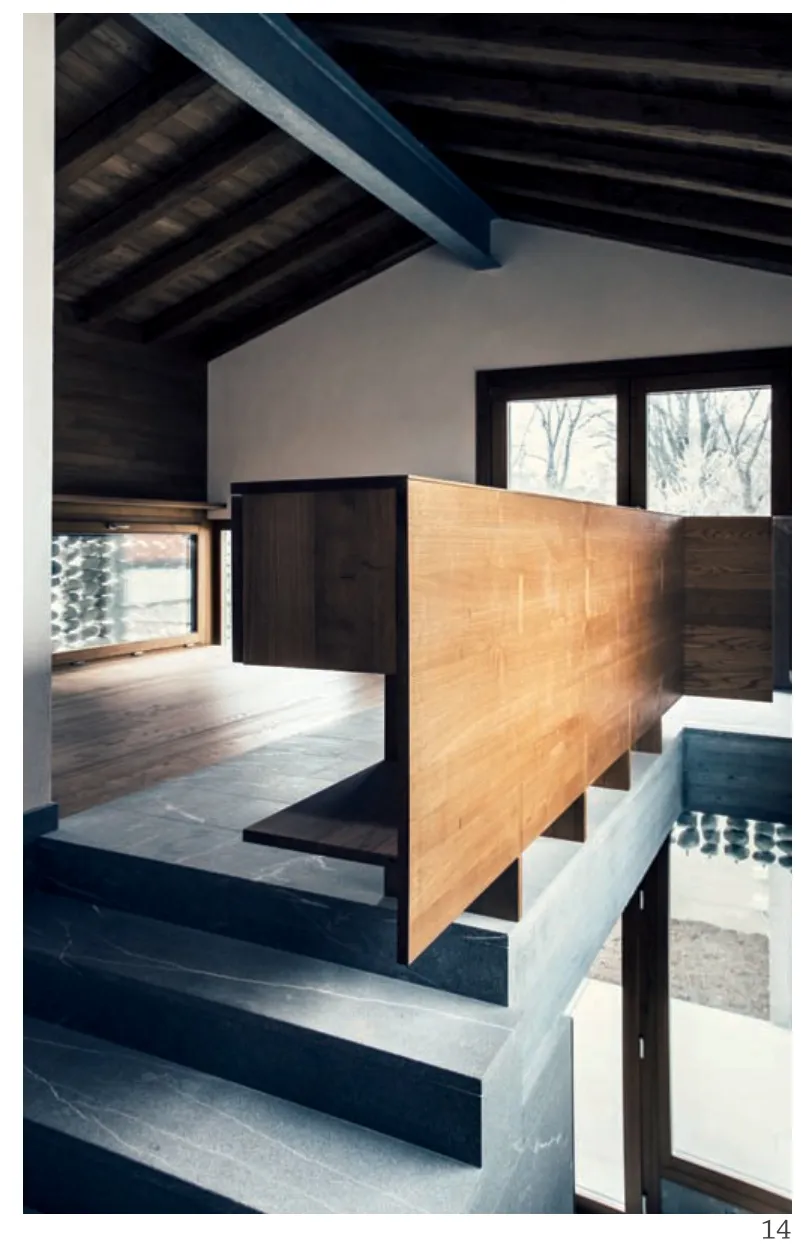
14 Elastico Farm事務所,STONED住宅2,室內空間中的木制細部和表面,意大利圣基里諾,2018/Elastico Farm,STONED House 2,interior space with wooden details and surfaces,San Quirino,Italy,2018

15 Elastico Farm事務所,STONED住宅2,創造性的磚石結構建立起住宅附屬單元和住宅主體之間的美學聯系,意大利圣基里諾,2018/Elastico Farm,STONED House 2,creative masonry generates aesthetic references between the ADU and the main house,San Quirino,Italy,2018
3 Mitigate
While the camouflage concept in Los Angeles supports idiosyncratic solutions and experiments,the European approach to building conservation tends to obstruct investigations into concepts of how to mitigate historical preservation with aspects of future change.When explored through design sensibility,however,the guidelines for historical preservation may hold incentives for adding contemporaneity through ADU architecture without compromising the memory of place.
Two European ADUs combine to serve as a critical inquiry into the city planning processes that legislate the conservation of buildings.These are Unit C by smogstudio at the fisherman's village R?? in Sweden,and STONED by Elastico Farm at the historic centre of San Quirino in Italy.Each was constrained by strict guidelines for historical preservation.Determined to explore innovative design solutions,both architects identified a paradox in the City's regulation feasible to use for mitigating the objectives of code.
In R??,the paradox referred to relationships between tectonics and style in the City's conservation programme.While the conservation programme required all new building designs to obey the tectonics of the local fisherman's house,the delineated building stock,which remained the object of conservation,included a small number of neoclassical villas with no disciplinary connection to local tectonics[5].Thus,the conservation programme imposed preservation codes that eventually would harm the historical significance of neoclassical architecture.This paradox became the incentive for smogstudio to mitigate the intent of preservation,and provided a space to interpret the architectural qualities of traditional designs through a contemporary approach on building form and plot distribution.
The paradox in San Quirino also arose from rules that regulate tectonics in design.Contrary to Unit C,which was a new addition,STONED was received from the refurbishment of an existing house,which previously had served as a barn.While the preservation code at San Quirino's historic centre required stone material for all building renovations,the seismic code prohibited stone in structural elements because "it is the most unsafe material to use in the seismically active area"[6].Thus,the preservation code shifted the historical significance of stone from a masonry concept to a stylistic exercise.When drained of disciplinary connotation,the stone material became an incentive for Elastico Farm to creatively mitigate the tradition of tectonics in contemporary architecture.Through unconventional combinations of concrete,stone,and see-through materials such as glass and electrowelded metal net,the architects drew on aspects of pattern,patina,and colour to upgrade aesthetic relationships between structure and detail in masonry architecture.
4 Conclusions
The distributed city may provide incentives for battling the current and future pandemics.However,the socio-cultural dynamics and historical significance of suburban space often converge to hamper efforts to upgrade the environmental ills that are propelled through the concept of suburbia itself,such as car dependency,social homogeneity,racial segregation,and consumerist behaviour.Methods are needed to insert change by preserving the memory of place.ADU architecture offers such a method.Through tactical designs,architects can utilise the ADU as a Trojan Horse to implement transformation while masking its avatar amnesia.To succeed at such a mission,conceptual frameworks to tangle the socio-political and cultural complexities in suburban development are needed.This article has framed "camouflage" and "mitigate"as two concepts feasible to use when regenerating the distributed city through design.Both concepts postulate a critique on the legislation in urban planning that continues to obstruct architecture's ability to explore alternative solutions.Drawing on the disciplinary premises of architecture to intensify the memory of suburbia,the ADU becomes the harbinger of sustainable low density.
猜你喜歡
北方建筑(2021年6期)2021-12-31 03:03:54
文苑(2020年10期)2020-11-07 03:15:36
學苑創造·A版(2020年10期)2020-11-06 05:21:26
現代裝飾(2020年6期)2020-06-22 08:43:12
現代裝飾(2020年4期)2020-05-20 08:55:08
作文周刊·小學一年級版(2016年27期)2017-06-03 23:21:17
絲綢之路(2016年9期)2016-05-14 14:36:33
新湘評論·下半月(2016年4期)2016-05-05 22:12:41
新湘評論·下半月(2016年4期)2016-05-05 22:12:41
海外文摘(2016年4期)2016-04-15 22:28:55