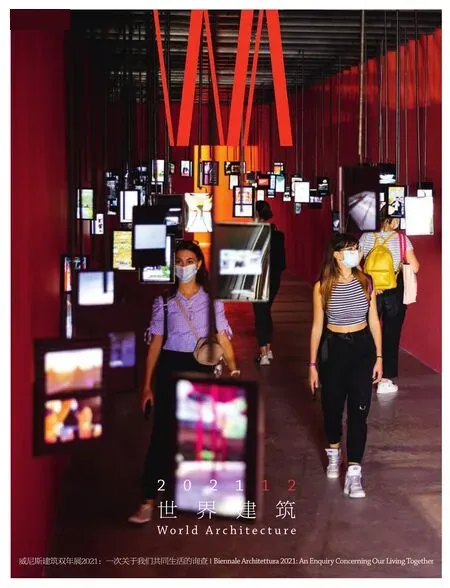
丹麥館:萬-物-連-通
2021-12-24 03:21:04策展人瑪麗安娜克羅
世界建筑 2021年12期
關鍵詞:建筑
策展人:瑪麗安娜·克羅

1 展館內景/Interior view of pavilion
丹麥館的循環水系統使參觀者、感官與周邊環境相互連通
萬-物-連-通:第17屆威尼斯國際建筑雙年展的丹麥館展示了一個由從威尼斯當地集水的巨型循環水系統構成的完整裝置,并以此聚焦人與人、人與自然之間的連通。
參觀者能在整個探索連通概念的作品中進行體驗,呼應2021建筑雙年展的主題“我們將如何共同生活?”丹麥館的創作讓我們思考:建筑作為一種藝術形式如何能讓人看到不可見的東西,并喚起一種人與地球萬物之間不可磨滅的連通感。
“人類在數百年間將世界分割成許許多多相互獨立的部分,造成了大量與氣候相關的問題,卻對我們的行為給千里之外帶來的影響毫無意識。而在我們生活的時代里,這些影響已能清晰地呈現出來。當前的疫情就是一個令人憂慮的實例,而這是好事也是壞事。丹麥館的目的就是創造一個新的關于凝聚的體驗空間,在這里,參觀者可以通過自己的身體感受到我們與萬物之間的連通。”丹麥館策展人瑪麗安娜·克羅表示。
展覽的建筑設計方、倫高與特蘭貝里建筑師事務所同策展人瑪麗安娜·克羅合作創造了整個裝置,徹底改變了丹麥館,并使它沉浸在自然的循環系統之中,而水是其中的核心要素。這個場地特有的展覽會調動人的所有感官。
“我們相信,通過調動各種感官,我們就能從更宏觀的環境中去理解自身。這是擔起善待地球和善待彼此責任的第一步。”瑪麗安娜·克羅稱。
作為藝術和建筑手法的一部分,現有兩館的建筑是該展覽整體的一部分。貫穿建筑的管道和室外的集水罐清晰可見。在場館大廳里,從地面到天花的紡織物為簡樸的結構增添了一種對比和觸感,另有一塊從原來的體育館中回收的地板被改造成巨大的懸浮平臺。在探索展覽各個空間的過程中,參觀者可以喝一杯用館中種植的檸檬馬鞭草沏成的茶,并以此融入這個循環系統之中,而這些植物也會吸收這個龐大的循環系統中的水。
本展覽提出了一個問題:我們如何能同這個世界(重新)建立一種有意義的新關系,并使它成為一個讓我們意識到人與人,以及與一切生物相互連通的基本狀態的地方?人與地球之間的依賴關系是全人類可持續發展的基礎。這一點通過將場館的裝置與地球本身的循環系統連通體現出來。
共同的生命系統
這個展覽的體驗出自參觀者與這座建筑及周邊環境之間的邂逅。在這里,水循環系統不斷營造著感官的體驗,場館中的水在原地進行收集。氣候的變換將不斷改變展覽的形象和感受——例如,場館的局部會被水淹沒,以此表明水既充滿詩意、具有強大的力量、能賦予生命,同時也難以控制。這一作品由相互連通的房間組成,水會流入這些房間,并成為展覽和感官體驗的一部分,隨后再離開場館,通過人體循環、蒸發、光合作用等過程,滲入大地。
“作為建筑師,我們嘗試探索人們共同生活的方式。我們創作的前提是:建筑永遠處在同自然的關系之中。在這座場館中,我們嘗試讓人們看到循環系統。這有助于我們將自身理解為宏觀世界的一部分。在最理想的情況下,展覽有助于澄清這一點:我們與萬物是連通一體的,并生活在互惠互利的關系之中。”倫高與特蘭貝里建筑師事務所的聯合創始人、建筑師萊娜·特蘭貝里解釋道。□(尚晉 譯)

2 展館外景/Exterior view of pavilion
項目信息/Credits and Data
委托方/Commissioner: Kent Martinussen, 丹麥建筑中心/Danish Architecture Center
主要贊助方/Main Sponsors: 丹麥建筑與規劃基金會,丹麥文化部,丹麥藝術基金會/Realdania, the Ministry of Culture Denmark, the Danish Arts Foundation's Committee
策展人/Curator: Marianne Krogh
建筑設計團隊/Architectural Team: Lundgaard & Tranberg Architects
合作/Collaborators: Ministry of Culture, Realdania, Statens Kunstfonds Legat- og Projektst?tteudvalg for Arkitektur, Beckett-Fonden, Dreyers Fond, Ny Carlsbergfondet, Knud H?jgaards Fond, Bestles Fond
其他贊助方/Other Sponsors: Kvadrat, Mads N?rgaard, HAY, Junckers, STARK, Danish Blue Cross, Danish Red Cross
設計時間/Design Time: 2019-2020
竣工時間/Completion Time: 2021.05
模型/Model: Lundgaard Tranberg Architects (fig. 3)
攝影/Photos: Hampus Berndtson (fig.1,2,4-10,12,13), Luca Delise (fig.11)

3 展陳模型/Exhibition model

4 展覽裝置/Exhibition installation
A Cyclic Water System Connects Visitors, Senses and Surroundings at the Danish Pavilion
Con-nect-ed-ness: The Danish Pavilion at the 17th International Architecture Exhibition - La Biennale di Venezia focuses on people's connection with each other and with nature, in a total installation consisting of a giant cyclic system of water collected locally in Venice.
Visitors to the Danish Pavilion at the 17th International Architecture Exhibition - La Biennale di Venezia in Venice can experience a single, complete work that explores the concept of connectedness. With reference to the main theme of the Biennale Architettura 2021, "How will we live together?", the Danish contribution reminds us of how architecture as an art form can render the invisible visible and evoke an indelible sense of connection between people and the Earth's elements.
"We are living in a time where we clearly experience the climate-related consequences of people having divided the world into separate units for centuries, without understanding that our actions have consequences many thousands of miles away. For better and for worse, with the current pandemic as a disturbing example. The aim of the Danish Pavilion is to create a space for a new experience of cohesion; where, with their own bodies, visitors can feel the connectedness between us all," says Marianne Krogh, curator of the Danish Pavilion.
Working together, the exhibition architects, Lundgaard & Tranberg Architects, and curator Marianne Krogh, have created a total installation that completely transforms the Danish Pavilion and immerses it in nature's cyclic system - with water as the core element. The site-specific exhibition caters to all the senses.
"We believe that, through our senses, we can begin to understand ourselves in a larger context. This is the first step toward taking responsibility, both in our approach to the planet and to each other", says Marianne Krogh.

5-7 展覽裝置/Exhibition installations
As part of the artistic and architectural approach, the existing architecture of the two pavilions is an integrated part of the exhibition. The pipes running throughout the building and the water collection tanks outside are visible. In the pavilion's large hall, floor-to-ceiling textiles add a contrast and tactility to the simple raw structures, while a recycled floor from a former gymnasium has been transformed into a giant floating platform. While exploring the various spaces of the exhibition, visitors can become part of the cyclic system by drinking a cup of tea brewed with leaves from the lemon verbena shrubs planted in the pavilion - shrubs which also absorb water from the extensive cyclic system.
The exhibition asks the question: How can we (re)create a new, meaningful relationship with the world as a place where we recognise the fundamental condition that we are connected - not just with each other, but with all living beings? The dependence between humans and Earth as the basis for a sustainable future for all is illustrated by linking the pavilion's installation directly to the planet's own cyclic system.

8.9 展館內景/Interior views of pavilion
One Living System
The exhibition experience arises in the encounter between the visitor, the building and the surroundings, where the power of water's cyclic system continuously shapes the sensory experience. Water in the pavilion is collected on site, and climatic fluctuations will continuously shape the look and feel of the exhibition - for example, parts of the pavilion will be flooded to illustrate that water is at once life-giving, poetic, powerful and uncontrollable. The work comprises connected rooms where the water flows in, becomes part of the exhibition and sensory experience, and then leaves the pavilion again, through bodies, evaporation, photosynthesis, and absorption into the ground.
"As architects, we try to provide answers to how people can live together. We work on the precondition that architecture always stands in relation to nature. In the pavilion, we have sought to make a cyclic system visible, which helps us begin to understand ourselves as part of something bigger. In the best-case scenario, the exhibition can help to make clear that we are all connected and live in reciprocity," explains Lene Tranberg, co-founding partner and architect at Lundgaard & Tranberg Architects.□

10-12 展館外景/Exterior views of pavilion13 展館內景/Interior view of pavilion
猜你喜歡
北方建筑(2021年6期)2021-12-31 03:03:54
文苑(2020年10期)2020-11-07 03:15:36
現代裝飾(2020年6期)2020-06-22 08:43:12
現代裝飾(2020年4期)2020-05-20 08:55:08
攝影之友(影像視覺)(2019年2期)2019-03-05 08:27:16
藝術家(2017年3期)2018-01-26 08:54:49
文學自由談(2016年3期)2016-06-15 13:01:16
福建農業科技(2016年10期)2016-03-07 09:46:49
少兒科學周刊·兒童版(2015年6期)2015-11-24 03:49:38
中國工程咨詢(2015年4期)2015-02-14 03:49:56