從圖紙到建筑:2021年威尼斯雙年展中國館建設過程中的參與者、條件和影響
2021-12-24 03:21:50馬塔曼奇尼余紫悅張顯MartaManciniYUZiyueZHANGXian余紫悅張顯TranslatedbyYUZiyueZHANGXian
世界建筑 2021年12期
馬塔·曼奇尼,余紫悅,張顯/Marta Mancini, YU Ziyue, ZHANG Xian余紫悅,張顯 譯/Translated by YU Ziyue, ZHANG Xian
第17屆威尼斯國際建筑雙年展中國館布展是一個空間的錯綜復雜的非線性變化的過程。2021年9月-11月期間,展館的室內和室外結構靜靜地矗立在威尼斯舊軍械庫展區里。然而從建筑學角度看,展館是一個由多方參與者、構成實體和背景條件的復雜網絡交織而成的動態空間[1]。策展及設計者是總部設在北京的建筑師張利教授及其團隊清華大學建筑設計研究院簡盟工作室,由于疫情原因展覽的搭建在主設計師被迫 “缺席”、布展推遲的情況下進行,并在現場進行了簡單的修改。
本文以圖片和文字的形式對2021年威尼斯雙年展中國館的施工過程進行了描述,反映了其實現過程的復雜性,不僅體現在空間元素的構成方面,而且體現在社科藝術品的構建方面[2]。作者旨在展開從構思到建成建筑的多方面的設計過程:這個過程通常試圖實現 “最大限度地保存”和 “最小的損失”[3],但需要進行轉譯、演繹和重新設計的步驟。下面的調查也是為了引發對建筑如何形成的思考,或者換句話說,當設計師不在現場,不能直接了解到當地環境和場地特征時,設計如何變成實際的建筑。中國館是這些條件的縮影,并且體現了設計師無法到達現場、當地建筑師和專業人員這些因素之間的關系及性質將如何影響所造建筑的呈現效果。
本文的作者部分地參與了設計過程,并在施工階段作為現場管理團隊的成員。因此,文章的敘述提供了一個來自 “內部 ”的觀點。論點圍繞著5個關鍵詞的探討,這些關鍵詞概述了在整個布展完成過程中遇到的主要難點:延遲、缺席、演繹、整合、重新設計。文章配合現場照片以提供視覺的信息。并使用圖表,通過系統的、概要的、涵蓋參與者的關系圖來進一步豐富闡述。參與者之間的相互影響和互動也在時間線上得到了體現[4]。
中國館的落地過程解決了該項目在實體,內容,關系上的特征問題。“實體”表示了展覽中實體的構件和技術設備;“內容”代表類似數字資料的展示;“關系”指代多方參與者和實際情況以及他們對最終建筑呈現的影響。
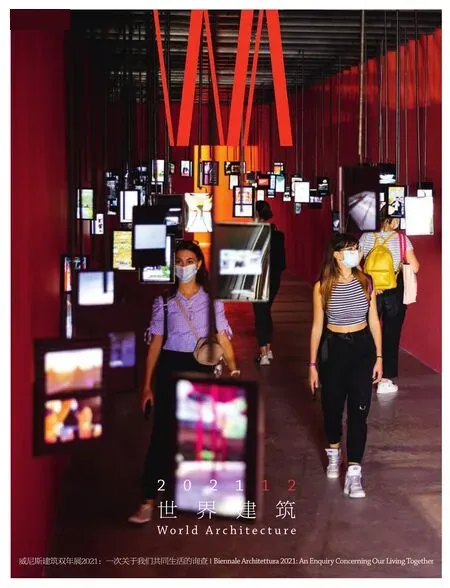
以“院兒:從最大到最小” 為題,中國館在空間上通過建筑元素分為5部分展示[5]。游覽路徑從30m長的廊道開始,在3m高的石膏板墻之間懸掛著110臺平板顯示器,展示職業建筑師在作品中對院兒(中國傳統多戶共享的院落)的相關詮釋。接著轉入了6個相繼排放位于標志性弧墻后方的“盒子”。弧墻長34m、高7m,表面以鋁板覆蓋,由16根鋼柱支撐。在室外,在有頂棚的開放結構中,固定了16塊彩色的刻有圖案的面板,描繪著中國的街巷游戲(圖1)。
原定于2020年舉辦的第17屆威尼斯雙年展的策展委托和中國館的空間主題構思都開始于2019年夏天。初步階段在2020年1月中旬告一段落,最終的設計方案遞交給了威尼斯雙年展組委會。此后,新冠肺炎疫情成為了最主要的一個“因素”[6],影響著中國館施工現場、威尼斯雙年展組織以及全球范圍活動運營的原定計劃。
延誤
在中國館建造初始,“延誤”作為一個內在的因素出現了。疫情不僅僅導致了公共衛生相關的安全限制,還有物流延期的問題。在2020年4月中旬,威尼斯雙年展宣布由于疫情影響,開展日期將從2020年5月23日延遲到8月29日。從那時起,中國館策展方改變了在意大利當地購買材料并管理整個制造過程的最初計劃。當時由于勞動力和建造材料的成本提升,以及2020年春季的嚴格封鎖,許多意大利的工廠和建筑公司關閉,大部分預制工程轉移到了中國北京。2020年5月,雙年展主辦方宣布第17屆國際建筑展最終將推遲到2021年5月22日-11月21日。這個決定不僅僅考慮到在當時的情況下,無法舉辦這類大型國際性活動,也表達了對參加由哈希姆·薩基斯策展、主題為“我們將如何共同生活”展覽的建筑師和參與方的尊重[7]。北京華薇天成文化傳媒有限公司在2020年完成了預制過程,并在2021年初進行了預搭建測試。在接下來的時間里,所有的結構和飾面材料被儲藏起來,等待被運往威尼斯。
2021年5月22日,第17屆國際建筑展正式向公眾開放。由于全球封鎖的幾個月里,海運貨物積壓,送達的日期一再推遲。最終,在8月13日,集裝箱才抵達威尼斯軍械庫。
時間維度的因素變得非常關鍵,也讓現場及時的修改變得必不可少。時間影響了建筑構件的“實體”和“關系”特征。計劃的推遲和船運的拖延意味著預制件面臨長時間的存儲和暴露在溫差較大的環境。這導致了一些構件的變形和飾面材料的劣化。此外,船運的延期也給當地施工帶來挑戰,他們不得不加快整個施工的進程。
缺席
The China Pavilion installation at the 17th International Architecture Exhibition - La Biennale di Venezia has been the spatial outcome of an nonlinear process. Between September and November 2021, the indoor and outdoor structures of the pavilion stood still and majestic in the Arsenale. Nonetheless, they innerly vibrated of the dynamics that had been performed by an intricate network of interacting actors, constituting entities and contextual conditions[1]. Curated and designed by architect and professor ZHANG Li, based in Beijing - Atelier TeamMinus, Tsinghua University, the physical on site completion of the installation was partly characterised by compelled "absences", postponements and in itinere modifications.
The present article proposes the textual as well as pictorial portrayal of the assembly phase of the China Pavilion at La Biennale di Venezia 2021, reflecting on the complexity of its realisation process, not only in terms of spatial elements' composition, but in terms of implications of a sociotechincal artefact's construction[2]. The authors aim to unfold the multifaceted process of design that led from conception to built architecture: a process that generally attempts to "maximum preservation" and "minimum loss"[3], yet required operations of translation, integration and redesign. The following enquiry intends also to trigger reflections on how architecture can happen, or in other words, how design can turn into built architecture when the designer is not present on site and does not have direct access to local environmental and context's features. China Pavilion epitomises these conditions and offers, in addition, insights on how the nature of the relationship between the non-present designer, on one hand, local architect and professionals, on the other, can affect the architectural outcome.
The authors of the article were partially involved in the design process and were part of the site manager team during the construction phase. Therefore, the narration provides a point of view from "within". The arguments are organised around the discussion of five keywords that outline the main entangled challenges encountered throughout the completion of the installation: delay, absence, interpretation, integration, redesign. Pictures integrate the text with visual information. A diagram enriches the narration through a systematic and synoptic mapping of the actors involved. Their implications and interactions are taken into account in terms of diachronic networks[4].
The realisation process of the China Pavilion is tackled in terms of physical, content and relational features of the project. "Physical" stands for the spatial elements and technological devices of the exibition; "content" for the analogical and digital materials displayed; "relational" for the actors involved as well as for the contextual conditions and their effects on the final built outcome.
Titled "Yuan-er, a Courtyard-ology: From the Mega to the Micro", the Chinese pavilion included five conceptual sections spatiallly displayed through different architectural elements and digital devices[5]. The path visit started with a 30-metre-long corridor defined by 3-metre-high plasterboard walls where 110 pads hanged and showed videos of practicing architects' interventions related to yuan-er - the Chinese multi-family traditional courtyard. It then turned along six subsequent "boxes", positioned on the back of a monumental curved wall: a 34-metre -long and 7-metre-high surface of alluminium panels, supported by 16 steel pillars. Outdoor, a covered open structure framed 16 carved coloured panels depicting Chinese street games (Fig. 1).
The process of both curatorship and spatial conception of the China Pavilion for La Biennale di Venezia 2021 (originally 2020) begun in Summer 2019. This early phase ended around mid January 2020 when a final design project was delivered to the organising committee of La Biennale. Thereafter, COVID-19 pandemic became a major "actant"[6], impacting on the original schedule of China Pavilion's construction site, La Biennale di Venezia organisation and worldwide operations.
Delay

1 中國館軸測:2021年威尼斯雙年展,都靈理工大學管理團隊現場修改后的展覽設計/Axonometry of the China Pavilion - La Biennale di Venezia 2021, exhibition design after on site modifications made by the site manager team from Politecnico di Torino ?Atelier TeamMinus & China Room - Politecnico di Torino
Delay emerged as an inherent condition of the China Pavilion realisation process; firstly, due to health-related restriction measures, secondly, to logistic issues, both caused by the break out of the pandemic.
In mid April 2020, La Biennale annoucend the postponement of the opening date from May 23 to August 29, 2020, as a first response to the health emergency. At that point, China Pavilion curator's earliest plan of purchasing and managing the entire production process in Italy changed. Due to the cost of labour and building materials and to the strict lockdown in Spring 2020 - that forced the closure of factories and construction companies in Italy - most of the prefabrication process was moved to Beijing, China. In May 2020, La Biennale announced the definitive postponement of the 17th edition of the International Architecture Exhibition to May 22 - November 21, 2021. The decision was taken in view of the impossibility of managing such articulated and international event, and also as a sign of respect towards the commitment of architects and participants to the "How will we live together?" exhibition curated by Hashim Sarkis[7]. The Beijing Huawei Tiancheng Culture Media Co., Ltd construction company completed the prefabrication process in 2020 and tested the elements' assembly in the early months of 2021. During the rest of the months, structural and finishing materials were stored waiting to be shipped over to Venice.
On May 22, 2021, the 17th edition of La Biennale opened to the public. The shipment did not follow the planned schedule. Due to maritime traffic accumulated throughout months of global lockdown, the delivery was further delayed. The containers eventually arrived at the Arsenale in Venice on August 13.
The dimension of time played a crucial role and brought to necessary on site in itinere modifications. It impacted on both the "physical" and the "relational" features of the installation. The schedule postponement and the prolonged period of transition by ship implied the storage of the prefabricated structures and their exposure to large temperatures excursions. In some cases, this caused the alteration of structural elements' shape and the deterioration of finishing materials. Moreover, the delay of the containers' delivery raised challenges in managing the labour force on site which had to speed up the construction process.
Absence
Not only the temporal but also the spatial dimension impacted on the completion of China Pavilion's installation. The entire Chinese curatorial team was not able to reach Venice due to the pandemic break out and the travel restrictions. The physical distance between Beijing and Venice caused the absence of the curator designer on the working site and a number of related consequences. In order to deal with this compelled condition, curator ZHANG Li commissioned the supervision of the pavilion's construction to an international group of researchers and students of the China Room research centre and the Department of Architecture and Design-DAD at Politecnico di Torino, Italy, coordinated by professor and architect Michele Bonino. Thanks to the collaborative relationship with Tsinghua University established almost a decade ago, the Politecnico team was entrusted as site manager and interpreter of the curatorial project. The main goal was to pursue a high-quality architectural outcome that respected the original design and at the same time responded to on site features and requirements.
The absence of the curator on site implied actions that would have not been performed otherwise. First, videos showing the assembly process of the architectural elements were shooted during structural tests in China by the manufacture company to instruct the construction companies in Venice. Second, since in some cases design drawings did not provide detailed information about the prefabricated structure, the site manager had to interpret them. Third, on site modifications and integrations required negotations with the curator designer. Fourth, alterations of the original project were needed to respond to safety requirements, incorrect survey measurements of the site and materials' deterioration.
The set up of the construction process was challenging. The building procedure had to be adapted to on site features. For instance, the existing building of the Arsenale hosting China Pavilion is much smaller than the producing factory in China. This condition impacted on the assembly process of the curved alluminiun wall. Nonetheless, once the cooperative and interactive relation among the curatorial team and the construction company in China, the Politecnico team, the contractor, the test engineer and the construction companies in Venice was clarified and strengthened, the progress of the construction was only challenged by the deterioration of the building materials. At every step, the Politecnico team checked the procedures on site with the construction companies and the engineer in charge of the final test, and reported to the curatorial and Chinese construction team, constantly discussing and negotiating modifications and integrations when necessary. In this way, the circumstance of contingent "absence" was rapidly turned into a regular "dialogic interaction" among the actors involved, led and filtered by the curatorial team, on one hand, and the Politecnico team, on the other.
不僅僅是時間維度上的因素,空間維度上的因素也影響著中國館的搭建。由于疫情,整個中國的策展團隊無法到達威尼斯。北京和威尼斯之間的客觀距離造成了策展人設計師在工作現場的缺席以及一系列相關后果。為了應對這種迫不得已的情況,策展人張利委托中國室研究中心及意大利都靈理工大學建筑與設計系(DAD)的研究人員和學生組成的國際小組監督展館的建設,由建筑師、教授米凱利·博尼諾協調現場工作。由于與清華大學建立了近10年的合作關系,都靈理工團隊被委托作為現場管理者,成為策展項目的現場闡釋者。我們的主要目標是追求高質量的建筑成果,在尊重原設計的同時,也需要靈活變通以滿足現場的特點和要求。
策展人不在現場,就意味著不得不增加一些行動。首先,在中國的結構測試期間,制造公司拍攝了建筑構件搭建過程的視頻,以指導威尼斯的施工公司。其次,由于部分設計圖紙沒有提供關于預制構件的詳細信息,因此現場管理人員必須對其進行解釋。 第三,現場的修改和整合需要與策展設計師進行協商。第四,需要對原項目進行修改,以適合安全要求、解決對場地尺寸誤差和材料的劣化產生的問題。
施工過程的推進是具有挑戰性的,建筑程序必須適應現場的特點。例如,中國館所在的軍械庫舊建筑比中國預搭建團隊的工廠小許多。這種情況影響了弧形鋁板墻的搭建過程。盡管如此,一旦策展團隊和中國的建筑公司、都靈理工團隊、承包商、測試工程師和威尼斯的建筑公司之間的合作和互動關系得到明晰和加強,施工的進展則只受到建筑材料劣化帶來的挑戰。在每一個步驟中,都靈理工團隊都與建筑公司以及負責最終測試的工程師一起監督現場的施工過程,并向中國展館負責人和中國建筑團隊報告,在必要時不斷討論和協商修改和整合。以這樣的方式,在策展團隊和理工大學團隊的引導和過濾下,特定環境下的 “缺席”迅速演變成為相關合作方之間的定期 “對話式互動”。

2 曲線墻的早期施工階段。在安裝前3根立柱時,由于材料在儲存和運輸過程中變形,導致立柱頂部錯位,現場施工團隊受到誤導/Early construction phase of the curved wall. When setting up the first 3 columns, the construction team on site was misled by the misalignment of the top of the pillars caused by material's deformation during storing and shipping ?Marta Mancini
演繹
來自都靈理工大學的監理團隊彌補了策展團隊在施工和搭建過程不在場的情況,不僅保證了搭建的完成,更追求將原本設計方案完整地轉譯成真實的建筑。在中國館的案例中,建筑師的設計媒介:圖紙——和他的作品的最終成果建筑——之間的區分明顯地顯現出來[3]。這個轉譯的過程意味著對原本設計的演繹。轉譯過程包含了兩個層級,首先是一般建造過程中也常常遇到的、從圖紙到建筑物的轉譯。其次是從策展方設計師的視角到更了解現場情況的當地建筑師的視角的轉譯。由可信賴的專業設計師團隊擔任施工現場的監理,對于策展方案全面而準確的演繹至關重要。
比如,預制鋁板墻的建造就具有挑戰性。三維建模曲面的剖面并沒有從上而下統一,二維圖紙所提供的裝配步驟信息非常有限(圖2-5)。此外,由于從中國發送的部件的標簽不系統,現場施工團隊需要監理建筑師的支持,以確定結構的層次結構,以便與構件匹配(例如立柱對齊、龍骨分布、臨時對角支撐定位、弧形墻與背面支撐“盒子”之間的連接,圖6)。
整合
監理團隊不僅協助威尼斯建造團隊更好地根據設計圖紙和中國預制公司拍攝的指導視頻對設計進行演繹,他們更保證了搭建過程的效率,控制了搭建部分的品質,同時采取積極主動的方法彌補現場的錯誤。在一些搭建部分,施工管理者需要臨時地擔任設計師的角色,提出技術上整合的方案和根據策展方的設計理念的局部重新設計。
比如,在展覽的第一部分,懸掛平板顯示器的金屬管的長度和原本設計不一致。因此,都靈理工團隊重新排布了平板的位置和它們各自對應的金屬管,旨在達到最初設計的在展廊上形成三維拱廊的視覺效果。此外,不僅僅是實體構件的重新整合,平板廊展示的內容也需要重新整合。最初的設計是由110部平板展示建筑師的訪談,并在特定時間同步出現孔明燈的景象。雖然,策展團隊提供了媒體管理平臺,可以根據平板的注冊編號控制在線的平板,然而,由于運輸的問題,所有的設備失去了遠程連接,并且無法和原本設定的位置相對應。作為補救措施,監理團隊不得不依次登記每個設備的Mac地址并重新投放正確的視頻。這些對電子設備的重新設置、整合,對于最終效果的完整連貫呈現是必不可少的(圖7)。

3 曲線墻結構:支柱和臨時支撐結構/Curved wall construction. Pillars and temporary supporting structures ?Marta Mancini
重新設計
出于兩個原因一些重新設計是有必要的。首先,在現場的測量和當時考察后繪制的圖紙數據不同:現實中的空間更狹窄。這些數據的誤差意味著一系列現場的改動:整個弧形墻在平面上轉動了,同時6個盒子的體量被重新設計,為了讓走廊達到最低的安全通行寬度,一塊結構板被移走。其次,一些建筑材料在船運儲存期間嚴重地劣化了。室外展館的兩層屋面材料損壞且無法使用。由于只有在第一塊面板安裝到位后才能進行評估,在當地工程師確認預制結構不適合抵抗威尼斯定期發生的強風天氣后,不得不修改和重新設計。現場管理團隊向策展人提出了不同的解決方法,建議用半透明的輕質織物代替原本不透明的屋面覆蓋材料,并且改變了最終建筑呈現的空間感受(圖8)。
盡管困難重重,在2021年9月15日,室內和室外展館終于向公眾開放了,而距離最初的設想已經過去了將近兩年。
對這5個關鍵詞的分析讓中國館的一些隱藏特征浮出水面,更廣泛地說,是建筑的一些隱藏特征。如圖表所示(圖9),縱觀實體和內容特征,關系特征——由參與者和特定情境組成——使得最終的建筑以這樣的形式呈現。
疫情在時間和空間維度上都影響了威尼斯雙年展的呈現。推遲和延誤對搭建造成了時間上的轉移。相應地,這也導致了承包商對威尼斯施工團隊的重新選擇,施工時間的壓縮,建筑材料的劣化此類問題。否則室外的屋面材料就不會重新設計。
假如策展團隊可以到達現場?他們會不會找到不同的方案來整合設計呢?在第17屆威尼斯雙年展中,中國館不是唯一一個面臨策展團隊“缺席”的展館。比如,日本館也是其中一個遇到類似情況的展館。然而,在日本館,策展方“接受”缺席施工現場以及部分裝置構件在船運期間丟失的情況,并且接納它們作為展覽理念的一部分[8]。在中國館,目標則是即便遇到突發情況,也要盡可能地尊重初始設計。而選擇可信賴的現場監理團隊則是實現最終建造的關鍵。

4 曲線墻結構:支柱和龍骨/Curved wall construction. Pillars and keels ?Marta Mancini

5 曲線墻結構:鋁板的定位/Curved wall construction. Positioning of aluminium panels?Marta Mancini
在一般的建造過程中,如果設計者能在施工現場,項目的材料文件歸檔就不需要了。建筑師可以將所有施工操作一步步地描繪出來,如需要采取怎樣的尺寸、需要建造怎樣的體量,他可以指導工人如何對構件進行塑形和展示。但建筑師經常會因為各種各樣的原因而無法抵達現場,進而將他們這種任務的實現委托以工程文件[9]。相應的,這些工程文件需要被轉譯和演繹。正如前OMA設計師奧雷·舍人所說:“解釋和翻譯的過程是一個過程,設計只有在建筑完工時才會停止。有時甚至不存在,因為建筑一直在變化。”[10]
圖紙是建筑師的主要手段之一,是探索和實驗的工具。它們在建造之前就要完成,“它們存在于構造體驗發生之前。”[11]它們因現實中無法預見的、圖紙之外的現實中各種不可抗力因素而被充分利用[12]。它們揭開了將建的建筑的面紗,同時允許插入不同的想法作為替換。然而,“繪畫和建筑之間的變化在很大程度上仍然是一個謎”[13]。
盡管中國館的建造過程中有被迫延期和(建筑師)缺席的情況,但最終建成的展覽仍體現出策展團隊、現場管理團隊和建造公司之間溝通與合作的能力。在富有成效的協商中,討論得出的修改和整合方案帶來了計劃外的高質量結果。由于多年的合作,監理團隊對于策展人的想法和工作方式十分熟悉[14], 在某些情況下,監理團隊僅僅負責現場對原本設計圖紙的演繹,在少數特定情況,監理團隊也擔任了積極主動的設計師的角色。

6 曲線墻:共同感受/Curved wall - Together we Feel ?Samuele Pellecchia/Prospekt

7 “平板街”:共同學習(第一部分)/Pads street -Together we Learn (Part I) ?Samuele Pellecchia/Prospekt

8 戶外展亭:共同治愈/Outdoor pavilion - Together we Heal ?Samuele Pellecchia/Prospekt
疫情一直在影響著我們對建筑的構思和建造方式。設計者對現場的缺席通常會導致施工效率和美學品質的顯著降低,甚至發生事故[15]。盡管如此,中國館證明了(在這種情況下)建筑仍然可以落成,以及相互信任和信息交流的紐帶可以將建筑師的缺席轉變為一個建造的多方交流過程,最后落成計劃外但仍具有高質量的建筑。□
Interpretation
The supervising site manager team from Politecnico di Torino compensated the absence of the curator architect during the construction and assembly works, guaranteeing the completion of the installation and pursuing the translation of the original design drawings into built architecture. In the case of the China Pavilion, the separation between the architect's medium of design -drawing - and the final the outcome of his work - the building - emerged distinctly[3]. The act of translation implied operations of interpretations of the original design. The translation was operated at two levels. First, from drawings to built up space, as it ordinarily happens in the architectural discipline. Second, from curator designer's vision to local architect's direct understanding of on site conditions. The on site supervision by a trustful team of professional designers was essential for the accurate interpretation of the comprehensive curatorial project.
The construction of the prefabricated alluminium curved wall, for instance, was challenging. The three-dimensionally modelled surface did not have a uniform section and the twodimensional drawings provided limited information about the assembly procedure (Fig. 2-5). Moreover, due to the unsystematic labeling of the components sent from China, the construction team on site needed support from the supervising architect to figure out the hierarchy of the structure, and match the physical elements (e.g. columns alignement, keels distribution, temporary diagonal supports positioning, linkage between the curved wall and the supporting "boxes" in the back, Fig. 6)
Integration
The supervising team not only supported the construction company in Venice in the interpretation of the design drawings and the instructive videos shooted by the manufacturing company in China. It guaranteed also the efficiency of the construction process, it controlled the aesthetic quality of the architectural outcome and it adopted a proactive approach to on site errors remediation. In some operations, the site manager temporarily took up the role of the designer proposing technical integrations and details redesign, in coherence to the curatorial and design concept.
In the first section of the exhibition, for instance, the length of the pipes supporting the hanging pads turned out not to correspond to the original design. Therefore, the Politecnico team reorganised the position of the pads and their corresponding pipes to form the original visual "arch" developed three-dimensionally throughout the corridor. Furthermore, not only the physical but also the content features of the pad street needed on site integrations. The original plan was to have 110 pads displaying interviews of architects and one shared image of a lantern showing up synchronously. Although, the curatorial team had provided a media management system to control online the single pads based on their registration number, due to transportation problems, the devices lost their remote connection and were unable to match with the originally designated position. As remediation, the supervising team had to record again the Media Access Control Address of all devices and relink the correct video one by one. These operations of reset of the digital devices were necessary integrations to guarantee the coherent final performance of the installation (Fig. 7) .
Redesign
A few actions of redesign were necessary for two reasons. First, on site measurements turned out to be different from those reported in the aftersurvey drawings: the real space was narrower. This erroneous information implied a series of in itinere modifications: the rotation in plan of the entire curved wall and the redesign of the six boxes' volume through the removal of one structural panel in order to meet the minimum safety requirements of corridors' width. Second, some building material were highly deteriorated due to the prolonged storing periods. Two layers of the outdoor pavilion's roof were damaged and inoperable. Since this evaluation was possible only after the first panels were put in place, when the local engineer verified that the prefabricated structure would have not been suitable to resist conditions of strong wind periodically occuring in Venice, modifications and redesign were necessary. The site manager team proposed to the curator a different formal solution, suggesting to substitute the opaque layer cover with a semi-transparent light fabric and, thus, changing the spatial atmosphere of the final architectural outcome (Fig. 8).
Despite the numerous challenges, on the 15th of September 2021 the indoor and outdoor pavilions eventually opened to the public after almost two years from their preliminary conception.
The analysis of these five keywords has let emerge some hidden features of the China Pavilion and, more in general, of architecture. As shown in the diagram (Fig. 9), looking over the physical and the content features, the relational ones - consisting of actors and contextual conditions - were what made the final built outcome possible in the way it showed.
The pandemic impacted on the display of Venice Biennale in terms of both temporal and spatial dimensions. Postponements and delay caused a temporal shift in the realisation of the installation. In turn, this implied the reselection of the construction companies by the main contractor in Venice, the reduction of time of the on site processes and the deterioration of building materials. Would the cover roof of the outdoor structure have not been redesigned otherwise?

9 從設計概念到建筑。關于中國館“關系”特征的圖表:涉及的參與者、采取的行動、背景條件/From design concept to built up architecture. Diagram about the "relational" features of China Pavilion: actors involved, actions pursued, contextual conditions ?Marta Mancini, YU Ziyue, ZHANG Xian
What if the curator designer had been present on site? Would he have found different solutions to integrate the design?
Within the 17th edition of La Biennale di Veneice, the Chinese Pavilion was not the only one to face the "absence" of the curator architect on site. The Japanese Pavilion, for instance, was among the ones which encountered similar issues. Nonetheless, if in the Japanese case the curator "accepted" the condition of distance from the site - as well as the partial lost of the installation's components during the shipment, embracing it as conceptually part of the exhibition[8]- in the China Pavilion, the goal was to respect the original design as much as possible when facing unexpected situations. The selection of a trustworthy site manager was key to the achievement of the final outcome.
In ordinary architectural construction processes, if the designer was always present on site, documentation of the project would not be needed. The architect could illustrate step by step the operations to follow, what measurements to take, what volumes to build. He could instruct the craftsmen on how to shape and display the components. Yet, architects - due to a number of different reasons - are often absent and delegate the actuality of their tasks to documents[9]. In turn, documents need to be translated and interpreted. As argued by former OMA designer, Ole Scheeren: "The process of interpretation and translation is one, and design is one that only stops when the building is finished. And sometimes it's not even there, because the building keeps on changing."[10]
Drawings are one of the main means of the architect, tools of exploration and experimentation. They are done prior to construction, "they exist before tectonic experiences could take place"[11]. They are exploited for their unforeseen generative power of a reality outside the drawing. They unveil the building-to-come and at the same time allow to fix alternatives unfamiliar ideas[12]. However, "the transmutation that occurs between drawing and building remains to a large extent an enigma"[13].
Although the realisation process of the China Pavilion presented conditions of compelled delays and absences, the final built up exhibition embodied abilities of dialogue and cooperation among the curatorial team, the site manager team and the construction companies. Modifications and integrations were discussed during fruitful negotiations that brought to unplanned outcomes of high quality. Filled in with knowledge regarding the curator's vision and modus operandi due to many years of previous collaborations[14], in some cases, the supervising team solely supported the interpretation of the original design drawings, in few others, it acted as proactive designer.
The pandemic has been impacting on the way architecture is conceived and produced. The absence of the designer on site may often result in a significant reduction of process efficiency and aesthetic effectiveness or even in accidents[15]. Nonetheless, China Pavilion proved how architecture can still happen and how a relationship of mutual trust and intellectual exchange can turn absence into a dialogic process of uplanned yet high-quality architectural production.□
猜你喜歡
北方建筑(2021年6期)2021-12-31 03:03:54
建材發展導向(2021年9期)2021-07-16 07:11:36
文苑(2020年10期)2020-11-07 03:15:36
現代裝飾(2020年6期)2020-06-22 08:43:12
藝術啟蒙(2018年7期)2018-08-23 09:14:18
海峽姐妹(2017年7期)2017-07-31 19:08:17
Coco薇(2017年5期)2017-06-05 08:53:16
中國房地產業(2016年2期)2016-03-01 01:25:48
河南電力(2016年5期)2016-02-06 02:11:34
少兒科學周刊·兒童版(2015年6期)2015-11-24 03:49:38