干旱綠洲農(nóng)田無核白葡萄樹蒸散發(fā)的分割研究
2022-01-26 05:43:10王尚濤趙楠張揚(yáng)張琨朱高峰
灌溉排水學(xué)報(bào) 2021年12期
王尚濤,趙楠,張揚(yáng),張琨,朱高峰
?專家評(píng)述?
干旱綠洲農(nóng)田無核白葡萄樹蒸散發(fā)的分割研究
王尚濤1,趙楠2,張揚(yáng)2,張琨3,朱高峰2
(1.青海大學(xué) 水利電力學(xué)院,西寧 810016;2.蘭州大學(xué) 資源環(huán)境學(xué)院,西部環(huán)境教育部重點(diǎn)實(shí)驗(yàn)室,蘭州 730000;3.中國科學(xué)院 青藏高原研究所,北京 100101)
【】探究干旱綠洲區(qū)典型農(nóng)田生態(tài)系統(tǒng)作物蒸騰蒸散特征及蒸騰占總蒸散的比值,為的研究提供數(shù)據(jù)支撐。聯(lián)合運(yùn)用樹干液流(包裹式)、渦度相關(guān)法以及微氣象觀測系統(tǒng)于整個(gè)生長季(5—10月)對(duì)敦煌沙漠綠洲區(qū)無核白葡萄樹(L.)的冠層蒸騰(Transpiration,)和總蒸散(Evapotranspiration,)特征進(jìn)行了連續(xù)測定;并分析了不同生態(tài)系統(tǒng)及不同觀測模擬手段下蒸散發(fā)的分割結(jié)果。生長季中,冠層蒸騰量從0.20 mm/d上升到生長中期的8.13 mm/d,然后逐漸下降至末期落葉時(shí)到達(dá)極小值,日均蒸騰量為3.32 mm/d。總蒸散發(fā)量由0.44 mm/d增加到9.97 mm/d,然后逐漸下降至末期到達(dá)極小值,日均總蒸散量為4.91 mm/d。生長季冠層蒸騰量()占總蒸散量()的值()約為63.5%。生長季內(nèi),干旱綠洲區(qū)農(nóng)田系統(tǒng)無核白葡萄樹冠層蒸騰是總蒸散的主要水分通量。
干旱綠洲區(qū);無核白葡萄;樹干液流;渦度相關(guān);
0 引言
【研究意義】蒸散發(fā)主要包含土壤蒸發(fā)與植被蒸騰2個(gè)組分,其過程受植被根系分布、氣孔導(dǎo)度和氣象因素(輻射、水汽壓差)等影響,是全球能水循環(huán)的重要環(huán)節(jié)[1-4]。研究表明,陸地生態(tài)系統(tǒng)每年通過蒸散發(fā)返回大氣的降水有60%左右,而在干旱區(qū)農(nóng)田生態(tài)系統(tǒng)高達(dá)90%[2, 5-7]。其中,蒸騰過程是蒸散發(fā)的主要分量,也是精準(zhǔn)灌溉及水資源規(guī)劃中不可或缺的數(shù)據(jù)之一[8]。因此,分析干旱綠洲區(qū)農(nóng)田生態(tài)系統(tǒng)蒸騰及蒸散特征有助于理解區(qū)域水能循環(huán)過程,為揭示農(nóng)田生態(tài)水文過程、精準(zhǔn)灌溉等提供科學(xué)指導(dǎo)[9]。
【研究進(jìn)展】目前,蒸散發(fā)的獲取方法有水量平衡法(如蒸滲儀法)[10-12,16]、微氣象法(渦度相關(guān)法、空氣動(dòng)力學(xué)法等)[13-15, 21-22]、各類數(shù)學(xué)模型(如大葉模型、雙源模型、陸面過程模型)等[27-30],而其分割方法主要有穩(wěn)定同位素法[8]、聯(lián)合渦度相關(guān)與樹干液流技術(shù)[14-15,31-32]、模型模擬等[7, 43, 45, 47]。【切入點(diǎn)】樹干液流技術(shù)可以在野外精準(zhǔn)連續(xù)測量單株耗水,然后進(jìn)行升尺度處理,即可獲得冠層尺度蒸騰[20, 23-26],再將其與渦動(dòng)相關(guān)法所得總蒸散結(jié)果相比較,可進(jìn)一步揭示區(qū)域農(nóng)田生態(tài)系統(tǒng)蒸騰及總蒸散特征。【擬解決的關(guān)鍵問題】基于渦度相關(guān)和樹干莖流技術(shù),進(jìn)行干旱綠洲農(nóng)田無核白葡萄樹蒸散發(fā)的分割研究,為進(jìn)一步研究干旱綠洲農(nóng)田生態(tài)水文過程、實(shí)施精細(xì)灌溉及提高水資源利用率提供依據(jù)[6]。
1 材料方法
1.1 研究區(qū)概況
研究區(qū)(94°06′E,39°55′N)位于敦煌市西南沙漠綠洲區(qū)境內(nèi),屬暖溫帶干旱性氣候。土壤類型為沼澤土和鹽漬土等,多年平均0約2 400 mm,年日照時(shí)間3 115~3 247 h,年平均氣溫約為9.3 ℃,年均降水量36.9 mm[41]。地表植被均質(zhì),地勢平坦,地下水埋深10~50 m。研究區(qū)灌溉水源來自河水補(bǔ)給,無核白葡萄為當(dāng)?shù)刈钪饕魑颷14-15, 33-34]。
試驗(yàn)田規(guī)模450 m×160 m(圖1(a),圖1(b)),籬架式栽植,架高約2.5 m,壟間距3 m,西北-東南朝向,棵間距約0.6 m,整個(gè)生長季長約180 d左右(4—10月),地表無其他覆蓋物。研究區(qū)不同深度土壤干體積質(zhì)量約為1.19~1.62 g/cm3,飽和持水率(質(zhì)量含水率)約為25.77%~47.54%,田間持水率約為(質(zhì)量含水率)18.99%~35.07%。試驗(yàn)地平均每20 d漫灌1次,灌溉水源穩(wěn)定,灌水均勻度較好。觀測期為整個(gè)生長季。

圖1 研究區(qū)概況圖,其中(a)、(b)、(c)、(d)、(e)分別表示研究區(qū)位置、試驗(yàn)田概況、葡萄園、樹干液流以及渦度相關(guān)系統(tǒng)
1.2 試驗(yàn)設(shè)計(jì)
1.2.1 樹干液流
采用包裹式莖流計(jì)(Dynamax, Houston, USA)測定(圖1(b),圖1(d))。選具有代表性不同胸徑的6棵葡萄樹(表1),生長季內(nèi)連續(xù)監(jiān)測。

表1 代表性葡萄樹屬性
液流速率(,g/s)計(jì)算式為:

式中:p為水的比熱;Pn為總的輸入熱量(W);v和r分別為徑向和豎向傳導(dǎo)的熱量(W);d為熱電偶電壓和的平均值()。上述參數(shù)可通過傳感器測量、計(jì)算而得到。
冠層蒸騰速率(, mm/h)用“葉面積指數(shù)法”[14-15, 31],計(jì)算式為:

式中:為第棵樹的葉面積(m2);為監(jiān)測時(shí)段的葉面積指數(shù);為樣本量;為第樣本的液流速率(kg/h),由式(1)中液流速率(,g/s)經(jīng)量綱換算而得到。
1.2.2 蒸散發(fā)
采用渦度協(xié)方差法測定總蒸散發(fā)(圖1(b)、圖1(e))。冠層高度約2.0 m,儀器高度距地面4.0 m。如圖1所示,研究區(qū)主風(fēng)向?yàn)楸憋L(fēng)~東北風(fēng)為主(60.7%),80%貢獻(xiàn)度穩(wěn)定-非穩(wěn)定層結(jié)的源區(qū)長度約為150~250 m,滿足要求。因此,研究區(qū)所測的通量數(shù)據(jù)基本來自葡萄下墊面[14,36]。采用EddyPro 6.0軟件進(jìn)行數(shù)據(jù)處理,剔除降水當(dāng)天的數(shù)據(jù)[32, 36-38]。數(shù)據(jù)缺失2 h以內(nèi)的采用線性插值,缺失較多的采用人工神經(jīng)網(wǎng)絡(luò)法插補(bǔ)[36]。渦度數(shù)據(jù)能量閉合率達(dá)到87%。符合70%~90%的可接受范圍,數(shù)據(jù)質(zhì)量良好[17-19]。
1.2.3 氣象因子
實(shí)驗(yàn)樣地內(nèi)布設(shè)小型氣象站(圖1(e))。溫濕度傳感器用于測量不同高度的冠層溫度和相對(duì)濕度;二維風(fēng)速儀(5103, R. M. Young, USA)測量風(fēng)速;傳感器(LI-190R, LI-Cor, USA)獲取光合有效輻射。此外,采用土壤水分傳感器(ML2x, Delta T, UK)連續(xù)測量了不同深度處的體積含水率(圖2(b))。采用翻斗式雨量筒(TE525, Texas Electronics, USA)測量降水。上述數(shù)據(jù)均用CR1000(Campbell, Logan, UT, USA)采集,0.5 h間隔。
1.2.4 土壤蒸發(fā)
采用內(nèi)徑10cm的PVC管制成的小型蒸滲儀進(jìn)行測定。每次試驗(yàn)設(shè)置4~5個(gè)小型蒸滲儀,分別置于不同的位置。20 d左右測1次,每次連續(xù)測1~2 d,每隔半小時(shí)采用0.01 g電子天平稱其質(zhì)量變化,從而得到其土壤蒸發(fā)(,mm/d)。
2 結(jié)果與分析
2.1 氣象因子變化特征
從圖2可知,冠層溫度(a,℃)、參考作物蒸散(0,mm/d)、飽和水汽壓差()及光合有效輻射()的變化均隨時(shí)間呈先增大后減小的趨勢,平均溫度、0、、分別為19.69 ℃、4.27 mm/d、1.38 kPa和34.55 mol/(m2·d),相對(duì)濕度()在生長季內(nèi)波動(dòng)較為明顯,受降水等事件的影響較大。生長季內(nèi)總降雨為86.4 mm,不同深度的土壤含水率也隨降水等事件而波動(dòng)。這也與該地區(qū)多年氣候變化狀況相吻合。

2.2 蒸散發(fā)及其組分變化特征
從圖3可知,干旱綠洲區(qū)葡萄樹冠層蒸騰和總蒸散均表現(xiàn)為先增大后減小的波動(dòng)特征。生長季中,葡萄日尺度冠層蒸騰從初期0.20 mm/d增加到中期8.13 mm/d,然后逐漸下降至末期到達(dá)極小值,日均冠層蒸騰3.32 mm/d。而總蒸散發(fā)從生長初期0.44 mm/d增加到中期9.97 mm/d,然后逐漸下降,末期降至極小值,日均總蒸散發(fā)為4.91 mm/d。從季節(jié)變化差異性來看,生長季前期和末期,蒸騰占總蒸散發(fā)的比值相對(duì)較低,而生長季中期(約7—8月)的蒸散發(fā)則以植被蒸騰為主。
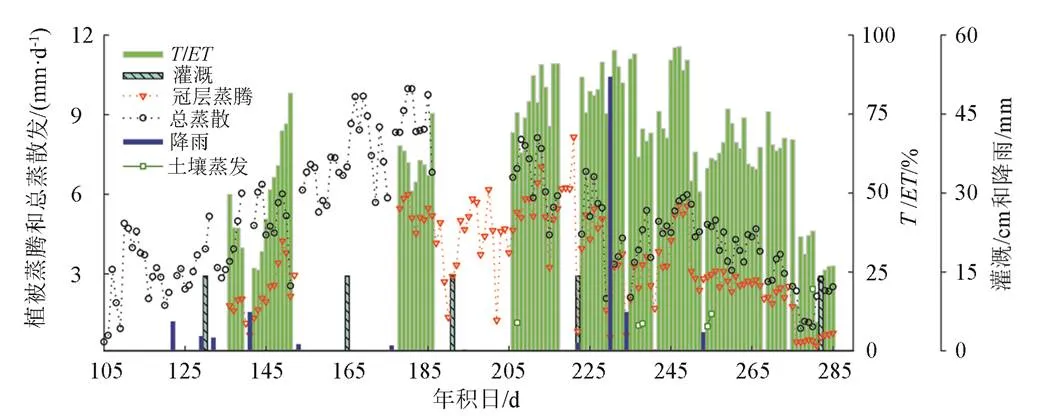
圖3 生長季葡萄樹冠層蒸騰/蒸散發(fā)的季節(jié)變化
2.3 蒸騰與總蒸散的比值(T/ET)
生長季葡萄樹平均的值為63.5%,結(jié)合圖4可知,干旱綠洲區(qū)農(nóng)田葡萄樹的范圍約為59.7%~63.5%[6]。表明干旱綠洲區(qū)作物蒸騰是總蒸散的主要水通量。同時(shí),綜合175個(gè)研究結(jié)果對(duì)不同生態(tài)系統(tǒng)及不同觀測模擬手段下蒸散發(fā)的分割結(jié)果進(jìn)行了分析[6, 43, 46-47],發(fā)現(xiàn)本結(jié)果與前人樹干液流和渦度相關(guān)分割的結(jié)果相符合(圖4)。陸地植被冠層的范圍約為60%~80%[46]。同時(shí),水文學(xué)方法得到的超過50%,同位素法約為70%,甚至可達(dá)到80%~90%,而模型估計(jì)的比例約為50%,已在許多研究中得到證實(shí)[8, 43]。

圖4 不同生態(tài)系統(tǒng)與不同方法總蒸散(ET)分割結(jié)果[6, 43, 46-47]
3 討 論
氣象因子方面,相對(duì)于a,0變化波動(dòng)較大,說明0可能受外界因素的影響較明顯。生長季10 mm以上的降雨只發(fā)生過1次(52.1 mm),同時(shí),小的降雨事件(低于10 mm)對(duì)土壤含水率的動(dòng)態(tài)變化影響很小[33]。而從不同土壤深度來看,表層5 cm受降雨影響最顯著,而50 cm則受降水影響變化不大,而大于50 cm的土壤水分僅在強(qiáng)降水或灌溉事件發(fā)生后才會(huì)產(chǎn)生一定的滯后響應(yīng)。
與其他研究[32, 39-42]相比,蒸騰與蒸散發(fā)的結(jié)果較高,這可能由于研究區(qū)強(qiáng)輻射提供了充足的能量,加上充分灌溉以及較大的潛在蒸散發(fā)0和高的冠層郁閉度以及綠洲平流效應(yīng)而導(dǎo)致的[6]。生長季葡萄樹的值為63.5%,結(jié)合圖4可知,干旱綠洲區(qū)葡萄樹的范圍約為59.7%~63.5%[6]。這表明,干旱綠洲區(qū)作物蒸騰是總蒸散的主要水通量。本結(jié)果相對(duì)于滴灌葡萄的結(jié)果偏低,同時(shí)比低覆蓋度葡萄的結(jié)果偏高[41, 44-45, 52],可能是由于滴灌的高水分利用效率和低覆蓋度導(dǎo)致的。從及的季節(jié)性變化特征可知,由于生長季前期主要是展葉期,葉面積和冠層覆蓋度較小,因此的值較低,此時(shí)土壤蒸發(fā)占主導(dǎo)地位。到生長季中期,隨著凈輻射和冠層溫度的進(jìn)一步增大,致使飽和水汽壓虧缺增大,導(dǎo)致蒸騰拉力迅速升高,其及的數(shù)值同時(shí)增大。同時(shí)葉面積迅速增大,蓋度升高,土壤蒸發(fā)在葉片遮蔽下逐漸減小,此時(shí)總蒸散以冠層蒸騰為主[15, 32, 45]。到生長季末期,葉片生理活性、葉面積指數(shù)、太陽輻射、蓋度及冠層溫度等因子逐漸下降,導(dǎo)致氣孔水汽交換減弱,葡萄樹冠層蒸騰逐漸減小至極小值。同時(shí),土壤蒸發(fā)亦同時(shí)減弱,然而,干旱區(qū)植被蒸騰特征不僅受胸徑、葉面積等因素的影響,還受制于太陽輻射、氣孔內(nèi)外水汽壓差、降雨和土壤含水率等因素,因此可能下降更快,導(dǎo)致該階段的比值相對(duì)較低[49-51]。另外,受特殊外界條件的影響,可能導(dǎo)致個(gè)別的比值過低或過高[14-15]。
從生態(tài)系統(tǒng)類型和研究方法方面來看,本結(jié)果低于熱帶雨林而偏高于大部分稀疏草原、地中海灌木等。這可能是由于熱帶雨林降水充足,葉面積指數(shù)大,輻射強(qiáng),而該區(qū)域CO2的影響也可能導(dǎo)致較高的蒸騰[43,46-47]。在農(nóng)田,作物的生長階段、環(huán)境因子、葉面積特征也對(duì)作物的蒸騰作用有較大影響,因此,需要針對(duì)不同生態(tài)系統(tǒng)類型對(duì)的范圍做出估算。另外,不同的方法也可能會(huì)帶來不同的結(jié)果。研究表明,同位素方法得到的范圍較其他方法略高(約70%,甚至80%~90%)[8],這可能是由于同位素分餾效應(yīng)的影響。而樹干液流、渦度相關(guān)方法分配的結(jié)果往往高于模型模擬。如本研究與前人樹干液流和渦度相關(guān)法所得到的結(jié)果相符合,而偏低與于同位素方法所得結(jié)果。因此,的結(jié)果受葉面積特征、生態(tài)系統(tǒng)類型、研究方法的影響較大。
4 結(jié) 論
1)干旱綠洲區(qū)葡萄樹生長季與的季節(jié)變化特征均為生長季中期高、前期和末期較低。同時(shí),由于強(qiáng)輻射、充分灌溉、高冠層郁閉度以及綠洲平流等效應(yīng),導(dǎo)致干旱綠洲區(qū)葡萄樹生長季與的結(jié)果較其他地區(qū)高。
2)干旱綠洲區(qū)葡萄樹的范圍約為59.7%~63.5%,該類地區(qū)蒸騰是總蒸散的主要水通量。
[1] JUNG M, REICHSTEIN M, CIAIS P, et al. Recent decline in the global land evapotranspiration trend due to limited moisture supply[J]. Nature, 2010, 467(7318): 951-954.
[2] AVISSAR R, SCHMIDT T. An evaluation of the scale at which ground-surface heat flux patchiness affects the convective boundary layer using large-eddy simulations[J]. Journal of the Atmospheric Sciences, 1998, 55(16): 2 666-2 689.
[3] WANG K C, DICKINSON R E. A review of global terrestrial evapotranspiration: Observation, modeling, climatology, and climatic variability[J]. Reviews of Geophysics, 2012, 50(2): RG2005.
[4] ZHU G F, ZHANG K, LI X, et al. Evaluating the complementary relationship for estimating evapotranspiration using the multi-site data across North China[J]. Agricultural and Forest Meteorology, 2016, 230/231: 33-44.
[5] 張琨. 遙感蒸散發(fā)模型參數(shù)敏感性分析與優(yōu)化方法研究[D]. 蘭州: 蘭州大學(xué), 2018.
ZHANG Kun. Parameter sensitivity analysis and optimization for remote sensing based evapotranspiration model[D]. Lanzhou: Lanzhou University, 2018.
[6] 王尚濤. 干旱綠洲區(qū)農(nóng)田葡萄樹蒸散耗水及水分利用策略研究[D]. 蘭州: 蘭州大學(xué), 2019.
WANG Shangtao. Characteristics of evapotranspiration and water up take of grapevine in an arid oasis ecosystem in northwest China[D]. Lanzhou: Lanzhou University, 2019.
[7] ZHU G F, LI X, SU Y H, et al. Simultaneously assimilating multivariate data sets into the two-source evapotranspiration model by Bayesian approach: Application to spring maize in an arid region of northwestern China[J]. Geoscientific Model Development, 2014, 7(4): 1 467-1 482.
[8] JASECHKO S, SHARP Z D, GIBSON J J, et al. Terrestrial water fluxes dominated by transpiration[J]. Nature, 2013, 496(7445): 347-350.
[9] 夏永秋, 邵明安. 黃土高原半干旱區(qū)檸條(Caragana korsh inskii)樹干液流動(dòng)態(tài)及其影響因子[J]. 生態(tài)學(xué)報(bào), 2008, 28(4): 1 376-1 382.
XIA Yongqiu, SHAO Ming’an. The Sap flow dynamics of Caragana korshinskii and the influence of environmental factors in semi-arid region of the Loess Plateau[J]. Acta Ecologica Sinica, 2008, 28(4): 1 376-1 382.
[10] 曾辰. 極端干旱區(qū)成齡葡萄生長特征與水分高效利用[D]. 楊凌: 中國科學(xué)院研究生院(教育部水土保持與生態(tài)環(huán)境研究中心), 2010.
ZENG Chen. The growth characteristics and high water use efficient on mature grape under extremely drought region[D]. Yangling: Institute of Soil and Water Conservation, CAS&MWR, 2010.
[11] 張建君. 農(nóng)田日蒸散量估算方法研究[D]. 北京: 中國農(nóng)業(yè)科學(xué)院研究生院, 2009.
ZHANG Jianjun. Estimation of cropland daily evapotranspiration[D]. Beijing: Graduate University of Chinese Academy of Agricultural Sciences, 2009.
[12] 孫樹臣. 農(nóng)田和灌叢生態(tài)系統(tǒng)蒸散發(fā)過程及水分利用效率研究[D]. 楊凌: 中國科學(xué)院教育部水土保持與生態(tài)環(huán)境研究中心, 2016.
SUN Shuchen. Study on evapotranspiration and water use efficiency of farmland and bushwood ecosystem[D]. Yangling: Institute of Soil and Water Conservation, CAS&MWR, 2016.
[13] THORNTHWAITE C W, HOLZMAN B. The determination of evaporation from land and water surfaces[J]. Monthly Weather Review, 1939, 67(1): 4-11.
[14] 白巖, 朱高峰, 張琨, 等. 基于樹干液流及渦動(dòng)相關(guān)技術(shù)的葡萄冠層蒸騰及蒸散發(fā)特征研究[J]. 生態(tài)學(xué)報(bào), 2015, 35(23): 7821-7831.
BAI Yan, ZHU Gaofeng, ZHANG Kun, et al. Research of transpiration and evapotranspiration from a grapevine canopy combining the Sap flow and eddy covariance techniques[J]. Acta Ecologica Sinica, 2015, 35(23): 7 821-7 831.
[15] 白巖. 干旱綠洲農(nóng)田生態(tài)系統(tǒng)葡萄冠層蒸騰耗水研究[D]. 蘭州: 蘭州大學(xué), 2016.
BAI Yan. Transpiration and water consumption in A grapevine canopy in an arid oasis ecosystem[D]. Lanzhou: Lanzhou University, 2016.
[16] ALLEN R G, PEREIRA L S, HOWELL T A, et al. Evapotranspiration information reporting: I. Factors governing measurement accuracy[J]. Agricultural Water Management, 2011, 98(6): 899-920.
[17] DING R S, TONG L, LI F S, et al. Variations of crop coefficient and its influencing factors in an arid advective cropland of northwest China[J]. Hydrological Processes, 2015, 29(2): 239-249.
[18] FOKEN T. The energy balance closure problem: An overview[J]. Ecological Applications, 2008, 18(6): 1 351-1 367.
[19] ONCLEY S P, FOKEN T, VOGT R, et al. The energy balance experiment EBEX-2000. part I: Overview and energy balance[J]. Boundary-Layer Meteorology, 2007, 123(1): 1-28.
[20] ZHANG H D, WEI W, CHEN L D, et al. Effects of terracing on soil water and canopy transpiration of Pinus tabulaeformis in the Loess Plateau of China[J]. Ecological Engineering, 2017, 102: 557-564.
[21] YANG P J, HU H C, TIAN F Q, et al. Crop coefficient for cotton under plastic mulch and drip irrigation based on eddy covariance observation in an arid area of northwestern China[J]. Agricultural Water Management, 2016, 171: 21-30.
[22] 邱國玉, 熊育久. 水與能: 蒸散發(fā)、熱環(huán)境及其能量收支[M]. 北京: 科學(xué)出版社, 2014.
QIU Guoyu, XIONG Yujiu. Water versus energy Water versus energy[M]. Beijing: Science Press, 2014.
[23] BAKER J M, VAN BAVEL C H M. Measurement of mass flow of water in the stems of herbaceous plants[J]. Plant, Cell & Environment, 1987, 10(9): 777-782.
[24] BUCKLEY T N, TURNBULL T L, ADAMS M A. Simple models for stomatal conductance derived from a process model: Cross-validation against Sap flux data[J]. Plant, Cell & Environment, 2012, 35(9): 1 647-1 662.
[25] GRANIER A, BOBAY V, GASH J H C, et al. Vapour flux density and transpiration rate comparisons in a stand of Maritime pine (Pinus pinaster Ait.) in Les Landes forest[J]. Agricultural and Forest Meteorology, 1990, 51(3/4): 309-319.
[26] NADEZHDINA N, VANDEGEHUCHTE M W, STEPPE K. Sap flux density measurements based on the heat field deformation method[J]. Trees, 2012, 26(5): 1 439-1 448.
[27] BASTIAANSSEN W G M, PELGRUM H, WANG J, et al. A remote sensing surface energy balance algorithm for land (SEBAL): Part 2: Validation[J]. Journal of Hydrology, 1998, 212/213: 213-229.
[28] FISHER J B, TU K P, BALDOCCHI D D. Global estimates of the land-atmosphere water flux based on monthly AVHRR and ISLSCP-II data, validated at 16 FLUXNET sites[J]. Remote Sensing of Environment, 2008, 112(3): 901-919.
[29] NORMAN J M, KUSTAS W P, HUMES K S. Source approach for estimating soil and vegetation energy fluxes in observations of directional radiometric surface temperature[J]. Agricultural and Forest Meteorology, 1995, 77(3/4): 263-293.
[30] SU Z B. A surface energy balance system (SEBS) for estimation of turbulent heat fluxes from point to continental scale[J]. Hydrology and Earth System Sciences, 2002, 6(1): 85-99.
[31] SOEGAARD H, BOEGH E. Estimation of evapotranspiration from a millet crop in the Sahel combining Sap flow, leaf area index and eddy correlation technique[J]. Journal of Hydrology, 1995, 166(3/4): 265-282.
[32] ZHANG Y Q, KANG S Z, WARD E J, et al. Evapotranspiration components determined by Sap flow and microlysimetry techniques of a vineyard in northwest China: Dynamics and influential factors[J]. Agricultural Water Management, 2011, 98(8): 1 207-1 214.
[33] 孫朋. 極端干旱區(qū)沙漠包氣帶降水入滲與蒸發(fā)規(guī)律模擬研究[D]. 蘭州: 蘭州大學(xué), 2017.
SUN Peng. Modeling the water infiltration and evaporation in unsaturated zone of the extremely arid area[D]. Lanzhou: Lanzhou University, 2017.
[34] 白巖, 朱高峰, 張琨, 等. 敦煌葡萄液流特征及耗水分析[J]. 中國沙漠, 2015, 35(1): 175-181.
BAI Yan, ZHU Gaofeng, ZHANG Kun, et al. Analysis of variation of Sap flow velocity and water consumption of grapevine in the Nanhu oasis, Dunhuang, China[J]. Journal of Desert Research, 2015, 35(1): 175-181.
[35] MA J Z, HE J H, QI S, et al. Groundwater recharge and evolution in the Dunhuang Basin, northwestern China[J]. Applied Geochemistry, 2013, 28: 19-31.
[36] 張琨, 朱高峰, 白巖, 等. 基于人工神經(jīng)網(wǎng)絡(luò)的渦度相關(guān)儀觀測蒸散量的數(shù)據(jù)插補(bǔ)方法[J]. 蘭州大學(xué)學(xué)報(bào)(自然科學(xué)版), 2014, 50(3): 348-355.
ZHANG Kun, ZHU Gaofeng, BAI Yan, et al. Gap filling for evapotranspiration based on BP artificial neural networks[J]. Journal of Lanzhou University (Natural Sciences), 2014, 50(3): 348-355.
[37] 王介民, 王維真, 奧銀煥, 等. 復(fù)雜條件下湍流通量的觀測與分析[J]. 地球科學(xué)進(jìn)展, 2007, 22(8): 791-797.
WANG Jiemin, WANG Weizhen, AO Yinhuan, et al. Turbulence flux measurements under complicated conditions[J]. Advances in Earth Science, 2007, 22(8): 791-797.
[38] 徐自為, 劉紹民, 宮麗娟, 等. 渦動(dòng)相關(guān)儀觀測數(shù)據(jù)的處理與質(zhì)量評(píng)價(jià)研究[J]. 地球科學(xué)進(jìn)展, 2008, 23(4): 357-370.
XU Ziwei, LIU Shaomin, GONG Lijuan, et al. A study on the data processing and quality assessment of the eddy covariance system[J]. Advances in Earth Science, 2008, 23(4): 357-370.
[39] NETZER Y, YAO C R, SHENKER M, et al. Water use and the development of seasonal crop coefficients for Superior Seedless grapevines trained to an open-gable trellis system[J]. Irrigation Science, 2009, 27(2): 109-120.
[40] ORTEGA-FARIAS S, POBLETE-ECHEVERRíA C, BRISSON N. Parameterization of a two-layer model for estimating vineyard evapotranspiration using meteorological measurements[J]. Agricultural and Forest Meteorology, 2010, 150(2): 276-286.
[41] POBLETE-ECHEVERRíA C A, ORTEGA-FARIAS S O. Evaluation of single and dual crop coefficients over a drip-irrigated Merlot vineyard (L.) using combined measurements of Sap flow sensors and an eddy covariance system[J]. Australian Journal of Grape and Wine Research, 2013, 19(2): 249-260.
[42] RANA G, KATERJI N, INTRONA M, et al. Microclimate and plant water relationship of the “overhead” table grape vineyard managed with three different covering techniques[J]. Scientia Horticulturae, 2004, 102(1): 105-120.
[43] SUTANTO S J, VAN DEN HURK B, DIRMEYER P A, et al. HESS Opinions “A perspective on isotope versus non-isotope approaches to determine the contribution of transpiration to total evaporation”[J]. Hydrology and Earth System Sciences, 2014, 18(8): 2 815-2 827.
[44] LóPEZ-URREA R, MONTORO A, MA?AS F, et al. Evapotranspiration and crop coefficients from lysimeter measurements of mature ‘Tempranillo’ wine grapes[J]. Agricultural Water Management, 2012, 112: 13-20.
[45] ZHAO P, LI S E, LI F S, et al. Comparison of dual crop coefficient method and Shuttleworth-Wallace model in evapotranspiration partitioning in a vineyard of northwest China[J]. Agricultural Water Management, 2015, 160: 41-56.
[46] SCHLESINGER W H, JASECHKO S. Transpiration in the global water cycle[J]. Agricultural and Forest Meteorology, 2014, 189/190: 115-117.
[47] KOOL D, AGAM N, LAZAROVITCH N, et al. A review of approaches for evapotranspiration partitioning[J]. Agricultural and Forest Meteorology, 2014, 184: 56-70.
[48] WILLIAMS D G, CABLE W, HULTINE K, et al. Evapotranspiration components determined by stable isotope, Sap flow and eddy covariance techniques[J]. Agricultural and Forest Meteorology, 2004, 125(3/4): 241-258.
[49] CHEN D, WANG Y K, LIU S Y, et al. Response of relative Sap flow to meteorological factors under different soil moisture conditions in rainfed jujube (Ziziphus jujuba Mill.) plantations in semiarid Northwest China[J]. Agricultural Water Management, 2014, 136: 23-33.
[50] TIE Q, HU H C, TIAN F Q, et al. Environmental and physiological controls on Sap flow in a subhumid mountainous catchment in North China[J]. Agricultural and Forest Meteorology, 2017, 240/241: 46-57.
[51] JIAO L, LU N, SUN G, et al. Biophysical controls on canopy transpiration in a black locust (Robinia pseudoacacia) plantation on the semi-arid Loess Plateau, China[J]. Ecohydrology, 2016, 9(6): 1 068-1 081.
[52] FANDI?O M, CANCELA J J, REY B J, et al. Using the dual-Kc approach to model evapotranspiration of Albari?o vineyards (L. cv. Albari?o) with consideration of active ground cover[J]. Agricultural Water Management, 2012, 112: 75-87.
Changes in Transpiration and Evapotranspiration of Grapevines (L) in Arid Oasis in Northwestern China
WANG Shangtao1, ZHAO Nan2, ZHANG Yang2, ZHANG Kun3, ZHU Gaofeng2
(1. School of Water Resources and Electric Power, Qinghai University, Xining 810016, China; 2. Key Laboratory of Western China’s Environmental Systems with the Ministry of Education,College of Earth and Environmental Sciences, Lanzhou University, Lanzhou 730000, China; 3. Institute of Tibetan Plateau Research, Chinese Academy of Sciences, Beijing 100101, China)
【】The ratio of transpiration () to evapotranspiration () varies with plants and their growth stages. The aim of this paper is to experimentally study T and ET, as well as their temporal variations.【】The experiment was conducted at a grapevine vineyard in an arid oasis in northwestern China. The transpiration and evapotranspiration of the grapevines (L.) were measured using sap-flow sensor, microclimatic station and eddy-covariance methods, respectively, at different growth stages.【】During the whole growth season, the transpiration increased from the initial 0.20 mm/d to 8.13 mm/d at the middle of growth season; it then dropped gradually to 3.32 mm/d when the leaves started falling. In comparison, the associated evapotranspiration increased from initial 0.44 mm/d to 9.97 mm/d before gradually decreasing to 4.91 mm/d. The averageratio was approximately 63.5%.【】Transpirationis the dominant soil water loss during the growth season of the grapevines (L.) in arid oasis in northwestern China.
arid oasis area;L.;sap flow; eddy covariance; transpiration-evapotranspiration ratio
TV93
A
10.13522/j.cnki.ggps.2021228
1672 - 3317(2021)12 - 0001 - 06
2021-06-01
國家自然科學(xué)基金面上項(xiàng)目(41871078);國家重點(diǎn)研發(fā)計(jì)劃重點(diǎn)專項(xiàng)項(xiàng)目(2018YFC0406602);青海省重點(diǎn)研發(fā)與轉(zhuǎn)化計(jì)劃項(xiàng)目(2021-SF-134)
王尚濤(1985-),男,甘肅平?jīng)鋈恕4T士生導(dǎo)師,博士,主要從事生態(tài)-水文過程研究。E-mail: wangsht@qhu.edu.cn
王尚濤, 趙楠, 張揚(yáng), 等. 干旱綠洲農(nóng)田無核白葡萄樹蒸散發(fā)的分割研究[J]. 灌溉排水學(xué)報(bào), 2021, 40(12): 1-6.
WANG Shangtao, ZHAO Nan, ZHANG Yang, et al. Changes in Transpiration and Evapotranspiration of Grapevines (L.) in Arid Oasis in Northwestern China[J]. Journal of Irrigation and Drainage, 2021, 40(12): 1-6.
責(zé)任編輯:趙宇龍
猜你喜歡
體育科技文獻(xiàn)通報(bào)(2022年3期)2022-05-23 13:46:54
天津外國語大學(xué)學(xué)報(bào)(2021年3期)2021-08-13 08:32:18
遼金歷史與考古(2021年0期)2021-07-29 01:06:54
小讀者(2021年2期)2021-03-29 05:03:48
科技傳播(2019年22期)2020-01-14 03:06:54
瘋狂英語·新悅讀(2019年11期)2019-12-18 05:14:16
華人時(shí)刊(2019年13期)2019-11-17 14:59:54
民用飛機(jī)設(shè)計(jì)與研究(2019年4期)2019-05-21 07:21:24
NBA特刊(2018年21期)2018-11-24 02:48:04
文苑(2018年22期)2018-11-19 02:54:14