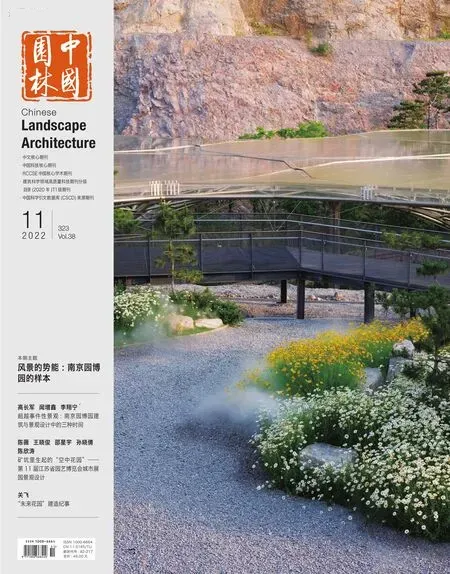
Transcending Eventful Landscape: Three Temporalities in the Architectural and Landscape Design of Nanjing Horticultural Expo Park
2022-02-12 10:04:07GAOChangjunWENZengxinLIXiangning
中國園林 2022年11期
GAO Changjun,WEN Zengxin,LI Xiangning
1 The Event-driven Landscape to be Continued
Since the late 1990s,major expositions have become a significant method for Chinese cities to promote the economy,expand the influence,and revitalize the urban landscape.Many cities choose to host horticultural expositions considering their lower cost and easier organization.The 1999 World Horticultural Expo in Kunming sparked significant interest in similar expositions in China.
However,the host cities also face the difficulty of maintaining the built environment after one to three months of these expositions.If the megaevent of expositions is driven by the concentration and deployment of urban resources in a short period of time,both in terms of cultural reach and physical landscape,the resulting architecture and landscape are distinctly "eventful" because of the goal-oriented nature of the process.
Initially,the limited time available for planning and construction makes it difficult to consider subsequent use.In addition,due to the exposition's independent functions,the spaces cannot be merged directly into urban use until they have been rationally transformed,whereas the funds for this secondary transformation are not fully considered at the outset.Further,if the host city attempts to retain the venues or landscape,such large-scale projects often conflict with the historical fabrics.In short,the problem of utilizing the architecture and landscape after the mega-event lies in the tension between the materiality of the built environment and the eventfulness of the production process.
This paper suggests incorporating the multiple temporal dimensions of the site into the pre-expo environmental design to transcend the eventful landscape.The paper will first define the three temporal dimensions latent in the construction site,introducing the often overlooked geological and social temporalities in addition to the general eventful temporality.Then,taking the 11thJiangsu Horticultural Expo in Nanjing (hereafter Nanjing Expo)as an example,the paper illustrates the specific strategies to integrate the three temporalities in architectural and landscape design.
2 Three Temporalities to Transcend the Eventful Landscape
To transcend the eventful landscape is related to both space and time.For one thing,the site planned for the exposition is not static,abstract,or homogeneous.Instead,the site itself contains a wealth of information.At the same time,an intimate relationship exists in the constant interaction between social patterns,individual behaviour,and the environment.Thus,designers need to confront the material characteristics of the site,its form and texture,and the collection of social relationships.
For another,although major expositions give the site a high profile in the short term,the accumulation of different elements is synchronous.The site thus has more than one temporal dimension.If borrowing from the historian Fernand Braudel's description of the different rhythms of time,three different speeds of change can be distinguished: the almost static"geological time",the slowly evolving "social time",and the rapid and turbulent "eventful time".Thus,the time anchored to the site is not singular,while the eventful time is merely a more visible dimension.
With the three temporal dimensions of the site,designers can respond strategically to the richer information of the site.As for the geological time of the site,the topography,geology,and ecology of the site all have engineering and aesthetic constraints that the architectural and landscape design should first fulfil.In the social time of place,the elements of historical heritage,cultural tradition and collective memory form the basis for intensifying the impact of the event over a larger span of time.The more visible elements of the eventful time include policy,events and temporary claims targeting the exposition.By superimposing geological,social and eventful temporalities of the site,designers are able to balance the tension between materiality and event production.
3 Projects: Architectural and Landscape Design of the Nanjing Expo Park
In April 2021,the 11thJiangsu Horticultural Expo was opened in Nanjing,with a planned park of about 3.45 square kilometres in the Tangshan area,about one-hour drive from the city center.The decision-makers had planned from the start to turn the park into a tourist destination after the Nanjing Expo.As a result,the architectural and landscape design must extend beyond the event itself.
3.1 Geological time: shaping landscape on a natural substrate
Tangshan is located in the northeast of Nanjing and consists of seven hills running east-west.The special geological conditions of the Tangshan area have led to a wide range of karst formations.In the 1960s,many quarrying enterprises were established in Tangshan,leaving huge pits in the previously lushly vegetated hills.
The first challenge for the designers was to reconceptualize the relationship between the surrounding ecological environment and the rough remains of the pits.The design of the Future Garden,therefore,attempts to balance these features in three ways: 1) The general strategy is to restore the pit with three complexes of buildings and to allow sufficient open space for viewing the cliff (Fig.1).2) This is matched by engineering solutions that are either hidden,disconnected or embedded,in order to reveal the qualities of the cliff itself (Fig.2).3) In addition,materials like weather-resistant steel and mirror stainless steel,and umbrella structures of thin stainless-steel columns and acrylic film,allow the buildings to fade into the surrounding environment (Fig.3 &4).
The second challenge comes from the topographical restrictions of the valley.To shorten the routes to the main pavilions,a shortcut was created by splitting the Kongshan Hill.The path was designed to follow a zigzag pattern along the hill to minimize the impact on the natural landscape and to suit the practical requirements of construction(Fig.5).In addition,the visitor center at the main entrance extends the open space in the visitor plaza to the roof of the building by using a grand staircase along the hill (Fig.6).
Even on milder slopes,designers still need to address the microtopography.The Huanghua'an Inn is originally located in a paulownia forest.The sloping ground,paulownia trees,visiting paths,and historic brick buildings form the substrate of the site.The design uses a single roof to situate the site on the hill,while interspersed guest units are inserted in response to the position of the paulownia trees.The courtyards between the units provide sunlight,ventilation,and an elevation change (Fig.7 &8).Through the viewing platform on the roof,visitors can look out over the spectacular Future Garden (Fig.9).
3.2 Social time: interpreting landscape on the historical legacy
Before the Nanjing Expo,the Tangshan area was mainly known for its recreational and quarrying industries.In recent years,with the growing importance of "post-industrial" and "heritage" discourses,the conservation and reuse of industrial structures have become a key consideration for designers.
In the face of the considerable scale and volume of industrial heritage,it is more effective to choose a modest and progressive "light" strategy.In the case of the Grand Gallery,the industrial manufactory line of the cement factory has been transformed into a touring path,linking hotels,restaurants,cultural and creative bazaars,exhibits,bookstores and other functions (Fig.10).The"light" strategy is also reflected in the visual lightness rendered by structures and materials.For example,the Grand Gallery uses 70mm steel rods to form an envelope,in contrast to the rough and closed surface of the original industrial buildings (Fig.11 &12).In addition,the "light" construction mode also takes into account the different possibilities for flexible use of the space after the event.
The parallel history of Tangshan as a resort provides a cultural meaning that needs to be interpreted with new typologies and technologies.The Crafts Garden,which concentrates on the traditional gardens of different cities in Jiangsu Province,is a direct way of responding to history,while the Westin Hotel,located between the Crafts Garden and the Grand Gallery,takes advantage of the topographic conditions to form a settlement that drops down step by step (Fig.13 &14).
Similarly,the Radisson Hotel,with its more rugged and complex topography to the east of the Crafts Garden,is also at a nodal point (Fig.15).The strategy adopted by the Radisson Hotel is to transform the traditional sloping roof into a signifier that bridges different elevations.The continuous,revolving roof integrates the five different ground elevations and linear circular paths into a coherent spatial sequence (Fig.16 &17).
This combination of historical and contemporary elements is also evident in the corridor bridge to the north of Expo Village.To meet the needs of traffic,leisure,and navigable height at the same time,the designer divided the bridge into nine progressively lifting platforms and used the arched roof as the main structure to suspend these nine separate platforms (Fig.18 &19).In contrast,the Expo Village and the Treasure Pavilion respond to the historical character with village-like layouts and rusty steel fa?ades respectively (Fig.20 &21).
3.3 Eventful time: activating landscape in the event planning
As the primary task of the Expo,the designers must consider the pre-planning of service buildings,the integrity of the building and landscape,and the flexibility for later renovation.There are two strategies,spatial complexes and spatial nodes.
The spatial complexes can meet temporary pedestrian flows during the event,and can also be easily transformed into other venues at a later stage.The design of the Geology Science Campus preserved most workshops and plants,trying to evoke the visitor's connection to the site's past(Fig.22 &23).The former machinery belt has been transformed into a visiting path,where visitors see the geological section through the glass.At the top of the silo,visitors can see the Future Garden from afar.A group of factory buildings has been transformed into the Huayu Station (Fig.24).The designers have incorporated a steel system to support the new aluminium oxide roofing,creating a visual response to the adjacent train station (Fig.25 &26).
Another strategy is to link the spatial nodes that are several kilometres apart.In addition to the Huayu Station,three other stations are distributed along the main visiting route of the park.The Huawei Station serves as a botanical exhibition room,a café,and a souvenir shop,providing both a quiet inward garden and a spectacular outward view (Fig.27 &28).The Huase Station encloses several blocks with different functions,thus making the visitors capture serial apertures of the external landscape as they walk around (Fig.29).Similarly,the various spaces of the Huaxiang Station are organized around the central courtyard (Fig.30).These stations serve as important infrastructure for catering,resting and information services,both during the exposition and the post-event operation.
4 Conclusion:Landscape Takes Time,and Time Takes Landscape
If time can bring new things to light,then it is also necessary to incorporate time into design when dealing with architecture and landscape in expositions: to see the figurative place through time,to see the topography and geology of the place,the ecological information,the history and culture,the heritage,the state of life and the episodic events,and to use plural temporalities to overcome the conflict between materiality and event production.
The designers of the 11thJiangsu Horticultural Expo Park have introduced the geological,social,and eventful dimensions of time to see and strategically respond to the richer information.At the same time,the attributes of the site itself emerge and continue through the design,allowing the energy embedded in time to reconnect people and the environment into a shared whole.