Static solvent effect simulation of NAA
2022-03-04 08:47:02ZENGXiuLinJUXueHaiPANXiangPingYANShouBao
原子與分子物理學報 2022年2期
ZENG Xiu-Lin, JU Xue-Hai, PAN Xiang-Ping, YAN Shou-Bao
(1.School of Chemistry and Materials Engineering, Huainan Normal University, Huainan 232038, China;2.School of Biological Engineering, Huainan Normal University, Huainan 232038, China;3.School of Chemical Engineering, Nanjing University of Science and Technology, Nanjing 210094, China)
Abstract: Quantum mechanics(QM)calculations at DFT-B3LYP/6-311+G** level in conjunction with polarized continuum model(PCM)were adopted to simulate gas-phase structure of naphthalene acetic acid(NAA)and solvation structures in water, ethanol and acetone solutions, respectively.With regard to the results of bond lengths, Mulliken populations and atomic charges, it is noted that the O-H bond becomes weaker and the acidity of NAA increases in solutions since water, ethanol and acetone are all polar solvents.Molecular mechanics(MM)simulations were carried out on the radial distribution functions for solvent hydrogen around oxygen of NAA’s carboxyl group and mean square displacements of NAA in NAA/H2O, NAA/EtOH and NAA/Acetone systems, respectively.The results indicate that solute-solvent intermolecular interactions could be ascribed to short-range effect(hydrogen-bonding effect)and long-range effect(van der Waals effect).The intermolecular interactions in NAA/EtOH system are more intense where hydrogen-bonding effect prevails, while the ones in NAA/H2O system are less.NAA has lower diffusion in water solution and larger in ethanol solution.
Key words: Naphthalene acetic acid(NAA); Solvent effect; Quantum mechanics(QM); Molecular mechanics(MM); Radial distribution function(RDF)
1 Introduction
Some auxin compounds are often used in the process of crop production or cultivation[1-6], which include natural auxin as indole-3-acetic acid(IAA), indole-3-butyric acid(IBA)and synthetic auxin as 2,4-dichlorophenoxyacetic acid(2,4-D), naphthalene acetic acid(NAA), etc.The experimental studies showed that they can significantly accelerate the growth rate[7-10]and increase the yield through improving the photosynthetic rate of plants[11-13].As a kind of synthetic auxin, NAA can be provided with the function mechanism and physiological characteristics of natural auxin[14, 15].Moreover, recent literature reports NAA’s effect on plant expansion by promoting the cell division and inducing the formation of adventitious roots[16, 17].When used in crop production, NAA can be found in increasing fruit setting, preventing fruit falling and alleviating the damage to plants caused by abiotic stress[18, 19].It is worthy to note that NAA is widely used in Chinese agriculture, and it is also a test substance commonly investigated by many research institutions for the sake of NAA's cheap, effective and no side effects[20, 21].
The structures and properties of compounds can be explored by quantum mechanics(QM)approach, which can accurately determine molecular structures, electronic structures, energy properties and other parameters.In the meantime, molecular mechanics(MM)approach has been remarkably improved and provided satisfactory results for a wide range of chemical systems.Here, we report quantum mechanics simulations focusing on the bond lengths, atomic charges and Mulliken populations of NAA in gas phase, and in water, ethanol and acetone solutions, respectively.Once again, we also carry out molecular mechanics(MM)simulations on the radial distribution functions(RDFs)for solvent hydrogen around oxygen of NAA’s carboxyl group and mean square displacements(MSDs)of NAA in NAA/H2O, NAA/EtOH and NAA/Acetone systems, respectively.So far, little attention has been paid to the influence of solvent polarity and species on the structures and properties of NAA.In the present work, a combined quantum mechanics and molecular mechanics approach(QM/MM)was implemented to simulate static solvent effects of NAA in the above systems, which can better design the experimental scheme and provide theoretical technical support for the crop cultivation.
2 Computational method
2.1 Quantum mechanics calculation
The PCM model[22]was adopted to observe the molecular and electronic structures of NAA in gas phase, and in water, ethanol and acetone solutions, respectively.The DFT-B3LYP method and 6-311+G**basis set were applied to optimize the geometries of NAA in gas phase and in three solutions by Berney energy gradient method.All the calculations were performed on Dell workstation with Gaussian 03 package[23].
2.2 Molecular mechanics simulation
Molecular mechanics simulations were performed using Material Studio software with amorphous cell module for the three-dimensional periodic boundary boxes containing NAA in water, ethanol or acetone.After equilibration period by smart method, the three amorphous cells were calculated using isothermal-isobaric NPT ensemble for a simulation time of 50 ps and an integration step of 1fs at given temperature and 1atm.Then, NVT ensemble was employed to simulate the dynamics of the three amorphous cells, the number of simulations steps was 100,000(100 ps), and the output frequency was every 250 steps.The time step of 1 fs was taken to be constant for all the simulations in this study.Trajectory file data generated from simulations had been used in all the system property calculations and analyses presented in this research.During the whole simulation process with the Compass Force Field, the Nose thermostat and Berenden barostat were used to control the temperature and pressure, while atom-based and Ewald method were carried out on Ewald and Coulomb summation.
3 Results and discussion
3.1 Structure properties
The molecular structure andselected atom number of NAA were shown in Fig.1(a).The bond lengths and Mulliken populations of NAA’s carboxyl group were studied in gas phase, and in water, ethanol and acetone solutions, respectively.As shown in Fig.1(a)and Table 1, the bond lengths of C2-O3, C2-O4and O3-H7obviously change from gas phase to three solutions.It is worth noting that the change trend and range of bond lengths are similar, that is, the bond length of C2-O3decreases from 0.1355 nm to 0.1340 nm(0.1339 nm in acetone), C2-O4increases from 0.1214 nm to 0.1222 nm(0.1223 nm in acetone)and O3-H7increases from 0.0972 nm to 0.0995 nm(0.0997 nm in acetone).In this sense, the O-H bond of NAA’s carboxyl group becomes weaker and the acidity of NAA increases in solution for the sake of the magnified conjugation effect, which is overlapped from the π orbital of C=O and the p-orbital locating the unparalleled electron pairs of oxygen in the NAA hydroxyl group.As a result, the bond lengths of C2-O3and C2-O4are averaged.
Usually, the strength of chemical bond can be quantified by Mulliken population.The larger the Mulliken populations, the more the bonding overlaps, and the stronger the corresponding chemical bond.It can be seen from Fig.1(a)and Table.1 that the Mulliken populations of C2-O3, C2-O4and O3-H7change in a similar fashion from gas phase to three solutions.The Mulliken population of C2-O3bond increases, while the Mulliken populations of C2-O4and O3-H7bond decrease, which are consistent with the change of bond length.
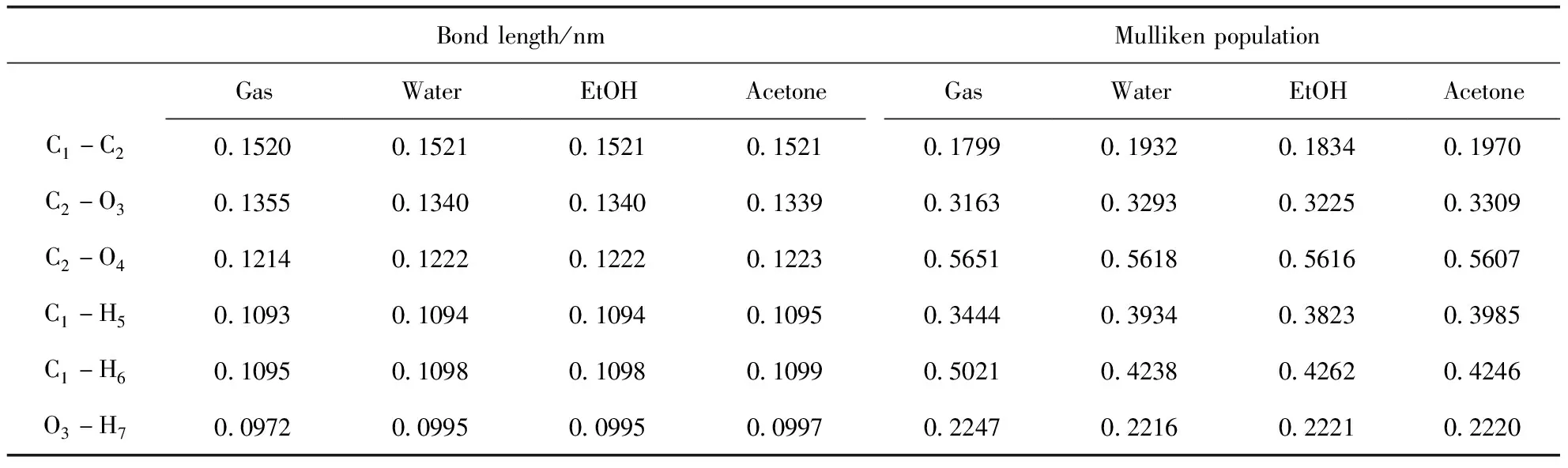
Table 1 Selected bond lengths(nm)and Mulliken populations of NAA in gas or solvents
3.2 Charge distribution
Table 2 lists the atomic charge distribution of NAA’s carboxyl group in gas phase and in three solutions.Obviously, from gas phase to three solutions, the absolute values of positive and negative charges all increase, which could result in the positive and negative charges gathering respectively.The calculated dipole momentsμof NAA in gas phase and three solutions are also given in Table 2.It is 1.6643d in gas phase while about 2.60d in solutions.It may be attributed to NAA partly polarization in solutions for acetone is a polar solvent of non proton type, while water and ethanol are polar solvents of proton type.
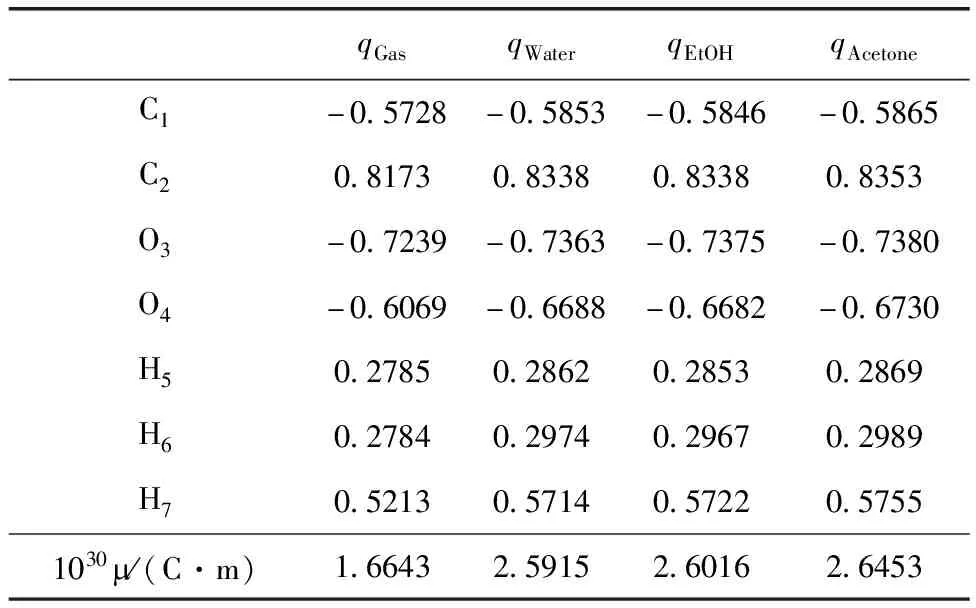
Table 2 Selected atomic charges and dipole moments of NAA in gas or solvents
3.3 Radial distribution function(RDF)
It is found that intermolecular interactions are ascribed to short-range and long-range interactions.The short-range interaction is dominated by hydrogen-bonding, and the distance is shorter than 0.31 nm.The long-range interaction is mainly van der Waals(VDW)effect.The strong van der Waals effect is usually in the range of 0.31-0.50 nm and the VDW effect is very weak when it is greater than 0.50 nm.The radial distribution function(RDF), also known as the pair correlation functiong(r), indicates that the probability density of particleBcan be found in the range ofr+ draround particleA[24, 25], which can be used to study the interaction between solute and solvent molecules in solutions.
Amorphous cells of NAA/H2O, NAA/EtOH and NAA/Acetone systems are shown in Fig.1(b), 1(c)and 1(d), respectively.Fig.2 shows the radial distribution function statistical curves in three systems, which are found that solute-solvent intermolecular interactions are not only hydrogen-bonding, but also van der Waals effect.For the NAA/H2O system,g(O3-HW)andg(O4-HW)define as RDFs for water hydrogen around oxygen of NAA’s carboxyl group.This definition method is also applied to NAA/EtOH and NAA/Acetone systems, where E and A represent ethanol and acetone, respectively.From Fig.2(a), we find that the RDFs forg(O3-HW)in NAA/H2O system have several peaks, centered at 0.205 nm with height of 0.633, 0.265 nm with height of 0.898, 0.345 nm with height of 1.141, 0.435 nm with height of 1.304 and 0.475 nm with height of 1.194, respectively.The first and second peaks correspond to hydrogen-bonding, while the others correspond to van der Waals effect.The RDFs forg(O4-HW)also have several peaks, centered at 0.225 nm with height of 0.970(corresponding to hydrogen-bonding), 0.365 nm with height of 1.235 and 0.445 nm with height of 1.058(corresponding to van der Waals effect), respectively.Although the region of RDF peaks forg(O3-HE)andg(O4-HE)in NAA/EtOH system is neighboring at the ones forg(O4-HW), it is important to mention that the peak is observed at 0.235 nm with height of 5.209 forg(O4-HE), indicating that there is strong hydrogen-bonding.In Fig.2(c), it can be seen that the RDFs in NAA/Acetone system have peaks at 0.245 nm with height of 1.189 and 0.315 nm with height of 1.279 forg(O3-HA), and 0.255 nm with height of 2.453 and 0.315 nm with height of 2.545 forg(O4-HA).The above results indicate that there are hydrogen-bonding and VDW effect between NAA and solvent molecules.The analysis carried out so far demonstrates that the intensity of O3-H hydrogen-bonding is less than that of O4-H hydrogen-bonding.It is also clear from series of RDF results that intermolecular interactions in NAA/EtOH system are more intense, followed by NAA/Acetone and then NAA/H2O system.
3.4 Mean square displacement(MSD)and diffusion coefficient(D)
Particles never stay in a fixed position and move all the time in solutions.The mean square displacement(MSD)defines the moving distance square of random walking particles.In the meantime, the diffusion coefficientDcan be derived from the linear region of MSD versus time[26-28]:
(1)
where, N is the total number of diffusion atoms,ri(t)andr0(t)are the spatial and initial positions of particleiat timetandt=0.It is instructive for analyzing motion of solute molecules and theoretical understanding of a molecular-lever diffusion mechanism.
On the basis of NPT and NVT MD data obtained for amorphous cells of NAA/H2O, NAA/EtOH and NAA/Acetone systems, MSDs of NAA at 273, 298 and 323 K for each solution were calculated and plotted as a function of temperature at 100 ps long time in Fig.3.
In NAA/H2O system, the diffusion coefficients of NAA at 273, 298 and 323 K obtained from MSD vs time according to Equation(1)are 1.11×10⁻⁶, 1.38×10⁻⁶and 3.24×10⁻⁶cm2·s-1, respectively.With the data in Fig.3(b)and 3(c), it is also predicted that in NAA/EtOH system, the diffusion coefficients of NAA are 2.72×10⁻⁶cm2·s-1at 273 K, 2.90×10⁻⁶cm2·s-1at 298 K, 3.98×10⁻⁶cm2·s-1at 323 K, respectively and in NAA/Acetone system, the diffusion coefficients of NAA are 2.14×10⁻⁶cm2·s-1at 273 K, 2.75×10⁻⁶cm2·s-1at 298 K, 3.67×10⁻⁶cm2·s-1at 323 K, respectively.The analysis of data reveals that the mean square displacements and diffusion coefficients of NAA increase with increasing temperature as expected.At the same temperature, the MSDs and diffusion coefficients of NAA in three systems are in the order: NAA/H2O < NAA/Acetone < NAA/EtOH.Upon examining the results of radial distribution functions in section 3.3, the increasing order of solute-solvent intermolecular interactions and increasing diffusion of NAA in three solutions appear to follow the expected trend when compared with solubility of NAA in the series(NAA/H2O < NAA/Acetone < NAA/EtOH).
4 Conclusions
Series of studies employing a combined quantum mechanics and molecular mechanics approach(QM/MM)were performed on the solvent effects of NAA in water, ethanol and acetone solutions, respectively.The B3LYP/6-311+G**method in conjunction with PCM model were used to simulate bond lengths, atomic charges and Mulliken populations of NAA in gas phase and in three solutions.The results demonstrate that three polar solvents enhance the conjugation effect of NAA’s carboxyl group, which make the positive and negative charges gathering separately, and the dipole moment increasing.According to the results obtained from molecular mechanics simulations, the solute-solvent intermolecular interactions in NAA/H2O, NAA/EtOH and NAA/Acetone systems are not only hydrogen-bonding, but also van der Waals effect.The solute-solvent intermolecular interactions in NAA/EtOH system are more intense, with the hydrogen-bonding prevailing.And in case of the NAA/H2O system, the solute-solvent intermolecular interactions are less, where the hydrogen-bonding is close to van der Waals effect.It is also found that mean square displacements and diffusion coefficients of NAA in three systems increase with increasing temperature.At the same temperature, the diffusion of NAA is in the order NAA/H2O < NAA/Acetone < NAA/EtOH, which exhibits the similar trend to intermolecular interaction.This simulation study suggests that a combined QM/MM method is a useful tool in gaining insights into the solute behavior and solvent effect in solutions at atomic and molecular levels.