
基于蒸發皿水面蒸發量的溫室生菜適宜灌溉量研究
2022-05-13 07:16:28李銀坤詹保成郭文忠梁熠李亮柏敏戰
灌溉排水學報 2022年4期
關鍵詞:產量
李銀坤,詹保成,,郭文忠*,梁熠,李亮,柏敏戰
基于蒸發皿水面蒸發量的溫室生菜適宜灌溉量研究
李銀坤1,詹保成1,2,郭文忠1*,梁熠2,李亮2,柏敏戰3
(1.北京市農林科學院 智能裝備技術研究中心,北京 100097;2.寧夏大學 農學院,銀川 750000;3.陜西榮華農業科技有限公司,西安 710000)
【】探究基于蒸發皿水面蒸發量(p)的溫室生菜適宜灌溉策略。設置5個灌溉處理:0.3p(I1)、0.5p(I2)、0.7p(I3)、0.9p(I4)和1.1p(I5),利用直徑20 cm的稱質量式標準蒸發皿自動記錄冠層水面蒸發量(p),開展了連續2茬溫室生菜灌溉試驗。通過研究不同灌溉處理對溫室生菜蒸散量、地上部生物量、產量和水分利用效率的影響,確定溫室生菜適宜的灌溉量及其對應的蒸發皿適宜灌溉系數(p)。試驗期間,p隨時間的增加呈上升趨勢,第二茬累積水面蒸發量為96.0 mm,相比第一茬增加了33.3%;太陽輻射是影響p的重要環境因子,二者呈極顯著的正相關(<0.01)。第一茬和第二茬各處理的累積蒸散量波動范圍分別為43.4~70.4 mm和58.3~73.6 mm,累積蒸散量隨灌水量的增加而增加。生菜地上部生物量隨灌溉量的增加呈先增加后降低的變化規律,其中I3處理地上部生物量最高,相比I1處理和I5處理分別提高了17.5%~38.2%和4.2%~13.2%。適量灌溉可顯著提高溫室生菜的產量和水分利用效率,與I1處理和I5處理相比,I3處理的產量增加了36.6%~37.3%和6.1%~23.7%,水分利用效率提高了9.9%~15.2%和12.6%~61.4%。生菜產量和蒸發皿灌溉系數(p)之間具有顯著的二次曲線關系(<0.01),綜合2茬產量,當p為0.77時可獲得生菜產量的最高值。I3處理(即0.7p)是供試條件下溫室生菜的適宜灌溉處理,在以獲得溫室生菜高產為目標時,推薦蒸發皿灌溉系數0為0.77。
溫室生菜;稱質量式蒸滲儀;水面蒸發量;產量;水分利用效率
0 引言
【研究意義】生菜是溫室栽培的代表性葉類蔬菜,具有生育期短、耗水量大等特點,溫室生菜生長所需水分主要依賴于灌溉[1-2]。灌溉是溫室生菜生產過程中重要的田間措施,在提高生菜產量、改善生菜品質等方面具有至關重要的作用[3-4]。雖然滴灌、噴灌等節水灌溉技術已在溫室生產中被廣泛應用,但生菜的灌溉量確定仍主要依據傳統經驗進行決策,灌溉量不合理或灌溉時間不適宜將導致水資源浪費,灌溉水利用效率偏低以及產量下降等問題[5-7]。因此,開展溫室生菜的適宜灌溉量試驗研究對于保障設施蔬菜綠色高效可持續生產具有重要意義。【研究進展】P-M公式是FAO-56提出的計算參考作物蒸散量(0)的標準方法,有研究利用溫室內參考作物蒸散量計算公式[8],制定了針對溫室番茄、黃瓜等作物的合理灌溉制度,在生產中獲得了顯著的節水高產效果[9-12]。但0計算過程復雜、涉及的參數繁多,決策成本較高,限制了其在生產中的大范圍應用。許多研究將標準蒸發皿的水面蒸發量(p)作為溫室灌溉決策的依據,此外也在夏玉米、冬小麥等糧食作物上進行了研究,通過確定適用于不同作物的蒸發皿灌溉系數(p),建立了基于水面蒸發量(p)的合理灌溉制度[13-14]。在溫室栽培條件下,張魯魯等[15]認為按照水面蒸發量的60%進行灌溉(0.6p),溫室甜瓜具有較好的產量、品質和水分利用效率。Cakir等[16]研究表明,黃瓜產量隨灌水量的增加而增加,當p為0.75時的水分利用效率、平均產量均為最高。在溫室番茄上的研究表明,滴灌水量為0.8p時具有最佳的產量、灌溉水利用效率和品質,當灌水量進一步增加時,灌溉水利用效率和果實品質均會降低,進而得出適用于溫室番茄的最優p為0.8[17]。【切入點】利用水面蒸發量(p)進行灌溉決策的關鍵在于蒸發皿灌溉系數(p)的確定。截至目前,依據水面蒸發量(p)的灌溉決策研究主要聚焦于典型的糧食作物和溫室番茄、黃瓜、茄子等茄果類蔬菜作物[18-21],而在溫室生菜上的研究較少,尤其是溫室栽培生菜的生長發育快、水分需求量大,明確適宜于溫室生菜的p是實施溫室生菜科學合理灌溉的關鍵前提。【擬解決的關鍵問題】本研究基于標準蒸發皿的水面蒸發量(p)設定了5種溫室生菜灌溉量,分別為0.3p、0.5p、0.7p、0.9p和1.1p(p分別為0.3、0.5、0.7、0.9和1.1),結合稱質量式蒸滲儀開展了不同灌溉處理對生菜生物量、產量以及水分利用效率影響的研究試驗,探討溫室生菜的適宜灌溉量及其對應的蒸發皿灌溉系數(p),以期為溫室生菜節水、綠色生產提供理論支持。
1 材料與方法
1.1 研究區概況
試驗于2021年3—5月在北京市農林科學院多功能連棟溫室內進行,試驗溫室南北走向,南北長35.4 m,東西寬33.0 m,試驗布置于三連跨多功能連棟溫室的中跨。試驗地位于東經116.29°,北緯39.94°,海拔56 m,年均降水量為500~600 mm,多年平均氣溫為11.1 ℃,屬溫帶大陸性季風氣候。試驗地土質為砂壤土,試驗前0~10 cm土層的土壤體積質量為1.32 g/cm3,土壤田間持水率為26.3%,有機質量為15.89 g/kg,全氮量為0.60 g/kg,速效鉀量為0.15 g/kg。
1.2 試驗設計
利用直徑為20 cm的稱質量式標準蒸發皿測定生菜冠層的水面蒸發量,以累積水面蒸發量(p)為標準制定灌溉量,蒸發皿的灌溉系數(p)分別設置為0.3、0.5、0.7、0.9和1.1,對應的灌溉量依次為0.3p(I1)、0.5p(I2)、0.7p(I3)、0.9p(I4)、1.1p(I5),當累積水面蒸發量p為(15±1)mm時統一灌水。供試生菜品種為“富蘭德里”,定植時選取4葉1心的秧苗。第一茬和第二茬生菜定植時間分別為3月3日和4月8日,收獲時間分別為4月7日和5月7日。試驗中采用的稱質量式蒸滲儀長1 m,寬0.6 m,土深0.9 m。栽培方式為畦栽,畦寬70 cm,畦高20 cm,行距20 cm,株距20 cm。各處理施肥量相同,以純氮(N)計每茬的施氮量為75 kg/hm2,施肥類型為水溶性肥(N∶P2O5∶K2O質量比為3∶1∶1)。
1.3 測定指標與方法
1.3.1 稱質量式標準蒸發皿
利用直徑為20 cm的稱質量式水面蒸發皿獲取生菜冠層的水面蒸發量,每10 min自動采集1次數據,儀器精度為0.1 mm。蒸發皿的觀測高度隨生菜生育期的推進進行實時調整。
1.3.2溫室環境因子
溫室中央布置小型氣象站(型號為AG1000,美國制造)實時采集溫室內的氣象數據,包括太陽輻射(s)、空氣溫度()、相對濕度()。
1.3.3 生菜單株質量與產量
生菜收獲采摘后,單株鮮質量采用電子天平(精度為0.01 g)進行稱質量,并折算成每公頃產量(,kg/hm2)。
1.3.4 生菜地上部生物量
生菜測產結束后,每個處理隨機取3株植株樣本,在烘箱中于105 ℃殺青30 min,然后再于85 ℃烘干至恒質量,測定生菜地上部生物量。
1.3.5 生菜蒸散量
利用稱質量式蒸滲儀測定生菜蒸散量(),蒸滲儀每10 min記錄1次土柱質量,的計算原理為:
=(t-1-t)/+, (1)
式中:為時間段內的蒸散量(mm);為蒸滲儀箱體表面積(m2);t-1和t分別為t-1時刻和t時刻箱體內土壤及水分的質量之和(kg);為水密度(g/cm3);為時間段內的灌水量(mm)。
1.3.6水分利用效率()
=/, (2)
式中:為水分利用效率(kg/m3)。
2 結果與分析
2.1 溫室氣象因子動態變化
由圖1可知,2茬溫室生菜種植期間,整個生育期內生菜所處溫室環境的日均氣溫()與日均相對濕度()總體變化趨勢呈波動狀,其中呈波動上升趨勢,呈波動下降趨勢。試驗期間內的變化范圍為13.2~24.5 ℃,在第一茬和第二茬生育期內的平均氣溫依次為18.9 ℃和21.2 ℃;變化范圍為28.9%~87.9%,在第一茬和第二茬生育期內的平均相對濕度分別為63.2%和56.6%。
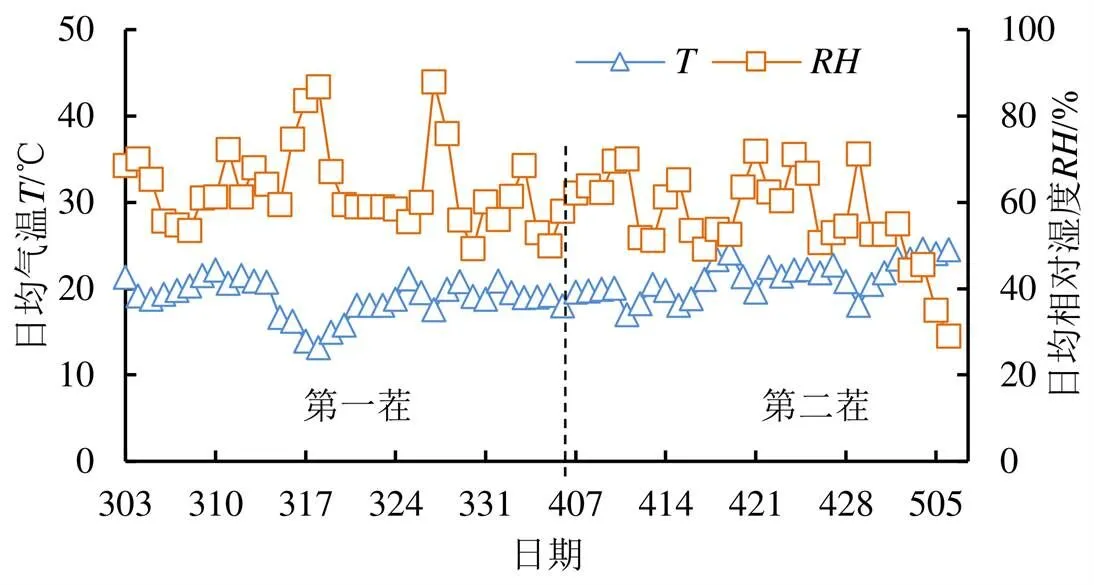
圖1 溫室內日均氣溫和日均相對濕度動態變化
2.2 溫室生菜冠層水面蒸發量動態變化及影響因素
由圖2可知,試驗期間溫室生菜冠層水面蒸發速率峰值隨時間的增加總體呈上升趨勢。第一茬生菜在生長初期的水面蒸發速率峰值較低,在0.2 mm/h上下波動,水面蒸發速率峰值的最高值出現在第二茬生菜生育期內,達0.75 mm/h。累積水面蒸發量在第二茬生菜生育期內為96.0 mm,相比第一茬增加了33.3%。由表1可知,除相對濕度外,其他環境因子均與水面蒸發量呈極顯著正相關(<0.01),其中太陽輻射與水面蒸發量的相關系數最高,達到0.88,說明太陽輻射是影響水面蒸發量的最關鍵的氣象因子。平均溫度與水面蒸發量的相關系數最低,僅為0.59,但相關性仍達到了極顯著水平(<0.01)。
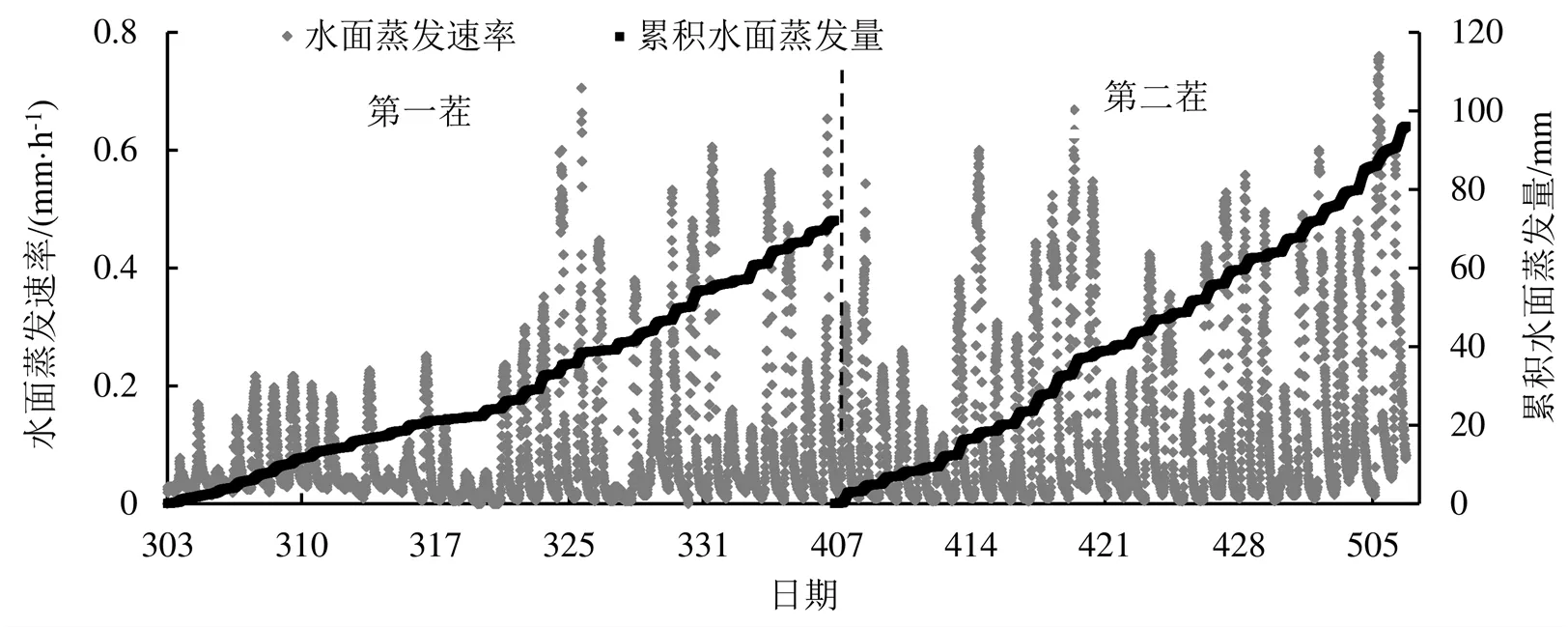
圖2 溫室生菜冠層水面蒸發速率與累積蒸發量的變化
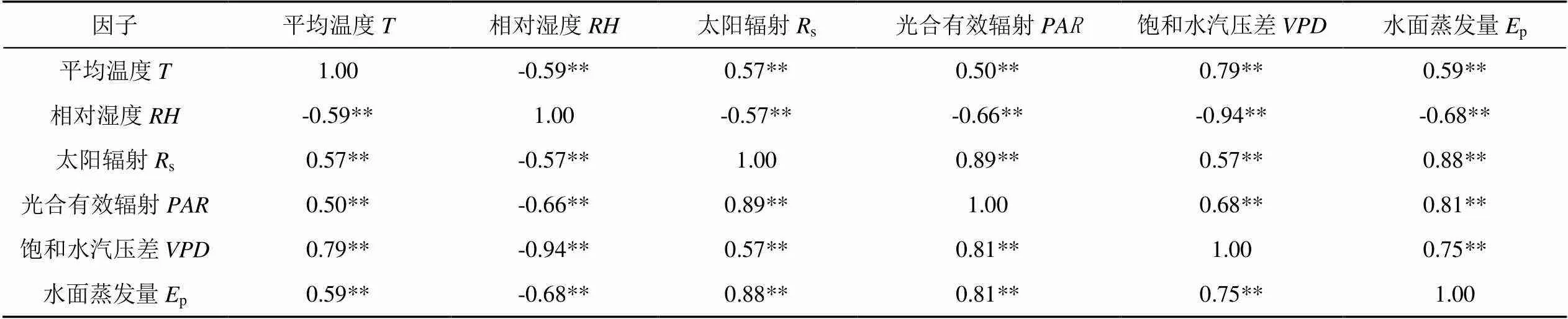
表1 溫室蒸發皿水面蒸發量與各環境因子的相關性
注 **表示在0.01水平上顯著相關。
2.3 溫室生菜累積蒸散量變化
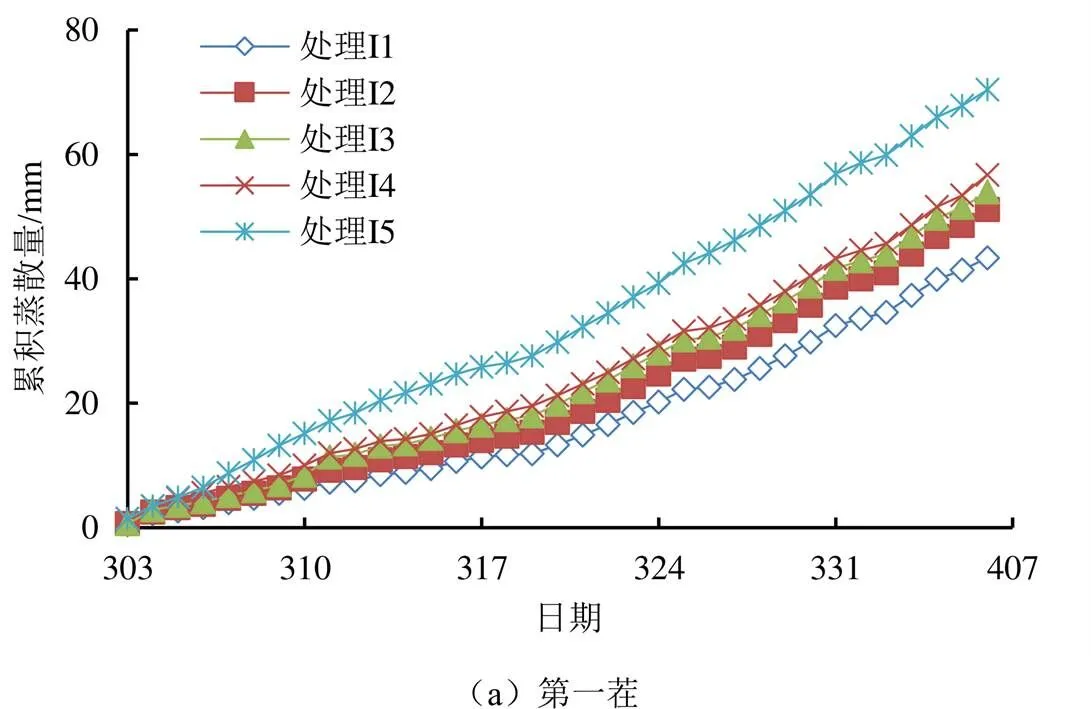
各處理溫室生菜累積蒸散量在不同茬口的變化趨勢相似,在生菜定植10 d內蒸散量增加較為緩慢,之后隨著生菜生長加快呈快速增加的趨勢。5個灌溉處理在第一茬和第二茬的蒸散量波動范圍分別為43.4~70.4 mm和58.3~73.6 mm。隨著灌水量的增加,蒸散量也隨之增加。其中,I1、I2處理在第一茬的蒸散量分別為43.4 mm和51.2 mm,而I5處理的蒸散量達到了70.4 mm。在第二茬也存在相似的規律,其中I1、I2處理和I5處理的蒸散量分別為58.3、67.0 mm和73.6 mm。
2.4 溫室生菜地上部生物量
由圖4可知,2茬生菜灌溉試驗的地上部生物量變化規律基本相同。隨著灌溉量增加,不同處理的生物量均呈先增加后降低的變化趨勢。I3處理的生菜生物量最高,與I1、I2、I4、I5處理相比,I3處理在第一茬分別提高了38.2%、16.1%、3.8%、13.2%,在第二茬分別提高了17.5%、10.9%、4.8%、4.2%。可見,適中的灌溉量(I3處理)最有利于提升溫室生菜地上部的生物量。
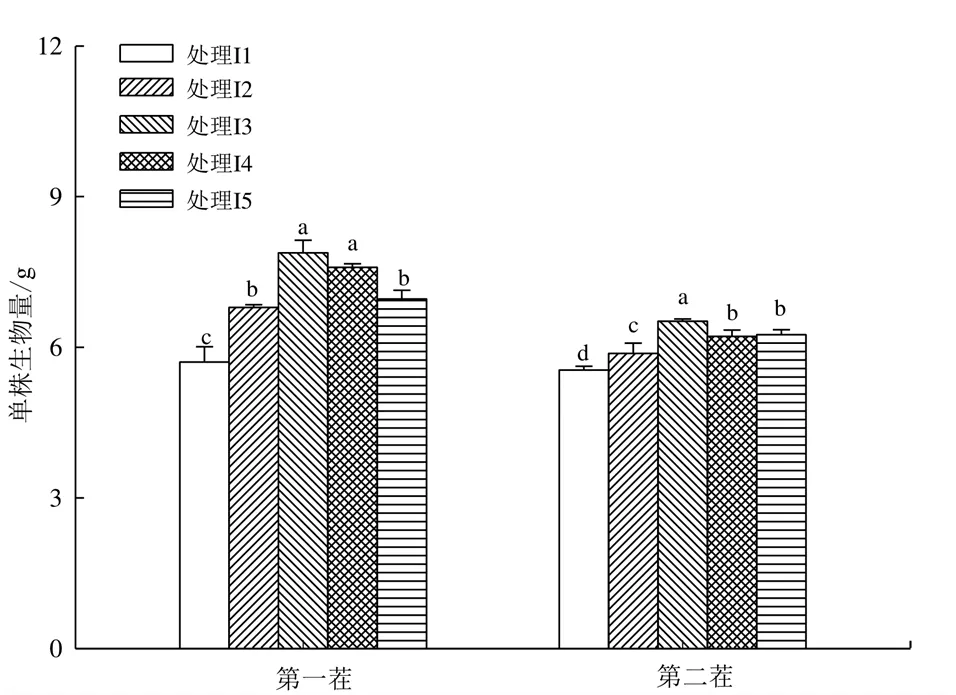
圖4 不同灌溉量下溫室生菜生物量變化
2.5 溫室生菜產量與水分利用效率
由表2可知,溫室生菜單株質量、產量及水分利用效率的變化規律隨灌溉量的增加整體上呈先增加后降低的變化規律。I3處理的單株質量、產量和水分利用效率最高,其次為I4處理,I1處理的單株質量和產量最低,而I5處理的水分利用效率最低。相比I1處理,I3處理的產量和水分利用效率分別提高了36.6%~37.3%和9.9%~15.2%;與I5處理相比,I3處理的產量提高了6.1%~23.7%,水分利用效率提高了12.6%~61.4%。綜合分析,適中的灌溉量(I3處理)可顯著提高溫室生菜的產量以及水分利用效率。
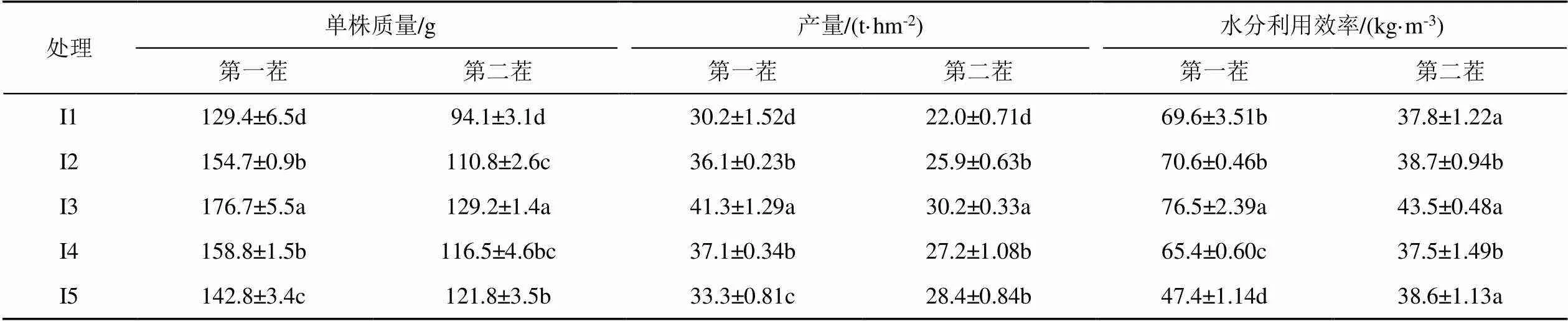
表2 不同灌溉量下的溫室生菜單株質量、產量及水分利用效率
注 相同列不同小寫字母表示差異顯著(<0.05)。
2.6 溫室灌溉生菜蒸發皿適宜灌溉系數(Kp)
制定適宜的蒸發皿灌溉系數(p)是溫室灌溉生菜實現高產的關鍵因素。如圖5所示,表示單位面積生菜產量,表示蒸發皿灌溉系數(p),生菜產量與蒸發皿灌溉系數p呈顯著的二次曲線回歸關系,第一茬和第二茬的2分別為0.929、0.827,均達到了極顯著水平(<0.01)。隨著p的增大,生菜產量呈先增加后降低的變化趨勢,當第一茬和第二茬的p分別為0.74和0.86時,生菜產量分別達到其最高值39.7 t/hm2和29.1 t/hm2。綜合2茬生菜產量(圖5(c)),2為0.882(<0.01),獲得生菜產量最高值對應的p為0.77。
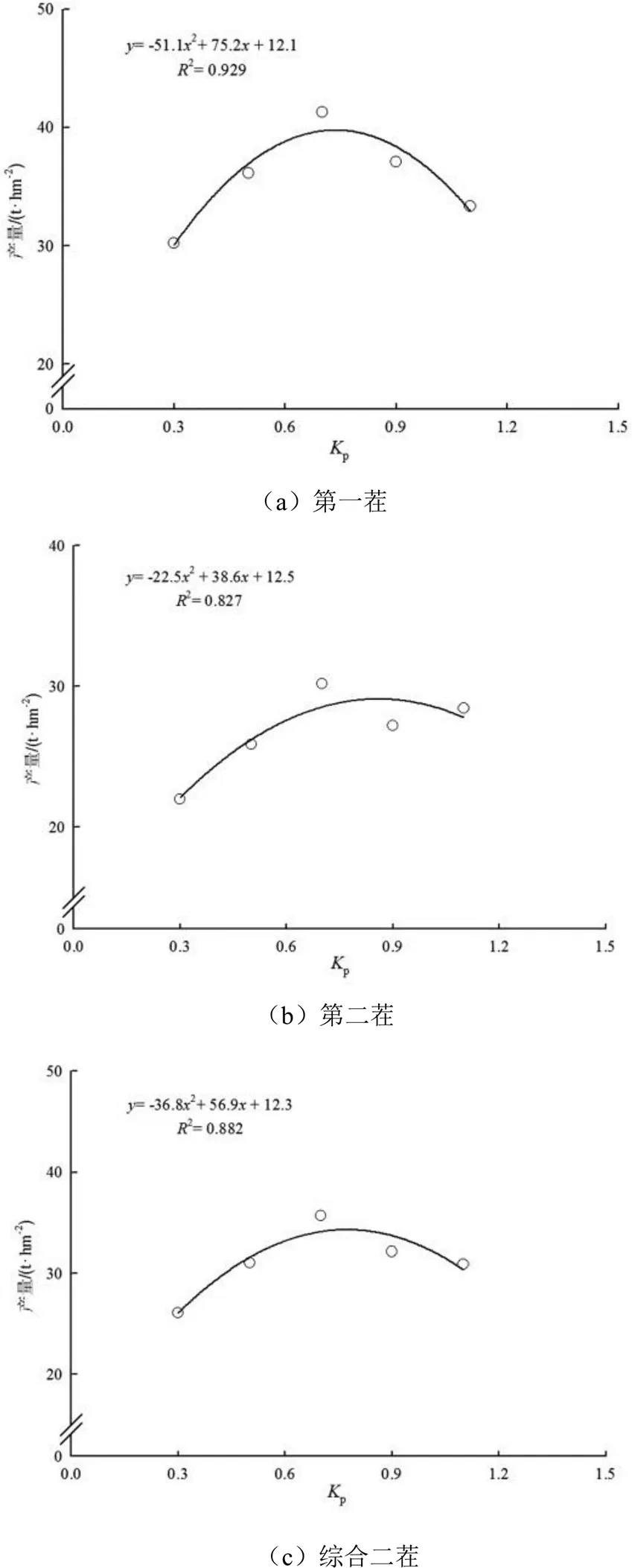
圖5 生菜產量與蒸發皿灌溉系數Kp的關系
3 討論
確定合理的蒸發皿灌溉系數(p)是基于標準蒸發皿水面蒸發量指導科學灌溉的前提,也是維持作物生長在最適宜需水狀態的關鍵保證[22-25]。為確定不同蔬菜作物的蒸發皿灌溉系數(p),前人做出了大量工作。許崢等[20]研究表明,在p為0.7的灌溉水平時,溫室菜心的產量、生物量以及水分利用效率最高。王湛等[26]開展了基于水面蒸發量的溫室茄子灌溉決策研究,結果表明,當p為0.8時,能夠獲得最高產量與水分利用效率,進而確定了溫室茄子灌溉管理的最優p為0.8。對于溫室黃瓜的研究表明,依據水面蒸發量進行灌溉管理的優選p為0.75[27]。姜展博等[28]研究也表明,溫室番茄的蒸發皿灌溉系數(p)為0.8。綜合上述研究可知,在溫室栽培條件下,葉類蔬菜的蒸發皿灌溉系數(p)為0.7左右,而番茄、黃瓜等果類蔬菜的蒸發皿灌溉系數(p)為0.75~0.8。本試驗條件下,I3處理的溫室生菜的單株產量、生物量、水分利用效率均為最高,其對應的p為0.7,這與許崢等[20]在溫室菜心上的研究結論完全一致。通過對2茬生菜進行產量擬合得到的p為0.77,這與王湛等[26]、焦艷平等[17]在茄子和黃瓜上的研究結果非常相似。可見,在利用標準蒸發皿的水面蒸發量進行灌溉管理時,適用于溫室蔬菜的合理p在0.8左右。蔬菜種類、以及生長環境條件差異可能是造成不同研究中p變化的主要原因。由本研究結果可知,溫室生菜第二茬的p明顯高于第一茬,其原因主要與2茬溫室環境條件的差異有關。在第二茬試驗期間,溫室平均溫度比第一茬高出了12.2%,累積水面蒸發量提高了33.3%,生菜蒸散量在第二茬顯著高于第一茬,p相比第一茬也有較大幅度提高。眾多研究也指出了環境因素是影響作物灌溉量的主要因素[16,25]。
與其他作物相比,蔬菜對水分的反應尤為敏感,蔬菜灌溉過多或者過少都不利于植株生長、生物量的積累以及產量的提高[29]。郭月萍等[30]研究表明,大棚茄子每次灌溉量為23 m3/667 m2的處理與灌溉量為28 m3/667 m2和18 m3/667 m2的處理相比,可顯著促進植株長勢、提高作物產量,且水分利用效率依次提高18%和4.3%。范鳳翠等[31]研究也表明,秋冬茬溫室番茄的適宜灌水量為930~1 230 m3/hm2,灌溉量過高或過低均不利于保證番茄產量和水分生產效率。可見,設施蔬菜并不是灌溉量越大則生產效率越高,適量灌溉是確保蔬菜高產和水分利用效率提高的關鍵。在本試驗中,I3處理(灌溉量為0.7p)的生菜地上部生物量、產量和水分利用效率在所有灌溉處理中均為最高。Liu等[32]研究表明,溫室番茄的適宜灌溉量為0.7p,與0.9p相比,番茄產量和水分利用效率分別提高了5.7%和4.2%。以往對溫室菜心的研究表明,與0.8p處理和0.9p處理相比,灌溉量為0.7p的菜心產量分別增加了5.6%和13.8%,水分利用效率分別增加了8.5%和27.7%[20]。與處理1.0p相比,溫室茄子灌溉量為0.8p時的水分利用效率增加了13.3%[25]。也有研究表明,土壤相對含水率超過80%時,產量不會顯著增加,而灌水不足引起的土壤含水率過低則會直接抑制植株的正常生長[33]。適量灌溉是確保作物生長在一種適宜的土壤水分條件下,進而促進植株生長和產量增加[34]。綜合考慮溫室生菜產量、生物量及水分利用效率,I3處理(即灌溉量為0.7p)是本試驗條件下的最適宜灌溉量,在以獲得溫室生菜高產和高水分利用效率為目標時,推薦的蒸發皿灌溉系數p為0.77。
4 結論
太陽輻射是影響溫室生菜p的關鍵環境因子,二者呈極顯著正相關,相關系數達到0.88。
第一茬和第二茬的生菜累積蒸散量變化范圍是43.4~70.4 mm和58.3~73.6 mm,并隨灌水量的增加而增加。I3處理(0.7p)的生菜地上部生物量、產量、水分利用效率最高,相比I1處理和I5處理,I3處理地上部生物量增加了17.5%~38.2%和4.2%~13.2%,產量增加了36.6%~37.3%和6.1%~23.7%,水分利用效率增加了9.9%~15.2%和12.6%~61.4%。
生菜產量和蒸發皿灌溉系數(p)呈二次曲線關系(<0.01),綜合2茬情況,當p為0.77時可獲得產量的最高值。綜合分析,I3(0.7p)是供試條件下溫室生菜最佳灌溉處理,但在以溫室生菜高產為目標時,建議優選的p為0.77。
[1] 張輝, 張玉龍, 虞娜, 等. 溫室膜下滴灌灌水控制下限與番茄產量、水分利用效率的關系[J]. 中國農業科學, 2006(2): 425-432.
ZHANG Hui, ZHANG Yulong, YU Na, et al. Greenhouse film under drip irrigation control limit its relationship with tomato yield, water use efficiency[J]. China’s Agricultural Science, 2006(2): 425-432.
[2] 劉明池, 張慎好, 劉向莉. 虧缺灌溉時期對番茄果實品質和產量的影響[J]. 農業工程學報, 2005, 21(S2): 92-95.
LIU Mingchi, ZHANG Shenghao, LIU Xiangli. Effects of different deficit irrigation periods on yield and fruit quality of tomato[J]. Journal of Agricultural Engineering, 2005, 21(S2): 92-95.
[3] 郭文忠, 陳青云, 高麗紅, 等. 設施蔬菜生產節水灌溉制度研究現狀及發展趨勢[J]. 農業工程學報, 2005, 21(S2): 24-27.
GUO Wenzhong , CHEN Qingyun, GAO Lihong, et al. System of water saving irrigation facilities vegetables production research status and development trend[J]. Journal of Agricultural Engineering, 2005, 21(S2): 24-27.
[4] 李銀坤, 郭文忠, 薛緒掌, 等. 不同灌溉施肥模式對溫室番茄產量、品質及水肥利用的影響[J]. 中國農業科學, 2017, 50(19): 3 757-3 765.
LI Yinkun, GUO Wenzhong, XUE Xuzhang, et al. Effects of different irrigation and fertilization patterns on yield, quality and water and fertilizer utilization of tomato in greenhouse[J]. Scientia Agricultura Sinica, 2017, 50(19): 3 757-3 765.
[5] 張友賢, 馮成, 方小宇, 等. 日光溫室滴灌條件下番茄需水規律研究[J].節水灌溉, 2014(8): 16-18.
ZHANG Youxian, FENG Cheng, FANG Xiaoyu, et al. Tomato under the condition of sunlight greenhouse drip irrigation water requirement rule research [J]. Journal of Water-saving Irrigation, 2014(8): 16-18.
[6] LIU Hao, DUAN Aiwang, LI Fusheng, et al. Drip irrigation scheduling for tomato grown in solar greenhouse based on pan evaporation in North China Plain[J]. Journal of Integrative Agriculture, 2013, 12(3): 520-531.
[7] RANA Gianfranco, KATERJI Nader. Measurement and estimation of actual evapotranspiration in the field under Mediterranean climate: A review[J]. European Journal of Agronomy, 2000, 13(2): 125-153.
[8] 曹金峰, 李玉中, 劉曉英, 等. 四種參考作物蒸散量綜合法的比較[J].中國農業氣象, 2015, 36(4): 428-436.
CAO Jinfeng, LI Yuzhong, LIU Xiaoying, et al. Four types of reference crop evapotranspiration quantity synthesis comparison[J]. China Agricultural Meteorology, 2015, 36(4): 428-436.
[9] 方棟平, 吳立峰, 張富倉, 等. 灌水量和滴灌施肥方式對溫室黃瓜產量和養分吸收的影響[J]. 灌溉排水學報, 2016, 35(11): 34-41.
FANG Dongping, WU Lifeng, ZHANG Fucang, et al. Irrigation water and the way of drip irrigation fertilization on greenhouse cucumber yield and nutrient absorption[J]. Journal of Irrigation and Drainage, 2016, 35(11): 34-41.
[10] 方棟平. 溫室黃瓜對不同灌水量和滴灌施肥方式的響應機制研究[D]. 楊凌: 西北農林科技大學, 2015.
FANG Dongping. Responding mechanism of greenhouse cucumber to different drip irrigation amount and various fertilization methods[D]. Yangling: Northwest Agriculture and Forestry University of Science and Technology, 2015.
[11] OWEIS Theib, FARAHANI Hamid, HACHUM Ahmed. Evapotranspiration and water use of full and deficit irrigated cotton in the Mediterranean environment in northern Syria[J]. Agricultural Water Mannagement, 2011, 98(8): 1 239-1 248.
[12] GREWAL Harsharn, MAHESHWARI Basant, PARKS Sophie, et al. Water and nutrient use efficiency of a low-cost hydroponic greenhouse for a cucumber crop: An Australian case study[J]. Agricultural Water Management, 2011, 98(5): 841-846.
[13] UZOKPE Pauline, 李新強, 高陽, 等. 不同灌水方式下基于水面蒸發量的夏玉米灌溉試驗研究[J]. 灌溉排水學報, 2013, 32(3): 59-62.
UZOKWE Pauline, LI Xinqiang, GAO Yang, et al. Based on the water surface evaporation under different irrigation modes of summer corn irrigation experimental study[J]. Journal of Irrigation and Drainage, 2013, 32(3): 59-62.
[14] 劉海軍, 黃冠華, 王明強, 等. 基于蒸發皿水面蒸發量制定冬小麥噴灌計劃[J]. 農業工程學報, 2010, 26(1): 11-17.
LIU Haijun, HUANG Guanhua, WANG Mingqiang, et al. Based on the evaporating dish water surface evaporation winter wheat irrigation plan[J]. Journal of Agricultural Engineering, 2010, 26(1): 11-17.
[15] 張魯魯, 蔡煥杰, 王健, 等. 不同灌水量對溫室甜瓜生長和生理特性的影響[J]. 干旱地區農業研究, 2009, 27(6): 58-62.
ZHANG Lulu, Cai Huanjie, WANG Jian, et al. Different irrigation water on the influence of greenhouse muskmelon growth and physiological characteristics[J]. Journal of Arid Region Agricultural Research, 2009, 27(6): 58-62.
[16] CAKIR Rcecep, KANBUROGLU-CEBI Ulviye, ALTINATAS Surreya, et al. Irrigation scheduling and water use efficiency of cucumber grown as a spring-summer cycle crop in solar greenhouse[J]. Agricultural Water Management, 2017, 180: 78-87.
[17] 焦艷平, 趙勇, 張艷紅, 等. 基于蒸發皿蒸發量的日光溫室番茄滴灌灌水量研究[J]. 干旱地區農業研究, 2011, 29(5): 133-138.
JIAO Yanping, ZHAN Yong, ZHANG Yanhong, et al. Greenhouse tomato infuse water drops based on evaporation pan evaporation study[J]. Journal of Agricultural Research in Arid Regious, 2011, 29(5): 133-138.
[18] 楊宜, 李銀坤, 郭文忠, 等. 基于稱重式蒸滲儀的溫室秋茬茄子蒸散特征及影響因素分析[J]. 節水灌溉, 2021(2): 47-51.
YANG Yi, LI Yinkun, GUO Wenzhong, et al. Analysis of evapotranspiration characteristics and influencing factors of aubergine in greenhouse based on weighing lysimeter[J]. Water Saving Irrigation, 2021(2): 47-51.
[19] 李銀坤, 郭文忠, 韓雪, 等. 基于稱重式蒸滲儀實測值的溫室茄子日蒸散量估算方法評價[J]. 中國農業氣象, 2020, 41(3): 129-137.
LI Yinkun, GUO Wenzhong, HAN Xue, et al. Evaluation of methods for estimating daily evapotranspiration of eggplant in greenhouse based on measured values of weighing lysimeter[J]. Chinese Journal of Agrometeorology, 2019, 41(3): 129-137.
[20] 許崢, 李銀坤, 郭文忠, 等. 基于稱重式蒸滲儀的溫室菜心耗水規律[J]. 北方園藝, 2017(16): 85-90.
XU Zheng, LI Yinkun, GUO Wenzhong, et al. Water consumption law of greenhouse vegetable core based on weighing lysimeter[J]. Northern Horticultural Science, 2017(16): 85-90.
[21] 王加蓬, 蔡煥杰, 王健, 等. 溫室甜瓜膜下滴灌初花期適宜蒸發皿系數研究[J]. 干旱地區農業研究, 2009, 27(4): 22-26.
WANG Jiapeng, CAI Huanjie, WANG Jian, et al. Coefficient of greenhouse muskmelon membrane under drip irrigation in the early flowering suitable evaporating dish study[J]. Journal of Arid Region Agricultural Research, 2009, 27(4): 22-26.
[22] ZHANG Zhikun, LIU Shiqi, LIU Suhui, et al. State key laboratory of estimation of cucumber evapotranspiration in solar greenhouse in northeast China[J]. Agricultural Sciences in China, 2010, 9(4): 512-518.
[23] INCROCCI L, THOMPSON R B, FERNANDEZ-FERNANDEZ M D, et al. Irrigation management of European greenhouse vegetable crops[J]. Agricultural Water Management, 2020, 242: 106 393.
[24] HUANG Lin, DENG Lianhua, LI Angui, et al. Analytical model for solar radiation transmitting the curved transparent surface of solar greenhouse[J]. Journal of Building Engineering, 2020, 32: 101 785.
[25] 葛建坤, 李佳, 羅金耀. 基于水面蒸發法的日光溫室膜下滴灌番茄需水量計算模型[J]. 灌溉排水學報, 2015, 34(8): 53-56.
GE Jiankun, LI Jia, LUO Jinyao. Sunlight greenhouse film based on water surface evaporation method with drip irrigation tomato water demand calculation model[J]. Journal of Irrigation and Drainage, 2015, 34(8): 53-56.
[26] 王湛, 李銀坤, 郭文忠, 等. 不同灌水量對溫室茄子蒸騰規律及水分利用的影響[J]. 中國農村水利水電, 2019(7): 6-10.
WANG Zhan, LI Yinkun, GUO Wenzhong, et al. Different irrigation water on the impact of greenhouse eggplant transpiration and water use[J]. China’s Rural Water Conservancy and Hydropower, 2019(7): 6-10.
[27] 龔雪文, 孫景生, 劉浩, 等. 基于20 cm蒸發皿蒸發量制定華北地區溫室黃瓜滴灌灌水制度[J]. 應用生態學報, 2015, 26(11): 3 381-3 388.
GONG Xuewen, SUN Jingsheng, LIU Hao, et al. Study on the irrigation system of cucumber drip irrigation in greenhouse based on 20 cm pan evaporation in North China[J]. Chinese Journal of Applied Ecology, 2015, 26(11): 3 381-3 388.
[28] 姜展博, 王麗學, 李明陽, 等. 基于蒸發皿蒸發量的日光溫室番茄適宜水-炭管理模式[J]. 生態學雜志, 2020, 39(10): 3 521-3 530.
JIANG Zhanbo, WANG Lixue, LI Mingyang, et al. The sunlight greenhouse tomato based on evaporation pan evaporation is suitable for water - carbon management model[J]. Journal of Ecology, 2020, 39(10): 3 521-3 530.
[29] 李銀坤. 不同水氮條件下黃瓜季保護地氮素損失研究[D]. 北京: 中國農業科學院, 2010.
LI Yinkun.Study on the nitrogen loss in the protected soil under different water and nitrogen conditions during cucumber growing season[D]. Beijing:Chinese Academy of Agricultural Sciences, 2010.
[30] 郭月萍, 曾燁, 李晨, 等. 春大棚茄子微噴灌溉量探討[J]. 中國瓜菜, 2020, 33(2): 53-56.
GUO Yueping, ZENG Ye, LI Chen, et al. Spring greenhouse eggplant micro spray irrigation quantity study[J]. Journal of Chinese Vegetables, 2020, 33(2): 53-56.
[31] 范鳳翠, 劉勝堯, 賈宋楠, 等. 覆膜溝灌下灌水量對日光溫室番茄生長動態、產量及水分生產效率的影響[J]. 北方園藝, 2018(13): 63-68.
FAN Fengcui, LIU Shengyao, JIA Songnan, et al. Effects of irrigation amount under plastic film mulching furrow irrigation on growth dynamics, yield and water production efficiency of tomato in solar greenhouse[J]. Northern Horticulture, 2018(13): 63-68.
[32] LIU Hao, LI Huanhuan, NI Dongfeng, et al. Optimizing irrigation frequency and amount balance yield, fruit quality and water use efficiency of greenhouse tomato[J]. Agricultural Water Management, 2019, 226: 105 787.
[33] 張憲法, 于賢昌, 張振賢. 土壤水分對溫室黃瓜結果期生長與生理特性的影響[J]. 園藝學報, 2002(4): 343-347.
ZHANG Xianfa, YU Xianchang, ZHANG Zhenxian. Soil moisture on growth and physiological characteristics of greenhouse cucumber result influence[J]. Journal of Gardening, 2002(4): 343-347.
[34] LI Yinkun, XUE Xuzhang, XU Fan, et al. Negative-pressure irrigation improves water and fertilizer use efficiencies and fruit yield of greenhouse tomato on the North China Plain[J]. Irrigation and Drainage, 2021, 70(5): 1 027-1 038.
Optimizing Irrigation Amount for Greenhouse Lettuce Production Based on Pan-measured Evaporation
LI Yinkun1, ZHAN Baocheng1,2, GUO Wenzhong1*, LIANG Yi2, LI Liang2, BAI Minzhan3
(1. Intelligent Equipment Research Center, Beijing Academy of Agriculture and Forestry Sciences, Beijing 100097, China; 2. College of Agriculture, Ningxia University, Yinchuan 750000, China; 3. Shanxi Ronghua Agricultural Science and Technology Co. LTD, Xi’an 710000, China)
【】Optimizing irrigation is critical to sustaining agricultural production in arid and semi-arid regions. The purpose of this paper is to investigate the feasibility of using pan-measured evaporation (p) to optimize irrigation for greenhouse lettuce production.【】The experiment was conducted using weighing-lysimeters installed in a greenhouse. We compared five treatments by irrigating the crop at 30% (I1), 50%, (I2), 70%(I3), 90% (I4) and 110% (I5) ofpmeasured from a standard evaporation pan with diameter of 20 cm, respectively. In each treatment, we measured the evapotranspiration, above-ground biomass, yield and water use efficiency, from which we calculated the optimal irrigation amount and its associated pan coefficient (p). We rotated the lettuce after harvesting the first one.【】It was found thatpincreased as time elapsed, and the cumulativepof the rotated crop was 96.0 mm, increasing 33.4% compared to the first harvest. Solar radiation affectedpmost at significant level (<0.01). The cumulative evapotranspiration in the first and second harvests varied from 43.4 mm to 70.4 mm, and 58.3 to 73.6 mm, respectively, both increasing with the irrigation amount. The cumulative pan-evaporation in the rotated crop under I1, I2 and I5 was 58.3 mm, 67.0 mm and 73.6 mm, respectively. With the increase in irrigation amount, the aboveground biomass increased firstly followed by a falling. Compared with I1 and I5, I3 increased the aboveground biomass by 17.5%~38.2% (<0.05) and 4.2%~13.2% (<0.05), respectively. Optimizing the irrigation significantly improved the yield and water use efficiency. Compared with I1 and I5, I3 increased the yield by 36.6%~37.3% (<0.05) and 6.1%~23.7% (<0.05), water use efficiency by 9.9%~15.2% (<0.05) and 12.6%~61.4% (<0.05), respectively. There was a quadratic relationship between the yield and the pan irrigation coefficient (p=0.77) with<0.01.【】Among all treatments we compared, irrigating 70% of evaporation measured from the 20 cm standard pan was optimal for greenhouse lettuce production with a pan irrigation coefficient of 0.77.
greenhouse lettuce; weighing lysimeter; water surface evaporation; yield; water use efficiency
1672 - 3317(2022)04 - 0013 - 07
S274.3;S626.5
A
10.13522/j.cnki.ggps.2021458
李銀坤, 詹保成, 郭文忠, 等. 基于蒸發皿水面蒸發量的溫室生菜適宜灌溉量研究[J]. 灌溉排水學報, 2022, 41(4): 13-19.
LI Yinkun, ZHAN Baocheng, GUO Wenzhong, et al. Optimizing Irrigation Amount for Greenhouse Lettuce Production Based on Pan-measured Evaporation[J]. Journal of Irrigation and Drainage, 2022, 41(4): 13-19.
2021-09-24
河北省重點研發計劃項目(21327005D);國家重點研發計劃資助項目(2020YFD1000300)
李銀坤(1982-),男。副研究員,博士,主要從事作物水肥高效利用研究。E-mail: lykun1218@163.com
郭文忠(1970-),男。研究員,博士,主要從事設施蔬菜高效栽培與智慧管理研究。E-mail: guowz@nercita.org.cn
責任編輯:韓 洋
猜你喜歡
礦山安全信息(2022年40期)2022-04-07 02:16:52
當代水產(2021年10期)2021-12-05 16:31:48
今日農業(2021年14期)2021-11-25 23:57:29
今日農業(2021年13期)2021-08-14 01:37:56
石油與天然氣地質(2021年1期)2021-02-22 14:14:44
今日農業(2020年20期)2020-11-26 06:09:10
中國果業信息(2019年10期)2019-11-13 01:21:34
中國化肥信息(2019年2期)2019-01-18 15:24:35
中國化肥信息(2019年1期)2019-01-17 21:31:12
中國化肥信息(2019年4期)2019-01-17 18:47:06
