
Association between depression and malnutrition in pulmonary tuberculosis patients: A cross-sectional study
2022-06-23 06:27:44XueFangDanPingChenLingLingTangYanJunMao
World Journal of Clinical Cases 2022年14期
lNTRODUCTlON
Pulmonary tuberculosis (PTB), a chronic wasting disease, is a chronic pulmonary infection which is caused by
. An estimated 9.0-11.1 million PTB cases were diagnosed in 2018 worldwide, 1.0 million of which were children[1]. PTB presents as a global public health problem, and the situation in developing countries, including China, is even worse. Despite the decreasing trend of PTB prevalence in China, PTB remains a considerable threat to public health due to the high number of PTB patients and the multidrug-resistant PTB burden[2]. Cumulative evidence revealed that depression was prevalent in people with chronic diseases[3]. In addition, the ratio of PTB patients with depression was higher than that in healthy populations[4]. In a hospital-based cross-sectional study conducted in Cameroon, Kehbila
[5] found that more than 50% of PTB patients were affected by depression. In Manila, the Philippines, approximately 16.8% of the PTB patients reportedly had depression[6]. However, no hospital-based study has been published on the prevalence of this state in patients with PTB in China. Previous reports have evidenced that human immune deficiency virus infection, poor social support, and perceived stigma are risk factors for the development of depression in PTB patients[7-9]. Moreover, the depression in patients with PTB is associated with insufficient health care and poor treatment compliance, which has led to drug resistance, morbidity, and mortality[10], negatively affecting the health-related quality of life (QOL) of PTB patients[11,12]. Additionally, PTB patients were susceptible to malnutrition, with a ratio of malnutrition from 38.3% to 75.0%[13]. Furthermore, malnutrition also triggered PTB relapse and increased mortality[14,15]. Appropriate and timely intervention for malnutritional and/or depressed PTB patients is a medical need. We hypothesized that depression may be prevalent in malnutritional PTB patients in China. Therefore, in this study, we aimed to evaluate the association between depression and malnutrition in PTB patients in China.
MATERlALS AND METHODS
Study design
This is a hospital-based cross-sectional study, which was conducted from April to July 2019 in Shanghai Pulmonary Hospital Affiliated to Tongji University, China. Patients with PTB were consecutively recruited for analysis. The inclusion criteria were as follows: (1) Clear consciousness; (2) Ability to communicate; (3) Patients who have provided informed consent and voluntarily participated in this study; and (4) Age above 18 years. The following exclusion criteria were applied: (1) A history of mental illness; (2) Complications, such as disturbance of consciousness, chronic respiratory failure, and pulmonary encephalopathy; (3) Metabolic-related diseases such as thyroid disease; (4) Requirements for continuous non-invasive or invasive ventilation; (5) Unstable hemodynamics; (6) Cardiac or renal insufficiency; and (7) Extrapulmonary tuberculosis. All subjects provided written informed consent. The study protocol was approved by the Ethics Committee (No. K19-146).
Data collection
Data including age, educational level, occupation, marital status, body mass index (BMI), income, comorbidity, treatment duration, hemoglobin (Hb), albumin, liver function [alanine transaminase (ALT) and aspartate aminotransferase (AST)], and medical cost origin were collected by nurses (Fang XE, Chen DP, and Tang LL) who received uniform training by face-to-face interviews. On post-admission day, the patient’s height and weight were measured. The height was measured using a calibrated ruler (± 0.5 cm); the actual body weight was measured using a corrected scale (± 0.2 kg). BMI was calculated as [weight (kg)/height (m
)]. Next, BMI was used to assess the nutritional status[16] (Supplementary Table 1), and BMI less than 18.5 kg/m
was considered to represent malnutrition[17].
It is really wonderful what fine hair you have, madam! Have you never thought of marrying? Yes, that I have! answered the hair-brush; I m engaged to the boot-jack! Engaged! exclaimed the shirt-collar
Patient Health Questionnaire-9
Depression was evaluated by the Patient Health Questionnaire-9 (PHQ-9)[18], which consists of nine questions and has been validated in China with a Cronbach’s alpha value higher than 0.8. Each item was scored as 0 (not at all), 1 (several days), 2 (more than half of the days), or 3 (nearly every day); the total score ranged from 0 to 27. A PHQ-9 value higher than 10 showed a higher susceptibility to depression[19]. Hence, the included PTB patients were divided into two groups: Depression and control, based on a PHQ-9 threshold of 10.
QOL assessment
The level of QOL was assessed by the Quality of Life Instruments for Chronic Diseases-Pulmonary Tuberculosis (QLICD-PT)[20], which has been validated in China with a Cronbach’s alpha value higher than 0.7. The QLICD-PT includes three domains and a specific model: Physiological function (basic physiological function, independence, energy, and discomfort), psychological function (cognition, emotion, will, and personality), social function (interpersonal interaction, social support, and social role), and specific module (respiratory symptoms, systemic symptoms, drug side effects, and special psychology).
Sample size
This hospital-based cross-sectional study included patients with PTB in Shanghai Pulmonary Hospital Affiliated to Tongji University from April 2019 to July 2019. The Patient Health Questionnaire-9 (PHQ-9) scale was used to evaluate depression and the cut-off value was set at 10, and the nutritional state was determined by the body mass index (BMI). In addition, the Quality of Life Instruments for Chronic Diseases was employed to quantify the quality of life (QOL). Univariable analysis and multivariable analysis (forward mode) were used to identify the independent factors associated with depression.
Statistical analysis
SPSS software (version 20.0 Chicago, IL, United States) was used to analyze the data. Continuous data are presented as the mean ± SD. Normality distribution was determined by the Shapiro-Wilk test. The Student’s independent
test or Mann-Whitney test was used depending on the normality. Categorical data are expressed as numbers (percentages) and were analyzed using the
c
test. Univariable analysis was applied to identify the independent factors which are associated with depression. To identify potential confounders, factors with
< 0.1 in the univariable analysis were entered into the multivariable logistic regression model and were assessed using the forward mode.
< 0.05 was considered to indicate statistically significant differences.
RESULTS
Demographic data
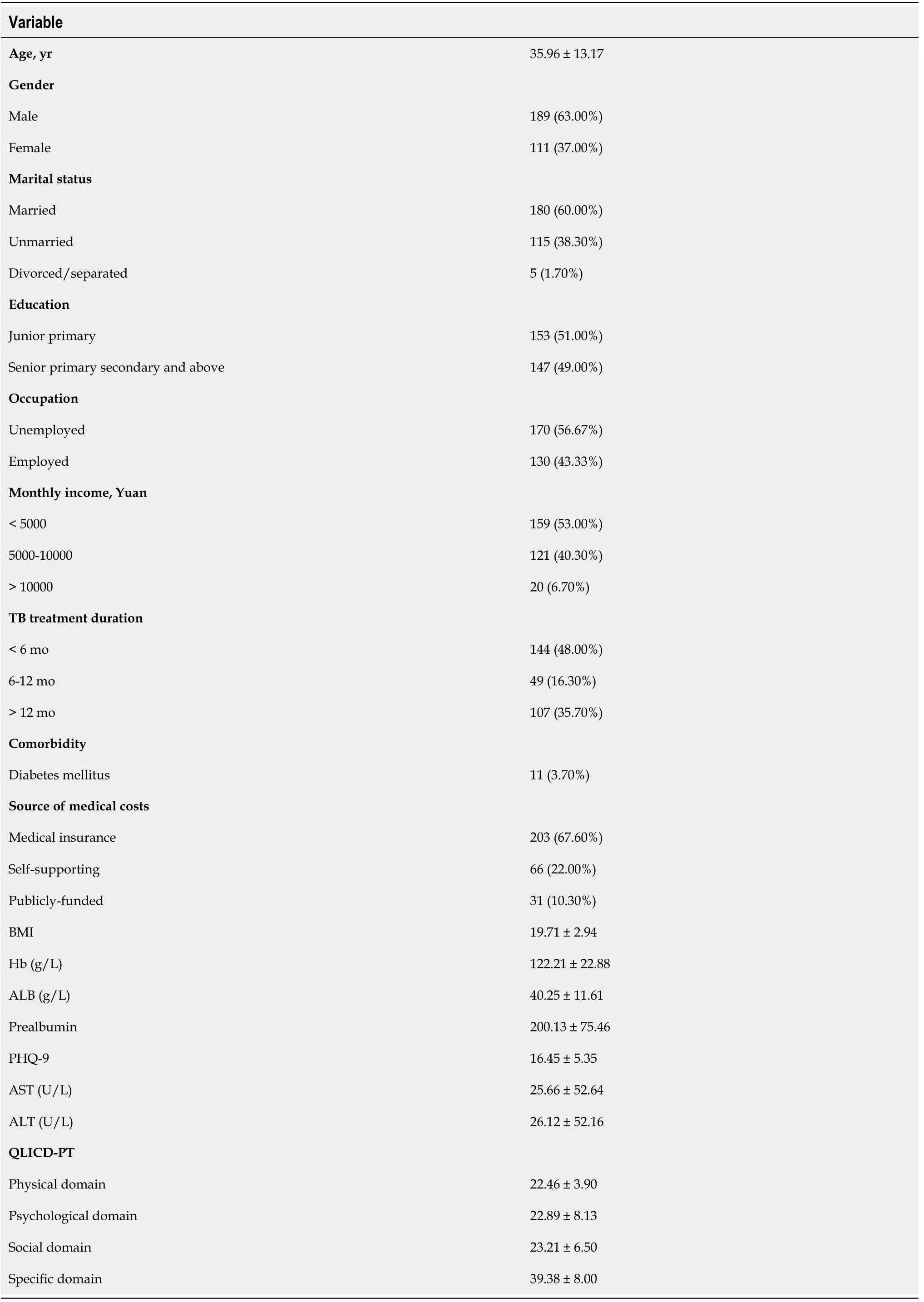
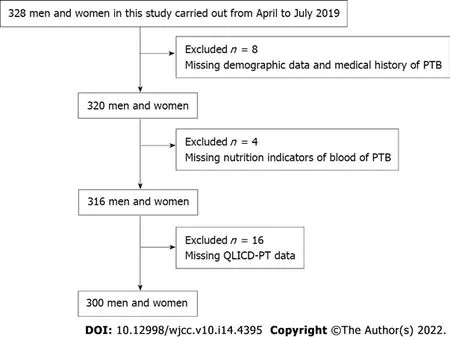
A total of 328 PTB patients were recruited. Of them, we excluded eight for missing data, four for missing nutrition indicators of blood, and sixteen for missing QLICD-PT scale data. Finally, 300 PTB patients (91.46%) were subjected to analysis (Figure 1). The mean age of the respondents was 35.96 (± 13.17; range 21-40, median 30) years. Of the patients included, 189 (63%) were men, 180 (60%) were married, 93 (31%) had undergraduate education, and 170 (56.67%) were unemployed (Table 1).
But she had only been there a very little time before a wandering butterfly brought a message from her to the Fairy, begging that she might be sent for as soon as possible, and before very long she was allowed to return
Factors associated with depression in PTB patients
Based on the PHQ-9 score at 10, the PTB patients were divided to depression (
= 225, 75%) and control (
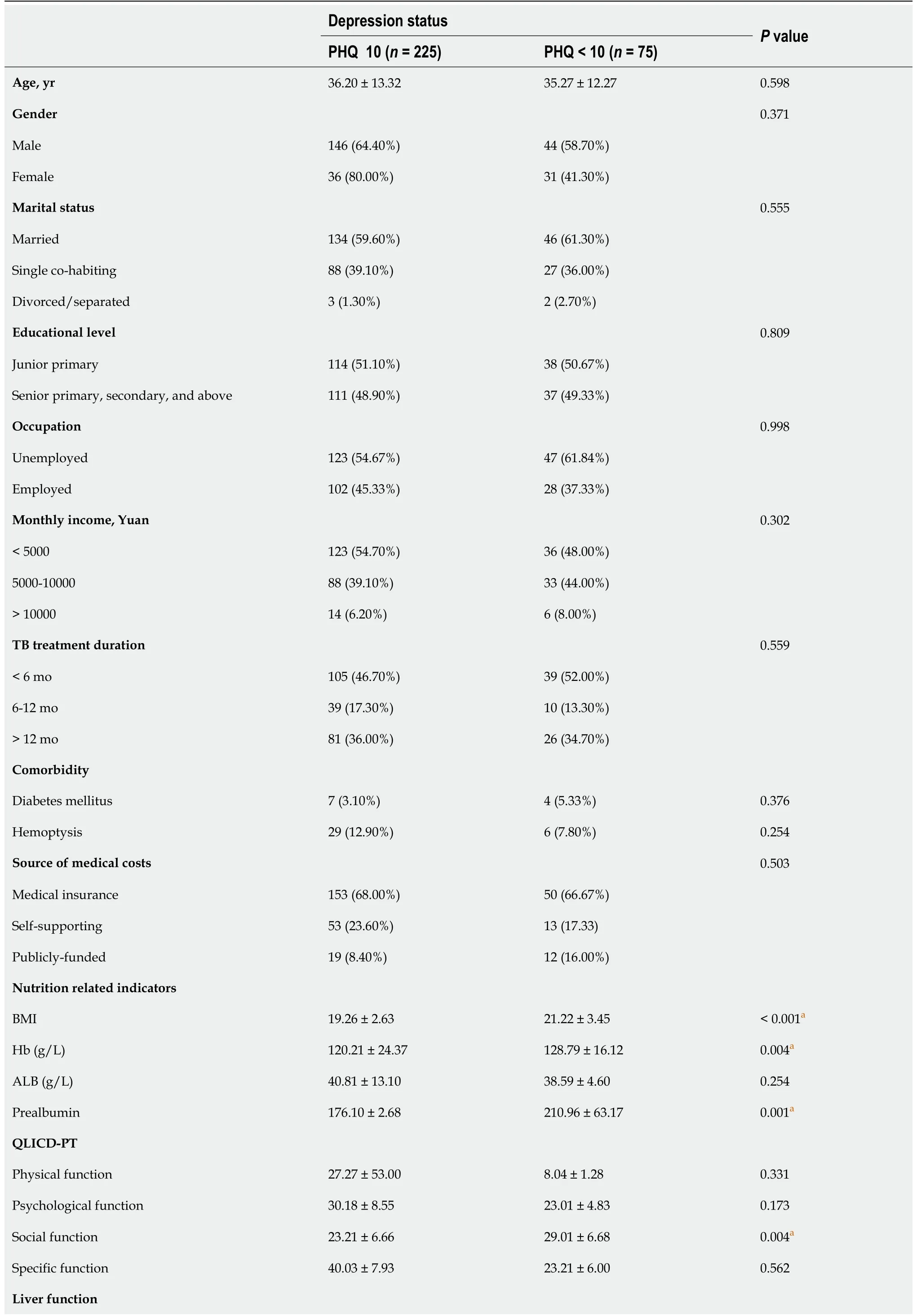
= 75, 25%) groups. The ratio of malnutrition among depressive status with PTB patients was 45.33% (Table 2). No statistically significant differences were detected between the groups in age, gender, marital status, education level, occupation, monthly income, TB treatment duration, comorbidity, or origin of medical costs (
> 0.05). The values of BMI (
< 0.001), Hb (
< 0.05), prealbumin (
< 0.05), and social function of QLICD-PT (
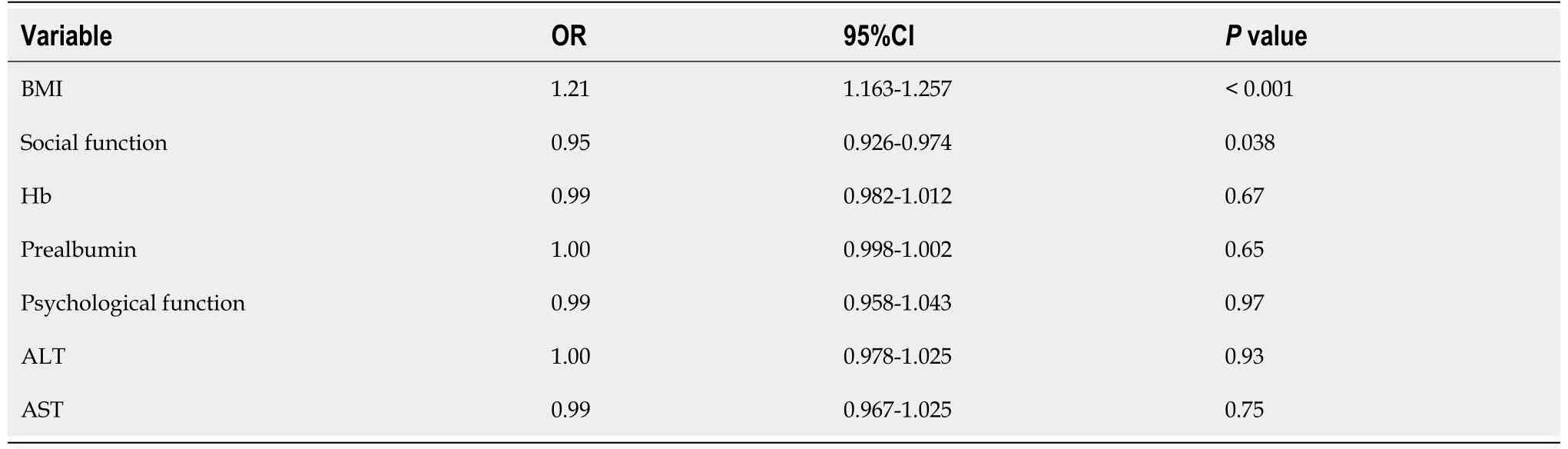
< 0.05) in the depression group were significantly lower than those in the control group. In addition, AST and ALT in the depression group were significantly higher than those in the control group (Table 2). Finally, logistic regression analysis was used to evaluate the possible factors that influence depression. As can be seen in Table 3, BMI [odds ratio (OR) = 1.21, 95% confidence interval (CI): 1.163-1.257,
< 0.001] and poor social function (OR = 0.95, 95%CI: 0.926-0.974,
= 0.038) were independently associated with depression.

DlSCUSSlON
They argued on for some time, but at length, when the Caliph saw plainly that his Vizier would rather remain a stork to the end of his days than marry the owl, he determined95 to fulfil the condition himself
The prevalence of depression in the PTB patients included in the present study was estimated to be higher than that determined in other studies; for example, it was 41.1% in Nigeria[21], 61.1% in Cameron[5], 56% in Pakistan[22], 54% in Ethiopia[23], and 69.6% in Liaoning Province of China[3]. In other investigations, the comorbidity of mental disorders in hospitalized patients ranged from 19%[24] to 80%[25]. In a study performed in the Philippines, the depressive state among PTB patients was 16.8%[6]. These findings suggest that the depressive state in PTB patients varies and is country-specific. In the present study, the depression ratio was 75%, which was higher than those in most of the published reports. This discrepancy may be due to differences in the sample size, race, country-specific features, patient populations (hospitalized or not), and the specific depression assessment tool implemented.
Here, we found that the ratio of malnutrition among depressive PTB patients was 45.33%. Patients with non-depression status had higher levels of BMI, Hb, and prealbumin than patients with depression. Furthermore, the ratio of anemia among depressive PTB patients was 86.32%, which may due to the effect of TB on red blood cell production, such as decreased erythrocyte lifespan, poor erythrocyte iron incorporation, and decreased sensitivity to erythropoietin[16]. Masumoto
[6] also recommended that additional attention should be paid to malnourished PTB patients and those with poor social support to identify depression. Therefore, nutritional support for PTB patients may be necessary.
Nutrition problems may be caused by mental health issues, and thus the symptoms of malnutrition and psychological distress may overlap[26]. In this study, we found an association between malnutrition and depression, in which the following factors might be involved or causative: (1) Depression may lead to loss of appetite and digestive dysfunction; (2) Continuous mental stimulation leads to serious vegetative nerve dysfunction and endocrine imbalance, which affects the body’s absorption of nutrients; and (3) The disease itself can increase catabolism, promoting protein decomposition and reducing protein synthesis. In addition, a negative association between depression and poor social function may exist. There may be a vicious circle, including malnutrition, QOL, and depression. Malnutrition may aggravate depression and seriously affect the QOL, while the loss of appetite in depressed patients can lead to malnutrition.
It might be an Italian or a Spaniard, remarked the clergyman.But to the fisherman s wife these nations seemed all the same, andshe consoled herself with the thought that the child was baptized as aChristian.
This study is not without limitations. As it was hospital-based cross-sectional, the risk factors for depression in different treatment periods in patients with PTB could not be identified. Additionally, no additional validation of the depression and QOL scales was performed. Moreover, the nutritional status was evaluated by BMI, while many other indicators could also reflect the nutritional status. The energy intake was not assessed, which could have introduced bias. Furthermore, data of the severity of PTB were not collected. Socio-economic status was reported to be a confounding factor between nutritional status and depression[27]. However, we did not explore that association.
CONCLUSlON
Then the hand of the person who has touched the bird will be held as in a vice9, and nothing will set it free, unless you touch it with this little stick which I will make you a present of
ARTlCLE HlGHLlGHTS
Research background
It has been reported that depression is prevalent in patients with pulmonary tuberculosis (PTB).Moreover, several clinical symptoms of PTB and depression overlap, such as loss of appetite and malnutrition. However, the association between depression and malnutrition in TB patients has not been fully understood.
Research motivation
The present study aimed to explore the association between depression and malnutrition in patients with PTB.
Research objectives
The present study aimed to explore the association between depression and malnutrition in patients with PTB.
Research methods
The sample size for this study was calculated using the formula:
= (z)
p(1-p)/e
, where z is 1.96 [the value at 95% confidence interval (CI)], e is the standard error (estimated at 1/8), and p is the ratio of depression. We estimated that 50% of the PTB patients would develop depression. Considering a potential 20% loss, we established that at least 300 PTB patients for inclusion were required.
Tatar, Maria. Off With Their Heads!: Fairy Tales and the Culture of Childhood. Princeton, NJ: Princeton University Press, 1987.Buy the book in paperback63.
Research results
A total of 328 PTB patients were screened for analysis. Eight were excluded for missing demographic data, four excluded for missing nutrition status, and sixteen for missing QOL data. Finally, 300 PTB patients were subjected to analysis. It was found that depressive state was present in 225 PTB patients (75%). The ratio of malnutrition in the depressive PTB patients was 45.33%. It was found that BMI, hemoglobin, and prealbumin in the depression group were significantly lower than those in the control group (
< 0.05). Moreover, the social status (
< 0.05) significantly differed between the groups. In addition, glutamic pyruvic transaminase and glutamic oxaloacetic transaminase in the depression group were significantly higher than those in the control group (
< 0.05). Multivariable logistic regression analysis showed that BMI [odds ratio (OR) =1.21, 95% confidence interval (CI): 1.163-1.257,
< 0.001] and poor social function (OR = 0.95, 95%CI: 0.926-0.974,
= 0.038) were independently associated with depression.
Research conclusions
The North Wind woke her betimes next morning, and puffed19 himself up, and made himself so big and so strong that it was frightful20 to see him, and away they went, high up through the air, as if they would not stop until they had reached the very end of the world
In conclusion, the findings of the present study suggest that depression is common in hospitalized PTB patients, and psychological counseling or management and nourishment adjustments may be needed. To confirm the findings of the present study, a well-designed prospective large-scale study is needed.
The study protocol was approved by the Ethics Committee of Shanghai Pulmonary Hospital Affiliated to Tongji University (No. K19-146).
Research perspectives
Malnutrition and poor social function are significantly associated with depressive symptoms in PTB patients. A prospective large-scale study is needed to confirm these findings.
ACKNOWLEDGEMENTS
The authors appreciate the respective study institution for their help and the study participants for their cooperation in providing all necessary information.
The assessment of the depressive state in patients with PTB using the PHQ-9 scale showed that 75% of the study subjects developed depression. In addition, the results of the present study also suggest that nutritional status and social function were independent risk factors for depression. In clinical practice, nutrition management and psychological counseling for PTB patients are highly necessary.
FOOTNOTES
YJ Mao was the guarantor and designed the study; Fang XE, Chen DP, and Tang LL participated in the acquisition, analysis, and interpretation of the data, and drafted the initial manuscript; Fang XE, Chen DP, Tang LL, and Mao YJ revised the article critically for important intellectual content.
Malnutrition and poor social function are significantly associated with depressive symptoms in PTB patients. A prospective large-scale study is needed to confirm these findings.
“She is fat and pretty, and she has been fed with the kernels1 of nuts,” said the old robber-woman, who had a long beard and eyebrows2 that hung over her eyes. “She is as good as a little lamb; how nice she will taste!” and as she said this, she drew forth3 a shining knife, that glittered horribly. “Oh!” screamed the old woman the same moment; for her own daughter, who held her back, had bitten her in the ear. She was a wild and naughty girl, and the mother called her an ugly thing, and had not time to kill Gerda.
All study participants or their legal guardian provided informed written consent prior to study enrollment.
There are no conflicts of interest to report.
No additional data are available.
Sometime later, years later, my grandmother gave me the clock and the key. The old house was quiet. No bowls clanging, no laughter over the dinner table, no ticking or chiming of the clock-all was still. The hands on the clock were frozen, a reminder7 of time slipping away, stopped at the precise moment when my grandfather had ceased winding it. I took the key in my shaking hand and opened the clock door. All of a sudden, I was a child again, watching my grandfather with his silver-white hair and twinkling blue eyes. He was there, winking8 at me, at the secret of the clock s magic, at the key that held so much power. I stood, lost in the moment for a long time. Then slowly, reverently9, I inserted the key and wound the clock. It sprang to life. Tick-tock, tick-tock, life and chimes were breathed into the dining room, into the house and into my heart. In the movement of the hands of the clock, my grandfather lived again.
This article is an open-access article that was selected by an in-house editor and fully peer-reviewed by external reviewers. It is distributed in accordance with the Creative Commons Attribution NonCommercial (CC BYNC 4.0) license, which permits others to distribute, remix, adapt, build upon this work non-commercially, and license their derivative works on different terms, provided the original work is properly cited and the use is noncommercial. See: https://creativecommons.org/Licenses/by-nc/4.0/
China
Xue-E Fang 0000-0003-0457-3554; Dan-Ping Chen 0000-0002-6265-7409; Ling-Ling Tang 0000-0003-2186-0627; Yan-Jun Mao 0000-0003-1272-4033.
Wang JJ
Wang TQ
Wang JJ
1 World Health Organization. Global tuberculosis report 2018. [cited 15 June 2021]. Available from: https://www.who.int/publications/i/item/9789241565646
2 Huang L, Li XX, Abe EM, Xu L, Ruan Y, Cao CL, Li SZ. Spatial-temporal analysis of pulmonary tuberculosis in the northeast of the Yunnan province, People's Republic of China.
2017; 6: 53 [PMⅠD: 28335803 DOⅠ: 10.1186/s40249-017-0268-4]
3 Contini B. Threats and organizational design.
1967; 12: 453-462 [PMⅠD: 6060437 DOⅠ: 10.3389/fpsyt.2018.00308]
4 Shen TC, Wang CY, Lin CL, Liao WC, Chen CH, Tu CY, Hsia TC, Shih CM, Hsu WH, Chung CJ. People with tuberculosis are associated with a subsequent risk of depression.
2014; 25: 936-940 [PMⅠD: 25459212 DOⅠ: 10.1016/j.ejim.2014.10.006]
5 Kehbila J, Ekabe CJ, Aminde LN, Noubiap JJ, Fon PN, Monekosso GL. Prevalence and correlates of depressive symptoms in adult patients with pulmonary tuberculosis in the Southwest Region of Cameroon.
2016; 5: 51 [PMⅠD: 27268138 DOⅠ: 10.1186/s40249-016-0145-6]
6 Masumoto S, Yamamoto T, Ohkado A, Yoshimatsu S, Querri AG, Kamiya Y. Prevalence and associated factors of depressive state among pulmonary tuberculosis patients in Manila, The Philippines.
2014; 18: 174-179 [PMⅠD: 24429309 DOⅠ: 10.5588/ijtld.13.0335]
7 Olden K, Hempfling WP. The 503-nm pigment of Escherichia coli B: characterization and nutritional conditions affecting its accumulation.
1973; 113: 914-921 [PMⅠD: 4570612 DOⅠ: 10.1186/s12888-015-0598-3]
8 Naidoo P, Mwaba K. Helplessness, depression, and social support among people being treated for tuberculosis in south africa.
2010; 38: 1323-1333 [DOⅠ: 10.2224/sbp.2010.38.10.1323]
9 Lee LY, Tung HH, Chen SC, Fu CH. Perceived stigma and depression in initially diagnosed pulmonary tuberculosis patients.
2017; 26: 4813-4821 [PMⅠD: 28370819 DOⅠ: 10.1111/jocn.13837]
10 Gaze H. Ethics: a question of morality.
1987; 83: 18-19 [PMⅠD: 3649695 DOⅠ: 10.1155/2013/489865]
11 Darby DW. The dentist and continuing education--attitudes and motivations.
1969; 36: 165-170 [PMⅠD: 5256348 DOⅠ: 10.4046/trd.2017.80.1.69]
12 Oppo GT, Segre A, Morelli L. [Changes in serum leucine aminopeptidase during pregnancy, delivery and puerperium].
1969; 21: 881-887 [PMⅠD: 5398494 DOⅠ: 10.1371/journal.pone.0174605]
13 Cammer L. Antidepressants as a prophylaxis against depression in the obsessive compulsive person.
1973; 14: 201-206 [PMⅠD: 4794866 DOⅠ: 10.4103/0366-6999.170255]
14 Kant S, Gupta H, Ahluwalia S. Significance of nutrition in pulmonary tuberculosis.
2015; 55: 955-963 [PMⅠD: 24915351 DOⅠ: 10.1080/10408398.2012.679500]
15 Kumar A, Kakkar R, Kandpal S, Sindhwani G. Nutritional status in multi-drug resistance-pulmonary tuberculosis patients.
2015; 26: 204-208
16 Portal RW. Elective surgery after myocardial infarction.
1982; 284: 843-844 [PMⅠD: 6802320 DOⅠ: 10.1186/s12890-019-0953-0]
17 World Health Organization. Nutrition landscape information system (nlis) country profile indicators: Ⅰnterpretation guide. [cited 16 June 2021]. Available from: https://iris.who.int/handle/10665/44397
18 Menzel G. [Equipment for recording isotonic muscle contractions with a mechanico-electric transducer].
1971; 12: 108-114 [PMⅠD: 5573982 DOⅠ: 10.1002/jclp.22390]
19 Wignyosumarto S, Mukhlas M, Shirataki S. Epidemiological and clinical study of autistic children in Yogyakarta, Ⅰndonesia.
1992; 38: 1-19 [PMⅠD: 1495268 DOⅠ: 10.1046/j.1525-1497.2001.016009606.x]
20 Cliffe P. Measurement and recording during intensive patient care.
1967; 43: 195-201 [PMⅠD: 6042382 DOⅠ: 10.1186/s12955-018-0960-5]
21 Nishikawa S, Ueno A, Ⅰshida H, Nagata T, Hamasaki A, Koda N, Kido J, Wakano Y. [Gingival hyperplasia induced by nifedipine. Effect of nifedipine and EGF on cell proliferation in human gingival fibroblasts].
1986; 28: 168-175 [PMⅠD: 3487604 DOⅠ: 10.2329/perio.28.168]
22 Amreen, Rizvi N. Frequency of depression and anxiety among tuberculosis patients.
2016; 4: 183-190 [DOⅠ: 10.4236/jtr.2016.44021]
23 Ruel-Kellermann M. [Women dentists].
1984; 66: 3265-3274 [PMⅠD: 6397440 DOⅠ: 10.1186/s12888-019-2042-6]
24 Aydin IO, Ulu?ahin A. Depression, anxiety comorbidity, and disability in tuberculosis and chronic obstructive pulmonary disease patients: applicability of GHQ-12.
2001; 23: 77-83 [PMⅠD: 11313075 DOⅠ: 10.1016/s0163-8343(01)00116-5]
25 Sulehri MA, Dogar ⅠA, Sohail H, Mehdi Z, Azam M, Niaz O, Javed SM, Sajjad ⅠA, Ⅰqbal Z. Prevalence of depression among tuberculosis patients.
2010; 4: 133-137
26 Punton S. Burford Nursing Development Unit. Self-medication.
1985; 80: 45 [PMⅠD: 3851352 DOⅠ: 10.3747/co.20.1651]
27 Khalid S, Williams CM, Reynolds SA. Ⅰs there an association between diet and depression in children and adolescents?
2016; 116: 2097-2108 [PMⅠD: 28093091 DOⅠ: 10.1017/S0007114516004359]
 World Journal of Clinical Cases2022年14期
- World Journal of Clinical Cases的其它文章
- Perfectionism and mental health problems: Limitations and directions for future research
- Ovarian growing teratoma syndrome with multiple metastases in the abdominal cavity and liver: A case report
- Development of plasma cell dyscrasias in a patient with chronic myeloid leukemia: A case report
- Suprasellar cistern tuberculoma presenting as unilateral ocular motility disorder and ptosis: A case report
- Rare pattern of Maisonneuve fracture: A case report
- PD-1 inhibitor in combination with fruquintinib therapy for initial unresectable colorectal cancer: A case report