CloningResearches in 25 Years
2022-07-24 08:35:34周越
數(shù)理天地(高中版) 2022年9期
周越
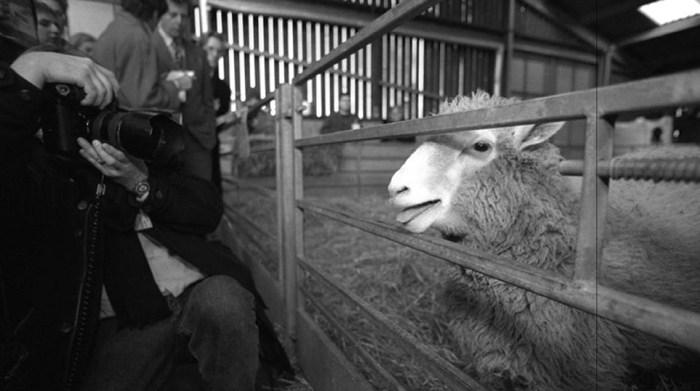
On 5 July 1996, a sheep was born who would go on to inspire entire industries, provide scientists with a new way of helping endangered species, and change medical science in ways that were barely conceivable at the time.
But this was no ordinary sheep. Her very entry to the world was groundbreaking \| she was cloned using cells taken from another sheep's mammary gland as part of an experiment conducted by the Roslin Institute in Midlothian, Scotland. They named her Dolly after the singer Dolly Parton.
At that point, scientists had been dabbling with cloning \| the process of creating a genetically identical copy of another living being \| since the 1950s, when British biologist John Gurdon found a way to clone African clawed frogs. Despite many attempts, repeating the feat in larger mammals had proven an elusive and near\|impossible task.
But like many scientific breakthroughs, the experiment that produced Dolly was something of a fluke. The Roslin Institute scientists had been attempting to clone a sheep using a complex process called nuclear transfer. Using electricity, they transferred the mammary gland cell's nucleus into an egg cell from a second sheep. This egg cell now contained all of the DNA from Dolly's mother, and it grew and developed into an embryo in the lab.
Except, this was not supposed to happen. At the time, no one thought that the DNA from an adult cell could possibly give rise to a new embryo. The entire experiment had intended to be a test run for the technology, before the Roslin Institute team conducted it using embryonic cells.
Having unexpectedly created an embryo, the Roslin Institute scientists placed it inside a third sheep, which ultimately gave birth to Dolly, to the surprise and bewilderment of the general public and much of the world's media.
A not very successful Japanese surgeon, Shinyi Yamanaka, was fascinated by news of Dolly the sheep. And he thought that what if an adult cell could be reprogrammed in this manner, and began wondering if adding transcription factors \| proteins that bind to DNA and turn certain genes on or off \| could reprogramme any adult cell back into an embryonic\|like state.
After a decade of work, Yamanaka achieved his goal, first with mice and then in human cells. His technology allowed skin or blood cells to be reprogrammed to a pluripotent state \| meaning that they could be turned into any cell type in the body \| through adding a cocktail of four transcription factors. It was considered such a breakthrough that Yamanaka was later awarded the 2012 Nobel Prize for Physiology and Medicine.
The reason Yamanaka's feat garnered such attention is it allows scientists to take a blood sample from patients and create organoids \| tiny pea\|sized versions of organs \| in the lab that behave identically to the cells within their own body. These can be used to test new drugs, vaccines, or to simply understand some of the basic processes involved in human development. Scientists are also excited about the potential medical applications for patients with genetic diseases.
In the years that followed Dolly's cloning, the central question was whether scientists would ever extend the technology to humans, and the many moral and ethical issues that would invoke. But while a human embryo was successfully cloned in 2013, the process of creating an entire human being has never been attempted because of the likely public outcry. Chinese scientists did clone the first primates in January 2018, long\|tailed macaques Zhong Zhong and Hua Hua, but there are currently no suggestions that this work will continue into further primate species.
Instead, most funding is being devoted to using cloning to resurrect animals on the verge of extinction. Efforts are underway to clone both the giant panda and the northern white rhino \| a species for which there are just two animals left on the planet \| while in the last two years, ViaGen have cloned the black footed ferret and Przewalski's horse, both of which are endangered.
Cloning may also have more sobering applications in the coming decades. In January, surgeons at the University of Maryland School of Medicine transplanted a pig heart into a man with terminal heart disease. It had 10 human genetic modifications that the team hoped would reduce the chances of the organ being rejected. While the patient sadly only survived for two more months, it captured the attention of doctors around the world who perceived it as a potential way of solving the world's organ transplant shortage.
However, not everyone is so positive about the use of animals for transplantation purposes. Animal rights activists have argued that it essentially degrades pigs to the status of organ factories while Animal Welfare Association have described the project as being ethically questionable.
More than 25 years on from the experiment that captured the world's imagination, cloning is just as relevant and controversial a topic as it was back when Dolly was born.