1331例高職院校女生原發性痛經危險因素分析
2023-04-10 18:34:02羅潔譚文英趙汝
醫學美學美容 2023年4期
關鍵詞:危險因素
羅潔 譚文英 趙汝
【摘 要】目的 探究湖南省高職院校女生原發性痛經的患病率及危險因素。方法 回顧性分析2022年9月-10月高職院校1331例女生的相關信息,比較社會人口信息、月經模式和生活習慣的高職院校女生原發性痛經發生率,分析原發性痛經的影響因素。結果 湖南省高職院校女生原發性痛經患病率為76.11%,單因素分析顯示,不同月經初潮年齡、母親痛經史、喝含糖飲料的頻次、吃早餐的頻次的女大學生的痛經發生率比較,差異有統計學意義(P<0.05);Logistic回歸分析顯示,母親痛經史是痛經的危險因素(OR=0.346,95%CI=0.261~0.459)。結論 湖南省高職院校女生原發性痛經多與母親有痛經史有關,且患病率較高。
【關鍵詞】原發性痛經;危險因素;高職院校女生
中圖分類號:R711.51 文獻標識碼:A 文章編號:1004-4949(2023)04-0131-04
Analysis of Risk Factors of Primary Dysmenorrhea in 1331 Female Students in Higher Vocational Colleges
LUO Jie, TAN Wen-ying, ZHAO Ru
(Xiangtan Medical Vocational and Technical College, Xiangtan 411104, Hunan, China)
【Abstract】Objective To explore the prevalence and risk factors of primary dysmenorrhea among female vocational college students in Hunan Province. Methods The relevant information of 1331 girls in higher vocational colleges from September to October 2022 was retrospectively analyzed. The incidence of primary dysmenorrhea among girls in higher vocational colleges with social demographic information, menstrual patterns and living habits was compared, and the influencing factors of primary dysmenorrhea were analyzed. Results The prevalence of primary dysmenorrhea among female students in higher vocational colleges in Hunan Province was 76.11%. Univariate analysis showed that there were significant differences in the incidence of dysmenorrhea among female college students with different menarche age, mother’s dysmenorrhea history, frequency of drinking sugary drinks and frequency of eating breakfast (P<0.05). Logistic regression analysis showed that maternal dysmenorrhea history was a risk factor for dysmenorrhea(OR=0.346,95%CI=0.261-0.459). Conclusion Primary dysmenorrhea of female students in higher vocational colleges in Hunan Province is mostly related to the mother’s history of dysmenorrhea, and the prevalence rate is high.
【Key words】Primary dysmenorrhea; Risk factors; Female students in vocational colleges
痛經指行經前后或月經期出現下腹部疼痛、墜脹,伴有腰酸或其他不適,可分為原發性和繼發性,原發性痛經(primary dysmenorrhea)指生殖器官沒有器質性病變的痛經[1],是青春期、育齡期女性最常見的婦科問題[2]。各國女大學生原發性痛經的患病率為45%~95%[3],痛經對生活質量、日常活動、工作效率和學業都有負面影響[4,5]。文獻報道顯示[6],痛經可能與月經初潮年齡較早、月經量多、痛經家族史、吸煙、飲酒等因素有關,然而不同的研究之間經常存在相互矛盾的結果。目前,對我國女大學生痛經的患病率及危險因素的研究多局限于一所學校或一個地區,大規模的研究資料亟待補充。基于此,本研究于2022年9月-10月對湖南省高職院校女生的痛經情況進行了抽樣調查,探討女大學生的原發性痛經影響因素,現報道如下。
1.1 一般資料 回顧性分析2022年9月-10月湖南省職高院校1331例女大學生相關資料。剔除標準:資料填寫不完整,有盆腔器質性病變者。年齡16~23歲,平均年齡(18.93±1.08)歲,除6例不清楚月經初潮年齡外,其余研究對象初潮平均年齡為(12.83±1.29)歲。本研究經湘潭醫衛職業技術學院附屬醫院醫學倫理委員會批準,所有研究對象均知情同意。
1.2 方法 課題組通過查閱文獻,經多次專家咨詢,自行設計編制調查問卷,并經過預調查檢驗后設計成《高職院校女生月經現狀調查問卷》。所有研究對象以匿名自填方式完成問卷,問卷由經培訓的調查員同意發放,并進行質量控制。問卷內容包括3個部分:①收集社會人口信息:年齡、學校所在地、體質量指數(body mass index,BMI)、家庭所在地及母親痛經病史;②月經模式:月經初潮年齡、月經周期、經期、經量和痛經情況;③生活方式習慣:食用含糖飲料、甜點、牛奶、水果、早餐的頻次、飲食葷素搭配、飲食口味、節食減肥、入睡時間、睡眠時長、體力活動水平、吸煙、喝酒和食用外賣的頻次。本研究對問卷中的部分內容進行分析,具體包括痛經情況和生活方式習慣。其中體力活動水平:通過詢問體力活動的頻率、強度和時間,依據公式計算體力活動水平,某種強度體力活動水平=該體力活動對應的代謝當量賦值×每周頻率(d/周)×每天時間(min/d),再計算3種強度體力活動總和,劃分為低水平組、中水平組和高水平組[7];②飲酒:最近30 d至少喝一杯酒,包括飲1杯酒的量,相當于半瓶/1聽啤酒、1小杯白酒、1玻璃杯葡萄酒或者黃酒[8];③吸煙:每周至少吸煙1次,且時間長達3個月以上者[9];④BMI:根據世界衛生組織的分類,低體重:<18.5 kg/m2,正常體重:18.5~24.9 kg/m2,超重:25~29.9 kg/m2,肥胖:≥30 kg/m2。
1.3 統計學方法 采用 SPSS 25.0 統計學軟件進行數據分析,計量資料以(x-±s)表示,組間比較行t檢驗;計數資料以[n(%)]表示,組間比較行χ2檢驗;采用多因素Logistic回歸分析痛經的發生因素;P<0.05表示差異有統計學意義。
2.1 痛經發病率 1331例研究對象中,1013名學生有痛經史,原發性痛經的患病率為76.11%。
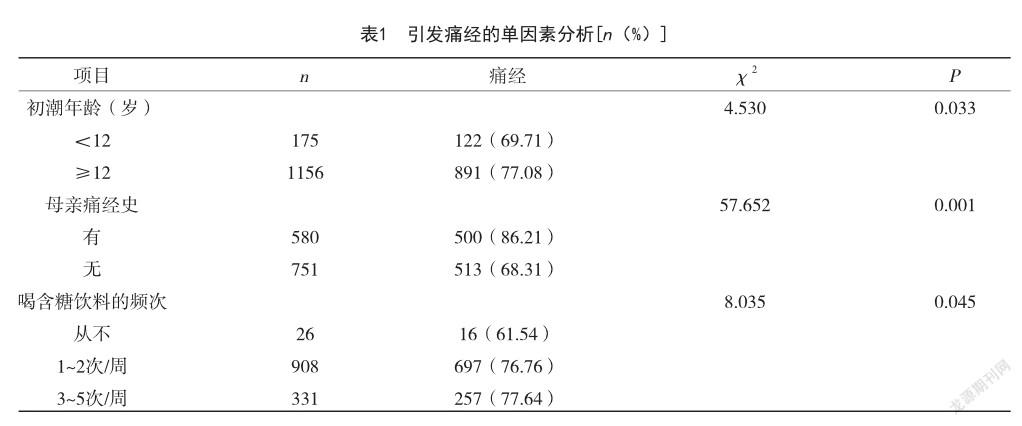
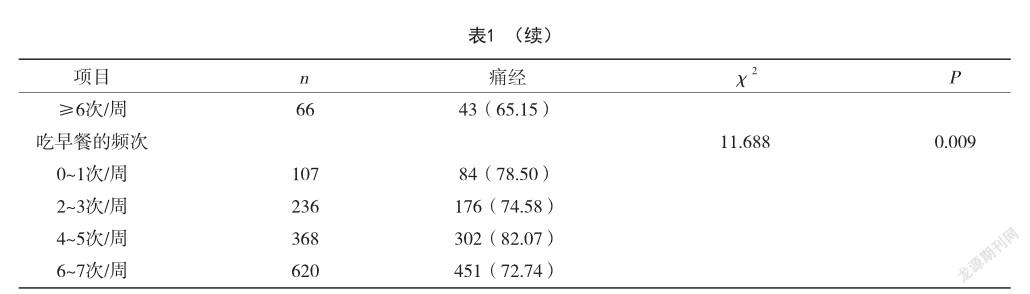
2.2 引發痛經的單因素分析 不同月經初潮年齡、母親痛經史、喝含糖飲料的頻次、吃早餐的頻次的女大學生的痛經發生率比較,差異有統計學意義(P<0.05),見表1;不同家庭所在地、食用甜點的頻次、飲食搭配、飲食規律性、喝牛奶的頻率、吃水果的頻率、飲食口味、節食減肥、體力活動水平、入睡時間、睡眠時長、飲酒、吸煙、點外賣的頻率的女大學生的痛經發生率比較,差異無統計學意義(P>0.05),數據已省略。
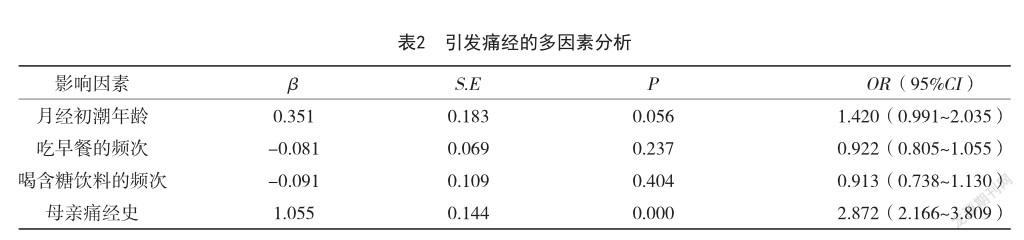
2.3 引發痛經的多因素分析 多因素Logistic回歸分析結果顯示,母親痛經史是痛經的影響因素(P<0.05),見表2。
在本研究中,納入研究對象中原發性痛經的患病率為76.11%,與梁雪迪等[10]在山東高校的調查結果相一致,高于Zhao H等[11]報道的長沙市女大學生的原發性痛經患病率(41.7%),低于埃及(93%)、伊朗女大學生(89.1%)痛經患病率[12],這可能與對原發性痛經的定義和評估不同,以及各地區的氣候、環境、文化差異有關。相關文獻報道[10,11,13],痛經會引起疲勞、易怒、惡心、頭痛等癥狀,會影響學業,甚至導致睡眠障礙、抑郁,影響生活質量。因此,如何降低女大學生痛經的患病率,促進女大學生的生殖健康仍然值得探討。
本研究表明,母親有痛經史是女大學生原發性痛經的危險因素,與相關文獻報道一致[4,10],其中一個原因可能與社會經濟地位、相似的生活模式和行為習慣有關[11],另一原因可能與遺傳因素有關。Wu D等[14]研究了細胞色素P450 2D6和谷胱甘肽S-轉移酶Mu多態性與痛經的關系,并得出結論,兩種基因型變異的女性發生痛經的風險最高。此外,有研究稱[15,16],原發性痛經還與CYP1A1-Hinc和GSTT1基因遺傳多態性、PON1和PON2基因遺傳多態性有關。
單因素分析中,月經初潮年齡、喝含糖飲料的頻次、吃早餐的頻次與原發性痛經的患病率有差異,經Logistic回歸分析,它們與原發性痛經沒有關聯。但相關研究表明[17],月經初潮較早的女性痛經風險增加了54%。也有研究表明[18],月經初潮年齡較大的女性痛經的患病率較高。這些關聯的機制尚不清楚,可能與排卵效率、月經期間較高水平的子宮活動和前列腺素的產生增加有關[19,20]。研究顯示[21,22],不吃早餐的學生往往比經常吃早餐的學生經歷更強烈的痛經,這可能與某些食物的攝入量不足有關,導致早晨出現一定程度的營養缺陷,如含纖維的食物和乳制品攝入量少被發現與痛經成負相關。在有痛經史的女性中,日常食用甜食的頻率更高,可能是由于糖會影響肌肉收縮所涉及的礦物質和維生素的吸收,因此會導致痛經[24,25],此外,本研究對引發痛經的因素未得出一致結論,可能與把食用含糖飲料、甜點的頻次分開統計有關。本研究還存在一定的局限性,由于疼痛體驗是一種個體的感知,具有較大的主觀性,所以難以準確評估。
原發性痛經困擾著很多女大學生,應將其視為預防、診斷和治療的目標群體,要加強家庭中尤其是母親對生理健康的認知,從女生月經初潮開始,對其進行相關生理知識的健康宣教以預防痛經的發生,并進行進一步的隊列研究和縱向研究,找到更多的的影響因素,以期降低女大學生原發性痛經的發病情況。
[1] 謝幸,孔北華,段濤.婦產科學[M].第九版.北京:人民衛生出版社,2018.
[2] Abd El-Mawgod MM,Alshaibany AS,Al-Anazi AM.Epidemiology of dysmenorrhea among secondaryschool students in Northern Saudi Arabia[J].J Egypt Public Health Assoc,2016,91(3):115-119.
[3] Iacovides S,Avidon I,Baker FC.What we know about primary dysmenorrhea today: a critical review[J].Hum Reprod Update,2015,21:762.
[4] Habibi N,Huang MS,Gan WY,et al.Prevalence of Primary Dysmenorrhea and Factors Associated with Its Intensity Among Undergraduate Students:A Cross-Sectional Study[J].Pain Manag Nurs,2015,16(6):855-861.
[5] Sharma A,Taneja DK,Sharma P,et al.Problems related to menstruation and their effect on daily routine of students of a medical college in Delhi,India[J].Asia Pac J Public Health,2008,20(3):234-241.
[6] Wang L,Yan Y,Qiu H,et al.Prevalence and Risk Factors of Primary Dysmenorrhea in Students:A Meta-Analysis[J]. Value Health,2022,25(10):1678-1684.
[7] Puciato D,Borysiuk Z,Rozpara M.Quality of life and physical activity in an older working-age population[J].Clin Interv Aging,2017,12:1627-1634.
[8] 祁月,嚴瓊,孫力菁,等.上海市2004—2019年青少年吸煙飲酒行為變化趨勢[J].中國學校衛生,2022,43(7):1003-1006,1010.
[9] 鄭保義.世界衛生組織關于吸煙行為調查的基本原則[J].中國健康育,1992,8(5):2-6.
[10] 梁雪迪,王文慧,王聰,等.女大學生原發性痛經現狀及影響因素分析[J].齊魯護理雜志,2017,23(2):43-45.
[11] Zhao H,Lu T,Ling Ch,et al.Prevalence and Risk Factors Associated with Primary Dysmenorrhea among Chinese Female University Students:A Cross-sectional Study[J]. Pediatr Adolesc Gynecol,2020,33(1):15-22.
[12] Tadese M,Kassa A,Muluneh AA,et al.Prevalence of dysmenorrhoea, associated risk factors and its relationship with academic performance among graduating female university students in Ethiopia:a cross-sectional study[J]. BMJ Open,2021,11(3):e043814.
[13] Ortiz MI.Primary dysmenorrhea among Mexican university students:prevalence,impact and treatment[J].Eur J Obstet Gynecol Reprod Biol,2010,152(1):73-77.
[14] Wu D,Wang X,Chen D,et al.Metabolic gene polymorphisms and risk of dysmenorrhea[J]. Epidemiology,2000,11:648-653.
[15] 吳滌,陳大方,劉學,等.CYP1A1-Hinc和GSTT1基因遺傳多態性與原發性痛經關系分析[J].中華醫學遺傳學雜志,2001(1):50-53.
[16] 吳滌,呂紅霞,張秀清,等.PON1和PON2基因遺傳多態性與原發性痛經間關系[J].疾病控制雜志,2000(2):129-131.
[17] Latthe P,Mignini L,Gray R,et al.Factors predisposing women to chronic pelvic pain:systematic review[J]. BMJ,2006,332(7544):749-755.
[18] Ozerdogan N,Sayiner D,Ayranci U,et al.Prevalence and predictors of dysmenorrhea among students at a university in Turkey[J].Gynaecol Obstet,2009,107:39.
[19] Dawood MY.Primary dysmenorrhea:advances in pathogenesis and management[J].Obstet Gynecol,2006,108:428.
[20] Calesnick B,Dinan AM.Prostaglandins and NSAIDs in primary dysmenorrhea[J]. Am Fam Physician,1987,35:223.
[21] Abdul-Razzak KK,Ayoub NM,Abu-Taleb AA,et al.Inflfluence of dietary intake of dairy products on dysmenorrheat[J].Obstet Gynaecol Res,2010,36:377.
[22] Nagata C,Hirokawa K,Shimizu N,et al.Associations of menstrual pain with intakes of soy,fat and dietary fifiber in Japanese women[J].Eur J Clin Nutr,2005,59:88.
[23] Fernández-Martínez E,Fernández-Villa T,AmezcuaPrieto C,et al.Menstrual Problems and Lifestyle among Spanish University Women[J].Environ Res Public Health,2020,17(20):7425.
[24] Ozerdogan N,Sayiner D,Ayranci U,et al.Prevalence and predictors of dysmenorrhea among students at a university in Turkey[J].Gynecol Obstet,2009,107:39-43.
[25] Muluneh AA,Nigussie TS,Gebreslasie KZ,et al.Prevalence and associated factors of dysmenorrhea among secondary and preparatory school students in Debremarkos town,North-West Ethiopia[J].BMC Womens Health,2018,18(1):57.
編輯 柴泛宇
猜你喜歡
中外醫學研究(2016年28期)2016-11-28 12:51:05
中外醫學研究(2016年28期)2016-11-28 12:48:47
中國現代醫生(2016年26期)2016-11-28 01:53:18
中國醫學創新(2016年30期)2016-11-28 00:19:10
今日健康(2016年12期)2016-11-17 14:41:50
今日健康(2016年12期)2016-11-17 13:12:34
今日健康(2016年12期)2016-11-17 12:29:29
科技資訊(2016年19期)2016-11-15 10:33:36
中國實用醫藥(2016年24期)2016-10-17 05:32:48
養生保健指南(2016年4期)2016-03-22 12:25:57