一類廣義Schur型多項式的不可約性
2023-04-29 15:36:53尹軒睿吳榮軍朱光艷
四川大學學報(自然科學版) 2023年3期
尹軒睿 吳榮軍 朱光艷
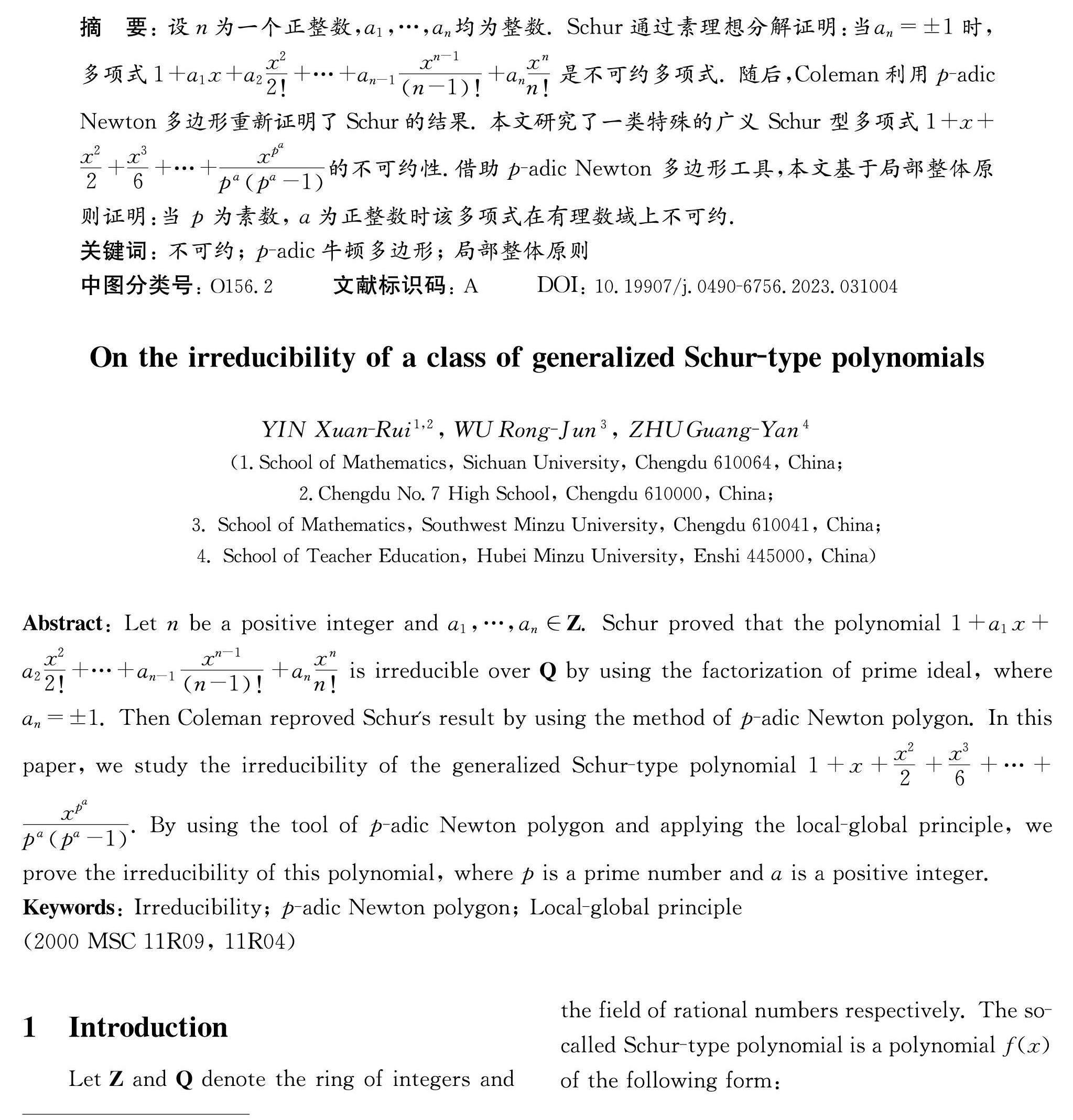
設n為一個正整數,a1,…,an均為整數. Schur通過素理想分解證明:當an=±1時,多項式1+a1x+a2x22!+…+an-1xn-1n-1!+anxnn! 是不可約多項式. 隨后,Coleman利用p-adic Newton多邊形重新證明了Schur的結果. 本文研究了一類特殊的廣義 Schur 型多項式1+x+x22+x36+…+xpapapa-1的不可約性.借助p-adic Newton 多邊形工具,本文基于局部整體原則證明:當 p 為素數, a為正整數時該多項式在有理數域上不可約.
不可約; p-adic牛頓多邊形; 局部整體原則
O156.2A2023.031004
收稿日期: 2022-03-24
基金項目: 西南民族大學科研啟動金資助項目(RQD2021100);四川省自然科學基金(2022NSFSC1830)
作者簡介: 尹軒睿, 男, 山西太原人, 碩士研究生,主要研究方向為數論. E-mail: 434307608@qq.com
通訊作者: 吳榮軍. E-mail: eugen_woo@163.com
On the irreducibility of a class of generalized? Schur-type polynomials
YIN Xuan-Rui1,2, WU Rong-Jun3, ZHU Guang-Yan4
(1.School of Mathematics, Sichuan University, Chengdu 610064, China;
2.Chengdu No.7 High School, Chengdu 610000, China;
3. School of Mathematics, Southwest Minzu University, Chengdu 610041, China;
4. School of Teacher Education, Hubei Minzu University, Enshi 445000, China)
Let n be a positive integer and a1,…,an∈Z. Schur proved that the polynomial 1+a1x+a2x22!+…+an-1xn-1n-1!+anxnn! is irreducible over Q by using the factorization of prime ideal, where an=±1. Then Coleman reproved Schur's result by using the method of p-adic Newton polygon. In this paper, we study the irreducibility of the generalized Schur-type polynomial 1+x+x22+x36+…+xpapapa-1. By using the tool of p-adic Newton polygon and applying the local-global principle, we prove the irreducibility of this polynomial, where p is a prime number and a is a positive integer.
Irreducibility; p-adic Newton polygon; Local-global principle
(2000 MSC 11R09, 11R04)
1 Introduction
Let Z and Q denote the ring of integers and the field of rational numbers respectively. The so-called Schur-type polynomial is a polynomial f(x) of the following form:
fx1+a1x+a2x22!+…+
an-1xn-1n-1!±xnn!(1)
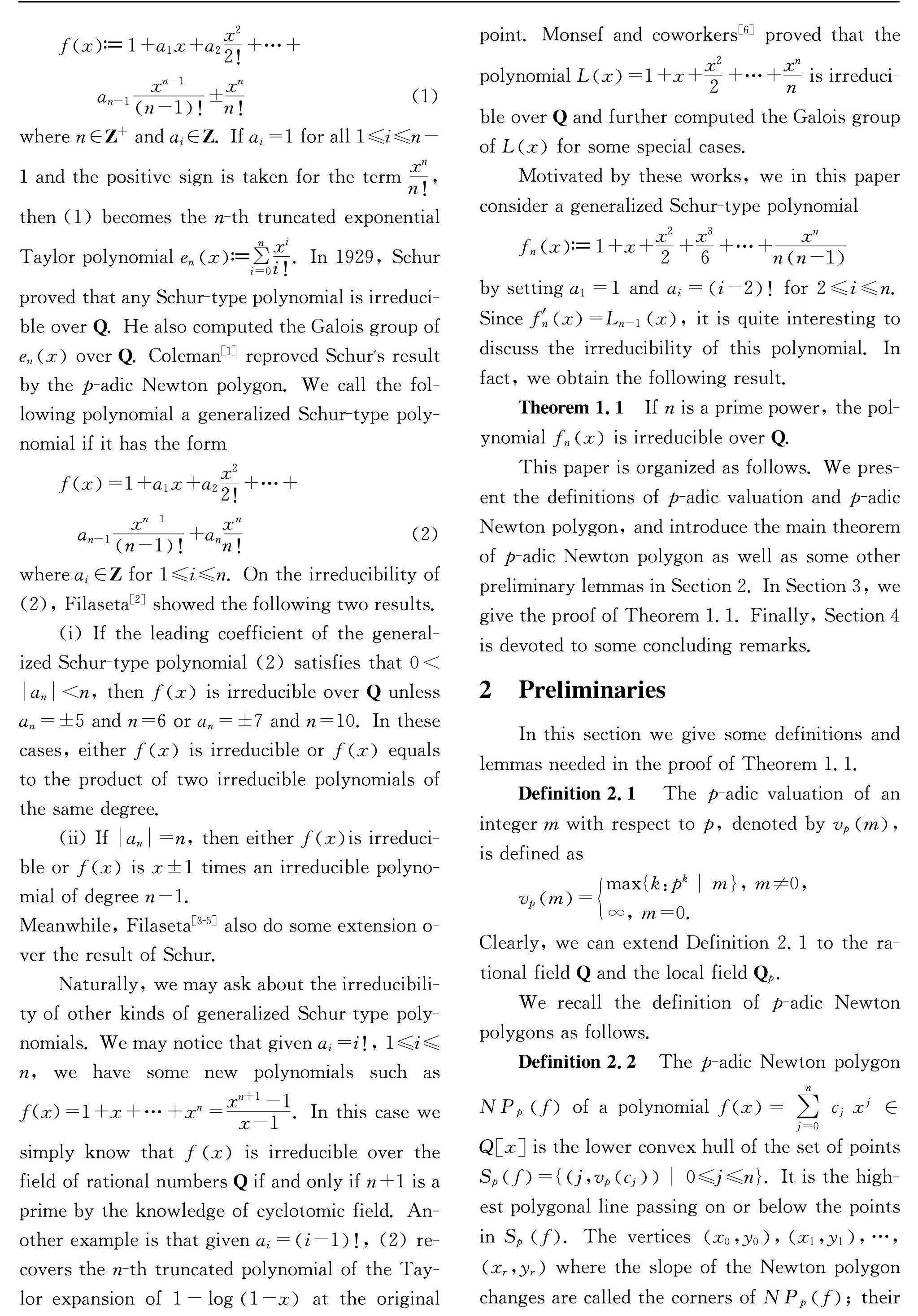
where n∈Z+ and ai∈Z. If ai=1 for all 1≤i≤n-1 and the positive sign is taken for the term xnn!, then? (1) becomes the n-th truncated exponential Taylor polynomial enx∑ni=0xii!. In 1929, Schur proved that any Schur-type polynomial is irreducible over Q. He also computed the Galois group of enx over Q. Coleman[1] reproved Schur's result by the p-adic Newton polygon. We call the following polynomial a generalized Schur-type polynomial if it has the form
尹軒睿, 等: 一類廣義Schur型多項式的不可約性
fx=1+a1x+a2x22!+…+
an-1xn-1n-1!+anxnn!(2)
whereai∈Z for 1≤i≤n. On the irreducibility of (2), Filaseta[2] showed the following two results.
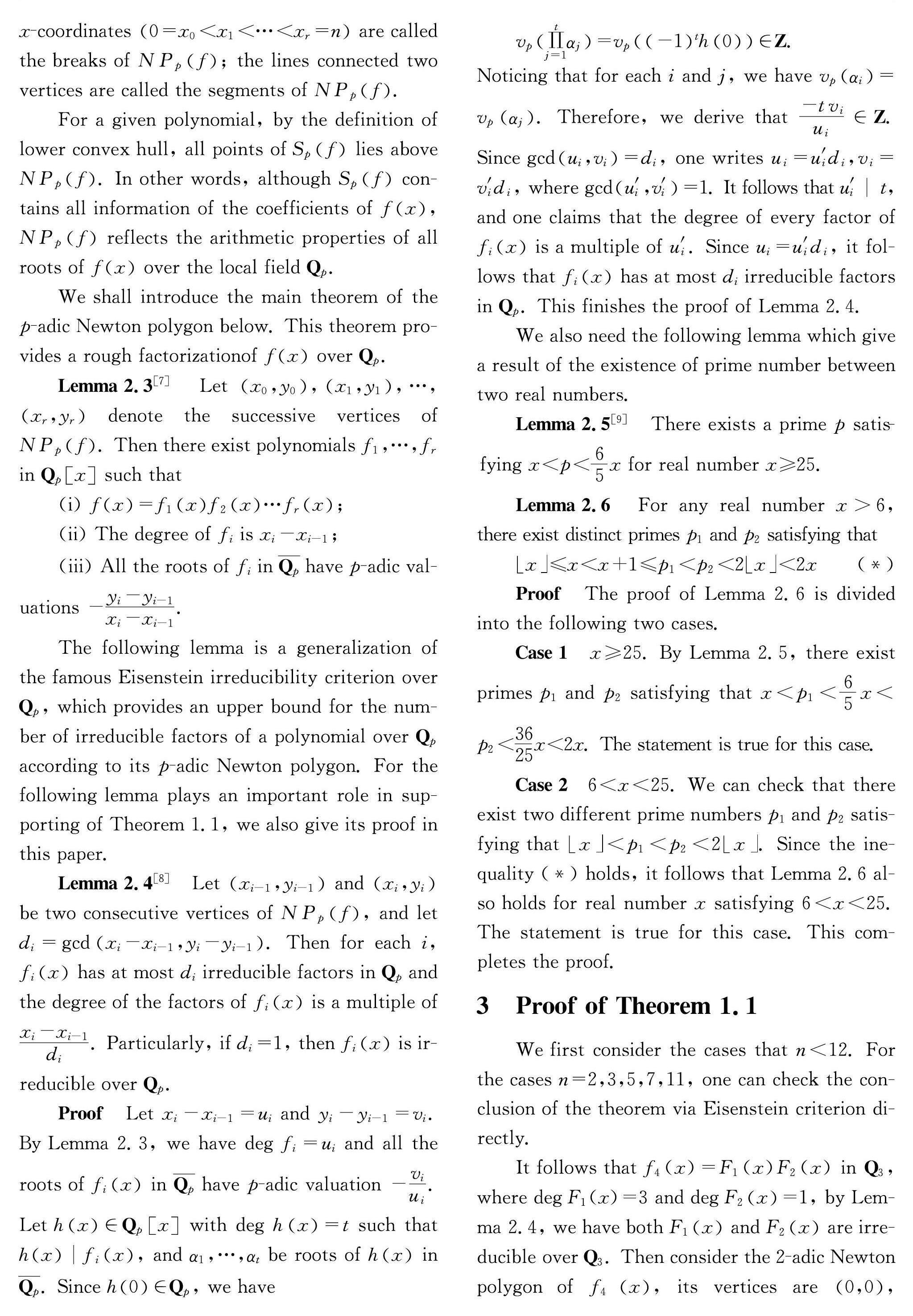
(i) If the leading coefficient of the generalized Schur-type polynomial (2) satisfies that 0 (ii) If an=n, then either fxis irreducible or fx is x±1 times an irreducible polynomial of degree n-1. Meanwhile, Filaseta[3-5] also do some extension over the result of Schur. Naturally, we may ask about the irreducibility of other kinds of generalized Schur-type polynomials. We may notice that given ai=i!, 1≤i≤n, we have some new polynomials such as f(x)=1+x+…+xn=xn+1-1x-1. In this case we simply know that fx is irreducible over the field of rational numbers Q if and only if n+1 is a prime by the knowledge of cyclotomic field. Another example is that given ai=i-1!, (2) recovers the n-th truncated polynomial of the Taylor expansion of? 1-log1-x at the original point. Monsef and coworkers[6] proved that the polynomial Lx=1+x+x22+…+xnn is irreducible over Q and further computed the Galois group of Lx for some special cases. Motivated by these works, we in this paper consider a generalized Schur-type polynomial fnx1+x+x22+x36+…+xnnn-1 by settinga1=1 and ai=i-2! for 2≤i≤n. Since f′nx=Ln-1x, it is quite interesting to discuss the irreducibility of this polynomial. In fact, we obtain the following result. Theorem 1.1 If n is a prime power, the polynomial fnx is irreducible over Q. This paper is organized as follows. We present the definitions of p-adic valuation and p-adic Newton polygon, and introduce the main theorem of p-adic Newton polygon as well as some other preliminary lemmas in Section 2. In Section 3, we give the proof of Theorem 1.1. Finally, Section 4 is devoted to some concluding remarks. 2 Preliminaries In this section we give some definitions and lemmas needed in the proof of Theorem 1.1. Definition 2.1 The p-adic valuation of an integer m with respect to p, denoted by vpm, is defined as vpm=max{k:pk∣m}, m≠0, ∞, m=0. Clearly, we can extend Definition 2.1 to the rational field Q and the local field Qp. We recall the definition of p-adic Newton polygons as follows. Definition 2.2 The p-adic Newton polygon NPpf of a polynomial fx=∑nj=0cjxj∈Qx is the lower convex hull of the set of points Spf={j,vpcj∣0≤j≤n}. It is the highest polygonal line passing on or below the points in Spf. The vertices x0,y0,x1,y1,…,xr,yr where the slope of the Newton polygon changes are called the corners of NPpf; their x-coordinates 0=x0 For a given polynomial, by the definition of lower convex hull, all points ofSpf lies above NPpf. In other words, although Spf contains all information of the coefficients of fx, NPpf reflects the arithmetic properties of all roots of fx over the local field Qp. We shall introduce the main theorem of the p-adic? Newton polygon below. This theorem provides a rough factorizationof fx over Qp. Lemma 2.3[7] Let x0,y0,x1,y1,…,xr,yr denote the successive vertices of NPpf. Then there exist polynomials f1,…,fr in Qpx such that (i) fx=f1xf2x…frx; (ii)? The degree of fi is xi-xi-1; (iii)? All the roots of fi in Qp have p-adic valuations -yi-yi-1xi-xi-1. The following lemma is a generalization of the famous Eisenstein irreducibility criterion over Qp, which provides an upper bound for the number of irreducible factors of a polynomial over Qp according to its p-adic Newton polygon. For the following lemma plays an important role in supporting of Theorem 1.1, we also give its proof in this paper. Lemma 2.4[8] Let xi-1,yi-1 and xi,yi be two consecutive vertices of NPpf, and let di=gcdxi-xi-1,yi-yi-1. Then for each i, fix has at most di irreducible factors in Qp and the degree of the factors of fix is a multiple ofxi-xi-1di. Particularly, if di=1, then fix is irreducible over Qp. Proof Let xi-xi-1=ui and yi-yi-1=vi. By Lemma 2.3, we have degfi=ui and all the roots of fix in Qp have p-adic valuation -viui. Let hx∈Qpx with deg hx=t such that hx∣fix, and α1,…,αt be roots of hx in Qp. Since h0∈Qp, we have vp∏tj=1αj=vp-1th0∈Z. Noticing that for each i and j, we have vpαi=vpαj. Therefore, we derive that -tviui∈Z. Since gcdui,vi=di, one writes ui=u′idi,vi=v′idi, where gcdu′i,v′i=1. It follows that u′i∣t, and one claims that the degree of every factor of fix is a multiple of u′i. Since ui=u′idi, it follows that fix has at most di irreducible factors in Qp. This finishes the proof of Lemma 2.4. We also need the following lemma which give a result of the existence of prime number between two real numbers. Lemma 2.5[9] There exists a prime p satisfying x Lemma 2.6 For any real number x>6, there exist distinct primes p1 and p2 satisfying that x≤x Proof The proof of Lemma 2.6 is divided into the following two cases. Case 1 x≥25. By Lemma 2.5, there exist primes p1 and p2 satisfying that x Case 2 6 3 Proof of Theorem 1.1 We first consider the cases that n<12. For the cases n=2,3,5,7,11, one can check the conclusion of the theorem via Eisenstein criterion directly. It follows thatf4(x)=F1(x)F2(x) in Q3, where degF1(x)=3 and degF2x=1, by Lemma 2.4, we have both F1x and F2x are irreducible over Q3. Then consider the 2-adic Newton polygon of f4x, its vertices are 0,0,4,-2. Hence we have either f4x is irreducible over Q2 or f4x=G1xG2x over Q2 with degG1x=degG2x=2 by Lemma 2.4. If f4(x) is reducible over Q, it leads a contradiction with the factorization of f4x over the local field Q2 and Q3 by local-global principle. It follows that Theorem 1.1 is true for n=4. Similarly, we take the 2-adic and 7-adic Newton polygon into account for f8x. For f9x, we consider the 3-adic and 7-adic Newton polygon. By the same argument as in the case n=4, we can always arrive at a contradiction by local-global principle. We omitted the tedious details here. Now we may assume that n≥12. We first prove that if fnx is reducible over Q, then one has fnx=x+agx, where a is a rational number. Since n>12, by Lemma 2.6, there exist distinct prime numbers p1 and p2 satisfying that n2 degF1x=p1,? degF2x=n-p1-1. Similarly, the vertices of the p2-adic Newton polygon of fnx are given by 0,0,p2,-1,p2+1,-1,n,0. By (i) of Lemma 2.3 and Lemma 2.4 again, one has fnx=x+a1G1xG2x in Qp2, where G1x and G2x are both irreducible over Qp2 with degG1x=p2 and degG2x=n-p2-1. If fnx is reducible over Q, the local-global principle implies that fnx has at most 3 factors in Q. Clearly, fnx cant have exactly 3 factors in Q, otherwise the factorization of fnx in the local field Qp1 and Qp2 cant coincide. Hence, we have the factorization fnx=g(x)hx in Q, where both gx and hx are irreducible over Q. Without loss of generality, it is natural for us to assume that deggx≤n/2. Noticing that 6≤n/2 degF2x by comparing the degree of the polynomialsfnx in Q and Qp1, it follows that hx=F1xF2x,which implies that deg gx=1. This proves that fnx=x+agx as desired. In what follows, we prove that such linear factor doesn't exist. Since n is a prime power, we may let n=pf, where p is a prime number and f is a positive integer. The p-adic Newton polygon of fnx has vertices (0,0),(p,-1),...,(pf,-f), p≠2,(0,0),(4,-2),...,(2f,-f), p=2. If p≠2, then by (i) of Lemma 2.3 and Lemma 2.4, we have fnx=∏fi=1gix, where gix are irreducible over Qp with degg1x=p and deggix=pi-pi-1, i=2,…,f. It follows that fnx cant have a linear factor in Qp. Furtherly, by local-global principle fnx cant have a linear factor in Q either. If p=2, by (i) of Lemma 2.3 and Lemma 24, we have fnx=∏fi=1gix, where g1x has at most two irreducible factors in Q2 and the degree of each factor of g1x is greater than or equal to 2. For i=2,…,f, gix are irreducible over Q2 and deggix=2i-2i-1. Thus fnx cant be with a linear factor in Q2. This finishes the proof of Theorem 1.1. 4 Conclusions In this paper we have studied the irreducibility of a class of generalized Schur-type polynomial (2) with a1=1 and ai=i-2!for 2≤i≤n=pa. By introducing the tool of p-adic Newton polygon and local-global principle, the irreducibility of the polynomial over Q was given. Here we point out that one can characterize the irreducibility and other properties of some more generalized Schur-type polynomials by relaxing the restrictions on coefficients of the polynomial (2). References: [1] Coleman R F. On the Galois groups of the exponential Taylor polynomials [J]. Enseign Math, 1987, 33: 183. [2] Filaseta M. A generalization of an irreducibility theorem of I. Schur [M]. Boston: Birkhuser, 1996. [3] Filaseta M. On an irreducibility theorem of I. Schur [J]. Acta Arith, 1991, 58: 251. [4] Allen M, Filaseta M. A generalization of a third irreducibility theorem of I. Schur [J]. Acta Arith, 2004, 114: 183. [5] Allen M, Filaseta M. A generalization of a second irreducibility theorem of I. Schur [J]. Acta Arith, 2003, 109: 65. [6] Monsef K, Shaffaf J, Taleb R. The Galois groups of the Taylor polynomials of some elementary functions [J]. Int J Number Theory, 2019, 15: 1127. [7] Koblitz N. p-Adic numbers, p-adic analysis, and Zeta-functions [M]. Berlin: Springer-Verlag, 1984. [8] Ao L F, Hong S F. On the Galois group of three classes of trinomials [J]. AIMS Math, 2022, 7: 212. [9] Harborth H, Kemnitz A. Calculations for Bertrands postulate [J]. Math Mag, 1981, 54: 33. 引用本文格式: 中 文:? 尹軒睿, 吳榮軍, 朱光艷. 一類廣義Schur型多項式的不可約性[J]. 四川大學學報:? 自然科學版, 2023, 60:? 031004. 英 文:? Yin X R, Wu R J, Zhu G Y. On the irreducibility ofa class of generalized? Schur-type polynomials [J]. J Sichuan Univ:? Nat Sci Ed, 2023, 60:? 031004.