Whatever happened to China’s earliest social media platforms?天涯往事知多少:初代社交媒體和古早論壇文化
2023-12-14 14:56:08HayleyZhao
漢語世界(The World of Chinese) 2023年4期
關鍵詞:文化
Hayley Zhao


Cyber Relics
Liu Minqiao has been in a state of mourning for the past few months. Not for a lost loved one, but for the passing of a different kind of companion shes had for two decades: Tianya, Chinas earliest and once largest online forum.
After news broke of the social media platforms official shutdown due to financial troubles on April 25, Liu, who asked to be identified by a pseudonym, quickly entered the first stage of grief—denial. “For someone like me, a Tianya veteran of 20 years, it wasnt just a website anymore. It was like a family member to me. You can accept your parents being elderly and frail, but you can never be OK with them suddenly dropping dead, right?” says Liu, who works in the pharmaceutical industry in Canada.
Liu, who is in her 40s, is not alone in her sadness. The closure of Tianya triggered waves of nostalgia among netizens, especially those born in the 1970s and 80s. A hashtag related to the platforms demise swiftly garnered over 10 million views on Weibo (a social media platform that ultimately out-competed Tianya).
This is not the first time Chinese netizens have mourned the death of a once popular social media platform, especially BBS (Bulletin Board Systems) like Tianya that hosted text-based discussion forums, and reminisced about the early years of the internet.
Maopu, an entertainment news-focused BBS platform founded in 1997 and the birthplace of multiple viral internet memes, disabled its new post function in April 2021, putting the website into eternal sleep mode. Renren Network, once popular among university students and dubbed Chinas Facebook when it launched in 2005, is almost obsolete. After failing to attract users outside of college campuses, the platform was eventually sold to a technology-focused media group in 2018, becoming a relic of the past for most netizens. Baidu Tieba, which once proclaimed itself the “worlds largest Chinese online community” with over 300 million monthly active users, had lost 90 percent of them by 2021, 18 years after it was founded. Tianyas closure is a typical tale of a platform that couldnt keep pace with the rapidly evolving internet landscape in China.
At skys end
Founded on the southern island province of Hainan in 1999, Tianya, which translates to “the ends of the sky,” started as a stock market forum used by trading enthusiasts. At the time, Chinas internet was populated by educated, higher-income users, and the site quickly evolved into a platform for discussing social, economic, and political topics. With the goal of becoming the “Online Sanctuary for the Global Chinese Community,” Tianya amassed 250 million monthly active users by 2019, as per its official website.
For Liu, Tianya was a window to the world beyond her hometown. Born in Hubei province, Liu was among Chinas first wave of netizens after the country officially connected to the World Wide Web in 1994. She discovered Tianya in 2001 and was immediately hooked. “It was a whole new world to me. All the posts were well-written with strong opinions; I could learn something from every one of them on the site,” Liu tells TWOC. “The first batch of Chinese netizens were mostly highly educated and well-mannered, unlike now where everyone can have an opinion online. The user experience on these platforms was much better then.”
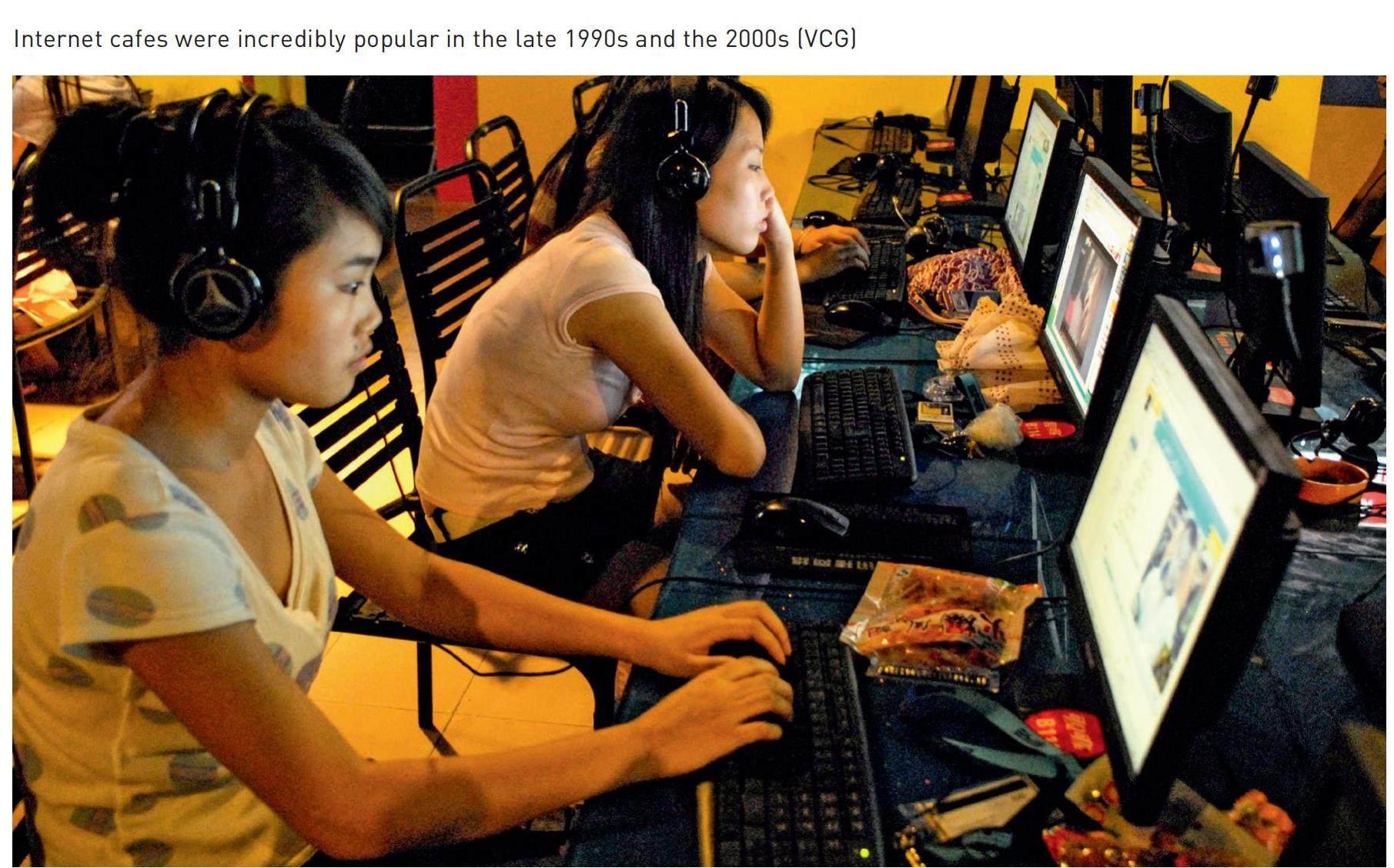
Not everyone could afford to be online in those years. A 486 personal computer, the most advanced model in 1995, cost over 9,000 yuan, almost double the average annual salary in China at the time. Internet cafes, orwangba(網吧), emerged as a popular yet still pricy alternative. The firstwangbaopened in Shanghai in 1996 and charged around 40 yuan per hour at a time when the average national monthly income was around 500 yuan. Liu remembers internet at home being charged by the minute. “To save on internet fees, I used to open a webpage, immediately disconnect the internet, read the content, and then reconnect to refresh the next page,” she says.
Still, Liu used to spend three to four hours a day on Tianya. She says the website fostered an environment of inclusivity, accommodating diverse opinions. Many published authors began their careers writing on Tianya, including Tianxia Bachang, whoseGhost Blows Out the Lightseries of novels have sold over 20 million copies worldwide and been adapted into multiple TV series and movies. Many posts on Chinas stock and real estate market have proven to be prophetic. For instance, in a now inaccessible 2010 post that has since become popular online, the author predicted 13 stages of development for Chinas housing market. More than half of them seem have become a reality.
But with the rise of microblogging sites like Weibo and short video platforms like Douyin (Chinas version of TikTok), users affinity for more rigid BBS forums like Tianya has waned. “From posts to images, then to videos, and finally to livestreaming, the industry has gone through many iterations. But Tianya is still the same,” Yu, a former Tianya employee who asked to be identified by her surname, tells TWOC. Tightened regulations of cyberspace also limited discussion on certain topics that used to draw users to the platform.
In 2005, Yu started her first job after college as a community operations manager at Tianya in her home province, Hainan. Her job was easy, she says, mostly managing and overseeing conversations on the forum, which left her time to learn other skills like Photoshop and coding. She was later promoted to the product management and operations team, working on projects in collaboration with Google, Tianyas strategic partner at the time.
“Tianya laid the foundation for my understanding of community operation and provided valuable insights for my later work,” says Yu. But she left the company in 2007 and worked for other internet firms, including e-commerce giant Alibaba, before she eventually quit the industry to open her own jewelry store in 2018. Though her later jobs paid much better than the 1,200 yuan per month she received at Tianya, she still misses her time there. “[Other companies] can be very demanding. They push people to their limits. But Tianya was chill. You could do whatever you wanted and hang out with your coworkers after you clocked out,” she says.
Yu thinks this lax atmosphere probably contributed to the platforms demise. “I had to find things to do on my own. Even my supervisor wasnt sure what I needed to do. When I look back now, it seems that most people lacked goal-oriented management,” she says.
Yu has kept in touch with her former colleagues (through the now ubiquitous messaging, payment, and social media platform WeChat, rather than via Tianya). They had gotten wind of the companys cash crunch before the website shut down in April. The company is 200 million yuan in debt, Tianyas founder Xing Ming told state-owned newspaper Beijing Youth Daily in June. The Chinese technology news platform Leiphone also reported in April this year that many employees have left the company due to unpaid wages and social security contributions. Tianya had nearly 1,000 employees at its peak, but just 20 or so when it announced its closure.
Attempts to raise funds to save Chinas once favorite social media platform have fallen flat. After news of its closure went viral online, Tianya organized a 7-day livestream crowdfunding event on Douyin in June to raise 3 million yuan to restart the platforms server. They made less than one-tenth of this goal. “They didnt do a good job promoting the event. I didnt know about it until it was over. Although Douyin is a major player in short videos, its audience doesnt overlap much with Tianyas,” says Liu.
Yu isnt optimistic about the possibility of a revival. “I watched one of the livestream sessions between Xing Ming and investors. He still doesnt have a clear vision for the site. He wants Tianya to be the largest online Chinese community in the world, but hes not clear on what that entails,” she says.
Though Tianyas website is inaccessible now, many remember it fondly as a place for insightful discussion. Netizens who saved or took screenshots of Tianyas most popular posts and discussion pages are now selling them online, giving people unfamiliar with the site a glimpse into its glory days. A search on Taobao, Chinas largest ecommerce platform, reveals thousands of stores selling the digital backups of those posts, with some shops boasting over 4,000 monthly unit sales.
The dark web
Other early online forums, however, were less benign. Baidu Tieba, Tianyas former competitor, is still running, but its reputation is in tatters with the platform now flooded with ads and misogynistic content.
Launched with the slogan “Born out of passion” in 2003, Tieba allows users to create online forums called “bars,” orba(吧), covering a wide range of topics from gaming to exam revision strategies. The platform also gained popularity among young people for its celebrity content.
Amber Yang, a 28-year-old warehouse manager in Guangdong province who agreed to be interviewed under a pseudonym, spent hours a day on Tieba when she first discovered the platform in 2014. She had just finished the highly stressful college entrance exam (gaokao), and suddenly found herself with a lot of free time that she filled by reading through thousands of new posts in a bar dedicated to Chinese celebrities. Occasionally she would contribute posts praising her favorite actresses or commenting on the latest celebrity fashion. “My posts used to get a lot of traffic. They often received more than 300 replies,” says Yang.
By 2015, Tieba had over 300 million monthly active users, more than Xiaohongshu, a popular Instagram-like platform launched in 2013 that had around 260 million users by the end of 2022. However, Tieba was a chaotic ecosystem, with advertisements flooding the platform while moderators deleted posts on some heavily debated topics and even closed bars deemed controversial. As it did to Tianya, Weibo stole traffic from its earlier rival, with celebrities opening their own accounts there and taking their fans with them. Yang stopped using Tieba in 2017, though the platform still had 37 million users by the end of 2021.
Its gotten worse since. “I logged back into my old account last month just to reminisce about my college days. I found that the environment on Tieba has become very hostile, especially toward women,” she says. Many forums on the platform have become dark corners of the web. One of the most infamous is Sun Xiaochuan Bar, named after a popular video game streamer, which is rife with misogynistic content and has been dubbed the “online male public toilet” by critics.
Xiao Yi, a 22-year-old college student in Hangzhou, Zhejiang province, who asked to use a pseudonym for this piece, received abusive comments on Tieba despite not being an active user. In June, Xiao posted a photo of herself in a partially torn, tight gray top, on Xiaohongshu with the caption, “The male gaze is really annoying.” In the post, she went on to complain about how some middle-aged men stared and even took photos of her and her friends when they were out shopping that day.
A day later, insults and swear words flooded the comment section under her post. Someone had taken a screenshot of her post and reposted it on Tieba. The thread there had received more than 700 replies, most of them slut-shaming her or mocking her appearance. Some even Photoshopped her photo into explicit content.
Shocked and frightened, Xiao contacted the posts creator and the forums manager, urging them to remove the post and issue her an apology. She received no response for days while hundreds of abusive private messages flooded her inbox on Xiaohongshu.
One of Xiaos followers eventually found the person who posted the photo to Tieba. Finally, after a barrage of messages from supportive (mainly female) Xiaohongshu users, the man deleted the post and reluctantly offered a half-hearted apology. He insisted that since he didnt make the abusive comments himself, a public apology on Tieba was unnecessary.
“I was so disgusted by the whole thing, I decided to call the police,” Xiao tells TWOC. But they told her they couldnt act without confirming the users real identity. They instead suggested that she file a defamation suit against Tieba to force them to provide the mans personal information.
In July, Xiao filed a lawsuit against Tieba along with another woman who had a similar experience. A hearing could be months away and she spent over 3,000 yuan on legal fees in just one month this summer, “but I still want to go through with it,” says Xiao. “Ive received so much kindness and support from my followers on Xiaohongshu, I want to prove to them that there are ways to fight back.” Tieba has not responded to TWOCs request for comment at the time of writing.
Though newer social media platforms like Xiaohongshu are not perfect, they have long since left the likes of Tieba and Tianya in the past. The prospects for the revival of earlier platforms, with their stagnant interfaces and sometimes chaotic, abusive content, continue to diminish. Even Liu, still struggling to get over the end of Tianya, admits the platform failed. “Even those born in the 90s hardly know or use the site. It failed to attract the younger generation and emerging markets,” she says.
With China now boasting over 1 billion internet users, new platforms and apps will keep emerging, vying for netizens increasingly short attention spans. Who knows what popular platform today will be the Tianya of the future. Perhaps in 20 years, netizens will reminisce about the joy influencers on Douyin once brought them while it lasted.
猜你喜歡
中國德育(2022年12期)2022-08-22 06:16:18
湖北教育·綜合資訊(2022年4期)2022-05-06 22:54:06
金橋(2022年2期)2022-03-02 05:42:50
金橋(2022年1期)2022-02-12 01:37:04
英語文摘(2019年1期)2019-03-21 07:44:16
小天使·一年級語數英綜合(2018年9期)2018-10-16 06:30:16
西部大開發(2017年8期)2017-06-26 03:16:12
西部大開發(2017年8期)2017-06-26 03:15:50
人民中國(日文版)(2015年10期)2015-04-16 03:53:52
人民中國(日文版)(2015年9期)2015-03-20 15:08:05